Key Takeaways
- Address Validation prepares address records before they enter geocoding, POI databases, CRM systems, mapping tools, territory models, and location analytics.
- Address verification helps confirm whether an address is complete, structured, deliverable, and usable for enterprise workflows.
- Address validation software should detect missing fields, inconsistent formats, invalid postal codes, duplicate records, country-specific formatting issues, and low-confidence matches.
- Bulk address validation is critical when enterprises process customer files, store networks, business locations, franchise territories, supplier records, or POI datasets.
- Strong validation prevents weak address data from becoming inaccurate coordinates, duplicate places, broken territory assignments, or misleading location analysis.
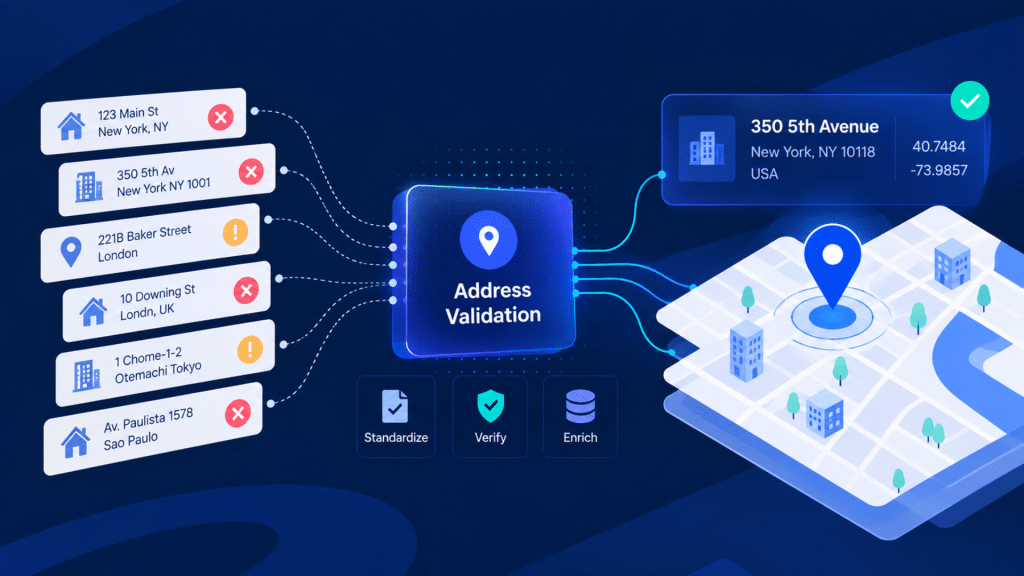
Address data looks simple until it enters enterprise systems. A record may contain a street name, city, postal code, and country, but still be incomplete, duplicated, misspelled, outdated, or formatted for the wrong geography. Once that weak address is geocoded, matched to a POI, assigned to a territory, or loaded into CRM, the error becomes harder to detect.
Address Validation is the control step before address records become operational location data. It standardizes, verifies, enriches, and scores addresses so downstream systems know whether the record is ready, incomplete, ambiguous, or unsafe for use.
For location intelligence, address quality is not administrative cleanup. It is the foundation for reliable coordinates, place matching, routing, mapping, and market analysis.
Why Address Validation Matters
Address Validation matters because enterprise location workflows depend on clean address inputs. A geocoding API can only produce reliable coordinates if the input address is specific enough to match correctly.
Deloitte’s geospatial analytics research describes geospatial use cases across site selection, logistics, infrastructure risk, and operations. These workflows depend on reliable spatial data because weak location inputs can distort the analysis layer before decisions are made. Location intelligence market strategies are essential for businesses aiming to enhance their decision-making processes. By leveraging advanced analytics and real-time data, organizations can optimize their operations and improve customer engagement. Furthermore, understanding the competitive landscape through precise location intelligence allows companies to tailor their services to meet specific market demands.
Bad Addresses Become Bad Coordinates
An incomplete address may geocode to a city center. A missing postal code may match the wrong branch. A misspelled street may return an approximate location. A duplicate business address may inflate market density.
These problems are not just technical. They affect delivery zones, store coverage, sales territories, trade areas, customer proximity analysis, and site selection models.
Address verification reduces this risk by checking whether the record can support the intended workflow before it becomes a coordinate.
Enterprise Systems Need Structured Address Fields
Enterprise systems need address components, not only free text. Street, city, region, postal code, country, building, unit, and formatted address should be separated where possible.
Structured fields improve geocoding, deduplication, CRM enrichment, POI matching, and data quality monitoring.
Without structure, every downstream system must reinterpret the same address text differently.
What Address Validation Checks
Address validation software should do more than format text. It should evaluate completeness, consistency, deliverability, geography, and confidence.
The goal is to determine whether the address can safely enter production workflows.
Completeness and Format
The first check is whether required components exist. A business address may need street, city, region, postal code, and country. Some countries require province, district, locality, building number, or administrative area.
Formatting rules vary internationally. A valid US address does not follow the same pattern as a valid Japanese, German, Georgian, or Brazilian address.
A useful validation process should preserve the raw address while creating a standardized version for systems.
Postal and Geographic Consistency
Postal code, city, region, and country should agree with each other. If the postal code belongs to another city, the record should be flagged. If the region is missing, the system may need enrichment. Also, if the country is ambiguous, validation should not silently guess.
Geographic consistency matters because downstream location models often depend on boundaries.
A wrong city or postal code can place a customer, store, supplier, or business location into the wrong territory.
Bulk Address Validation
Bulk address validation is used when enterprises need to process large files of addresses. These may include customer records, store networks, franchise lists, supplier locations, business POIs, sales accounts, or property datasets.
The challenge is not one address. The challenge is thousands or millions of inconsistent records.
Batch Processing and Status Codes
A bulk validation workflow should return status fields for every record. Useful statuses include valid, corrected, incomplete, ambiguous, duplicate, invalid, low confidence, and manual review.
A basic validation pattern can look like this:
ADDRESS_VALIDATION_RULES = {

    "required_fields": ["street", "city", "country"],

    "review_statuses": ["ambiguous", "partial_match", "postal_conflict"],

    "blocked_statuses": ["invalid", "duplicate", "country_missing"],

}


def validate_address_record(record):

    missing = [field for field in ADDRESS_VALIDATION_RULES["required_fields"] if not record.get(field)]


    if missing:

        return {"valid": False, "reason": "missing_required_fields", "fields": missing}


    if record.get("status") in ADDRESS_VALIDATION_RULES["blocked_statuses"]:

        return {"valid": False, "reason": "blocked_address_status"}


    if record.get("status") in ADDRESS_VALIDATION_RULES["review_statuses"]:

        return {"valid": False, "reason": "manual_review_required"}


    return {"valid": True}
This prevents weak records from entering geocoding, POI matching, or territory workflows without review.
Deduplication and Standardization
Bulk files often contain duplicates. The same business may appear with different abbreviations, unit numbers, punctuation, or city spelling. The same customer may have several versions of one address.
Standardization helps identify duplicates by converting addresses into comparable forms.
However, deduplication should be cautious. Two businesses in the same building may be separate real entities. Two branches of the same chain may sit near each other. Also, address validation should support entity review, not blindly merge records.
Address Verification Before Geocoding
Address verification should happen before geocoding. Otherwise, weak address text becomes weak spatial data.
A coordinate returned from a bad input may look precise, but precision is meaningless if the match is wrong.
Preparing Addresses for Geocoding
Before geocoding, records should be parsed, normalized, checked for missing fields, and enriched where possible. The system should identify whether the address is complete enough for rooftop, parcel, street-level, or broader matching.
If the record is incomplete, it should be corrected or routed for review.
This improves geocoding confidence and reduces false matches.
Filtering Low-Confidence Inputs
Not all addresses should be geocoded automatically. Some should be paused before they create bad coordinates.
A simple routing model can look like this:
ADDRESS_EXCEPTION_ROUTING = {

    "postal_conflict": {"owner": "data_quality_team", "action": "verify_postal_city_match"},

    "missing_street": {"owner": "data_operations", "action": "complete_address_fields"},

    "ambiguous_address": {"owner": "location_data_team", "action": "add_disambiguating_context"},

    "duplicate_candidate": {"owner": "data_steward", "action": "review_duplicate_record"},

}


def route_address_exception(exception):

    route = ADDRESS_EXCEPTION_ROUTING.get(exception.get("exception_type"))


    if not route:

        return {"owner": "data_operations", "action": "manual_triage"}


    return {

        "record_id": exception.get("record_id"),

        "exception_type": exception.get("exception_type"),

        "severity": exception.get("severity"),

        "owner": route["owner"],

        "action": route["action"],

    }
This keeps address issues operational. Missing fields, postal conflicts, ambiguity, and duplicates require different remediation paths.
Address Validation in Enterprise Systems
Address Validation supports many enterprise workflows. It improves the quality of CRM records, POI databases, site selection models, GIS layers, delivery systems, store networks, and customer analytics.
The value is strongest when validation happens before data enters shared systems.
CRM, ERP, and Customer Records
CRM and ERP systems often contain inconsistent address records. Sales teams enter addresses manually. Customers use abbreviations. Supplier records may lack postal codes. International records may follow local formats.
Bulk address validation helps clean these records before they are used for segmentation, territory assignment, customer proximity, service routing, or account enrichment.
Clean address data reduces duplicate accounts and improves downstream analytics.
POI Databases and Business Locations
For POI infrastructure, address validation supports entity resolution. It helps determine whether two records describe the same business, two businesses in one building, or separate locations nearby.
Address verification also improves open/closed status checks, category review, geocoding, and location confidence.
Without validated addresses, a business POI database becomes harder to deduplicate and maintain.
Governance and Auditability
Address data should be governed because it feeds operational and analytical systems. Once validated, corrected, or rejected, the decision should be traceable.
The OECD’s data governance work emphasizes trust, quality, ownership, stewardship, and responsible data use. Address validation follows the same principle because address records become part of enterprise decision infrastructure.
Validation Evidence
Each address record should preserve raw input, standardized output, validation status, correction applied, confidence score, source system, timestamp, and review decision.
This evidence helps teams understand why a record was accepted, corrected, rejected, or routed for review.
It also supports auditability when address data is used in site selection, territory planning, routing, or customer analytics.
Ownership and Review
Address exceptions should have owners. Data operations may handle missing fields. Data stewards may review duplicates. Geospatial teams may handle coordinate-sensitive issues. Business teams may resolve ambiguous customer or supplier records.
Gartner’s 2025 data and analytics trends highlight governance and AI-ready data as priorities. Address validation supports that readiness by improving the quality of location inputs before they feed analytics, automation, or AI workflows.
What Address Validation Enables
Address Validation makes location data safer to use across enterprise workflows. It reduces hidden errors before they reach geocoding, POI systems, mapping tools, and analytics models.
The result is cleaner location infrastructure. Trade area analysis techniques by experts can further improve data accuracy in market assessments. Implementing these strategies allows businesses to identify optimal locations for new ventures. As a result, companies can make informed decisions that align with consumer behavior trends.
Better Geocoding and Mapping
Validated addresses produce stronger geocoding outcomes. They reduce low-confidence matches, wrong-city results, duplicate coordinates, and approximate placements.
Mapping products and GIS workflows become more reliable when address quality is controlled before spatial analysis begins. Geocoding API for accurate address data is essential for businesses seeking to enhance their location services. By leveraging advanced algorithms, organizations can ensure precise geocoding that minimizes errors and improves user experiences. This leads to better decision-making and operational efficiency across various sectors.
More Reliable Location Intelligence
Address validation improves territory planning, site selection, customer proximity analysis, store network analysis, and market mapping.
Deloitte’s site selection guidance notes that serious location decisions require rigor, objectivity, and multidisciplinary analytics, even when online location data makes the process appear simple. Clean address inputs are one of the basic controls that make that rigor possible.
Conclusion
Address Validation matters because enterprise location systems cannot rely on raw address text. Addresses must be parsed, standardized, verified, deduplicated, scored, and routed before they become coordinates, POI records, territories, delivery zones, or analytics inputs.
Address verification improves the quality of geocoding, CRM enrichment, POI matching, site selection, and market mapping. Address validation software helps automate these checks, while bulk address validation makes large enterprise files usable at scale.
The capability matters because poor addresses create false location confidence. With governed validation workflows, enterprises can prevent weak records from becoming bad coordinates, duplicate places, broken territories, and misleading analysis.
A structured review can help evaluate whether current workflows have reliable Address Validation, address verification, address validation software, and bulk address validation controls. You can run a location data infrastructure audit with our team to review your current address workflows and understand what is required to build reliable enterprise POI infrastructure.