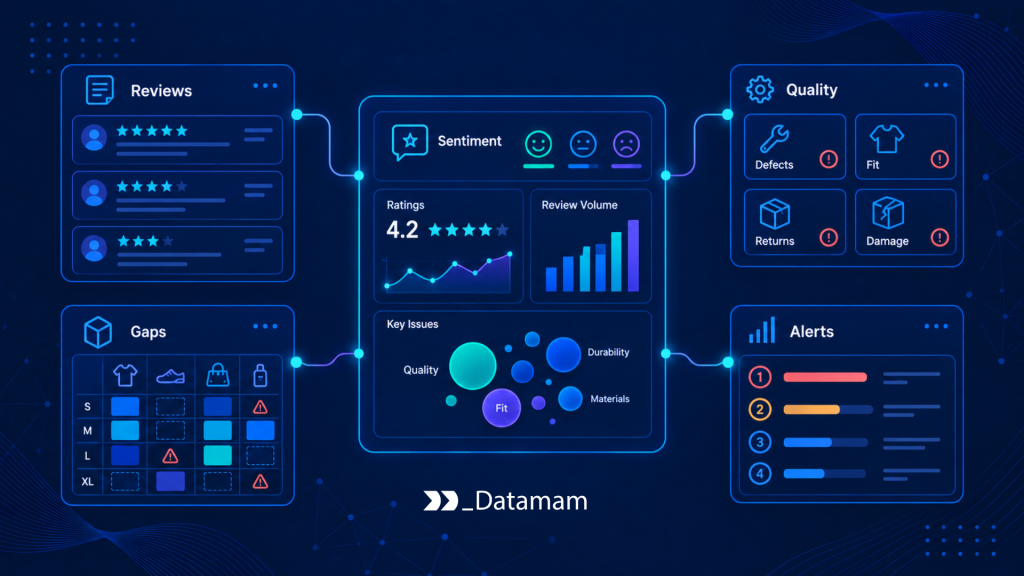
Competitor reviews can tell retailers things that price, assortment, and availability data cannot.
Customers describe products as too small, difficult to assemble, irritating, poorly packaged, comfortable, durable, easy to use, inconsistent with images, or missing features they expected.
But reviews need to be interpreted carefully.
A complaint in a review is not automatically a confirmed product defect. A repeated request for a larger size does not prove that adding that size would be commercially attractive. A five-star review can still contain a durability complaint, while a one-star review may be primarily about delivery rather than the product.
Reviews also come from a self-selected group of customers rather than every purchaser. Research on online reviews has documented self-selection effects, and more recent work shows that platform differences can influence both review participation and ratings.
The useful Customer Sentiment model is therefore:
capture review evidence → resolve product, variant, and source context → classify aspects and aspect sentiment → establish repeated patterns → compare with stable baselines → form a product or assortment hypothesis → corroborate with other evidence → review action
This keeps competitor review analysis useful without turning customer comments into conclusions stronger than the evidence supports.
Key Takeaways
- Competitor reviews provide observable customer-reported feedback, not a representative census of all customers or purchases.
- Review frequency is not the same as defect prevalence, and review sentiment is not automatically population-level customer sentiment.
- Rating, overall textual sentiment, review aspect, and aspect-level sentiment should be stored separately.
- One review can contain several positive and negative aspects at the same time.
- Product-quality complaints should be separated from fulfillment, seller service, packaging, pricing perception, content accuracy, and expectation mismatch.
- Verified-purchase labels are useful provenance signals, but their meaning varies by platform. Verified does not mean truthful or representative, while unverified does not mean fake.
- Product and variant attribution should preserve whether the mapping is explicit, inferred, or unresolved.
- Complaint growth should be measured relative to comparable review volume and stable source coverage, not raw complaint counts alone.
- Repeated review requests can identify candidate assortment needs, but demand, economics, strategy, and operational feasibility still determine whether the retailer should act.
- Cross-platform ratings and sentiment should not be treated as directly comparable without accounting for rating scales, solicitation methods, verification practices, moderation, and source coverage.
- Review intelligence should preserve raw evidence, provenance, classification logic, and model versions so patterns remain traceable.
- AI classification should be evaluated by aspect, category, language, and product context rather than through one generic confidence score.
Competitor Reviews Are Evidence, Not Ground Truth
Competitor reviews provide one view of how customers describe their experiences.
They can contain useful observations about:
- durability;
- fit;
- sizing;
- color;
- material;
- packaging;
- assembly;
- battery life;
- scent;
- flavor;
- irritation;
- freshness;
- compatibility;
- instructions;
- delivery;
- seller service.
But the people who leave reviews are not necessarily representative of everyone who purchased the product.
Some customers never review.
Others may be more motivated to review after an unusually good or bad experience.
The review population can also depend on how a platform solicits, verifies, moderates, or displays reviews. Research published in 2024 on online-review self-selection found that selection effects can alter the usefulness of reviews as signals of product quality. Research published online in 2025 and in a 2026 journal issue also found that platform differences can affect both review participation and ratings.
The key distinction is:
review population ≠ purchaser population
and:
review frequency ≠ issue prevalence among all purchasers
A retailer can still learn from the observed review pattern.
It simply should not pretend that the review sample represents the entire customer base.
Customer Sentiment Needs More Than Positive and Negative Labels
A single sentiment score throws away much of the information that makes reviews useful.
Consider:
“The air fryer cooks really well, but the basket coating started peeling after three weeks.”
The overall review may still be positive.
But the useful analytical representation is closer to:
| Dimension | Example |
| Overall rating | 4/5 |
| Cooking performance | Positive |
| Ease of use | Positive or neutral |
| Basket coating | Negative |
| Durability | Negative |
| Evidence | Specific sentence describing peeling |
| Product/variant | Resolved where possible |
This is aspect-level sentiment.
One review can contribute to several themes, and those themes can have different sentiment.
The stronger model is:
review → aspect → sentiment → evidence span
rather than:
review → one sentiment score
Rating and Text Sentiment Should Stay Separate
Star ratings are useful.
They are not substitutes for understanding the text.
A five-star review may say:
“Great value, although the zipper feels weak.”
A one-star review may say:
“The product itself is excellent, but delivery took three weeks.”
The first contains a negative product-quality observation inside an overall positive rating.
The second may contain a positive product assessment inside a negative service experience.
A review record should therefore preserve separately:
- source rating;
- rating scale;
- review text;
- overall textual sentiment where useful;
- aspect;
- aspect sentiment;
- evidence span;
- classification confidence.
Rating validation should also be source-specific.
Not every platform uses a five-star scale. Other systems may use:
- ten-point ratings;
- thumbs up/down;
- recommendation indicators;
- text without ratings.
rating scale ≠ universal 1–5 scale
Separate Product Feedback From Service and Fulfillment Feedback
A negative customer comment is not automatically a product-quality complaint.
Useful review-driver categories may include:
Product Quality
Examples:
- coating peeled;
- fabric tore;
- component failed;
- packaging mechanism broke.
Fit or Product Suitability
Examples:
- shoes run narrow;
- shirt fits smaller than expected;
- cabinet is unsuitable for the stated space.
Product Content or Expectation
Examples:
- color differs from product images;
- dimensions were difficult to understand;
- instructions omit an important step.
Packaging
Examples:
- bottle leaked;
- protective packaging was insufficient;
- seal was damaged.
Fulfillment
Examples:
- delivery was late;
- item arrived damaged;
- wrong item received.
Seller or Customer Service
Examples:
- refund difficulty;
- poor seller communication;
- unresolved support issue.
Price or Value Perception
Examples:
- feels expensive for the material;
- strong value at the current price.
A useful Customer Sentiment system should preserve these distinctions before category or product teams interpret the result.
Otherwise, retailers can end up blaming a product for a logistics problem or treating a content problem as a manufacturing defect.
Map Review Themes to Product Attributes
The most useful themes depend on the category.
Apparel
Relevant aspects may include:
- fit;
- sizing;
- fabric;
- shrinkage;
- color accuracy;
- transparency;
- comfort;
- stitching.
Beauty
Relevant aspects may include:
- shade;
- texture;
- scent;
- irritation;
- application;
- coverage;
- packaging;
- wear duration.
Electronics
Relevant aspects may include:
- battery life;
- setup;
- connectivity;
- compatibility;
- durability;
- display;
- accessories.
Furniture
Relevant aspects may include:
- dimensions;
- material;
- assembly;
- comfort;
- stability;
- finish;
- delivery condition.
Grocery
Relevant aspects may include:
- flavor;
- freshness;
- texture;
- packaging;
- portion;
- pack format.
Attribute-level analysis makes the signal more actionable because it identifies what reviewers are reacting to, not simply whether the review was positive or negative.
Product and Variant Attribution Need Confidence States
Review intelligence is only useful when the feedback is connected to the right product context.
But review platforms do not always make that easy.
A marketplace may:
- pool reviews across variants;
- combine parent and child listings;
- omit the purchased color or size;
- move reviews after catalog restructuring;
- display reviews across related product configurations.
The system should therefore distinguish:
- variant explicitly identified;
- variant inferred from available evidence;
- product family known but variant unresolved;
- product relationship unresolved.
For example:
variant_resolution = explicit
is different from:
variant_resolution = inferred
This matters because a complaint about one shade, size, flavor, or configuration should not automatically become a conclusion about the entire product family.
product relationship ≠ confirmed variant attribution
Detect Repeated Product-Quality Complaints, Not Automatic Defects
Competitor review analysis can surface repeated complaints around a product attribute.
For example:
- repeated overheating complaints;
- repeated zipper failures;
- repeated packaging leaks;
- recurring battery-life complaints;
- repeated irritation reports.
These patterns are valuable.
But the safe analytical output is:
repeated customer-reported quality complaint
not:
confirmed product defect.
A stronger workflow is:
repeated complaint pattern → product-quality hypothesis → corroborating evidence → review
Additional evidence might include:
- internal returns;
- support tickets;
- warranty claims;
- supplier data;
- product testing;
- recall or safety information;
- changes in product specifications.
Competitor reviews can generate the question.
They do not necessarily answer it.
Complaint Growth Needs a Denominator
Suppose leaking complaints increase from 10 to 30.
That looks significant.
But what if total reviews increased from 100 to 500?
The raw complaint count rose, while the share of observed reviews mentioning the problem actually fell.
Useful temporal measures may therefore include:
- number of reviews containing the aspect;
- share of comparable reviews containing the aspect;
- total review count;
- source coverage;
- product/variant coverage;
- observed period.
For example:
leaking-theme share = reviews mentioning leaking ÷ comparable reviews observed for the product or defined comparison group
That still does not represent the percentage of all purchasers experiencing leakage.
It represents the prevalence of that theme within the observed review sample.
complaint share among reviews ≠ defect rate
Review-Pattern Changes Need Stable Source Coverage
A review trend can change because customers changed.
It can also change because collection changed.
For example:
- another retailer was added;
- additional pagination was collected;
- old reviews became accessible;
- a product listing was merged;
- review filters changed;
- language coverage expanded;
- the platform removed reviews.
The system should therefore preserve:
- source;
- product scope;
- variant scope;
- collection method;
- review count;
- observation period;
- first-seen timestamp where relevant;
- review publication date where available.
The principle is:
review-pattern change ≠ customer-pattern change unless the measurement scope is comparable
Temporal Patterns Generate Hypotheses, Not Causes
A sudden increase in one review theme can be important.
It does not establish why the increase occurred.
Suppose complaints about leaking packaging rise sharply.
Possible explanations might include:
- packaging redesign;
- supplier change;
- product reformulation;
- transportation conditions;
- seasonal temperature changes;
- different customer mix;
- larger sales volume;
- platform or collection changes.
Review data alone cannot determine which explanation is correct.
If an independently documented packaging change occurred around the same time, the relationship becomes more interesting.
But:
after the change ≠ because of the change
The useful workflow is:
temporal review pattern → candidate explanation → independent evidence → product investigation
Use Reviews to Identify Candidate Assortment Needs
Reviews can contain explicit customer requests.
Examples include:
- larger size;
- smaller pack;
- unscented version;
- additional shades;
- wider fit;
- longer cable;
- refill option;
- easier assembly;
- travel-size format.
These are valuable assortment signals.
But:
customer request ≠ proven market demand
and:
candidate need ≠ approved assortment opportunity
A stronger workflow is:
repeated customer-reported need → candidate assortment question → internal demand/economic validation → assortment decision
Internal validation might consider:
- own search data;
- internal reviews;
- sales;
- substitution behavior;
- category strategy;
- margin;
- supplier feasibility;
- minimum order quantities;
- inventory implications.
This keeps Customer Sentiment connected to Assortment Planning without replacing it.
Positive Competitor Reviews Matter Too
Negative reviews are only half of the evidence.
Competitor praise can show which attributes repeatedly appear in positive feedback.
Examples might include:
- easy assembly;
- comfortable fit;
- long battery life;
- durable packaging;
- pleasant texture;
- accurate sizing;
- convenient pack format.
The correct inference is:
this attribute repeatedly appears in positive observed reviews.
Not:
this is definitively one of the most important attributes for all shoppers.
A retailer can use repeated positive themes to generate questions such as:
Do our own customers value the same attribute?
or:
Does our comparable assortment perform differently on this attribute?
Those questions can then be evaluated with internal evidence.
Compare Review Themes With Price Position Carefully
Customer expectations can vary across price positions.
A premium-priced product may create different expectations around:
- material;
- finish;
- service;
- durability;
- packaging.
A lower-priced product may be evaluated against a different value proposition.
But price tier should not be used to imply that product-quality or safety problems are acceptable at lower prices.
A better analysis asks:
How does the pattern of customer-reported expectations differ across clearly defined price positions?
Relevant fields may include:
- normalized product price;
- market;
- condition;
- internal or analytical price band;
- review aspect;
- aspect sentiment.
Review Provenance Is Part of Signal Quality
Review sources differ in how reviews are:
- solicited;
- verified;
- moderated;
- ranked;
- displayed;
- incentivized.
That makes provenance important.
A review record may preserve:
- marketplace or retailer;
- review ID;
- review URL where available;
- publication date;
- observed timestamp;
- displayed verification label;
- disclosed incentive status where available;
- reviewer fields only where necessary and permitted;
- rating scale;
- helpfulness fields where useful;
- moderation or source status where observable.
The displayed verification label should be preserved as platform metadata.
Do not silently translate it into:
verified_customer = true
unless the platform’s verification semantics justify that interpretation.
Verified Purchase Does Not Mean Verified Opinion
A platform may indicate that a reviewer purchased the product through that platform.
That can be useful evidence about review provenance.
It does not establish that:
- the review is representative;
- every statement is accurate;
- the reviewer used the product extensively;
- the sentiment should carry more weight automatically.
Similarly:
unverified review ≠ fake review
A customer might have purchased elsewhere.
Verification definitions can also differ across platforms.
Research published in Decision Support Systems in 2025 found that purchase-verification disclosures can affect how reviews are produced and interpreted, reinforcing the need to treat verification as context rather than a universal truth signal.
Review Authenticity and Manipulation Need Separate Controls
Review ecosystems can contain:
- fake reviews;
- false experience claims;
- undisclosed insider reviews;
- incentivized reviews;
- review suppression;
- coordinated manipulation.
That does not mean a sentiment model should attempt to declare every review genuine or fake.
Instead, source-quality workflows can preserve:
- disclosed incentive status where available;
- platform verification status;
- suspicious duplicate patterns;
- abnormal review timing;
- repeated text similarity;
- known moderation outcomes where observable;
- provenance confidence.
Legal context is jurisdiction-specific.
In the United States, the FTC’s Consumer Reviews and Testimonials Rule took effect on October 21, 2024 and addresses specified deceptive practices involving fake or false reviews, sentiment-conditioned incentives, certain insider reviews, and review suppression. FTC Consumer Reviews and Testimonials Rule
The FTC also clarifies that merely hosting reviews does not create a general obligation under that rule to investigate every review for falsity.
In the European Union, Directive (EU) 2019/2161 requires traders that provide access to consumer reviews to disclose whether and how they ensure that published reviews originate from consumers who actually used or purchased the products, where such verification processes are claimed or used. It also addresses misleading practices involving review authenticity. Directive (EU) 2019/2161 on EUR-Lex
These are jurisdiction-specific requirements and should not be converted into one universal global rule.
Cross-Platform Sentiment Needs Source Controls
A 4.4 rating on Marketplace A should not automatically be compared with a 4.4 rating on Retailer B as if the review systems were identical.
Platforms can differ in:
- rating scales;
- solicitation methods;
- reviewer populations;
- verification systems;
- moderation;
- ranking;
- review display;
- incentives.
Recent research on online-review platforms found that platform heterogeneity can affect both the likelihood of reviewing and the ratings reviewers provide.
A stronger model retains source-specific measures first.
Cross-platform aggregates should only be created under a documented comparison method.
platform rating difference ≠ product-experience difference by itself
International Review Analysis Needs Language Context
Review sentiment does not translate perfectly across languages.
A robust international workflow should preserve:
- original review text;
- detected language;
- translated text where translation is used;
- translation or model version;
- locale;
- product terminology;
- aspect taxonomy;
- classification confidence.
Language models can misread:
- sarcasm;
- idioms;
- negation;
- local product terminology;
- culturally specific expressions.
Aspect taxonomies may also need category- and language-specific adaptation.
Do not convert every country’s reviews into one global sentiment score without preserving how the translation and classification were produced.
Build Review Intelligence Around Evidence, Not a Generic Technology Stack
The important architecture is:
source capture → raw review evidence → product and variant resolution → provenance classification → language handling → aspect extraction → aspect sentiment → temporal aggregation → source-quality checks → hypothesis/review workflow
Each layer answers a different question.
Source Capture
What review did the source display?
Product and Variant Resolution
Which product or variant does the feedback apply to?
Provenance
What does the source tell us about verification, incentive status, retailer, marketplace, and timing?
Aspect Extraction
Which product, service, fulfillment, content, or value attributes are discussed?
Aspect Sentiment
What opinion does the review express about each aspect?
Temporal Aggregation
Is the same customer-reported pattern recurring under comparable source coverage?
Hypothesis Workflow
Does the observed pattern justify investigation by product, quality, merchandising, content, or category teams?
That architecture is more useful than any specific browser automation, orchestration, warehouse, or NLP platform.
Preserve Raw Review Evidence and Derived Intelligence Separately
A raw review might say:
“Looks great, but the white fabric is much more transparent than the black version.”
The analytical layer may derive:
product_family = t_shirt_221
variant = white
variant_resolution = explicit
aspect = fabric_transparency
aspect_sentiment = negative
evidence_span = “white fabric is much more transparent”
Those derived fields should not replace the original text.
The system should retain:
what the reviewer said
alongside:
what the analytical workflow inferred
This makes reclassification, auditing, and model evaluation possible.
AI Classification Needs Measurable Quality
A Customer Sentiment model should not be evaluated only on whether its summaries sound plausible.
Useful measures may include:
- aspect-extraction precision and recall;
- aspect-sentiment accuracy;
- product-resolution accuracy;
- variant-resolution accuracy;
- product-versus-service classification quality;
- performance by category;
- performance by language;
- confidence calibration;
- reviewer agreement;
- drift over time.
Performance should be inspected by class.
A model may classify overall sentiment accurately while missing the rare product-quality complaints that matter most.
Likewise, strong English performance does not establish equivalent performance in Georgian, French, German, Japanese, or another language.
Privacy and Data Minimization Matter
Public reviews can contain personal information that is irrelevant to product intelligence.
A review-analysis workflow should collect and retain only the reviewer-related information needed for the defined purpose, subject to:
- applicable law;
- platform terms;
- retention policy;
- access controls.
The objective is product and market intelligence.
It is not to build unnecessary personal profiles of individual reviewers.
How to Measure Customer Sentiment Data and Signal Quality
The number of reviews collected is not a useful quality metric by itself.
| Area | Example Measure |
| Source coverage | Share of required retailers, marketplaces, markets, and products observed |
| Collection continuity | Share of periods captured under comparable source scope |
| Review provenance | Share with usable source, date, review ID, and platform metadata |
| Product resolution | Share assigned to a usable product relationship |
| Variant resolution | Share with explicit, inferred, or known unresolved variant status |
| Rating normalization | Share interpreted under a documented source-specific rating scale |
| Aspect coverage | Share classified into usable product/service aspects |
| Aspect-classification quality | Precision and recall on reviewed labeled examples |
| Aspect-sentiment quality | Accuracy or F1 by aspect and category |
| Language coverage | Share processed under a validated language/model workflow |
| Evidence traceability | Share of derived aspects linked to supporting review text |
| Pattern comparability | Share of temporal comparisons using stable source/product scope |
| Hypothesis qualification | Share of material patterns meeting review criteria for internal investigation |
| Decision traceability | Share of competitor-review-informed decisions linked to supporting evidence |
| Model drift | Change in classification performance or distribution over time |
These metrics evaluate whether review intelligence is reliable.
They do not establish:
- product defect prevalence;
- purchaser-wide customer sentiment;
- causal commercial impact;
- validated assortment demand.
How to Evaluate Customer Sentiment Readiness
A retailer using competitor reviews should be able to answer:
- Do we distinguish observed reviewer sentiment from sentiment across the full purchaser population?
- Do we avoid treating complaint frequency among reviews as product defect prevalence?
- Are raw ratings stored separately from textual and aspect-level sentiment?
- Can one review contain multiple aspects with different sentiment?
- Is each aspect classification linked to supporting text?
- Are product-quality, fit, product-content, packaging, fulfillment, service, pricing, and expectation issues separated?
- Is product matching reliable enough for the intended analysis?
- Are variant assignments labeled as explicit, inferred, or unresolved?
- Do we preserve the review source, publication date, observation time, and collection scope?
- Are review trends calculated against comparable total review volume and stable source coverage?
- Can source-coverage changes be distinguished from actual review-pattern changes?
- Are verified-purchase labels stored according to platform-specific semantics rather than treated as universal proof?
- Are review-authenticity and manipulation indicators separate from sentiment classification?
- Are cross-platform ratings compared only under a documented methodology?
- Are original-language reviews preserved when translation is used?
- Is sentiment/classification quality measured separately by category and language?
- Are customer requests treated as candidate assortment needs rather than proven demand?
- Are repeated quality complaints treated as hypotheses until corroborated with other evidence?
- Are raw review text and derived analytical fields retained separately?
- Are reviewer-related fields minimized to what is necessary for the analytical purpose?
- Are AI models evaluated through precision, recall, class-specific performance, calibration, and drift?
- Can teams trace a review-derived hypothesis through corroboration and the eventual business decision?
If these questions cannot be answered consistently, the main problem may not be lack of customer feedback.
It may be that the review evidence is being interpreted more strongly than the data supports.
Conclusion
Competitor reviews can give retailers a valuable view into the language customers use to describe products, services, expectations, praise, and frustration.
But reviews should not be treated as a direct measurement of all customers.
They come from a platform-specific and self-selected review population.
A repeated complaint can surface a product-quality question.
It does not establish a defect rate.
A customer request can surface a candidate assortment need.
It does not prove commercial demand.
A positive competitor theme can highlight an attribute worth investigating.
It does not establish what every shopper values most.
The useful model is:
review evidence → product and variant context → aspect-level pattern → hypothesis → corroboration → decision
That means preserving four boundaries:
reviewers ≠ all buyers
complaint frequency ≠ defect prevalence
customer request ≠ proven assortment demand
review pattern ≠ causal explanation
When those distinctions are preserved, Customer Sentiment becomes more than automated review summarization. It becomes a disciplined external evidence layer that helps product, merchandising, category, ecommerce, and quality teams decide what deserves deeper investigation.