Key Takeaways
- Real estate scraping can collect listings, prices, rents, availability, property characteristics, amenities, floor plans, images, and other source-specific fields.
- The difficult part at scale is often not extraction itself but matching, normalization, history, change detection, and maintenance.
- A property record and a property listing should not be treated as the same data object.
- Modern property websites may load information dynamically, so the visible page is not always equivalent to the initial HTML response.
- Scraping frequency should follow how quickly the underlying data changes and how quickly the business needs to react.
- APIs are often preferable when they already provide the required sources and fields. Custom collection is more relevant when the data requirement is tied to specific websites or source-specific information.
- Website terms, licensing, privacy, and other compliance requirements should be reviewed separately for every source.
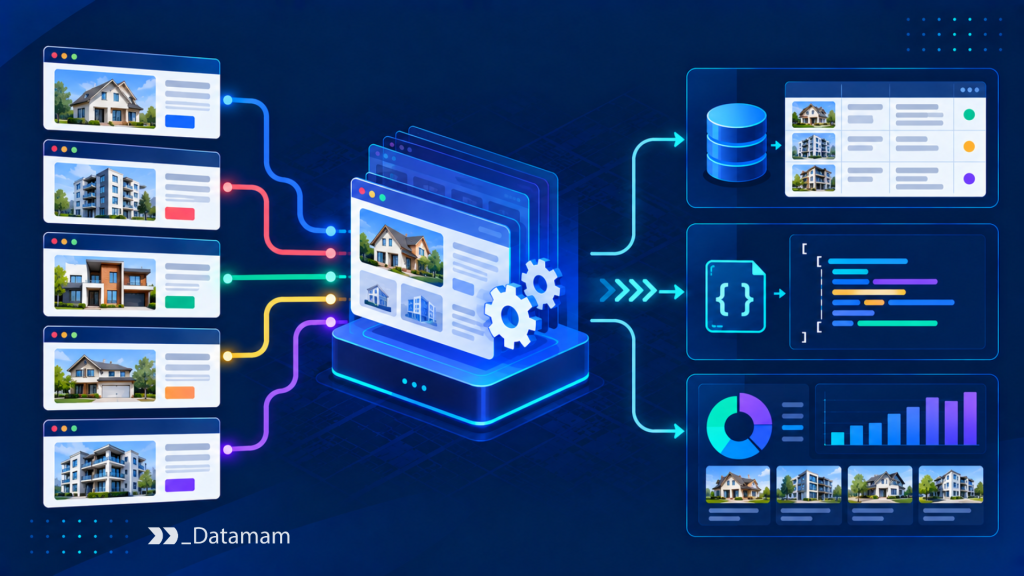
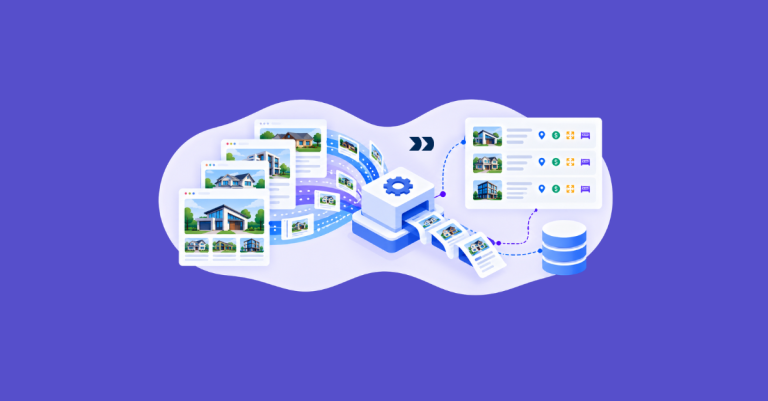
Real estate scraping is the automated collection of property information from websites and other web-accessible sources. Depending on the project, that information may include active listings, asking prices, rental rates, addresses, property characteristics, availability, amenities, agents, floor plans, images, price changes, and listing status. The basic concept is straightforward. But collecting real estate data reliably at scale is very different from extracting a few fields from one webpage. Real estate websites frequently use different schemas, identifiers, page structures, update schedules, geographic conventions, and listing models. A property shown on several websites may therefore appear as several unrelated records. All this even though each record refers to the same physical asset. Production real estate scraping has to solve both parts of the problem: acquiring the data and turning it into a stable dataset that can be monitored and used over time.
That difference is particularly important for businesses using external property data for pricing, investment research, rental intelligence, competitive monitoring, property search, market analysis, or analytics products. A one-time extraction can answer what a website shows today. A recurring collection system can answer what changed, when it changed, whether the same property appeared somewhere else, and whether the change is meaningful.
What Is Real Estate Scraping?
Real estate scraping uses automated software to retrieve information published through real estate websites and transform it into structured data. A scraper may collect data from property portals, broker websites, apartment marketplaces, commercial-property websites, property managers, developer websites, or other public-facing sources. The output can then be stored in formats such as JSON, CSV, databases. As well as cloud storage, APIs, or data warehouses depending on how the information will be used.
What is the difference between real estate scraping and property data?
Property data describes the information itself. Real estate scraping describes one method of obtaining it. Property information can also come from commercial databases, government records, MLS feeds, licensed datasets, APIs, or direct integrations. Scraping becomes relevant when important information is published through websites and an existing structured source does not provide the required coverage, fields, or update schedule.
The distinction matters because a scraping pipeline should not be designed before the actual data requirement is understood. If a commercial API already contains every required property and field with the appropriate freshness and usage rights, scraping the same information separately may add unnecessary engineering work. If the business specifically needs fields from selected websites, however, the source requirement changes the problem.
Is real estate web scraping the same as real estate listing scraping?
Real estate listing scraping is a subset of real estate web scraping. A listing scraper focuses on market offers such as homes for sale, rental units, office availability, or commercial properties. A broader real estate scraper may also collect property characteristics, historical values, location details, agent information, floor plans, or other information surrounding those listings.
One property can also have several listings over time. That means the scraper should distinguish the underlying property from a particular listing event if historical tracking is part of the project.
What Data Can Be Scraped From Real Estate Websites?
The available fields depend entirely on the source. A rental marketplace may contain unit-level availability and floor plans. While a residential-sale portal may emphasize asking prices, property characteristics, agents, and market history. A commercial-property website may focus on lease terms, building class, vacancy, square footage, or tenant-related information.
What property fields are commonly collected?
Typical projects may include combinations of address, listing ID, source ID, property type, bedrooms, bathrooms, square footage, lot size, asking price, rent, previous price, listing status, listing date, amenities, coordinates, agent, brokerage, description, images, floor plans, unit information, and observation timestamps. The fields should be defined before collection begins because field availability can differ sharply between sources.
A production schema should also distinguish fields that describe different objects. ListPrice, for example, describes a listing rather than the physical identity of a property. Real estate standards such as the RESO Data Dictionary exist partly because different real estate systems historically represented similar concepts using different terminology and structures. RESO organizes information into resources, fields, and lookup values. All of which illustrates why multi-source real estate data needs an explicit model rather than a flat collection of unrelated values.
Can real estate scraping collect apartment floor plans and unit availability?
It can when those fields are actually available through the selected source and collection is permitted. Apartment data can be substantially more complicated than a simple property record because one community may contain multiple buildings, floor plans, unit types, and individual units. A scraper may therefore need to preserve relationships between the property, floor-plan type, unit identifier, asking rent, lease term, availability date, and associated images.
This structure matters downstream. If the system saves every floor plan as though it were a separate property, or combines unit-level rents into one building-level value, the resulting dataset may technically contain the extracted information while still being analytically incorrect.
Can property images and media be part of the dataset?
Images, virtual tours, floor plans, and other media may be part of a real estate data requirement, but media should be modeled separately from ordinary text fields. A listing can have many media assets, their ordering can change, URLs can expire or be replaced, and usage rights may differ from the rights governing ordinary factual fields. Projects involving media therefore need explicit decisions about whether to collect URLs, metadata, source references, or the actual files.
How Does Real Estate Web Scraping Work?
At a basic level, a scraper requests a source, extracts the required information, converts it into a controlled structure, validates the result, and stores or delivers the output. At production scale, each of those steps usually becomes its own part of the pipeline.
How do you decide what to scrape from a real estate website?
Start with the output, not the HTML. Define the required fields, geographic coverage, property types, sources, historical requirements, and refresh frequency first. Then map those requirements to each source. This prevents the project from collecting hundreds of available fields simply because they exist while missing the small number of fields the business actually depends on.
A source map can identify which website provides each field, whether the field is mandatory, how frequently it changes, and what identifier can connect it to other records. This is especially important when several websites are being combined because one source may have better pricing information while another contains better unit, amenity, or property-characteristic coverage.
Why do some real estate websites need browser rendering?
Modern websites do not always return every visible listing field in the initial HTML document. JavaScript can request additional information after the page loads and then update the page dynamically. MDN’s explanation of JavaScript network requests describes this common web pattern. JavaScript can retrieve individual resources, often JSON, and update portions of a page without reloading the complete document. A scraper built around only the initial HTML response may therefore see less information than a normal browser session.
This does not mean that every real estate website requires a browser automation framework. Some sources expose the required data directly in HTML or another permitted structured interface. The acquisition method should be chosen source by source instead of assuming that one technical pattern works everywhere.
What does a simple real estate scraper look like?
For a static page where collection is permitted, a simplified Python example can illustrate the extraction process. This example intentionally parses local demonstration HTML rather than targeting a live property website:
from bs4 import BeautifulSoup


html = """

<article class="listing" data-id="A-1001">

    <span class="address">125 Example Street</span>

    <span class="price">$725,000</span>

    <span class="beds">3</span>

    <span class="baths">2</span>

</article>

"""


soup = BeautifulSoup(html, "html.parser")

listing = soup.select_one(".listing")


record = {

    "source_id": listing["data-id"],

    "address": listing.select_one(".address").get_text(strip=True),

    "price": listing.select_one(".price").get_text(strip=True),

    "bedrooms": int(listing.select_one(".beds").get_text(strip=True)),

    "bathrooms": int(listing.select_one(".baths").get_text(strip=True)),

}


print(record)
The result is a structured record rather than raw webpage content. A real production pipeline would add request handling, source-specific parsers, pagination, validation, retries, monitoring, logging, data normalization, and storage. It would also need to account for changes to the website over time.
How Do You Build a Real Estate Scraping Pipeline at Scale?
Scaling property data scraping is less about making one script faster and more about separating acquisition, interpretation, validation, and delivery into reliable stages. A source-specific collector should normally not be responsible for every downstream business rule because that makes changes harder to isolate when the source website changes.
How should scraped property data be normalized?
Normalization converts source-specific values into a common representation. One website may use for_sale, another active, and another its own numerical status code. One source may provide 2,450 sqft, another 2450, and another 227.6 m². Prices may contain currency symbols and separators. Addresses may use different abbreviations or unit formats.
A canonical output model reduces these differences. Source data can still be retained for provenance, but downstream systems receive predictable fields and controlled values. This separation is important because changing the source parser should not require every analytics model or customer application to change with it.
How do you match the same property across different websites?
Property matching is a separate problem from normalization. Two perfectly normalized records can still refer to the same building without sharing an identifier. Depending on the data, matching may use normalized addresses, unit numbers, coordinates, parcel identifiers, property names, source IDs, or combinations of physical characteristics.
The correct matching unit also depends on the project. A single-family property may map cleanly to one asset. A multifamily property can require separate records for the community, building, floor-plan type, individual unit, and listing. Treating all of these as one level produces false duplicates or false matches.
How do you preserve real estate listing history?
If each new scrape overwrites the previous row, the system loses much of the intelligence that recurring collection can create. Instead, the pipeline can preserve observations and derive events from differences between them. The following small example detects selected listing changes:
TRACKED_FIELDS = ("price", "status", "availability")


def detect_changes(previous, current):

    changes = {}


    for field in TRACKED_FIELDS:

        before = previous.get(field)

        after = current.get(field)


        if before != after:

            changes[field] = {

                "before": before,

                "after": after,

            }


    return changes
A production implementation would also preserve observation time, source, record identity, collection status, and rules for distinguishing a real removal from a temporary failure to collect the page. That last point matters because a missing listing is not automatically a delisting. It may instead reflect a network error, source outage, parser failure, or temporary page change.
How Often Should Real Estate Data Be Scraped?
The correct collection frequency depends on the volatility of the data and the decision it supports. There is little value in collecting a slowly changing property characteristic every few minutes, while a pricing or availability workflow may require much shorter intervals.
Should property listings be scraped daily or hourly?
There is no universal answer. A market-research workflow may be adequately served by daily collection. A business tracking rapidly changing availability or price movements may need several observations per day or, where appropriate and permitted, a higher-frequency schedule. The source itself also sets an upper bound on useful freshness. Collecting every hour does not help if the underlying website only changes once per day.
Frequency also affects infrastructure requirements. Increasing collection from weekly to daily multiplies the number of observations by seven. Moving from daily to hourly multiplies them by another 24. Storage, quality checks, error handling, change detection, and delivery all have to scale along with the requests.
What real estate fields benefit most from frequent monitoring?
Frequently changing fields commonly include asking price, asking rent, listing status, availability, promotions, units, days on market, and sometimes agent or marketing information. Relatively stable information such as year built or lot size usually does not need the same schedule. Designing cadence at the field or source level can therefore be more efficient than applying one refresh frequency to the entire dataset.
What Makes Real Estate Websites Difficult to Scrape Reliably?
Real estate websites are data-rich applications, and that creates several technical complications. Dynamic rendering is one, but it is not the only one. Search results can use pagination or infinite scrolling, websites may present different content by geography, records can be loaded from multiple services, and source schemas can change without notice.
Why do real estate scrapers break?
A scraper depends on assumptions about the source. If a selector expects a price inside one HTML element and the website moves that value elsewhere, the parser may fail or, more dangerously, return incomplete data without obvious errors. Production systems therefore need data-quality checks in addition to technical success checks.
Receiving HTTP 200 does not prove that the expected listing data was collected correctly. Validation should also test field population, record counts, expected value ranges, schema completeness, and deviations from historical behavior.
How should pagination and listing discovery be handled?
A collection system needs to understand how records are discovered rather than assuming that requesting the first result page provides complete coverage. Depending on the source, discovery may involve page numbers, result cursors, geographic searches, category filters, property detail pages, or other permitted navigation patterns.
Coverage should be measurable. If yesterday’s collection contained 40,000 listings and today’s contains 8,000, the system should investigate whether the market changed or the collection process failed rather than immediately treating 32,000 properties as removed.
Why is scraper maintenance part of the product?
Websites evolve. HTML structures change, frontend applications are redesigned, fields are renamed, new property types appear, and navigation logic changes. A one-time scraper can therefore work correctly when it is written and gradually become unreliable.
This is why production scraping should include monitoring for the collector itself. Errors, unexpected null rates, sharp record-count changes, duplicated IDs, stale timestamps, and sudden schema differences should trigger investigation before bad data moves further downstream.
Is Real Estate Scraping Legal?
There is no universal yes-or-no answer covering every website, dataset, jurisdiction, use case, and method of access. Legal analysis can involve website terms, contract law, copyright, privacy, database rights, access controls, and the nature of the data being collected. A technical ability to retrieve information should therefore not be treated as a legal conclusion about how that information may be collected or used.
Do real estate websites allow automated scraping?
Policies differ by source and can change. Zillow’s current Terms of Use, for example, expressly prohibit automated queries including screen or database scraping, spiders, robots, crawlers, and CAPTCHA bypassing on its services. That is a source-specific contractual restriction and should not be generalized into a universal statement about every real estate website or every form of external data collection.
Before building a collection workflow, businesses should review the relevant source terms, access restrictions, intended use, applicable laws, privacy considerations, and licensing requirements. High-risk or ambiguous cases should be reviewed with qualified legal counsel.
Does public visibility mean data can be used without restriction?
No. Information being visible in a browser does not by itself answer questions about contractual restrictions, copyright, privacy, redistribution, or commercial reuse. Public accessibility is one factor in a wider analysis.
The intended use also matters. Internal market research, redistribution of a complete dataset, publication of copyrighted media, collection of personal information, and development of a competing consumer product can raise different issues even when the underlying source is the same.
Real Estate API or Web Scraping: Which Is Better?
An API is generally preferable when it already provides the required information under acceptable access and licensing conditions. Structured interfaces reduce much of the source-maintenance burden and make data easier to integrate. Scraping becomes more relevant when the business requirement is tied to particular websites or fields that existing APIs do not provide.
When should a company use a property data API instead?
Use an existing API when it already satisfies the important requirements: target geography, property types, source coverage, fields, freshness, historical depth, identifiers, reliability, and permitted use. The cost of integrating a suitable API can be substantially lower than maintaining several independent website collectors.
When does web scraping provide information an API cannot?
Web scraping can be useful when source-specific information matters. A company may need live advertised rents from particular marketplaces, floor-plan information from apartment websites, listing attributes from specific competitors, or availability published directly by property managers. A standardized API may provide excellent property coverage while still not contain those source-specific observations.
The distinction is therefore not “API good, scraping bad” or the reverse. It is whether the required data already exists through a structured interface that meets the project requirements.
How Do You Validate Scraped Real Estate Data?
Successful extraction does not guarantee a useful dataset. A production pipeline should test whether the collected records are complete, internally consistent, current, and plausible before they are delivered downstream.
What quality checks should a real estate scraper perform?
Useful controls can include required-field completeness, duplicate detection, identifier consistency, price ranges, coordinate validation, status validation, unexpected null rates, source record counts, historical comparisons, and freshness checks. The exact rules should follow the use case because a missing floor plan may be irrelevant to one project and critical to another.
Validation is particularly important when several sources are combined. A price difference between two websites does not automatically mean one scraper is wrong. The sources may reflect different listing events, currencies, update times, unit types, or market offers. Quality rules should preserve those distinctions rather than flatten them prematurely.
How do you test a real estate dataset before scaling collection?
Start with a known sample. Select properties or listings whose values can be independently verified and compare the collected output against the expected result. Test ordinary cases and difficult ones, including unit numbers, duplicate addresses, missing fields, unusual property types, price changes, relistings, and records that disappear.
This type of validation is also useful when evaluating third-party datasets and APIs. A provider may offer broad coverage, but testing known examples reveals whether the fields most important to the project are actually complete and usable.
What Is Real Estate Scraping Used For?
The business value of property data scraping comes from the decision or product supported by the resulting dataset. Collecting more records has little value if the output does not answer a specific question.
Can real estate scraping be used for price monitoring?
Yes. Recurring collection can preserve asking prices and identify when they change. Price monitoring can support investment research, competitive analysis, rental benchmarking, acquisition workflows, and market intelligence. The important distinction is between simply storing today’s price and maintaining enough history to identify the direction and timing of change.
Can web scraping track rental availability?
Rental websites can contain property, floor-plan, unit, rent, lease-term, and availability information depending on the source. Repeated observations can help identify when units appear, disappear, change price, or become available under different conditions.
In documented Datamam real estate collection work, projects have required combinations of property details, listings, pricing, amenities, floor plans, media assets, and recurring updates across multiple external sources. That experience highlights why the output model matters as much as the extraction process. A property, floor plan, unit, and listing may all need to remain separate objects even when they are collected from the same page.
Can scraped property data support market intelligence?
Yes, particularly when observations are collected consistently over time. Individual listing events can be aggregated into measures such as new inventory, price reductions, rental changes, availability, or listing turnover. Market intelligence therefore depends on both breadth and history. A large one-time snapshot can describe a market at one moment, but recurring observations are required to measure movement.
What Should You Decide Before Building a Real Estate Scraper?
Before writing collection code, define the business requirements clearly. The most important decisions are the source websites, target geography, property types, required fields, collection cadence, historical depth, identity and matching requirements, output format, quality thresholds, and permitted use. Those choices determine almost every subsequent technical decision.
Should you start with the scraper or the schema?
Start with the schema. Define what the final record needs to contain and how different objects relate to one another. Then determine how each source maps into that model. Starting with the HTML often produces source-specific datasets that become difficult to combine later.
How many real estate websites should be collected?
Only as many as are needed to satisfy the coverage requirement. Adding another source increases potential coverage but also introduces another schema, set of identifiers, maintenance burden, matching problem, and quality surface.
The number of sources should therefore follow the business case. Ten highly relevant websites can be more useful than one hundred loosely related ones.
What should a real estate scraping proof of concept test?
A useful proof of concept should test more than whether a parser returns rows. It should verify source coverage, field completeness, data quality, matching, refresh behavior, historical tracking, technical stability, and the ability to produce the required output format. It should also identify source-specific compliance questions before the workflow is scaled.
When Does Managed Real Estate Scraping Make Sense?
Building an internal scraper can be reasonable for a narrow, stable project with limited sources and modest maintenance requirements. The economics change when the workflow becomes business-critical, multi-source, high-frequency, or dependent on continuous maintenance. At that point, engineering effort shifts from writing extraction code toward source monitoring, scraper repair, data validation, infrastructure, normalization, matching, historical storage, and delivery.
Managed collection is most relevant when the business wants the output rather than the responsibility of maintaining the acquisition system itself. It can also make sense when several internal teams consume the same external property data and require a stable data contract even as the underlying websites change.
The important distinction is between a scraper and a data pipeline. A scraper retrieves information from a source. A production data pipeline has to keep producing reliable, validated, structured data as the source, scale, and business requirements change.
How to Approach Real Estate Scraping at Scale
Real estate scraping works best when the project begins with a precise data requirement rather than a generic goal of collecting as much property information as possible. Define the sources, properties, fields, frequency, history, identifiers, delivery requirements, and permitted use first. Then choose the simplest acquisition method capable of satisfying those requirements.
For some projects, it will be an existing API or bulk dataset. For others, it will require real estate web scraping across selected websites. When custom collection is necessary, the extraction itself is only one part of the system. Matching, normalization, validation, monitoring, history, maintenance, and delivery determine whether the resulting data can actually support a production application or business decision.
That is the practical difference between scraping a real estate website and building reliable real estate data infrastructure.