Key Takeaways
- A reliable POI Database is not just a large list of places. It must control accuracy, freshness, duplication, categories, coordinates, and source traceability.
- A POI database provider should be evaluated by coverage depth, update cadence, validation methods, licensing clarity, schema stability, and delivery options.
- A global POI database needs country-level address handling, multilingual names, local category logic, and geocoding confidence controls.
- A business POI database becomes enterprise-ready when records can support mapping, site selection, territory planning, location analytics, and operational systems without heavy manual cleanup.
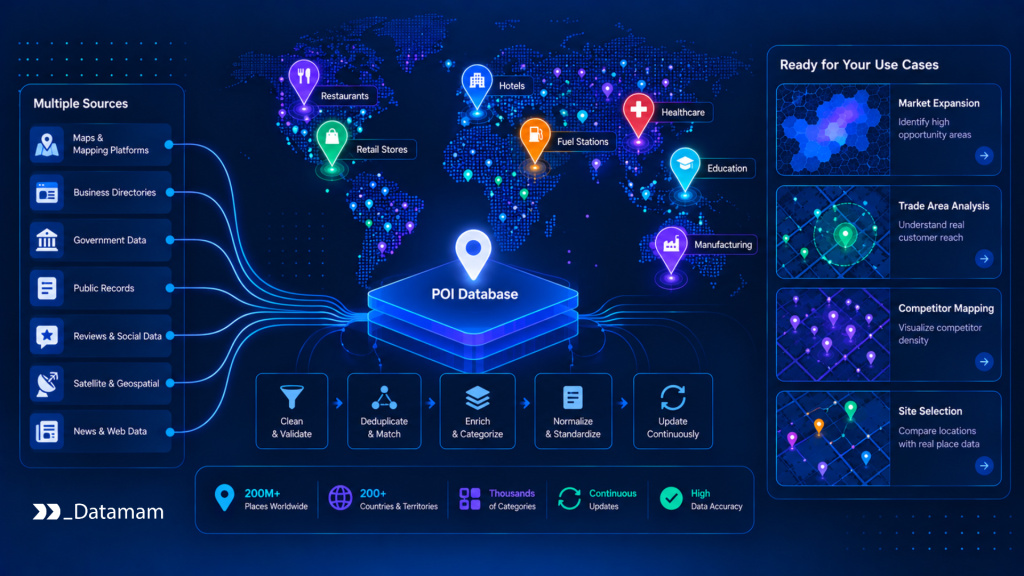
A POI Database becomes reliable when it can represent real-world places accurately enough for enterprise decisions. That sounds simple until the database must handle closed stores, duplicate listings, chain branches, franchise locations, store-within-store formats, inconsistent categories, incomplete addresses, and coordinates that place a business on the wrong road.
For location intelligence, the place layer is the foundation. If business locations are outdated, duplicated, or misclassified, every downstream model becomes weaker: trade area analysis, retail site selection, market mapping, delivery planning, territory design, and competitive coverage analysis.
Enterprise reliability therefore depends on controls, not just volume.
Why POI Database Reliability Matters
A large POI dataset can still be unreliable. Scale only helps if records are accurate, current, structured, and usable across systems.
Deloitte’s geospatial analytics analysis describes how organizations use geospatial data across retail, logistics, site selection, risk, and operations. Those use cases depend on trusted location records because inaccurate places distort the analysis before the model even runs.
POI Errors Become Location Decision Errors
A wrong coordinate can move a business into the wrong trade area. A duplicate location can inflate competitor density. A closed business can make a market look more active than it is. A weak category can classify a pharmacy as a grocery store or a café as a restaurant chain.
These are not small database issues. They affect expansion planning, competitor mapping, sales territories, customer proximity analysis, and market saturation models.
In practice, POI reliability is measured by whether the data can be used without constant manual correction.
Enterprise Use Cases Need Different Accuracy Levels
Not every workflow needs the same level of precision. A national market scan may tolerate broader coordinate accuracy. A retail site selection model may require rooftop or parcel-level confidence. A delivery routing workflow may need entrance-level or street-side precision. A territory planning model may prioritize business classification and branch status.
Therefore, a POI database should expose confidence levels. Enterprise users need to know whether a coordinate is rooftop-level, street-level, ZIP-level, interpolated, or uncertain.
Core Components of a Reliable POI Database
A reliable business POI database should combine location accuracy, entity resolution, category control, freshness monitoring, and governance evidence.
The quality model should be visible, not hidden behind a simple record count.
Address and Coordinate Accuracy
Address quality starts with parsing and standardization. A record should separate street, city, region, postal code, country, building, unit, and formatted address where available.
Coordinates should be validated against the address. A latitude and longitude pair is not enough if the point lands in the wrong city, wrong parcel, wrong shopping center, or wrong side of a boundary.
A simple POI validation pattern can look like this:
POI_QUALITY_RULES = {

    "required_fields": ["name", "address", "latitude", "longitude", "category"],

    "blocked_statuses": ["closed", "duplicate", "unverified"],

    "minimum_geocode_confidence": 0.85,

}


def validate_poi_record(record):

    missing = [field for field in POI_QUALITY_RULES["required_fields"] if not record.get(field)]


    if missing:

        return {"valid": False, "reason": "missing_required_fields", "fields": missing}


    if record.get("status") in POI_QUALITY_RULES["blocked_statuses"]:

        return {"valid": False, "reason": "blocked_poi_status"}


    if record.get("geocode_confidence", 0) < POI_QUALITY_RULES["minimum_geocode_confidence"]:

        return {"valid": False, "reason": "low_geocode_confidence"}


    return {"valid": True}
This keeps location quality explicit. A POI should not enter enterprise systems unless required fields, status, and geocoding confidence meet minimum standards.
Duplicate and Entity Resolution
Duplicate POIs are common because the same business may appear with different names, phone numbers, URLs, addresses, or coordinates. A chain branch may be listed as “Starbucks,” “Starbucks Coffee,” and “Starbucks inside Target.” A franchise may use a local business name while operating under a national brand.
POI matching should compare business name, address, phone, website, coordinates, category, brand, and source identifiers. Duplicates should be merged carefully so the system does not collapse separate nearby branches into one record.
Entity resolution is especially important for a global POI database because naming formats, address structures, and business identifiers vary by country.
Category and Taxonomy Consistency
Categories make POI data usable. A business may be classified as “food,” “restaurant,” “fast casual,” “coffee shop,” “bakery,” or “quick-service restaurant” depending on the source.
Enterprise users need a consistent taxonomy. Site selection, competitor analysis, and territory planning depend on knowing which businesses are comparable.
Category normalization should preserve both raw source category and standardized enterprise category. This allows teams to audit how classification decisions were made. Urban planners must implement effective site selection strategies for urban planners to ensure optimal placement of services and amenities. By analyzing demographic data and accessibility, planners can identify the best locations for new developments. Additionally, collaboration with local stakeholders enhances the accuracy of site selection and promotes community engagement in the planning process.
Freshness and Update Controls
POI data changes constantly. Businesses open, close, relocate, rebrand, merge, franchise, change hours, update websites, or change categories.
A POI database provider must prove that freshness is actively managed.
Open, Closed, and Temporarily Unavailable Status
A reliable POI record should distinguish active, closed, temporarily closed, relocated, duplicate, unverified, and pending review statuses. A closed location should not be treated the same as an active branch.
This matters for market density. If closed locations remain active in the database, a market may look saturated when it is not. If new openings are missed, expansion teams may underestimate competitor movement.
Update cadence should vary by use case. High-change categories such as restaurants, retail stores, clinics, and service businesses may require more frequent checks than stable institutional locations.
Source Traceability
Each record should preserve source evidence: source name, source URL where available, capture date, last verified date, update method, and confidence status.
The OECD’s data governance work emphasizes trust, data quality, ownership, and responsible data use. For POI infrastructure, traceability is how enterprise teams understand where a location record came from and whether it is fit for use.
Evaluating a POI Database Provider
A POI database provider should be evaluated by data quality and operating model, not only by claimed record volume.
Large datasets can create false confidence if coverage, freshness, and accuracy are uneven. Choosing the right poi data provider is essential for ensuring that your applications have access to reliable information. It is important to assess not only the data quality but also the provider’s methodologies for updating and maintaining their datasets. Ultimately, a thoughtful selection will result in better decision-making and enhanced user experiences.
Coverage Depth and Regional Reliability
A global POI database should provide country-by-country coverage visibility. Strong coverage in one market does not guarantee strong coverage elsewhere.
Enterprises should evaluate urban, suburban, rural, and international coverage separately. They should also review whether the provider handles multilingual business names, local address formats, local categories, and regional business structures.
For example, a chain restaurant may be easy to identify in one country but harder to resolve where franchise names, local scripts, and mall-based locations are common.
Delivery and Integration Readiness
Enterprise teams need data in usable formats. A POI database may be delivered through API, bulk files, cloud storage, warehouse tables, or direct integration.
APIs are useful for lookup, enrichment, and application workflows. Bulk delivery is better for large-scale market analysis, site selection models, territory planning, and periodic refreshes.
The provider should support schema documentation, stable identifiers, versioning, and change logs. Without those controls, every refresh can create downstream cleanup work.
Quality Controls for Enterprise POI Workflows
A business POI database becomes reliable when quality checks are operationalized. Validation should happen before data reaches analytics, mapping, or decision systems.
The goal is to prevent location errors from becoming business errors.
Confidence Scoring and Exception Review
Each record should carry confidence indicators for address, coordinates, category, duplicate status, and open/closed state. Low-confidence records should route to review instead of entering production models silently.
A routing model can look like this:
POI_EXCEPTION_ROUTING = {

    "duplicate_candidate": {"owner": "data_quality_team", "action": "review_entity_match"},

    "low_geocode_confidence": {"owner": "geospatial_team", "action": "verify_coordinates"},

    "category_conflict": {"owner": "taxonomy_owner", "action": "review_category_mapping"},

    "status_conflict": {"owner": "data_operations", "action": "verify_business_status"},

}


def route_poi_quality_exception(exception):

    route = POI_EXCEPTION_ROUTING.get(exception.get("exception_type"))


    if not route:

        return {"owner": "data_operations", "action": "manual_triage"}


    return {

        "poi_id": exception.get("poi_id"),

        "exception_type": exception.get("exception_type"),

        "severity": exception.get("severity"),

        "owner": route["owner"],

        "action": route["action"],

    }
This creates accountability. Coordinate issues, duplicates, category conflicts, and status conflicts require different owners.
Governance and Auditability
POI governance should cover source rights, update cadence, record lineage, quality thresholds, category ownership, duplicate resolution rules, and downstream usage permissions.
Gartner’s 2025 data and analytics trends highlight governance and AI-ready data as key priorities. POI data follows the same logic: location records must be governed before they can support analytics, AI, mapping, or operational decisions.
What a Reliable POI Database Enables
Reliable POI infrastructure makes location-based decisions more accurate and easier to operationalize.
The value is not the database itself. The value is what trusted place data makes possible.
Better Site Selection and Market Analysis
Retailers, restaurants, franchise brands, and commercial real estate teams can evaluate locations using accurate competitor density, nearby anchors, business clusters, category mix, and local market context.
A clean POI database helps teams understand whether a site is underserved, oversaturated, complementary, or strategically positioned.
Stronger Mapping, Search, and Territory Planning
Mapping and search products depend on accurate names, addresses, categories, and coordinates. Sales and service teams depend on clean business location data for territory design and coverage planning.
When POI data is reliable, teams spend less time correcting records and more time using location intelligence. Accurate point of interest data applications enhance the effectiveness of marketing campaigns and customer engagement. Businesses that leverage this data gain valuable insights into consumer behavior and preferences. This leads to more targeted strategies and improved overall performance in the marketplace.
Conclusion
A reliable POI Database is not defined by record count alone. It is defined by accuracy, freshness, entity resolution, category consistency, coordinate precision, traceability, governance, and delivery readiness.
Enterprise teams need a POI database provider that can support real workflows: site selection, trade area analysis, location intelligence, competitor mapping, territory planning, and market expansion. A global POI database must also handle local address formats, multilingual records, regional categories, and market-specific validation.
The capability matters because location decisions fail when the place layer is wrong. With a governed business POI database, enterprises can turn raw place records into reliable infrastructure for geospatial analysis and market decision-making.
A structured review can help evaluate whether current workflows have a reliable POI Database, POI database provider, global POI database, and business POI database controls. You can run a location data infrastructure audit with our team to review your current place-data workflows and understand what is required to build reliable enterprise POI infrastructure.