Key Takeaways
- Site Selection depends on market reality, not population data alone.
- Site selection analysis needs competitor density, POI context, accessibility, trade areas, and local demand signals.
- Business site selection becomes risky when demographics are not connected to actual commercial activity.
- Location selection strategy fails when teams ignore openings, closures, relocations, and market saturation.
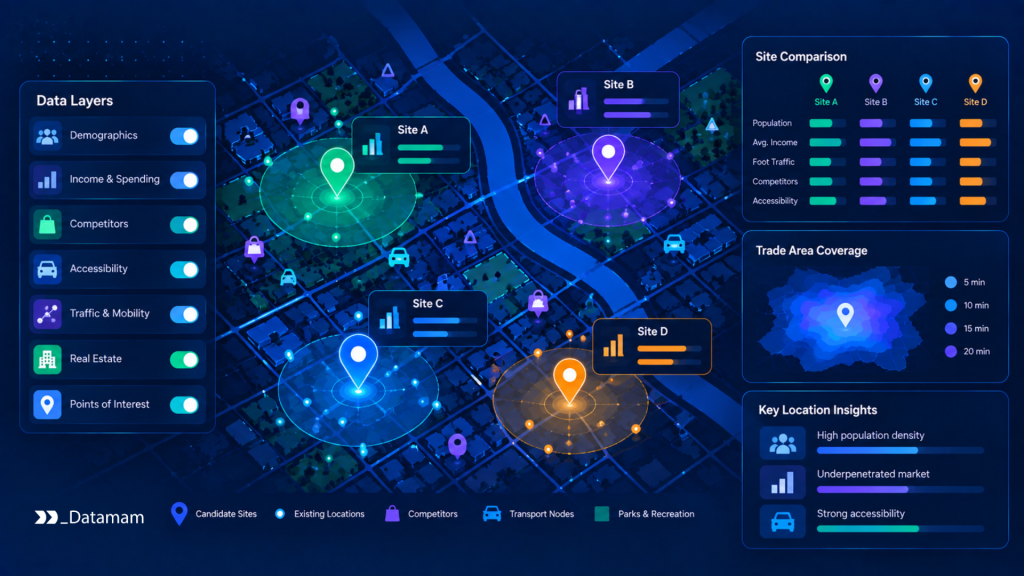
Site Selection has traditionally relied on population, income, age, household composition, and traffic patterns. Those inputs still matter. However, they are no longer enough to explain whether a location can support a store, restaurant, clinic, branch, franchise unit, or service point. A market may look attractive demographically while already being saturated with competitors. Another market may look average on population data but show strong local demand, weak competition, better accessibility, or complementary business activity.
Site Selection refers to the process of evaluating potential business locations using demographic, geographic, commercial, competitive, operational, and financial signals. It includes site selection analysis, business site selection, location selection strategy, POI data, competitor mapping, trade area analysis, catchment zones, accessibility, cannibalization risk, market saturation, and geospatial decision infrastructure.
Site Selection Depends on Market Reality, Not Population Data Alone
Demographics describe who lives or works in an area. Site selection requires understanding how that area actually functions as a commercial market. That means analyzing competitors, complementary businesses, transportation access, visibility, foot traffic, store networks, customer movement, trade areas, and local demand patterns.
A high-income neighborhood may not be attractive if the category is already overbuilt. A dense urban corridor may not work if access is poor or parking is limited. A suburban area may look weak in simple demographic tables but perform well because of commuter flows, nearby anchors, and underserved demand.
McKinsey’s analysis of geospatial analytics in retail explains that stronger retail network decisions require store-level details, site-specific information, foot traffic, demographics, and other local inputs, not one-dimensional market views.
Site Selection Analysis Needs Competitor Density, POI Context, Accessibility, Trade Areas, and Local Demand Signals
Site selection analysis should combine demographic strength with competitive and spatial evidence. Competitor density shows how crowded the market is. POI context shows the surrounding business mix. Accessibility shows whether customers can realistically reach the location. Trade areas and catchment zones show the market a site can serve. Demand signals show whether the area supports the category.
For example, a restaurant site may depend on nearby offices, nightlife, parking, delivery radius, and competing concepts. A clinic may depend on patient access, provider density, insurance network fit, and transit routes. A retail store may depend on anchor tenants, category adjacency, competitor proximity, and local shopping behavior.
In practice, demographics define potential. Market context defines whether that potential is reachable.
Business Site Selection Becomes Risky When Demographics Are Not Connected to Actual Commercial Activity
Business site selection becomes risky when demographic data is treated as the main evidence layer. Population and income may suggest opportunity, but they do not show whether customers already have nearby alternatives, whether competitors are expanding, whether the site is accessible, or whether adjacent businesses support demand.
A location may look promising because the surrounding area has strong income levels. However, if competitors already dominate key intersections, the site may face limited customer capture. Another location may have moderate income levels but strong foot traffic, limited competition, and high category relevance.
Therefore, demographic analysis should be interpreted through commercial activity, not used as a standalone location decision.
Why Demographics Alone Create Location Blind Spots
Demographics alone create blind spots because they are usually slow-moving and broad. They can describe local population structure, but they do not capture daily mobility, real competitor presence, business openings and closures, store formats, customer access, trade area overlap, or market saturation.
Deloitte’s 2025 Retail Industry Outlook highlights the continued importance of stores, customer experience, margin pressure, and technology-enabled decision-making in retail. Those pressures make better local market intelligence important because physical networks still shape performance.
Population, Income, and Age Data Do Not Explain Competition, Store Networks, Mobility, or Nearby Business Mix
Population, income, and age data do not explain how customers move through a market or which alternatives they consider. They do not show whether a competitor recently opened nearby, whether a shopping center lost an anchor tenant, whether a new residential development changed access patterns, or whether a chain is consolidating locations.
They also do not show nearby business mix. A pharmacy, coffee shop, grocery store, gym, medical office, bank branch, or restaurant may perform differently depending on surrounding anchors, complementary services, local employment, and competitor clusters.
Site selection analysis therefore needs POI data, store location data, business openings and closures, drive-time analysis, transit access, and local commercial context.
Location Selection Strategy Fails When Teams Ignore Openings, Closures, Relocations, and Market Saturation
Location selection strategy fails when it treats the market as static. Businesses open, close, relocate, rebrand, franchise, consolidate, and shift formats. A site that looked attractive six months ago may become less attractive after competitor entry. A market that looked saturated may become open after closures. A trade area may change when a major tenant leaves or a new development opens.
Market saturation is especially important. A category can have strong demographic fit but too many existing providers. In this case, a new location may need unusually strong differentiation, pricing power, visibility, or convenience to succeed.
Without current place data, teams may base expansion decisions on an old version of the market.
The Strategic Risk of Weak Location Evidence
Weak location evidence creates strategic risk because site decisions involve long-term capital, leases, staffing, buildout costs, supply chain planning, and brand exposure. Poor decisions are expensive and slow to reverse.
A weak site may reduce revenue. A poorly placed location may cannibalize an existing unit. A franchise territory may create conflict. A store network may become inefficient. A healthcare or service network may fail to reach the right population.
Gartner’s 2025 data and analytics trends emphasize governance and data readiness as important conditions for reliable analytical decision-making. Site selection is not an AI-only problem, but the principle applies directly: analytical outputs depend on the quality, governance, and readiness of the underlying data.
Enterprises Misread Expansion Opportunity When They Cannot See Competitor Presence and Local Market Structure
Enterprises misread expansion opportunity when they cannot see competitor presence and local market structure. A white-space opportunity may only appear open because competitor locations are missing, duplicated, misclassified, or poorly geocoded. A market may appear attractive because demand is high, while actual accessible demand is already captured by nearby competitors.
Local market structure includes competitors, substitutes, complementary businesses, anchors, traffic patterns, delivery coverage, public transit, store formats, and neighborhood boundaries. These factors determine whether demographic potential can become commercial performance.
A site selection model without local market structure is incomplete.
Poor Site Selection Decisions Can Increase Cannibalization, Territory Conflict, Capital Waste, and Revenue Risk
Poor site selection can create several long-term risks. Cannibalization occurs when a new location pulls demand from an existing location instead of expanding reach. Territory conflict happens when franchise or sales territories overlap inefficiently. Capital waste appears when buildout and lease costs are committed to weak locations. Revenue risk emerges when projected demand does not materialize.
A basic site risk model can help teams classify location signals before capital is committed:
def classify_site_risk(site):

    if site["competitor_density"] == "high" and site["demand_score"] < 70:

        return {"risk": "high", "reason": "saturated_market"}


    if site["internal_overlap"] == "high":

        return {"risk": "high", "reason": "cannibalization_risk"}


    if site["access_score"] < 60:

        return {"risk": "medium", "reason": "weak_accessibility"}


    if site["poi_context_score"] >= 80 and site["competitor_density"] == "low":

        return {"risk": "low", "reason": "strong_white_space_signal"}


    return {"risk": "review", "reason": "requires_deeper_analysis"}


site = {

    "site_id": "candidate_2481",

    "competitor_density": "low",

    "demand_score": 82,

    "internal_overlap": "low",

    "access_score": 76,

    "poi_context_score": 84,

}


classify_site_risk(site)
This logic shows why site selection should evaluate market structure, not only demographic fit.
How Better Place Data Improves Site Selection
Better place data improves site selection by making market reality visible. It helps teams understand which businesses exist, where they operate, whether they are active, what category they belong to, how close they are to the candidate site, and how the market is changing.
Reliable place data should include business name, address, coordinates, category, status, chain affiliation, source history, last verified date, and duplicate resolution. It should also connect to demographic, mobility, foot traffic, internal performance, and customer data where available.
POI Data, Address Validation, Geocoding, Category Mapping, and Entity Resolution Create More Reliable Market Views
POI data provides the base layer of business locations. Address validation standardizes location text. Geocoding turns addresses into coordinates. Category mapping defines business type. Entity resolution determines whether multiple records refer to the same place.
Together, these processes create a more reliable market view. A grocery chain can identify nearby competitors by format. A restaurant group can map similar concepts. A healthcare network can measure provider density. A franchise brand can detect territory gaps. A commercial real estate team can assess tenant mix.
Without these controls, site selection analysis can be distorted by missing records, duplicate businesses, wrong categories, and inaccurate coordinates.
Competitor Locations, Complementary Businesses, Foot Traffic, Trade Areas, and Catchment Zones Strengthen Site Evaluation
Competitor locations show market pressure. Complementary businesses show demand context. Foot traffic can indicate activity levels. Trade areas and catchment zones estimate customer reach. Drive times and walk times show real accessibility. Internal store networks show overlap and cannibalization risk.
These signals strengthen site evaluation because they connect demographic potential to actual market behavior. A site is not attractive simply because people live nearby. It is attractive because the right customers can reach it, the competitive environment is manageable, the surrounding business mix supports demand, and the location fits the network strategy.
The Infrastructure Layer Behind Scalable Site Selection
Scalable site selection requires location data infrastructure. Enterprises need pipelines that collect, validate, geocode, deduplicate, enrich, refresh, and deliver place data into analytics, GIS, BI, real estate, expansion planning, and strategy workflows.
Browser automation frameworks such as Playwright can collect public store locator data, business directory data, competitor locations, and market signals. Airflow can orchestrate recurring refreshes. Spark can process large POI datasets. dbt can standardize transformations. Snowflake, BigQuery, and Databricks can support spatial analytics and business intelligence. Great Expectations can validate addresses, coordinates, category completeness, and duplicate rates. Prometheus and observability systems can monitor data freshness and pipeline reliability.
POI Collection, Deduplication, Matching, Enrichment, QA, and Refresh Pipelines Make Location Data Decision-Ready
POI collection captures business locations and related attributes. Deduplication prevents the same location from being counted multiple times. Matching connects records across sources. Enrichment adds categories, chain relationships, market context, and geography. QA flags missing coordinates, invalid addresses, stale records, and category conflicts. Refresh pipelines detect openings, closures, relocations, and source changes.
A decision-ready site selection dataset should be current, traceable, and fit for spatial analysis. Teams should know when a competitor location was last verified, which source supported it, whether the coordinate is precise, and whether the business is active.
In practice, site selection quality depends on continuous location data operations.
Airflow, Spark, dbt, Snowflake, BigQuery, Databricks, Great Expectations, Prometheus, GIS Systems, and Geocoding APIs Support Scalable Site Selection Analysis
Each component supports a different part of the site selection workflow. Airflow manages data refresh dependencies. Spark processes large spatial datasets. dbt standardizes models. Snowflake, BigQuery, and Databricks store and analyze location data. Great Expectations validates quality. Prometheus monitors reliability. GIS systems support spatial joins, overlays, trade areas, and isochrones. Geocoding APIs convert addresses into usable coordinates.
However, the technology stack is only useful when tied to governance. Place records need source traceability, refresh cadence, quality thresholds, metadata, lineage, and review workflows. A site selection dashboard built on weak place data can look precise while still leading to poor decisions.
Why Site Selection Is Becoming an Executive Growth Issue
Site Selection is becoming an executive growth issue because location decisions affect revenue, capital allocation, market coverage, franchise growth, customer access, and competitive position. The cost of a poor location can extend across lease terms, operating expenses, staffing, inventory, brand perception, and network design.
Executives do not need to manage geocoding or POI deduplication. However, they need confidence that expansion recommendations are based on reliable market evidence.
Leaders Need Visibility Into Where Expansion Risk, Competitive Density, White Space, and Cannibalization Pressure Are Rising
Leadership visibility should focus on spatial opportunity and risk. Which markets show strong demand and weak competition? Which candidate sites face saturation? Which locations may cannibalize existing units? Which territories are under-covered? Which competitors are expanding nearby? Which local markets require deeper analysis before capital is committed?
These questions are not answered by demographics alone. They require current place data, competitor mapping, accessibility analysis, trade areas, internal network overlap, and market movement signals.
Scalable Site Selection Requires Reliable Place Data, Source Traceability, Spatial Governance, Quality Controls, and Continuous Market Review
Scalable site selection requires reliable place data and disciplined governance. Manage candidate locations, competitor records, POI categories, business status, addresses, coordinates, source history, and refresh timestamps as decision infrastructure.
Ultimately, Site Selection requires more than demographics because markets are not only populations. They are competitive, spatial, commercial systems that change over time. Site selection analysis becomes stronger when demographic data is combined with competitor density, POI context, accessibility, trade areas, catchment zones, and local demand signals.
Enterprises that build location selection strategy on reliable place data can make expansion decisions with stronger market evidence. Enterprises that rely mainly on demographic fit risk choosing sites that look attractive on paper but fail in real commercial environments.