Key Takeaways
- A POI Data Provider should be evaluated by quality, coverage, governance, and workload fit, not only by database size.
- POI data companies differ in freshness, geocoding precision, category consistency, duplicate handling, licensing, and delivery readiness.
- A places data provider must support the actual enterprise use case: site selection, market mapping, territory planning, application lookup, enrichment, or location intelligence.
- A location dataset provider should offer stable schemas, persistent IDs, source traceability, confidence scores, and clear update logic.
- The right provider reduces manual cleanup, stale locations, duplicate records, weak categories, and unreliable downstream location analysis.
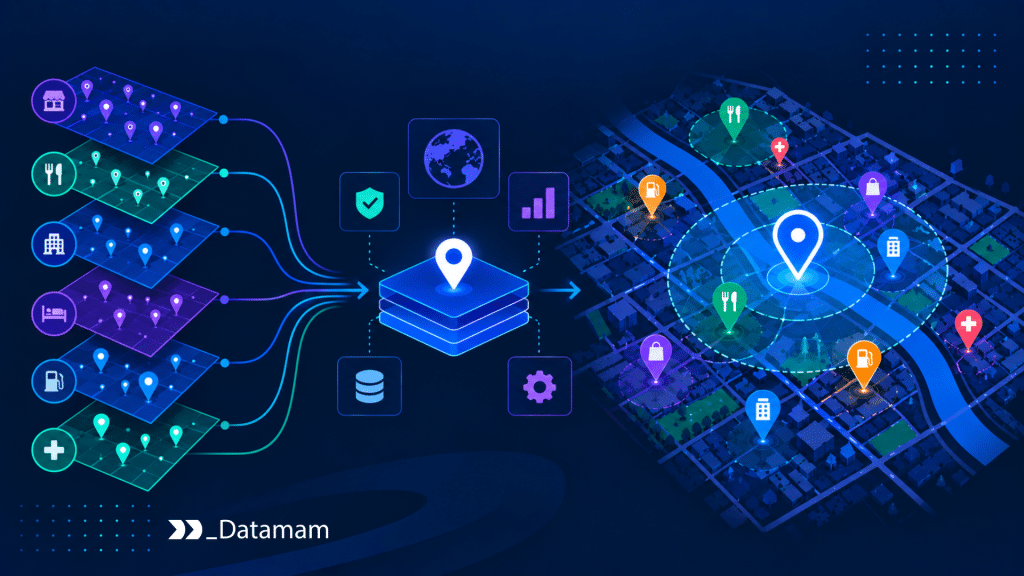
Choosing a POI Data Provider is an infrastructure decision. Enterprise teams are not just buying a list of places. They are choosing the location layer that will feed site selection models, mapping products, market analytics, territory planning, CRM enrichment, store network analysis, and competitive intelligence.
A provider may claim broad coverage or millions of records, but record count alone does not prove reliability. The real question is whether the data can support enterprise decisions without constant correction.
A strong evaluation should test coverage, freshness, address quality, coordinate precision, category logic, duplicate resolution, licensing, and integration readiness.
Start With the Enterprise Use Case
The right provider depends on what the data must do. A POI feed for market sizing has different requirements from one used for store locator enrichment, restaurant site selection, delivery planning, or B2B territory mapping.
Deloitte’s site selection guidance notes that online location data can make site selection appear easier than it is, while serious location decisions still require rigor, objectivity, and multidisciplinary analytics. That same principle applies to POI provider selection: easy access does not guarantee enterprise readiness.
Match Provider Strength to the Workload
A retail expansion team may need competitor locations, shopping centers, nearby anchors, store density, and trade area context. A restaurant brand may need cuisine categories, delivery zones, nightlife clusters, and open/closed status. A B2B sales team may need business locations, firmographic enrichment, and territory coverage.
A mapping product may prioritize API speed and global lookup. A data science team may need bulk delivery, historical snapshots, and stable IDs.
Therefore, the best POI Data Provider is not always the largest one. It is the one that fits the business workload.
Define Accuracy Requirements Before Evaluation
Accuracy requirements should be written before comparing vendors. Teams should define acceptable thresholds for address completeness, coordinate precision, open/closed status, category depth, duplicate tolerance, and refresh frequency.
Some use cases need rooftop-level coordinates. Others can tolerate street-level precision. Some need exact business categories. Others need broad commercial density.
Without these requirements, provider selection becomes subjective.
Evaluate Coverage and Freshness
Coverage and freshness are the first major tests. However, both must be evaluated at the market and category level.
A global provider may be strong in one country and weak in another. A provider may cover chains well but miss independent businesses.
Regional and Category Coverage
A global POI database should be evaluated country by country, city by city, and category by category. Urban coverage may be strong while rural coverage is thin. Restaurants may be well covered while professional services, clinics, warehouses, or local retail businesses are weaker.
A places data provider should be able to explain coverage depth, source mix, known gaps, and update logic by market.
For enterprise buyers, generic global coverage claims are not enough. The provider must prove coverage in the exact regions and categories that matter.
Freshness and Business Status
POI data decays quickly. Businesses close, relocate, rebrand, merge, franchise, change hours, change websites, and update categories.
A reliable location dataset provider should expose last seen date, last verified date, update cadence, source date, and business status. Active, closed, temporarily closed, relocated, duplicate, and unverified locations should not be treated the same.
Freshness matters because stale records distort market density, competitor mapping, territory planning, and site selection.
Assess Address Accuracy and Geocoding
A POI record is only useful if the business is placed correctly. A wrong coordinate can move a store into the wrong trade area, mall, neighborhood, sales territory, or delivery zone.
Deloitte’s geospatial analytics analysis describes geospatial use cases across site selection, supply chains, public services, and infrastructure risk. These workflows depend on reliable spatial data because location errors directly weaken the analysis layer.
Address Validation
Address validation should include parsing, standardization, normalization, and completeness checks. A useful POI record should separate street, city, region, postal code, country, building, unit, and formatted address where available.
International coverage makes this harder. Address formats, postal systems, scripts, abbreviations, and administrative boundaries differ by country.
A POI data provider should show how it handles local address formats, not just whether a record has a text address.
Coordinate Precision
Coordinates should include precision or confidence metadata. A rooftop coordinate is different from a street-level point, postal centroid, city centroid, or interpolated location.
For site selection, territory planning, and trade area analysis, precision matters. A location placed on the wrong side of a highway, boundary, or shopping center can change the decision.
Enterprise teams should reject datasets that provide coordinates without confidence context.
Review Duplicate Resolution and Place Matching
Duplicate records are one of the most common POI quality problems. They inflate business density and distort competitive analysis.
A good provider should explain how it detects duplicate and conflicting locations.
Duplicate Business Records
The same business may appear with different names, addresses, phone numbers, websites, categories, or coordinates. A chain location may be listed as a standalone store, a mall tenant, and a store-within-store record.
Weak deduplication creates inflated market counts. Over-aggressive deduplication can merge two real nearby branches into one.
A reliable places data provider should expose duplicate status, matching confidence, source evidence, and merge logic.
Persistent Place IDs
Enterprise systems need stable identifiers. If IDs change every refresh, teams cannot track openings, closures, relocations, historical trends, or territory changes.
A POI Data Provider should support persistent POI IDs, update history, change logs, and replacement logic.
A managed POI dataset should behave like a data product, not like a disconnected monthly file. Having an enterprisescale poi database reliability is crucial for maintaining data integrity over time. Organizations depend on this reliability to ensure that their strategic decisions are based on accurate and consistent information. Furthermore, a robust database will enhance collaboration across teams, allowing for a unified understanding of key metrics and trends.
Evaluate Taxonomy and Schema Design
Category structure determines whether POI data can support analysis. If businesses are misclassified, the dataset becomes unreliable even when coordinates are correct.
This is especially important for competitor mapping, site selection, and market saturation analysis.
Category Taxonomy
POI data companies use different category systems. One source may classify a business as “food,” another as “restaurant,” another as “coffee shop,” and another as “quick service.”
Enterprise users need consistent taxonomy. The provider should include raw source category, normalized category, parent category, category confidence, and local category handling.
This allows teams to audit category decisions instead of accepting black-box labels.
Schema Stability
A provider should offer stable field names, documented data types, allowed values, versioning, and deprecation rules.
If fields change without notice, downstream systems break. If category labels change without mapping, historical analysis becomes inconsistent.
Schema stability matters for BI, warehouse ingestion, mapping tools, APIs, CRM enrichment, and analytics pipelines.
Check Delivery and Integration Readiness
The delivery model should fit the workload. A provider that works well for API lookup may not be ideal for bulk analytics.
Some enterprises need both. The places API for enterprise workloads can enhance data accessibility across various departments. By streamlining information retrieval, organizations can improve decision-making processes. Furthermore, such integration allows for a seamless user experience, ensuring that employees can access the data they need efficiently.
API and Bulk Delivery
A Places API works well for lookup, enrichment, nearby search, validation, and application workflows. Bulk POI data works better for market mapping, site selection, territory planning, competitor density analysis, and data science workloads.
Useful formats include API, CSV, JSON, Parquet, SFTP, cloud storage, warehouse shares, or direct database delivery.
The provider should also document refresh cadence, pagination, rate limits, authentication, schema versioning, and error handling. Point of interest data analytics can provide invaluable insights for businesses by identifying trends and patterns in consumer behavior. By leveraging this data, organizations can enhance their customer experience and improve strategic decision-making. Furthermore, effective use of point of interest data analytics can lead to more targeted marketing campaigns and optimized resource allocation.
Analytics Readiness
A location dataset provider should deliver data that can move into Snowflake, BigQuery, Databricks, GIS platforms, BI tools, CRM systems, or internal analytics environments with minimal cleanup.
Analytics-ready data should include clean fields, confidence scores, timestamps, IDs, normalized categories, source metadata, and change indicators.
Without this, the hidden cost moves from the vendor invoice to the internal data team.
Validate Governance, Licensing, and Traceability
POI data is often used across departments, products, and markets. Licensing and governance must be clear before procurement.
The OECD’s data governance work emphasizes trust, quality, ownership, stewardship, and responsible data use. POI provider evaluation should follow the same logic because place data becomes part of enterprise decision infrastructure.
Licensing and Usage Rights
Enterprises should understand where the data can be used. Internal analytics, customer-facing apps, AI models, derived datasets, resale products, partner sharing, and international use may have different licensing implications.
A provider should clearly define usage rights, restrictions, attribution rules, redistribution limits, and renewal conditions.
Unclear licensing can create legal and operational risk later.
Source Traceability
Source traceability should include source type, capture date, last verified date, update method, confidence status, and lineage where available.
Gartner’s 2025 data and analytics trends highlight governance and AI-ready data as key priorities. For POI datasets, traceability supports the same requirement because location records must be explainable before they feed analytics, automation, or AI workflows.
Practical Evaluation Checklist
A structured evaluation should test provider claims against real enterprise requirements.
The best test is not a demo. It is a sample dataset in the markets and categories that matter.
Questions to Ask
Enterprises should ask:
- Which countries and categories are strongest?
- How often is the data refreshed?
- How are closed businesses detected?
- Are persistent place IDs supported?
- How are duplicates resolved?
- What coordinate precision levels are included?
- Are confidence scores available?
- Are raw and normalized categories both provided?
- What delivery models are supported?
- What usage rights apply?
These questions reveal whether the provider can support production workflows.
Test With Real Markets
A sample test should include known store networks, competitor locations, malls, rural areas, dense urban districts, international addresses, chain branches, independent businesses, and ambiguous locations.
Review coverage, duplicates, categories, coordinates, business status, schema usability, and refresh metadata.
A provider that looks strong in a generic demo may fail in the specific markets the enterprise needs.
Conclusion
Choosing a POI Data Provider requires more than comparing record counts. Enterprises should evaluate POI data companies by coverage depth, freshness, address validation, geocoding confidence, duplicate resolution, taxonomy consistency, stable identifiers, delivery readiness, licensing clarity, and governance evidence.
A places data provider must fit the actual workload. Site selection, trade area analysis, location intelligence, application lookup, territory planning, enrichment, and market mapping all require different levels of precision and refresh.
The capability matters because location decisions depend on the quality of the place layer. With the right location dataset provider, enterprises can reduce manual cleanup, improve geospatial analysis, and build more reliable location intelligence infrastructure.
A structured review can help evaluate whether current workflows have the right POI Data Provider, POI data companies, place data provider, and location dataset provider controls. You can run a location data infrastructure audit with our team to review your current place-data workflows and understand what is required to build reliable enterprise POI infrastructure.