
Key Takeaways
- Specify the data outcome, not a scraping tactic. A useful RFP defines the business observations, eligible population, acceptance rules, and delivery destination before asking vendors to choose methods.
- Provide a source inventory with difficulty signals. Domains alone are insufficient; list page families, markets, variants, discovery rules, and representative examples.
- Make every bid cover the same output contract. Include stable keys, typed fields, business context, null rules, timestamps, corrections, and historical continuity.
- Measure business completion. Require separate treatment for accepted observations, valid empty results, late results, and unresolved work. HTTP request success is not the delivery acceptance unit.
- Separate operational obligations from optional improvements. Standardize maintenance, reporting, integrations, change control, and pricing assumptions so procurement can compare actual responsibilities.
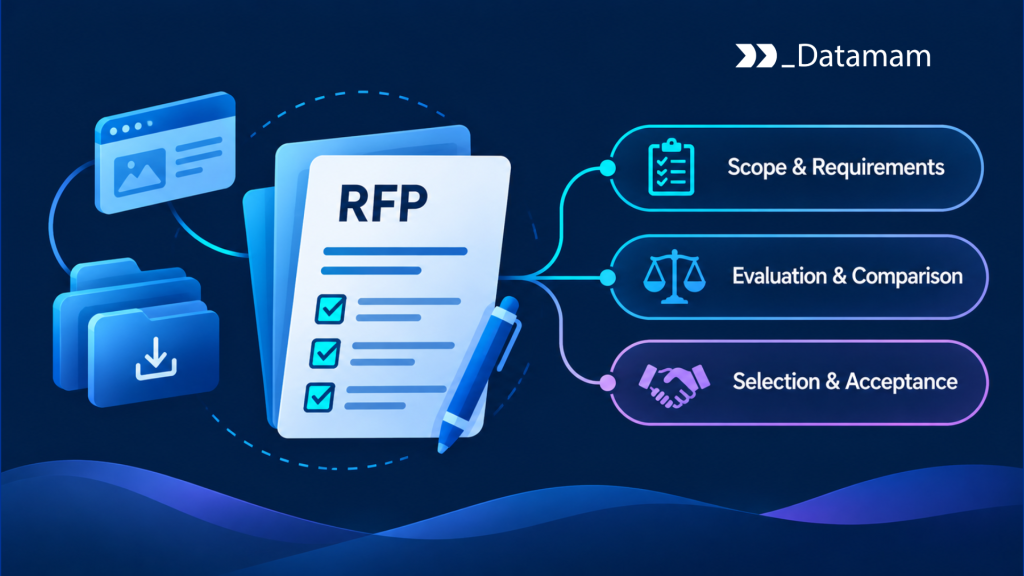
A web scraping RFP, or request for proposal, should make it possible for several suppliers to quote the same recurring data obligation. Without that shared scope, one vendor may price raw HTML retrieval, another may price a normalized API, and a third may promise a fully managed data feed. All three estimates can be internally reasonable while being impossible to compare.
For enterprise buyers, the solution is to translate the business requirement into a source inventory, data contract, operating schedule, validation method, and common response form. The RFP should leave appropriate technical implementation choices to vendors while defining what an acceptable delivery looks like. This article provides the requirements and examples needed to do that, including the cases that usually become disputes after a contract is signed.
Set the Procurement Objective Before Writing Requirements
The decision the feed supports and who will consume it
Begin with an operational use case, not a request for ‘web scraping of these websites.’ State which team relies on the data, what decision it makes, and what happens if a field is incorrect or late. A pricing group might compare offers for an existing product catalog. A market-research platform might update company records weekly. A logistics team might monitor available capacity or regional service coverage.
Identify the receiving consumer: a warehouse, pricing application, CRM enrichment process, research platform, or analyst workflow. The business decision determines the record grain. A retailer product, a seller offer, and an observed price are related but different data objects. When vendors are not given this distinction, they may quote a low cost per page while omitting the reconciliation work needed to create the customer’s useful record.
The RFP should state who approves business definitions. Vendors may recommend matching or validation rules, but a buyer should own rules that affect commercial comparisons, eligibility, and downstream interpretation. Specify the decision owner, engineering owner, procurement contact, and security or legal reviewer so clarification requests reach the correct party.
What is in and out of initial scope
List the initial countries, sources, record types, histories, collection dates, and delivery interfaces. Also state exclusions: authenticated environments not approved for access, checkout-only prices, customer-generated private information, unsupported languages, historical reconstruction, or new sources not yet assessed. Explicit exclusions prevent suppliers from silently assuming the easiest boundary.
Use a baseline and separately priced options. For example, an RFP might include weekly full catalog discovery and daily price refresh for an approved priority population, while requesting optional pricing for an additional country or faster tier. Keep options outside the baseline evaluation so vendors do not win by pricing a narrower engagement.
Set an initial operating horizon and phased implementation requirements. An RFP for a live feed might require setup, a verified acceptance run, recurring operation, and defined termination support. A backfill is a different workload; state whether it is included and how it reconciles with subsequent recurring observations.
Which vendor operating model the request assumes
A request for managed data delivery is not the same as a request for proxy access, scraping API credits, crawler software, or staff augmentation. State whether the desired outcome includes collector operation, normalization, matching, quality assurance, source-change repair, monitoring, historical retention, and publication into the customer’s destination.
When supplier categories are allowed to vary, require a responsibility matrix and a separate price for the customer-owned work. The same output must remain comparable even when the technical approach differs. A provider may offer a managed file feed while another proposes customer-orchestrated API calls. Procurement should not evaluate those as equivalent without pricing the missing responsibilities.
The outcome-first approach is consistent with a principle used in US public procurement. The Federal Acquisition Regulation section 37.602 emphasizes specifying required results and measurable standards rather than prescribing hours or methods. That regulation governs relevant federal acquisitions; it is cited here as a design principle, not a legal requirement for private-sector RFPs or contracts outside its scope.
Attach a Source and Population Inventory
Approved websites, regions, and access context
A list of homepages is not enough to price extraction. Include source names or domains, eligible page families, required regions and languages, and whether observations depend on location, session, date, or other contextual settings.
A structured approach to web scraping source discovery helps businesses identify suitable data sources, assess access requirements, verify geographic and technical coverage, and document potential limitations before finalizing project requirements. For each source, note whether access requires customer-approved authentication or an explicit permissions review. If the RFP does not yet establish permission for a source, mark it for feasibility and legal review rather than assuming collection is authorized.
Specify whether vendors may use existing public APIs, HTML collection, rendered browser workflows, or other methods consistent with the access requirements. Avoid prescribing a browser or anti-bot technique without a business reason. The objective is eligible, accurate records within agreed source and usage constraints.
A useful source-inventory attachment might contain the following illustrative fields:
| Inventory column | What the buyer supplies | Why bidders need it |
| Source and page family | Domain plus listing, search, or detail page type | Distinguishes technical workflows |
| Market context | Country, language, destination or session inputs | Defines which observed values are relevant |
| Population basis | Known IDs, discovery rules, or customer catalog | Separates fixed refresh from ongoing discovery |
| Required result | Business record and mandatory fields | Establishes extraction scope |
| Access status | Approved, needs review, or excluded | Prevents unsupported feasibility promises |
| Difficulty samples | Typical and unusual representative URLs | Exposes variants and ambiguity |
Eligible records and the difference between discovery and refresh
Define the eligible population using testable rules. Is the job to observe a supplied list of 200,000 product identifiers, discover every listed item in a category, or maintain a changing mapping between customer records and source offers? Those objectives require different collection plans and acceptance measures.
Discovery finds candidate records or changes to the population. Refresh revisits known eligible records under a defined schedule. A proposal that repeatedly crawls category pages may be appropriate for discovery but expensive or insufficiently precise for timely updates to a known catalog.
During web scraping source discovery, vendors should explain how they identify relevant websites, evaluate source eligibility, determine page coverage, and distinguish initial source discovery from ongoing monitoring of previously identified records. This helps buyers assess whether the proposed collection approach is appropriate for both initial coverage and long-term data maintenance. Conversely, a refresh-only solution can maintain known items while missing new listings.
Datamam’s documented retail pricing program illustrates the distinction. The approved source-mapping layer covered 1.2 million client SKUs and 4.8 million active retailer relationships across 12 integrations; not every theoretical SKU-retailer combination represented a valid match. The engagement used differentiated refresh tiers and separate discovery logic. An RFP for comparable work should specify both discovery coverage and the accepted relationships to refresh rather than ask vendors to price ‘all products on 12 websites.’
Representative URLs and unusual page or offer variants
Include a compact but representative sample of page families and edge conditions, with relevant context such as market, date, pack size, seller, availability, or hotel occupancy. Select samples to expose the source’s range of business representations, not simply convenient URLs. A single sample cannot establish feasibility for an entire site.
Useful cases include pagination near its end, a listing with several sellers, an out-of-stock variant, a redirected page, a product with a reused URL, a page missing a normally required field, and a valid search with no matching results. Explain which examples are critical and which are optional. The supplier should declare any source class it has not assessed and how that uncertainty affects the quote.
Do not publish customer-sensitive account tokens or proprietary URLs in a broadly distributed RFP. Share access-limited samples through a controlled diligence process and identify who will manage permissions.
Specify the Data Contract Vendors Must Price
Record grain and stable identifiers
Define exactly what one record represents and the keys required for each relationship. If the output is a daily offer observation, it needs identity for the customer product, source listing, seller or offer condition, and observation window. If the output is a business directory, distinguish the canonical business from its individual locations and source references.
Ask vendors to preserve source identifiers separately from customer canonical identifiers. URLs can redirect or be reused; titles are not durable keys. Include explicit states for exact matches, approved equivalents, candidate matches, and unresolved identities where these affect business decisions.
Specify whether output is current state, append-only history, or both. A current view needs deterministic revision selection; history needs actual observation timestamps and source or mapping versions. Without those definitions, two vendors can deliver the same row count with incompatible analytical meaning.
Required fields, types, units, provenance, and null rules
Attach a field dictionary with name, type, definition, unit, source or transformation origin, conditional applicability, and acceptance rule. Explain whether price means displayed price, unit price, total price including fees, or an enriched calculation. For dates, specify time zone and whether a field refers to source capture, source publication, or consumer delivery.
Use machine-readable null and status conventions. null should not silently mean zero, unavailable, missing from a page, failed retrieval, or an unresolved match all at once. Define which fields are mandatory for every accepted record, which are conditional, and which may be reported as unavailable with a reason code.
The W3C provenance framework offers a general way to describe relationships between data and the activities that produced it. An RFP need not mandate a particular ontology, but it should require traceability from a normalized value to its source observation and applied transformation or mapping rule.
History, corrections, schema evolution, and status outcomes
Require a correction model before launch. If a parser once interpreted a pack price incorrectly, the service should be able to supersede the bad value without falsely declaring a market price change. Define how the receiving system identifies a corrected record, what historical versions remain available, and how a previously loaded release is replayed.
State which schema changes require customer approval and whether fields may be added without breaking existing consumers. Include compatibility testing for data type changes and changes in the meaning of a field. A source changing from tax-exclusive to tax-inclusive display is a semantic change even if the column name remains price.
Status outcomes should be explicit: accepted observation, verified completed-empty result, late recovery, rejected business record, and unresolved collection. The RFP must prevent an unresolved search from becoming a false ‘out of stock’ or ‘no result’ observation.
Define Cadence, Coverage, and Service Windows
Priority populations and refresh tiers
State refresh requirements per business population. A stable long-tail catalog may need weekly checks; high-priority offers may need daily or intra-day updates. Avoid requiring the fastest cadence across all sources unless the business value justifies that workload. Define whether discovery follows the same schedule and how new or removed items enter the active population.
Give vendors a consistent workload formula. For each tier, scheduled observations = eligible active items multiplied by scheduled checks per item during the evaluation period, adjusted only for documented activation and removal rules. The denominator must be based on eligible business items, not on whatever requests a vendor chooses to make.
As an evidence-based reference, Datamam’s industrial-catalog takeover covered 56 source websites and 6.8 million source items, with a 340,000-item daily priority set and a broader four-week discovery and descriptive sweep. A comparable RFP should distinguish those obligations; treating all 6.8 million items as daily refresh targets would describe a materially different workload.
Valid empty results, late work, and unresolved exceptions
Define terminal outcomes and their acceptance conditions. A fully executed search returning no qualifying offers can be complete and valid. An access denial, timeout, partial pagination, or parser failure is unresolved. A result accepted after the scheduled deadline is late even if it eventually contributes to history.
An appropriate RFP asks each bidder to propose how it will report scheduled work, accepted results, completed-empty results, late results, and unresolved work at the source and tier level. Clarify whether legally unavailable or customer-disabled sources remain in the denominator, are suspended under a documented change, or receive a separate reporting class.
A helpful performance indicator is on-time accepted business obligations divided by eligible scheduled obligations. The RFP should define numerator, denominator, time zone, permitted exclusions, and independent acceptance checks. Google’s SRE discussion of service-level objectives reinforces this user-outcome approach, though the specific threshold is a negotiation based on business need, not a universal number.
Source and destination boundaries for measuring delivery
A supplier can finish capture and validation but still miss the customer’s deadline if files are delayed or fail to load. State where the measurement ends: accepted objects in customer storage, available API records, successful load into a designated table, or verified consumer-view availability. This boundary changes the work each vendor must price.
Require timestamps for scheduled due time, source capture, validation acceptance, release publication, and customer ingestion where applicable. These timestamps should remain independently visible. A provider should not be able to present a republished older observation as newly captured data.
Ask suppliers to mark dependencies that they cannot control, such as customer warehouse permissions or ingestion schedules. Contract responsibility should match the acceptance endpoint and the remediation path, rather than leave an unowned gap between file arrival and usable data.
Ask for Validation and Evidence Requirements
Completeness reconciliation and sampling methodology
Completeness should reconcile the eligible workload to accepted output and reason-coded exceptions. Counts alone cannot prove accuracy; they can show whether the expected population disappeared, duplicated, or changed unexpectedly. Specify required source-level counts, coverage bands for critical sources, and how the supplier treats newly discovered, invalidated, and out-of-scope records.
Define review sampling independently of the supplier’s best examples. A sampling plan can include random draws from routine records plus deliberate strata for critical sources, high-value offers, complicated variants, completed-empty states, and recently changed parsers. Specify the reference evidence reviewers use and the process for adjudicating disputed records.
The ISO/IEC 25012 data-quality model describes quality characteristics for structured data. The value in an RFP comes from converting such principles into operational tests for this particular dataset, not stating that a supplier ‘follows a quality standard’ without specifying what is measured.
Semantic comparisons and exception reporting
Require domain-level checks beyond schema validity: seller attribution, comparable product size, currency and geographic context, valid occupancy or room policy, effective dates, and plausible state transitions. A syntactically valid value can be economically wrong if it describes a different transaction condition.
Distinguish source absence from technical inability to verify. For example, a source failing to load cannot be counted as a confirmed out-of-stock condition. Where a source produces conflicting offers, require either the approved decision rule or an explicit ambiguity state.
Ask for exception reports grouped by reason and severity. These should identify the affected business unit, source, observation window, last accepted data age, and whether a correction is possible. A summary percentage is insufficient if an essential geography or source is missing.
What source evidence must survive a correction or dispute
Define a reasonable retention policy for source captures, content digests, input context, parser versions, mapping versions, and release manifests. Retention should be proportionate to operational need and contractual, security, copyright, and privacy constraints. Do not assume that retaining complete source pages indefinitely is always permitted or desirable.
Datamam’s documented 25,000-URL HTML archive accepted 24,250 target pages and retained 750 explicit exceptions with acquisition states and content identity. Its engineers could re-run parsing against archived evidence without recollecting every page. That project was an archive deliverable, not a generic scraping SLA; the transferable RFP principle is to make the evidence required for correction and replay explicit.
Specify who can access evidence, what is redacted, how a disputed record is traced, and how the corrected release is identified. This can save extensive downstream investigation when a source changes after the original observation.
Define Delivery, Integration, and Recovery Expectations
Files, object storage, API, or warehouse destination
Specify the supported output and transport: CSV, JSON Lines, Parquet, object storage, an API, or a direct warehouse integration. Each has different batching, schema, credential, consistency, and cost implications. If the buyer has a fixed consumer, include a sample accepted file and machine-readable schema rather than ask bidders to suggest a generic ‘dashboard.’
Document encoding, compression, date and decimal handling, file naming, partitioning, destination permissions, and limits on file or payload size. Define whether the supplier owns delivery to the destination or successful ingestion within it. Do not impose an unnecessary cloud technology where functional acceptance criteria are enough.
For example, Google Cloud’s BigQuery documentation details supported batch formats and write behaviors. Such official specifications matter when the RFP calls for direct compatibility with a named destination; otherwise, the provider may supply technically valid files that the intended loader cannot process as specified.
Manifest, versioning, replay, and deduplication
For batch output, request a manifest describing release identity, schema version, source windows, accepted partition files, record counts, checksums, and source completeness. A consumer should know whether it has received a full release, a partial source update, or a correction, without inferring state from filenames.
Require replay semantics. An ingestion retry must not double the accepted business observation. A corrected record must either supersede its prior revision or be explicitly linked as a new version. Specify the keys, ordering, and retention necessary for recovery, and ask the vendor to explain how a late source partition enters an existing analytical window.
In Datamam’s 200-website weekly service, source-level releases had independently identified completeness and could be replayed selectively; one redesigned site did not block the other 199. The lesson for a procurement document is not that all feeds should publish partially, but that the buyer should state what partial publication means and how missing sources are later reconciled.
Consumer test against a real loading workflow
Make end-to-end ingestion acceptance a procurement condition. A test file should include accepted rows, permitted nulls, nested or repeated fields where relevant, a completed-empty result, a correction, and a replay. Require the test to use the customer’s actual reader, schema, permission model, and transformation path.
A Datamam physician-data project delivered 26 alphabet-partitioned files, then adapted the export to the receiving system’s JSON-array contract and subsequently to its handling of three nested fields. The underlying collected relationships were preserved, but the receiving application’s compatibility needs changed the projection. This experience demonstrates why ‘JSON delivered’ is not the same as ‘customer system can load it.’
Write the acceptance endpoint clearly: successful parse, successful warehouse load, correct reconciliation of the expected counts, and safe replay where required. Identify who fixes each class of failure and which fixes are already included in the price.
Address Source Changes, Legal Review, and Risk Allocation
Template changes and incident ownership
The RFP should specify how providers detect source redesigns, field-semantic changes, access interruptions, and consumer ingestion failures. Require incident classes, notification routes, expected updates, source-level reporting, and correction responsibilities. A change in layout should not silently become an extra charge for maintaining already-contracted output.
At the same time, the agreement should distinguish corrective maintenance from new scope. Fixing an existing field after a routine page redesign is generally an operating responsibility to negotiate; adding a new source, country, or data category is a commercial change unless already included. The boundary should be explicit rather than decided after the incident.
For a critical population, require a plan for withholding invalid output, labeling stale records, or publishing partial accepted data. The right choice depends on what failure causes the least business harm. Ask bidders to explain the tradeoff and how the consumer learns the current completeness state.
Permitted access, privacy, and licensing decisions by source
An enterprise RFP should separate technical feasibility from permitted use. Buyers and vendors need a source-by-source review of access conditions, terms, contractual rights, privacy and personal-data rules, intellectual property, applicable jurisdiction, and downstream intended use. A vendor should disclose when authorization, licensing, or legal review is necessary instead of treating a public URL as blanket permission.
The IETF’s RFC 9309 Robots Exclusion Protocol documents how web servers communicate crawler access preferences through robots.txt. It is a technical protocol, not a complete determination of contractual, privacy, or copyright rights. The RFP should require vendors to respect applicable constraints and identify how policy changes affect eligibility without implying that a single technical rule resolves legality.
Ask about data minimization, storage geography, credential handling, third-party subprocessors, retention, incident access, and deletion. The current NIST cyber supply-chain risk-management guidance is a general resource for supplier-risk assessment; it does not by itself certify a scraping vendor or replace the buyer’s legal review.
Scope variation, escalation, and exit or migration support
Require bidders to explain how a source is added, removed, reprioritized, suspended, or migrated. Identify decisions that require written approval, escalation during unresolved source failures, and what information the buyer receives if collection cannot lawfully or technically continue.
Exit terms matter for recurring external data. Define ownership and exportability of customer-supplied identifiers, accepted output, history, schema descriptions, release manifests, exception history, and agreed transformation mappings. Clarify retention and deletion of source captures, permissions, transition assistance, and permitted reuse of provider-owned generic software.
Datamam’s documented industrial-catalog engagement replaced internally maintained scrapers across 56 sources while preserving the receiving application’s schema. The team used source-by-source parity checks and staged cutover so the buyer could compare identity, coverage, price interpretation, and exceptions before migrating. Those are examples of measurable exit or handover requirements; they are not automatic guarantees for every engagement.
Force Apples-to-Apples Commercial Responses
Separate setup, recurring operations, transfer, and transition
Require identical price categories from each bidder. Setup may include feasibility assessment, source onboarding, adapter development, mapping, schema agreement, and initial backfill. Recurring operations may cover collection, rendering, proxy or access costs where permitted, validation, monitoring, repair, storage, and delivery. Additional destination integrations and transition support should be priced explicitly.
Suppliers may choose fixed monthly fees, per-observation models, usage bands, or hybrids. The RFP need not dictate one model, but it should require a normalized estimate for the stated workload and disclose whether failed attempts, completed-empty searches, corrected releases, and retries consume billable units.
Do not assume a requested volume equals network calls. One business observation can require multiple requests, while one response can contain multiple accepted records. Bidders should map their billing unit to the business output they are promising and state the conditions under which costs change.
Declare billing units and separately priced exclusions
Ask each vendor to fill out a common response table, even if the submitted commercial proposal also contains its preferred pricing model:
| Pricing line | Required vendor response | Comparison issue it resolves |
| Initial onboarding | Fixed fee or documented calculation method | Avoids hiding setup cost in month one |
| Baseline recurring scope | Price for the same source, population and cadence | Establishes the common obligation |
| Usage overage | Billing unit, threshold, and rate | Shows exposure to volume growth |
| New source/market/field | Change-order rule and pricing basis | Defines expansion economics |
| Enhanced retention or destination | Included/excluded and separate cost | Exposes integration and storage differences |
| Incident repair and correction | In-scope vs separately chargeable cases | Avoids surprise maintenance charges |
| Transition or exit | Included services and rates | Makes the lifetime commitment comparable |
The purpose is not to require a universal amount. No published pricing figure can fairly stand in for an unassessed workload. Instead, ask vendors to estimate the approved population and identify the assumptions that could make that estimate change.
Require explicit assumptions, dependencies, and change rates
Each price should be tied to an assumptions register: source availability, geographic or language settings, eligible item counts, expected growth, historical backfill, delivery destination, retention window, required match quality, refresh tiers, and customer-owned access credentials. Require vendors to identify unassessed sources and commercial contingencies separately from the baseline.
Build a change mechanism around units of scope, not vague requests for a new quote ‘if complexity increases.’ For example, a new country may be priced as a source-market extension when page behavior is materially different; a new optional field may be inexpensive on an existing page but a major requirement if it demands an additional workflow. The mechanism should explain what evidence supports the classification.
This makes proposals more comparable without pretending every vendor has identical engineering costs. It also allows the buyer to calculate the effect of growth in accepted source mappings or refresh intensity rather than relying on a misleading single price-per-page number.
Create a Bid-Evaluation Sheet and Pilot Gate
Mandatory pass/fail answers before weighted scoring
Evaluate essential eligibility first: source authorization and access assumptions, required record meaning, minimum mandatory fields, acceptable delivery interface, handling of unresolved outcomes, security obligations, and ability to meet critical windows. Failing one truly mandatory requirement should not be offset by a low price or attractive reporting interface.
After that gate, compare technically acceptable proposals on the criteria that matter to this workload: demonstrated quality controls, operating reliability, maintenance ownership, integration effort, change flexibility, operational transparency, and commercial terms. Avoid inventing a universal weighting formula. The choice should reflect the enterprise’s business impact.
US federal competitive-procurement rules require evaluation factors that allow meaningful comparison among proposals, as described in FAR 15.304. Private organizations need not follow that provision, but its principle supports stating evaluation factors in advance instead of changing the standard to favor a particular supplier after bids arrive.
Evidence requests tied to each technical promise
Ask vendors to complete an evidence register alongside their proposal. Each required answer should identify a supporting artifact or a gap. This is more useful than collecting a long questionnaire of unverified yes/no statements.
| RFP claim to verify | Vendor artifact or response |
| Source coverage | Assessed source inventory with exclusions and feasibility assumptions |
| Accepted data quality | Representative reviewed records and sampling plan |
| On-time delivery | Defined SLI, scheduled-job denominator, and sample report |
| Maintenance | Source-change incident example and scope responsibilities |
| Corrected output | Example correction record, release identity, and replay method |
| Consumer compatibility | Sample file/schema and proposed real loading test |
| Security and legal governance | Source-specific review process and relevant handling controls |
Accept redacted historical evidence where confidentiality requires it, or require a controlled demonstration. Record unsupported claims as not verified, not as silently accepted. Avoid giving additional credit merely for an unverifiable large customer count or unqualified success percentage.
Representative pilot and acceptance criteria after selection
Use a pilot only for the risks that remain uncertain after the proposal review. The RFP can reserve a bounded technical validation phase with defined cost, duration, source subset, acceptance rules, and outputs. Include a representative difficult case, not only the easiest page, and require a safe customer ingestion test if integration is material.
Specify how the pilot outcome affects contracting: pass, remediation with agreed conditions, reduced source scope, or rejection. The pilot should deliver an assessment record explaining unverified sources and observed exceptions. It is not a substitute for the production contract, which still needs refresh windows, ongoing repair, and measurement of accepted outputs.
By defining the sample, evidence, and decision gate before suppliers begin, the buyer reduces the chance that an impressive extraction demo becomes the de facto acceptance standard for a much larger recurring service.
If you are specifying recurring external-data collection, share your source inventory and delivery requirements with Datamam to discuss an appropriate managed operating scope.
Frequently Asked Questions
What should an enterprise web scraping RFP contain?
Include the business purpose, source and regional inventory, eligible population, record grain, field dictionary, source and customer identifiers, refresh tiers, acceptance outcomes, validation plan, destination schema, replay and history rules, incident ownership, legal and security review, pricing response template, and bid-evaluation criteria.
These details should be consolidated into a web scraping requirements document so that potential vendors can evaluate the same technical scope, define their responsibilities, and submit comparable proposals based on consistent operational and commercial expectations. Explicit exclusions are as important as the requirements.
How many sample URLs should accompany an RFP?
There is no universally sufficient number. Provide enough examples to cover materially different page families, markets, business variants, and failure-prone states. A well-stratified set of samples is more useful than many near-identical URLs. Mark unassessed sources separately and allow feasibility questions through a controlled process.
How can buyers make vendor bids comparable?
Use the same baseline source inventory, population and cadence, data contract, acceptance endpoint, and responsibility matrix for all bidders. Require a common pricing table, explicit assumptions, and separately priced options. Compare total delivery ownership rather than raw requests or advertised page counts.
Should data validation be a separate RFP requirement?
Yes. Extraction success does not establish business accuracy. Specify completeness reconciliation, required-field checks, semantic comparisons, identity and matching rules, review sampling, exception reporting, and correction handling. State which quality obligations are included in the operating fee.
How should source redesigns be treated in the contract?
Distinguish corrective maintenance needed to keep the already-agreed output working from additions to scope, such as new markets or fields. Specify incident notification, evidence retention, quality regression, deadlines, and a change-order mechanism. A source becoming inaccessible or impermissible may require a separate review rather than a blanket performance promise.
What should happen after vendors submit their proposals?
Screen mandatory requirements, compare evidence and assumptions, normalize scope and commercial terms, and ask targeted clarification questions. Move only unresolved material risks into a bounded proof of concept. Document the decision and carry the approved record and acceptance definitions into the final agreement.