
Key Takeaways
- Define the eligible record and publishing authority before collecting URLs.
- Use official indexes, navigation, feeds and approved search routes as discovery signals, then reconcile them against source evidence.
- Store source identity, scope, discovery context, current status and reason for inclusion in a maintained registry.
- Report discovered candidates, accepted targets, duplicates, missing areas and unresolved records separately.
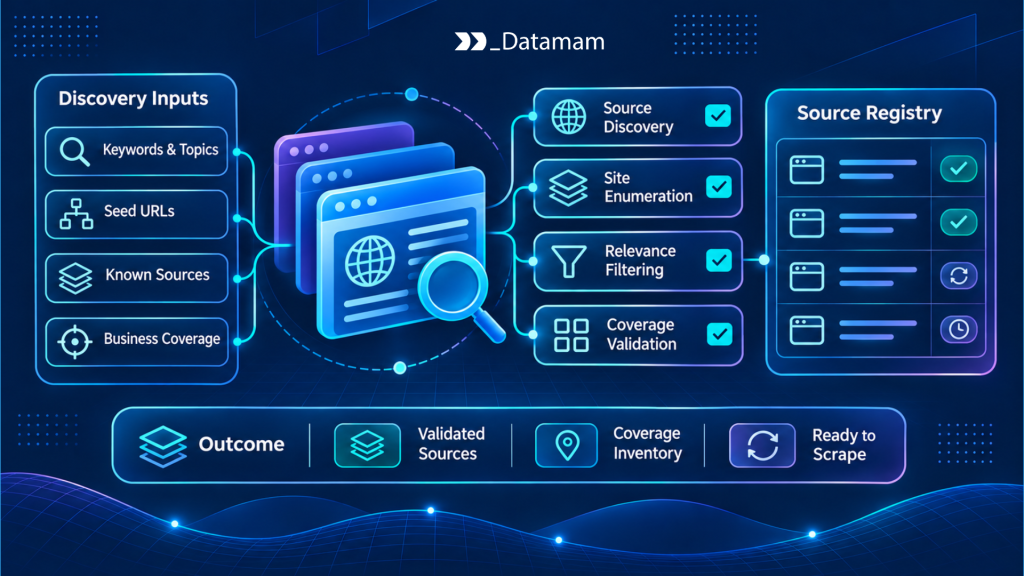
A scraper can return every requested page successfully and still miss most of the market if the initial URL list was incomplete. Web scraping source discovery is the work of identifying the eligible sources and records before measuring collection success. It establishes the denominator: what the system was supposed to find, inspect and keep current.
Discovery is a maintained research and engineering process, not a one-time exercise in copying links from search results. Sources rename records, add categories, move documents, introduce new page families and retire old content. Without an effective-dated inventory, a coverage dashboard can look healthy while the intended population quietly changes.
What Counts as an Eligible Source?
Start with the buyer’s decision. For a public-agency research feed, an official transport authority may be in scope while a commentary site quoting that authority is not. For a software catalog, the unit might be a product rather than a vendor, and a suite’s modules may require separate identities. Also, for retail, one SKU can have many retailer offers but not all are acceptable equivalents.
Write the eligibility rule in terms a reviewer can apply. It may include domain authority, publication type, market, business category, available fields, update period and exclusions. This is narrower than general crawling, which discovers accessible links without necessarily proving they represent the desired business population.
The web scraping data quality guide explains why completeness requires an expected population rather than a count of returned rows. Discovery is how that expected population gets established and revisited.
A Source Registry Is a Business Asset, Not a Bookmark Folder
Source discovery begins with a scope that can be reconciled. A regulator may be represented by an agency homepage, a searchable docket system, a document archive, and an official notice feed. Those are different source surfaces with different update behavior. A directory may also republish the same underlying agency content. Counting all pages as independent publishers inflates coverage and obscures which source is authoritative.
A practical registry tracks a source identifier, publisher, jurisdiction, domain and page families, relationship to the requested topic, permitted interface, discovery route, expected refresh cadence, status, confidence, and owner. For each candidate, record why it belongs in the approved population. Separate source identity from individual URL: a new URL alias does not automatically create a new publishing organization.
Candidate routes include official directories and registries, linked department pages, permitted site search, sitemaps, structured feeds, document indexes, and manual expert review. The Sitemaps protocol provides one discovery hint, but its presence alone does not prove full business coverage. Some records are behind search forms, while other sitemaps include pages irrelevant to the approved population.
Follow Multiple Discovery Routes Without Double Counting
Relevant sources can appear through sitemaps, public directories, official APIs, category browsing, internal search, linked PDF indexes or a customer’s own seed list. Each route has limitations: sitemaps can omit unlinked pages, search indexes may rank only a subset, and source-provided API results may be subject to geography or authorization.
Record which discovery route produced each candidate and when. Resolve canonical identifiers where available, preserve aliases for redirects, and attach the route’s geographic or search context as evidence. Do not interpret a redirected URL as a new record when the destination identity matches an already accepted source item.
| Registry field | Why retain it |
| Canonical source and operator | Establishes where the information originates |
| Source record ID and aliases | Preserves identity through URL moves |
| Record class and market | Determines inclusion and acceptance checks |
| Discovery route and first-seen date | Explains how coverage was established |
| Last verified and status | Distinguishes active, missing and unresolved items |
| Access or permission context | Prevents operational assumptions outside approved scope |
From city list to accepted source estate
Datamam’s public-agency project began with a jurisdiction and topic brief, rather than an existing list of web pages. Agency domains, departments, document libraries, and related public authorities needed to be researched as separate surfaces. Shared regional publishers serving several cities were recorded as one source relationship with several jurisdictions, not duplicated as independent government agencies.
The crucial separation was between discovery and recurring monitoring. Initial research established candidate sources and accepted publication surfaces. Later collections tracked those accepted sources, while newly identified old documents kept their original publication dates and a separate first-observed date. The distinction prevents the monitoring feed from reporting the discovery of an archive as if a new public decision had just been issued.
The inventory illustrates why fully managed web scraping can involve more than operating crawlers. Maintaining an approved, versioned source population can itself be a major part of the service, but the required research depth must be defined in the delivery contract.
First-Party Example: A Public Agency Register From Zero
A Datamam public-agency research client started with 200 cities and a subject brief, not a ready-made source list. The discovery work identified official city websites, departments, document libraries and shared regional authorities. The resulting operating register contained 1,460 accepted agency sources across those cities.
The monthly full pass collected 219,000 relevant pages and documents. A 320-source priority subset received weekly checks. One regional authority serving multiple cities appeared once as a publisher with several jurisdiction relationships, rather than being duplicated into separate fictional agencies. Each topic result retained the responsible publisher, supporting passage and publication context.
This illustrates two discovery principles: source identity differs from the number of markets it serves, and an old document first discovered today is not necessarily a new policy published today. Keep first-observed and publisher-provided publication dates separate so discovery does not manufacture events.
Coverage Has at Least Three Different Denominators
Publisher coverage asks how many eligible publishing organizations are represented. Surface coverage asks whether their required portals, repositories, and document types are included. Record coverage asks whether every eligible record within an accepted source was enumerated for the specified period. A team can have complete domain coverage and still miss filings hidden behind a second search interface.
Use a reconciliation table that separates planned, discovered, accepted, inaccessible, out-of-scope, and unresolved sources. At the record level, count scheduled partitions and completed searches separately from resulting items. One empty document library can be a valid result if it was checked completely. A failed pagination request must remain unresolved instead of counting as a complete empty collection.
Datamam’s software-catalog engagement shows another version of the denominator problem. The customer wanted to identify missing software products across different directories. A category’s displayed item count was not necessarily a deduplicated product population. Records needed vendor and product identities, alias handling, and reconciliation of omissions across directory sources. Discovery coverage cannot be equated with raw URL count when the same product appears under several names.
A credible large scale web scraping plan starts with this accepted work inventory. When comparing managed scraping vendors, ask who maintains that inventory and how additions are approved; infrastructure capacity does not solve a missing-source definition.
Retirement, redirects, and the risk of silent scope shrinkage
Source entries should move through explicit states such as candidate, accepted, paused, retired, and replaced. Keep alias and replacement relationships instead of deleting records. If a publication portal moves to a new domain, reconcile identities before the replacement becomes authoritative. When a regulator stops publishing a required record type, document the reason and effective date. This protects historical comparisons and makes missing coverage visible to the consumer.
Reconcile Coverage at the Business Grain
A useful report states how many candidates were found, how many met eligibility rules, which were duplicates, which remain inaccessible or ambiguous, and how many expected segments are still unreviewed. Count at the correct level. A catalog of 118,000 source profiles does not prove 118,000 unique software products; a retailer sitemap can include many variants or obsolete listings.
Datamam’s software-directory project underscores the problem. It collected 92,000 profiles from one directory and 118,000 from another, but accepted matching established 71,000 corresponding profile pairs. The resulting source-exclusive sets were 21,000 and 47,000 profiles respectively, with uncertain matches held for review. The difference was calculated after product-level identity resolution, not by subtracting page totals.
The discovery registry should therefore expose candidate-versus-accepted relationships and collection status. If a category unexpectedly loses half its entries, investigate source navigation, pagination and eligibility changes before claiming a genuine market contraction. A scraper monitoring framework can surface those population changes alongside ordinary job errors.
Different refresh tiers for sources and documents
Discovery cadence and content-refresh cadence should not be coupled by default. In the public agency engagement, a monthly full pass collected about 219,000 relevant pages and documents. A subset of 320 priority sources was checked weekly. Those are distinct populations and schedules: the full pass maintained broad source and document coverage, while the priority tier followed sources with a stronger need for recency. The resulting publication feed preserved source jurisdiction and the supporting passage used to classify a topical match.
A weekly priority check also cannot prove that every older document was first published during that week. Retain the source’s publication date where it is available, and a separate first-observed timestamp when the collection system encountered the document. When a source migrates to a new domain, record the redirect and publisher relationship so monitoring history does not split into artificial source identities.
Assign New and Retired Sources an Explicit Lifecycle
Sources enter the estate through a proposal, review, eligibility acceptance, adapter assignment and first successful verification. Retirement should be equally explicit: confirmed removal, scope exclusion, source consolidation or transfer to a new canonical identity. Keep historical identity and first/last accepted observation so past releases remain interpretable.
Define who approves source additions, how new page families are tested, and when the registry should trigger a larger discovery sweep. An upstream source may publish a new category without changing the current URLs; periodic discovery is needed to find records that were never on the old schedule. Monitoring known URLs alone cannot detect that gap.
Source discovery is successful when an independent reviewer can say which population the feed is meant to cover, how each source entered it, and what remains uncertain, not simply that a crawler found many links.
For a project that needs an auditable new source inventory and recurring coverage maintenance, discuss your discovery scope with Datamam.
Frequently Asked Questions
How is web scraping source discovery different from web crawling?
Crawling finds and follows links. Source discovery defines the eligible business population, validates which sources and records belong to it, resolves duplicates and maintains a coverage register.
Are website sitemaps enough to discover all records?
Not necessarily. They may omit pages, include obsolete entries or fail to represent market-specific or dynamically generated records. Treat them as one signal and reconcile the result.
How do you measure scraping coverage before extraction?
Define the expected source, category, market or record population; record accepted and unresolved candidates; and compare discovery to the approved scope. The denominator should not be invented from returned rows alone.
What if two domains publish the same business entity?
Preserve both source profiles while resolving them to one accepted business identity when evidence supports the match. Do not erase the source-specific provenance or assume every similarly named entity is identical.
How often should discovery run?
It depends on source changes and business requirements. New products, markets or publications may justify frequent discovery; stable official directories may support scheduled broader sweeps plus targeted updates.
When should a source be retired from the registry?
After an explicit, evidenced decision such as confirmed removal, scope change, canonical consolidation or approved replacement. Retiring a record solely because one crawl failed can corrupt coverage history.