
Key Takeaways
- A successful request is not a validated observation. Web scraping data quality must be checked against the expected source content, the correct business identity, and the decision the dataset supports.
- Completeness needs a denominator. Count scheduled checks, discovered records, legitimate empty results, accepted observations, and unresolved exceptions separately. A dataset can contain flawless rows and still omit entire categories.
- Field values need their commercial context. Price, currency, pack quantity, seller, stay dates, baggage, payment conditions, and timestamps determine whether a technically valid value is usable.
- Human sampling complements automated validation. Rules catch missing and implausible values; stratified review catches credible but semantically incorrect records. Report what the reviewed sample actually demonstrates.
- Quality is not finished at export. Release manifests, duplicate-safe ingestion, record relationships, and actual consumer queries determine whether accepted data survives handoff.
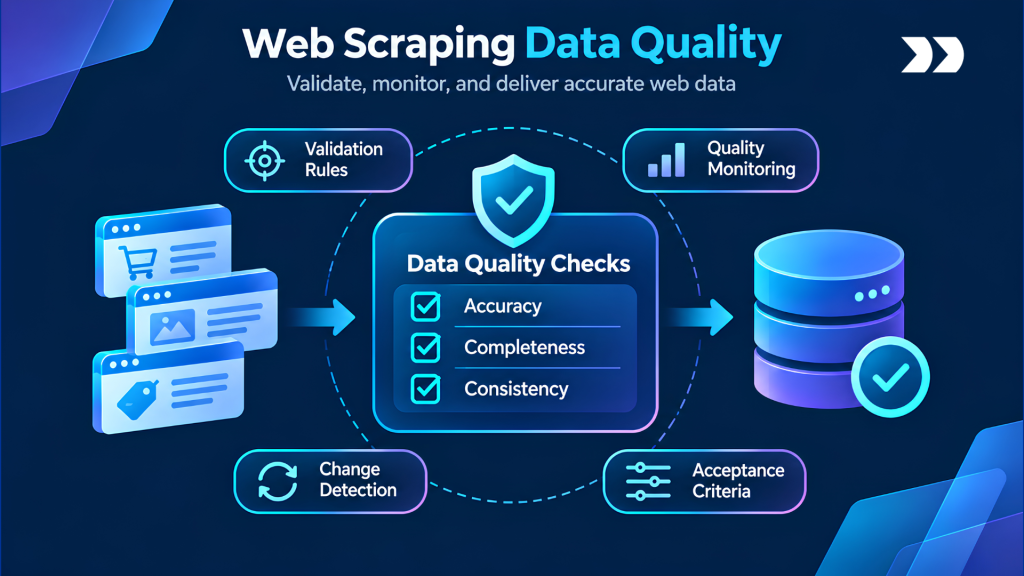
An extraction job can return HTTP 200, produce valid JSON, pass a schema validator, and still tell an analyst that a 12-pack is cheaper than a single item, that two different hotel rooms are equivalent, or that a failed availability check means a product is sold out. These are not cosmetic defects. They change business decisions.
Web scraping data quality is the degree to which accepted external-data observations faithfully represent the intended source population, the correct entities, and the relevant commercial or operational conditions, in a form the receiving system can use. The challenge is not simply finding bad rows. It is deciding what the row is supposed to mean, proving what was observed, and refusing to treat missing evidence as a business fact.
The W3C Data Quality Vocabulary distinguishes quality dimensions from the metrics used to assess them. That distinction matters in production extraction: a type check can measure schema conformance, but it cannot by itself establish whether a room rate includes breakfast or whether a seller offer belongs to the intended product.
Define Quality at the Business-Observation Level
Correct HTML, valid JSON, and a usable business record are different
Consider three stages of the same collection. The HTTP response delivers HTML successfully. The parser extracts {“price”: 21.00, “currency”: “USD”}. The analytics application assumes it describes one comparable item. The first two stages may be technically correct while the last is wrong if the page actually offers a ten-unit pack, a subscription-only price, or a restricted seller offer.
A usable business record needs an explicit observation contract: the observed entity, offer or event, relevant context, valid time, source, extraction method, and acceptance conditions. For product pricing, the observation may be a seller-specific offer for a given product variant. For hotel intelligence, it may be a rate plan for a particular room, occupancy, and stay. Also, for airline analysis, it may be a fare for an itinerary and passenger configuration. None is equivalent to “one page.”
The source record should remain distinguishable from the normalized interpretation. Original displayed text, source identifiers, observation timestamps, and rule versions make it possible to revisit an incorrect interpretation without inventing a fresh market change.
Dimensions of accuracy, completeness, identity, context, and freshness
A useful web data QA policy separates different failure types instead of aggregating them into one ambiguous “accuracy” percentage.
| Quality dimension | Question an acceptance check must answer | Typical failure |
| Acquisition validity | Did the response contain the intended source content? | HTTP 200 contains an access notice instead of a product page |
| Population completeness | Did the release cover the agreed record or search population? | A new pagination level or category was skipped |
| Field accuracy | Does the extracted value agree with source evidence? | Tax-inclusive total parsed as base price |
| Entity and relationship accuracy | Is the record connected to the right product, hotel, room, or itinerary? | Similar names hide different room types |
| Business-context validity | Are units, market, seller, currency, terms, and date correct? | Member rate compared with public rate |
| Freshness and timeliness | How old was the observation when consumers received it? | Yesterday’s accepted price displayed as today’s result |
| Consumer usability | Did the expected records load with their relationships intact? | Nested fields lost or duplicate rows created on replay |
These dimensions overlap operationally but should not be collapsed analytically. An empty search may be complete and valid; a nonempty search may be inaccurate. A correct historical price may be too old for a live-pricing decision without becoming factually false.
Quality thresholds follow the downstream decision
The acceptable error depends on what the consumer does next. A market-research team studying broad assortment changes may tolerate delayed publication for a small low-priority population. An automated repricing workflow should treat the wrong currency or a false product match as a blocking defect, even when the numerical price looks plausible. A hospital directory may require accurate provider-to-facility relationships, not merely complete provider names.
Define blocking conditions, review conditions, and informational limitations before collecting at scale. For example, a missing seller identity might block a seller-level price comparison, while a missing product description can remain acceptable for a feed whose primary purpose is inventory status. Distinguish acceptance for historical storage from eligibility for a specific comparison or automated action.
Establish the Expected Population Before Checking Rows
Source scope and scheduled-versus-accepted record counts
“Every returned row was valid” says little when the pipeline should have collected a million observations but returned only a narrow subset. The denominator for completeness should come from the agreed coverage contract: source domains, categories, search parameters, catalog mappings, date windows, countries, and scheduled check identities.
A recurring collection ledger should separate scheduled units, attempted units, completed units with records, completed units with valid empty results, late recovered units, and unresolved units. The sum of completed and unresolved units should reconcile to the scheduled cohort after accounting for explicitly canceled or excluded work. Count records and jobs separately: one successful hotel search may yield several room rates, and a legitimate empty search yields none.
In Datamam’s airline fare collection project, the 30-day review included 19,564,667 scheduled source searches. Of the 19,532,228 searches completed by the recovery cutoff, 4,769,809 returned no qualifying itinerary. Those outcomes were recorded as completed searches, not silently discarded as errors. The project produced 72,418,963 accepted fare observations from nonempty searches. Counting only the number of fare rows would conceal whether a route was properly checked and found empty or not checked at all.
Discovery omissions and silently disappearing categories
A parser can work flawlessly on the URLs it sees while upstream discovery omits a complete category, a new page type, or an entire geographic segment. This is a population-quality defect, not a field-quality defect. Useful signals include historical coverage by category, source-specific inventory counts, pagination exhaustion evidence, new-versus-retired keys, and the distribution of records across the expected segments.
Avoid equating a stable row count with healthy discovery. A source may replace products while keeping approximately the same total. Equally, a genuine market contraction can reduce counts. Unexpected distribution changes should trigger a review against page structure and source evidence, rather than an automatic attempt to fill missing rows using historical values.
Web scraping schema drift can change field names, data structures, or field meanings without causing obvious extraction failures. Data quality controls should detect these changes, validate affected records, and prevent incorrect information from entering downstream systems.
For recurring jobs, distinguish an eligible population from a known catalog to avoid confusing changes in source coverage with missing or failed observations. A product can exist in a retailer’s catalog without having a comparable offer in the buyer’s defined market. Completeness must be tested at the correct grain: discovered source item, approved catalog mapping, or scheduled observation.
Distinguishing legitimate zero results from failed collection
“No offers found” is a business outcome only after the search is known to have completed under the intended parameters. The same empty array could result from a source that returned no qualifying product, a page that had not loaded, a blocked request, a filter applied in the wrong location, or a parser that failed to locate its result container.
Require a terminal state with supporting evidence: completed_with_results, completed_no_qualifying_result, collection_failed, validation_failed, or another controlled set appropriate to the project. For results that depend on dates and market settings, keep the original search context. A hotel rate search with no accepted room is not proof that the whole hotel is sold out for all dates, rooms, and occupancies.
Cloudflare documents that its Challenge Pages can be identified through a cf-mitigated: challenge response header; the challenged content has text/html content type irrespective of the originally requested resource type. This is one example of why response classification matters before accepting a nominally successful retrieval. The appropriate handling is to classify the result and respect source access conditions, not mislabel a challenge as real data. See Cloudflare’s challenge-response documentation.
Validate Field Meaning, Not Only Field Types
Price units, currencies, packs, and membership conditions
A decimal price field does not tell you whether the source showed a unit amount, a case price, a promotional bundle, a tax-inclusive total, or a value available only under specific conditions. An analyst cannot compare two offers until those conditions are aligned or explicitly excluded.
Datamam’s retail price-intelligence program maintained 4.8 million active catalog-to-retailer mappings across 12 integrations. Its output retained seller, currency, offer condition, pack quantity, eligibility, and observation time where exposed. A source price of $24 for a 12-unit pack represents $2 per unit; $21 for a ten-unit pack represents $2.10 per unit. The lower displayed price is not necessarily the lower normalized unit price. Normalization must retain both the raw amount and the computation basis.
The source may also change a product’s package size without changing its URL. That should cause the affected mapping or comparison to be reviewed. A valid numerical value alone cannot detect the change.
Travel dates, stay totals, baggage, and cancellation terms
Travel comparison illustrates why technically correct values may be economically incomparable. A hotel room quoted at a nightly rate cannot automatically be ranked against another channel’s two-night stay total. Charges payable at the property may be material even if not included in the initial payment amount. Two apparently identical rooms may differ in bed configuration, breakfast entitlement, cancellation deadline, or occupancy restrictions.
Datamam’s hotel project therefore separated property identity, room equivalence, stay search, rate observation, and comparison. A specific two-night example involved THB 1,742.50 per night, THB 622.15 in disclosed additional mandatory charges, and a THB 4,107.15 visible stay total. Another channel showed THB 3,988.00. The comparison depended on compatible stay terms and aligned charge treatment, not simply subtracting two strings parsed as prices.
Airline offers require analogous checks for route, departure date, passenger configuration, point of sale, currency, baggage, and restrictions. In the documented airline project, accepted comparisons required compatible fare conditions and observations sufficiently close in time. A lower fare with missing baggage information was not treated as equivalent to one with a confirmed allowance.
Preserve unknown values rather than converting missing into zero
A missing price is not a free offer. A request timeout is not an “out of stock” state. An undisclosed baggage condition is not a zero-baggage condition. These substitutions make output look complete at the cost of making it false.
Represent the value separately from the knowledge state. At minimum, use explicit nullability and a reason or status when the distinction matters: not_displayed, not_applicable, unavailable_under_requested_conditions, not_collected, invalid_response, or pending_review. Avoid multiplying statuses without governance, but do not collapse materially different outcomes into a single null or zero.
A receiving model may expose a current best-known observation while retaining its original timestamp and a stale indicator. If today’s check fails, yesterday’s price remains historical evidence; it should not silently become today’s newly observed value. This principle protects downstream trend detection, pricing automation, and historical analysis.
Check Identity and Relationships Across Sources
Source keys versus resolved business entities
A source listing identifier answers “which page or offer did this website publish?” A canonical identifier answers “which business entity does this represent across sources?” The two should not be interchangeable. One hotel may have separate identifiers across multiple booking channels. One manufacturer product may be offered by several sellers. Conversely, a URL can be reused for a materially different variant or package.
Keep original source identity, the resolved business identity, mapping evidence, match type, effective dates, and rule version. This allows an audit to explain both the observation and the reasoning used to join it with other records. A mapping change then revises an interpretation rather than rewriting history as though the earlier evidence never existed.
Valid relationships without false equivalence
Identity is not always equivalence. A hotel can be correctly identified across channels while two room descriptions remain unsuitable for a like-for-like rate comparison. A client SKU can correspond to the correct product family while the retailer’s specific pack or condition is incompatible. A physician can be correctly identified while a credential belongs to a separate issuing jurisdiction or historical period.
Datamam reviewed 2,500 approved hotel-property mappings and identified three incorrect relationships. A separate review of 8,400 accepted room relationships found 37 discrepancies. Those are distinct acceptance questions and distinct denominators. The much smaller number of property-level errors does not imply that room-level comparability is automatically correct.
Where needed, model relationships as first-class records. Preserve links such as source_property_id -> canonical_hotel_id, source_room_id -> approved_room_equivalence_id, and the rule version under which each relationship was accepted.
Keep ambiguous matches outside accepted comparisons
An uncertain match can remain in a candidate pool without contaminating the accepted decision table. Use statuses such as proposed, approved, rejected, and needs review, with the reasoning attached. Do not force a binary match merely to avoid nulls or make the dashboard look complete.
In retail catalog matching, a manufacturer part number may support an exact-match candidate, while a private-label item requires category-specific comparison attributes. A similar description may establish a *possible* counterpart but not an approved commercial equivalent. For hotel rooms, “deluxe” and “superior” marketing labels are weak evidence without compatible occupancy, bedding, and rate-plan terms.
The cost of a false positive is often higher than the cost of withholding a comparison: it can create a misleading price gap or a false availability signal. Report both accepted matching coverage and unresolved candidate population so the buyer can understand the tradeoff.
Build Layered Quality Gates for Each Release
Acquisition and expected-content checks
The first gate should establish that a requested resource returned the expected page family and enough content to represent the requested entity or search. Check final URL, response metadata, page markers, required content sections, and whether the source reached a completed state. A successful network status cannot alone pass this gate.
Datamam’s HTML archive engagement processed 25,000 submitted URLs and accepted 24,250 target pages, retaining 750 explicit exceptions. An access notice returned with HTTP 200 was an exception, not a successful target acquisition. This distinction is especially important when downstream parsing teams assume any archived object contains a usable source page.
Schema, completeness, domain constraints, and anomaly detection
The next gates test representation and domain rules. Schema constraints catch type and mandatory-field failures. Reconciliation checks compare expected and delivered populations. Domain constraints test allowed currencies, dates, quantity units, status enums, and identity relationships. Distribution checks look for abrupt changes in missing values, zero prices, record counts, and category mix.
Google Cloud’s Dataform assertions documentation describes automated checks for non-null fields, unique keys, and row conditions. These are useful building blocks at the receiving layer. Yet a record with a valid unique key and plausible price can still describe the wrong pack. Rule-based tests should therefore be complemented by source-specific fixtures and contextual checks.
An anomaly is a review trigger, not automatically an extraction error. A retailer promotion may genuinely cause a large price change. The gate should route a suspicious event into appropriate review while retaining the original evidence, rather than flattening the series into an expected value.
Sampling for semantic discrepancies that rules cannot decide
Some errors are too plausible for deterministic constraints. A rate includes an unrecognized fee; a room mapping is semantically close but not comparable; a travel search ran in an unintended market while still returning a plausible currency; a product pack has been replaced with a similar variant.
Human review should compare accepted outputs with retained source evidence under a documented rubric. Reviewers need to know the intended market, product, time, and data contract, not simply check whether a number appears on a page. Classify discrepancies by cause: extraction, identity, normalization, context, interpretation, or receiving-system transformation.
A mature release process records why a human reviewer disagreed and turns repeated failure patterns into regression cases. The goal is to shrink the class of errors requiring judgment, not to pretend that samples can establish perfect population-wide accuracy.
How to Design a Useful Sample Review
Select source, category, and difficult-case strata
A random sample drawn exclusively from the easiest, most common records can systematically underrepresent the conditions most likely to fail: minority currencies, multi-pack offers, nonrefundable rooms, low-frequency routes, new source templates, or records touched by recent parser changes.
Construct strata around sources, record types, geographies, commercial conditions, high-risk mappings, and recent changes. Allocate sufficient review to high-impact categories even when they are rare, while retaining a representative component for aggregate monitoring. Mark oversampled strata so the simple pooled discrepancy proportion is not mislabeled as a population estimate.
Whenever a new adapter, matching rule, or data contract is released, review the affected strata. Samples should cover the exception cases that actually motivated the change, not just routine happy paths.
Report observed agreement with its sampled denominator
Datamam’s documented travel QA reviews provide a concrete way to report results without overstating their statistical meaning:
| Reviewed item and question | Reviewed sample | Discrepancies found | Observed agreement in that sample |
| Hotel property mappings | 2,500 | 3 | 99.88% |
| Hotel room relationships | 8,400 | 37 | 99.56% |
| Hotel accepted rate observations | 11,250 | 41 | 99.64% |
| Airline accepted fare observations | 12,500 | 26 | 99.79% |
These figures describe four separate review populations in Datamam projects. They are not a single cross-industry accuracy measure and should not be multiplied together or generalized to every accepted observation. Each sampled unit tested something different.
The distinction matters. An airline fare review found 11 market-context discrepancies, nine price-inclusion interpretation discrepancies, and six carrier or itinerary mapping discrepancies. A single summary agreement figure would hide which engineering controls needed repair. The useful result of the review is a traceable list of failure classes and their corrective actions.
Feed discovered errors into parser and acceptance tests
A sample review should produce three outputs: corrected affected records where justified, an updated rule or source adapter when appropriate, and a test that would catch a recurrence. Retain the original source evidence, the observed discrepancy, and the expected interpretation. An error found in a pack conversion should become a fixture with both the displayed amount and the quantity basis, not merely a hardcoded expected price.
When a reviewer corrects a relationship, identify all derived comparisons depending on that relationship and re-evaluate them under the new rule version. Avoid automatically revising unrelated raw observations or treating the correction as a newly observed source event.
Track review disposition separately from detection: open, acknowledged, corrected, rejected as false positive, and awaiting source evidence. A decrease in open discrepancies is meaningful only if the sample scope and review criteria remain clear.
Quarantine Suspect Records Without Losing Evidence
Explicit invalid, late, and unresolved states
Not every candidate belongs in the published “current comparable offers” view. A rate with mismatched occupancy can be valid evidence of what the source displayed but invalid for the specific comparison. A late price may be a correct historical observation yet unsuitable for an on-time delivery window. An unresolved request contains no accepted observation at all.
Separate raw or staged evidence, accepted source observations, eligible business comparisons, and published consumer views. Quarantine the suspect interpretation at the narrowest useful boundary. Preserving a valid underlying source record can support reprocessing after a corrected mapping is approved.
Retain source captures and transformation versions
To investigate a dispute, a data engineer needs more than the latest row. Retain, according to authorized retention and privacy requirements, the source URL or request identity, capture time, response content or diagnostic evidence, parser or adapter version, business rules, and mapping version. Associate every derived row with the evidence on which it was accepted.
Versioning enables reproducibility: the same source capture can be interpreted under the earlier rule and the corrected rule to isolate the defect. This is valuable when websites have changed since the disputed observation, making a fresh request unsuitable as proof of what the page displayed earlier.
Publish corrections without fabricating a new market event
Suppose a rate originally published as a nightly price was actually a two-night total. Correcting the normalization must not appear to analysts as a market price drop on the day the parser was fixed. Likewise, correcting a product match does not mean the source changed its inventory at the correction timestamp.
Maintain distinct timestamps for source observation, processing, and correction publication. Version the interpreted record or publish a correction event referencing the original observation identity. Consumers should be able to distinguish “the market changed” from “our interpretation of an older observation changed.”
Where the receiving system supports incremental loads, make the correction key and release identity explicit so replaying a correction replaces or revises the intended record rather than appending a duplicate.
Confirm Quality at the Receiving System
Manifest-to-warehouse row reconciliation
Data quality does not end when a supplier writes a file. An object can be truncated, skipped, loaded twice, or inserted under the wrong partition. Each release should supply a manifest describing expected objects, accepted row counts, schema version, source or cohort identity, checksums where appropriate, and a unique delivery identifier.
The receiving job should reconcile manifest objects -> staged records -> accepted warehouse records and produce exceptions for unexplained discrepancies. Compare at the correct grain: a release can contain multiple observations per scheduled search, and status records may be delivered separately from nonempty offer observations.
Datamam’s hotel feed delivered versioned JSON Lines batches via Amazon S3 to Snowflake, with staging and record-level publication. Its consumer model preserved hotel, property-channel mapping, room equivalence, search, rate observation, and comparison as connected but distinct tables. A single flat export would have obscured the reason two rates were accepted as comparable.
Nested fields, schema projections, and duplicate-safe loads
Valid JSON does not guarantee that the receiving application can load the chosen representation. Datamam’s national physician project initially delivered 26 alphabet-partitioned files. The receiving engineer required revisions to the JSON-array representation and three nested fields before the application accepted the export. The record relationships remained important throughout the compatibility changes.
A strong ingestion contract specifies nested-object behavior, character encoding, null semantics, schema compatibility, and duplicate handling. Google Cloud documents how BigQuery `MERGE` statements can combine inserts and updates in an atomic operation; business keys and unique source rows are still required to avoid unintended duplicates or ambiguous matches. The exact ingestion implementation depends on the destination and should be tested with repeat deliveries and corrected batches.
Consumer queries as the final acceptance test
A warehouse may contain all expected files while serving the wrong analysis. Run representative consumer queries before signoff: Can a pricing analyst compare offers with the correct units? Can a hotel analyst retrieve the rate, occupancy, cancellation policy, and mapping evidence behind a flagged difference? Does the current view show stale data when the newest refresh failed? Can a customer retrieve an earlier corrected observation without mixing it with a later market event?
Document the results as acceptance tests. The same queries can become regression tests after changes to source adapters, warehouse transformations, or business mappings. If consumers cannot answer the decision question from the delivered data, the data-quality contract is incomplete.
Which Quality Metrics Should the Buyer Receive?
Required-field coverage and accepted-population completeness
Report required-field coverage by relevant record category and source, not just one global percentage. A field that is mandatory for public fares may be optional for historical archival records. Use a denominator of records where that field was expected and applicable; keep not-applicable values separate from missing values.
Population completeness should reconcile scheduled or eligible units to terminal accepted, valid empty, late, and unresolved states. Include discovery coverage when the expected universe can be established. Otherwise, state the scope limitation rather than presenting returned rows as a complete market census.
Discrepancies by meaning, source, and severity
Keep review results segmented by error class, affected source, business consequence, and whether the sample was representative or risk-enriched. A tiny number of wrong-product mappings can have larger commercial impact than a higher number of missing descriptions. When reporting an observed agreement rate, always include its reviewed denominator, measurement period, tested unit, and definition of a discrepancy.
Do not combine hotel-property mapping accuracy, room-equivalence agreement, and rate-field interpretation into a single “web scraping accuracy” percentage. They answer different questions. Useful reporting preserves those distinctions.
Open exceptions and corrective release history
The buyer needs to know what remains unresolved, what was corrected, which releases changed, and what downstream consumers should do. Provide exception aging, affected population, severity, original and corrected release identities, and whether replay is required. Distinguish a source outage from a rule defect and an ingestion failure.
The result is a usable operational answer: which data can be trusted for which decision right now, and which data should not be used yet? Quality dashboards should serve that answer rather than a single reassuring percentage.
If your team needs recurring external data with explicit quality acceptance, source evidence, and integration-ready delivery, discuss your requirements with Datamam.
Frequently Asked Questions
How do you verify the accuracy of scraped data?
Define the intended business record and source context first. Verify the expected population, compare sampled accepted records against retained source evidence, test field semantics and identity relationships, and reconcile delivery to the receiving system. Report discrepancies by tested unit and sample denominator. Automated tests and targeted human review are complementary, not interchangeable.
Why can valid JSON still be wrong for business analysis?
JSON validation checks representation, not truth or comparability. A correctly typed price can belong to a different pack, seller, occupancy configuration, tax treatment, currency, or date. A record may also carry the correct data for the wrong entity. Semantic validation requires explicit business rules and provenance beyond a syntactic schema.
How should blank prices and failed availability checks be represented?
Use explicit null and status semantics. A genuinely completed search with no qualifying result is different from an incomplete page, a failed request, or an unverified source state. Never infer a free price from a blank amount or mark a product unavailable because a technical check failed. Preserve the last accepted observation as historical evidence with its timestamp.
How often should scraped records be sampled for accuracy?
Base review frequency on source variability, risk, business impact, new deployments, and recent defects. High-impact changes warrant immediate targeted sampling; stable sources may support lighter routine review. The important requirement is a documented plan covering ordinary records and difficult cases, not a universal calendar frequency.
Can automated checks replace human review entirely?
Not for every semantic problem. Automated checks excel at required fields, expected values, identity uniqueness, format, and defined business rules. Human review is still valuable for ambiguous product equivalence, nuanced offer conditions, changing source language, and questions where no trustworthy automated reference exists. Findings should become tests wherever practical.
What proof should accompany a high-quality scraped dataset?
A useful release includes source and observation identifiers, collection timestamps, schema and rule versions, accepted-population counts, valid-empty and unresolved states, exception reporting, evidence of sample review where applicable, and a manifest reconcilable to the delivered objects. The proof must be relevant to the intended downstream decision, not merely to request success.