
Key Takeaways
- Managed web scraping is an operating commitment, not simply a way to fetch pages. The deliverable is an agreed business dataset with a defined population, meaning, schedule, and receiving interface.
- A successful request is not necessarily a successful observation. A page may load while its price, location, availability, or other essential context is missing or wrong.
- The provider’s responsibilities must be contracted explicitly. Collection, source repair, normalization, entity matching, validation, publishing, and destination recovery are related but not automatically included in every agreement.
- The customer still owns business decisions. The enterprise defines which observations are useful, which entities are equivalent, which conditions are commercially comparable, and who accepts the data.
- Evaluate the feed through its actual destination. A real accepted batch, an exception ledger, and a demonstrated recovery tell more than a request-success chart.
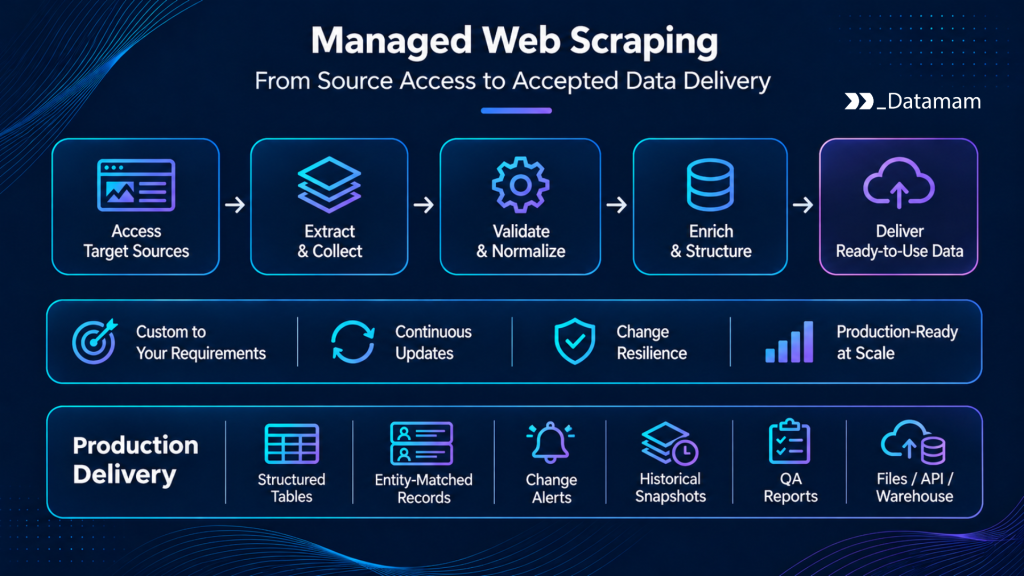
A managed web scraping service takes responsibility for operating an external-data pipeline against an agreed specification. Web scraping data delivery defines how collected information reaches downstream systems, including required schemas, delivery formats, refresh schedules, validation checks, and procedures for handling delayed or failed deliveries. Rather than handing a developer access to an extraction tool and leaving the rest of the work to the customer, the service maintains collection and delivers structured results on a defined schedule. For an enterprise buyer, the question is not merely whether a provider can reach the websites. It is whether the resulting observations arrive with the identity, commercial meaning, history, and evidence needed by the receiving system.
This distinction matters to teams collecting competitor prices, rental availability, supplier catalogs, hotel rates, company records, or research documents. All can involve web scraping, but they have different business units, quality conditions, and acceptable delays. A managed contract must express those differences before engineering begins.
What Makes Web Scraping a Managed Service?
A delivered business observation is not the same as a successful request
An HTTP response establishes that a network exchange occurred. It does not establish that the requested business fact was obtained. A retail page might return a consent notice. A hotel search might display a room rate for the wrong occupancy. A supplier page might expose three different prices, each tied to a different pack size or customer condition. Counting those exchanges as equivalent successful collections would misrepresent the usable result.
For managed delivery, the meaningful unit is usually a scheduled business observation. It is defined by the entity, source, context, and observation window: for example, a particular retailer offer in a given market at a specified refresh time. Completion requires either an accepted result or an explicitly validated empty result, not just a received page.
Datamam’s airline monitoring work illustrates the difference. A 30-day cohort admitted 19,564,667 scheduled searches and produced 72,418,963 accepted fare observations. A single search could need multiple HTTP calls and return several fare products. Conversely, 4,769,809 searches completed without a qualifying itinerary and were valid completed-empty results. The service preserved these as separate business outcomes rather than reducing everything to request counts.
Which responsibilities move to the provider
A fully managed arrangement may cover source feasibility, collector development, scheduling, extraction, normalization, validation, exception handling, source-change maintenance, and delivery. It can also include versioned releases, output reconciliation, and evidence needed to repair an earlier result. Whether it *does* cover those activities is a matter of scope, not a property of the label “managed.”
A useful responsibility statement names both an activity and its operating boundary. “We maintain scrapers” leaves unanswered whether the team fixes broken selectors only, corrects a changed price definition, reprocesses historical evidence, or owns a failed warehouse load. “We deliver validated price observations to a specified table by the agreed window and report unresolved mappings” describes a much more testable obligation.
The Google SRE framework for service-level objectives recommends defining measures around what the user needs from a service. That principle applies here: collection infrastructure is a component; usable external data is the consumer-facing result.
Which data decisions remain with the customer
The customer normally decides the business purpose and the definition of a useful observation. A pricing department decides whether membership-only offers belong in its comparison. A logistics team decides which locations qualify as serviceable. A product team owns the canonical identifiers expected by its application. The provider can translate these rules into extraction, transformation, and validation logic, but it should not silently invent the rules.
Customers also retain approval of source scope and permitted use, ownership of downstream business decisions, and an acceptance role for changes that affect meaning. A provider may propose matching rules or freshness bands, yet the buyer should approve any rule that could change what an analyst interprets as a competitor, available room, or active supplier.
Define the Output Before Discussing the Collection Method
Source population, record identity, and required fields
Begin with the record grain: what does one row mean? A product is different from a retailer listing; a listing is different from a seller-specific offer; an offer is different from a price observation captured at a particular time. Failing to choose the grain early creates duplicate rows, unstable joins, and comparisons between records that are not equivalent.
Datamam’s retail pricing program maintained 1.2 million client catalog SKUs and 4.8 million accepted product-to-retailer mappings across 12 integrations. It did not treat every possible SKU-retailer combination as an approved match. Each accepted relationship retained the client identity, source identity, match type, supporting evidence, and rule version. When a source changed a pack size or reused a URL, the affected relationship returned to review instead of erasing the historical product mapping.
This illustrates why buyers should specify identity and comparability alongside field names. A required field list saying price, product_name, and url is incomplete if the buying decision depends on currency, seller, quantity, condition, membership requirements, and availability context. The record definition must state what is required, what can be null, and what causes an observation to be rejected.
Refresh windows, delivery destinations, and acceptance rules
A refresh schedule is a contract about *when an accepted observation should exist*, not merely when a worker starts. A four-hour product check differs from a daily supplier catalog and a weekly long-tail discovery sweep. Each needs a stated schedule, time zone, allowed completion window, and rule for stale information when collection fails.
Delivery must be equally specific: JSON Lines files in object storage, an API response, database tables, or a warehouse-ready release are different interfaces. Define file framing, stable keys, schema versions, date and currency types, replacement behavior, and destination availability. A file that uploads successfully but cannot be read by the customer’s warehouse has not finished the end-to-end job.
A practical acceptance test should include a routine successful row, an unavailable product, a null field, an intentionally empty result, a corrected historical record, and a replay of an already accepted delivery. Testing these cases before recurring operation catches integration problems that a clean sample of ordinary pages can conceal.
How to classify valid empty results and unresolved work
An empty result is meaningful only when the collection process can establish that the requested search completed and no eligible item appeared. A complete search for a flight with no qualifying itinerary can be accepted. A timeout, blocked page, incomplete pagination, or failed parser cannot be interpreted as the absence of a flight.
The distinction also protects retail and property history. Failure to retrieve today’s stock status must not automatically change yesterday’s accepted item to out of stock. A failed rental listing check must not be treated as evidence that the property was withdrawn. Good managed feeds expose at least three states: accepted result, completed empty, and unresolved. They retain the last accepted observation with its age when an update is missing, without presenting it as fresh.
The Operating Lifecycle Behind a Recurring Web Data Feed
Source discovery and adapter design
Discovery establishes which records belong in the work inventory and how their sources can be enumerated. That may involve categories, pagination, public structured interfaces, or a customer-supplied list of entity IDs. The resulting source registry should track eligibility, effective dates, page families, required fields, and the evidence that a source was assessed.
An adapter translates one source’s structure into the agreed model. A reasonable design isolates site-specific parsing and session behavior from the common identity, validation, and publication rules. Some sources expose sufficient data through ordinary HTTP responses; others require rendered pages or multi-step interactions. The choice should be based on required fields and permitted access, not a blanket commitment to use browser automation everywhere.
For a recurring service, discovery and refresh deserve separate plans. Discovery finds new or changed candidate records; refresh observes approved records again. Repeating expensive discovery for every stable listing is often unnecessary, while refreshing only existing IDs can miss a new product or a newly opened facility.
Extraction, normalization, and relationship preservation
Extraction reads source content into typed fields. Normalization makes those fields usable across heterogeneous sources, while retaining the original representation for audit. Currency and quantity are especially sensitive: $24 for a 12-unit pack and $21 for a 10-unit pack are not directly comparable unit prices. A normalized view can calculate $2.00 and $2.10 per unit only because it retains the pack quantities and measurement basis.
Identity resolution requires a separate decision. Similar names do not necessarily identify the same business, property, room, or product. The system should distinguish exact matches, approved equivalence, unresolved candidates, and rejected candidates. Repeated affiliations and offers belong in related records rather than being flattened until their meaning disappears.
Versioning matters when rules change. If a corrected matching rule changes an earlier product relationship, the output should distinguish a revised interpretation of old evidence from a newly observed market change. Otherwise, analysts may see a false price movement that was actually caused by a parser or identity correction.
Validation, release manifests, and consumer-ready publication
Schema validation checks types and required identities. Population validation checks whether a source or category unexpectedly lost records. Domain validation catches impossible amounts, mismatched currencies, suspect status transitions, and rates attached to the wrong buying context. Reviewed samples examine semantic accuracy where deterministic tests cannot establish meaning.
Publication should make each delivery identifiable and safely repeatable. A release manifest can include the collection window, source, schema version, record counts, checksums, and delivery identifier. The receiving system can compare what was promised with what loaded. Idempotent loads prevent replayed files from multiplying historical observations; the Google Cloud discussion of idempotency explains why retrying an operation should not create duplicate effects.
In one Datamam collection portfolio, 200 websites contributed 4.6 million records to a full weekly sweep. Each source retained its own adapter and completion state, while immutable storage releases and manifests let the customer load a whole accepted portfolio or replay selected source updates. That is the practical distinction between sending files and maintaining a recoverable data delivery contract.
What Happens When a Website or Its Data Meaning Changes?
Template and access changes versus semantic price changes
A structural failure is often visible: a selector no longer finds a field, a JSON attribute moves, or pagination stops. A semantic failure can be harder. The parser may still return a valid numeric value, but the number now represents a member price, a different currency, or a different product quantity. The record passes type checks while failing its business definition.
Access incidents are another category. For instance, Cloudflare documents a cf-mitigated: challenge header on its Challenge Page responses. Detecting that condition helps classify an access notice as an exception instead of accepting its HTML as product content. Source permissions and access constraints still need to be respected; labeling a challenge is not authorization to circumvent it.
Classification determines the repair. An access problem calls for source and permission review. A parser regression calls for updated extraction logic. A changed pack or offer definition calls for corrected business interpretation, and sometimes recalculation of records captured earlier under the old parser.
Retained source evidence and regression checks
Preserving time-stamped source material makes repairs auditable. A retained page or response can be reprocessed with the old and proposed parser. The team can identify whether a changed output comes from the source itself, a new interpretation rule, or a modified customer requirement.
Representative test fixtures should cover the cases that have already caused problems: multiple sellers, missing prices, variable quantity packs, consent screens, search results with no eligible records, and changes in field location. Replay needs the capture timestamp and parser version. Fetching the page again tomorrow does not recreate yesterday’s price, stock, or booking availability.
Storage policy should follow this recovery need. Raw response evidence may expire sooner than accepted release history, while corrections must remain linked to the original observation. The contract should identify what is retained, for how long, and which forms of reconstruction are possible after source content changes.
Isolating affected sources while healthy feeds continue
A failure at one website should not automatically block the entire portfolio. Source-specific queues, limits, release identities, and exception states let the provider contain a broken integration while other eligible work continues.
Datamam’s 200-website weekly portfolio provides a concrete case. When one site redesign affected its collector, the other 199 healthy source deliveries continued. The missing source stayed visible in the completeness report; its recovered batch was later published under its own release identity. The result was not a claim of perfect coverage. It was a way to preserve usable delivery while making the gap explicit.
A separate industrial takeover shows the contractual consequence of semantic repair. Across 56 sources and 6.8 million source items, a vendor-template change could pause the affected field contract without stopping unrelated sources. Source-level incident handling protects the receiving team’s view of what is current, late, and unresolved.
Shared Responsibilities: Provider, Customer, and Receiving Team
Business definitions and approved source scope
The enterprise owns the question its data must answer. It must approve the source universe, fields, market and geography, comparisons, historical policy, and changes that alter business meaning. The provider should translate these into technical rules and flag ambiguous cases rather than silently choose a convenient interpretation.
This is not a one-time handshake. New countries, product conditions, and source platforms may introduce fresh legal, technical, or business constraints. A named customer owner should approve material changes and understand which outputs are now covered by the approved contract.
Pipeline operation, repair, quality, and escalation
The managed provider ordinarily owns the operating tasks expressly included in its statement of work. For example: schedule and execute jobs, maintain source adapters, enforce retry limits, classify failures, validate output, and publish an accepted release. The contract needs to specify who investigates each category of failure and what evidence they supply.
The following is a responsibility framework to negotiate, not an assertion that every provider offers identical terms:
| Activity | Typical accountable party | Decision that still needs to be documented |
| Select business population and accepted meaning | Customer | Which markets, products, and conditions qualify? |
| Operate approved source collectors | Provider, when in scope | What changes and access exceptions are covered? |
| Review ambiguous entity matches | Shared | Who authorizes new match rules or overrides? |
| Validate extraction and publish releases | Provider, when contracted | Which acceptance and deadline boundary applies? |
| Load and use the data in the consumer application | Customer or contracted provider | Who resolves a failed destination load? |
| Correct historical records or replay delivery | Shared, by contract | What is retained and who approves a correction? |
Warehouse ingestion, acceptance, and correction ownership
A warehouse-ready service needs a defined destination boundary. “Delivered to storage” and “queryable in the customer’s production table” are not synonyms. A malformed nested column, changed numeric type, or mismatched merge key may not surface until the actual reader loads the data.
Datamam’s national physician-data project demonstrates this boundary. After collecting approximately 1.35 million profile URLs and delivering 26 alphabet-partitioned files, the receiving system required JSON arrays rather than JSON Lines, followed by string-compatible projections of three nested fields. The nested-field compatibility revision was supplied in 1 hour 55 minutes. The useful outcome was a dataset the customer could ingest without losing underlying physician relationships.
The practical agreement should state who diagnoses such incompatibilities, who signs off on schema changes, and whether the provider must confirm consumer availability. It should also specify how corrections replace or supplement previously accepted records without multiplying them.
What Should a Recurring Managed Delivery Contract Specify?
Population coverage and freshness expectations
Write the scope as an observable inventory rather than a statement such as “scrape major marketplaces regularly.” Identify the approved source registry, expected entities or discovery rules, required fields, refresh tiers, start and end times, destination, and acceptance tests. A change in the active population should have an effective date so missed jobs cannot disappear from the denominator.
For each tier, state whether the obligation is collection start, capture completion, validation, or availability to the consumer. A four-hour observation can be late despite a successful later retry. Conversely, a completed search with no eligible result can be on time and fully accepted if its completion was established.
Reporting late, stale, and unresolved results
Reporting should connect expected jobs to actual outcomes. At minimum, a buyer should be able to inspect jobs due, jobs completed on time, late completions, unresolved observations, and the current age of each accepted record. Source-level breakdowns matter because a large healthy source can hide the absence of a smaller strategically important market.
Staleness should never be invisible. If today’s check fails, yesterday’s accepted value may remain useful for historical comparison, but the current view should expose its original observation time and missing-update status. Failure categories should distinguish access, parser, context-validation, and destination errors when they require different actions.
How changes in fields, sources, or cadence enter scope
Recurring agreements need a controlled change procedure. New source categories, tighter refresh windows, new geographic profiles, additional data fields, different record definitions, and longer retention can all alter operating work. A change request should describe the new requirement, feasibility, impact on existing deadlines, revised acceptance cases, and any commercial adjustment before the expanded scope starts.
A provider should also state how it handles a source that materially changes or withdraws accessible content. Continuing to retry forever is neither a recovery plan nor an acceptance policy. The customer needs an explicit report of the limitation and a decision about whether to revise, pause, or retire that part of the scope.
How to Evaluate a Managed Service Before Committing
Ask for a representative delivery, not a dashboard screenshot
A dashboard can show request throughput without showing whether the business observations were correct. Instead, ask for a sample representing the actual source mix, not merely the easiest pages. Include an awkward price condition, a missing field, a reused URL, an incomplete result, and a nontrivial matching decision.
The evaluation package should contain the accepted output, a definition of each row, source evidence where appropriate, delivery manifest, and an exception ledger. It should be possible to trace a final value back to the observed source and the interpretation rule that admitted it.
Test the sample with the actual receiving application
A sample is accepted only when the people who will use it can load and interpret it. Test field types, nesting, joins, currency definitions, time-zone handling, and duplicate behavior under the real destination interface. Replaying the same release should not add a second copy of the observations. A corrected release should be distinguishable from a newly collected observation.
Request one failed or intentionally incomplete case as well. The receiving system must show unknown values as unknown, rather than converting a missing price to zero or a failed search to unavailable. These are easy mistakes to miss when reviewers examine only the clean records.
Review a real incident and its recovery trail
A credible operating review should explain what was due, what failed, when the team identified the failure, which sources were isolated, and how the accepted output was restored. Ask whether the fix involved a new request, reprocessing retained evidence, an updated parser, or a warehouse replay. A well-defined scraper failure recovery process should distinguish between temporary collection failures, website structure changes, and downstream delivery errors.
Recovery procedures should also specify how missing records are restored, data quality is revalidated, and normal pipeline operations resume without compromising dataset completeness or reliability. These methods have different meanings for historical freshness and data correctness.
Look for the associated effect on downstream data. Was a late result labeled late? Were unaffected sources published? Did the delivery identifier prevent duplicates? Did the customer need to approve a new business rule? A provider capable of answering those questions is demonstrating the operating model rather than merely presenting a collection success percentage.
When the Managed Operating Model Is a Poor Fit
Internal strategic capabilities and highly experimental work
Managed operations are not always the right purchase. An enterprise developing a proprietary collection engine as core intellectual property may need direct control over every adapter and release. A research team exploring sources and hypotheses that change daily may be better served by internal experimentation before a stable recurring feed can be defined.
A managed arrangement can also introduce coordination costs when decisions require constant changes to undocumented business rules. In such cases, defining the model internally first may be more effective than outsourcing an ambiguous requirement.
A collection API may be enough when downstream ownership already exists
A collection API can be an economical component when the enterprise already operates its own scheduler, parsers, validation, matching, storage, monitoring, and recovery. The API supplies a request or browser capability; the engineering team supplies the surrounding system. That division is reasonable if the organization has the staff, service ownership, and support processes to maintain the rest of the pipeline.
The relevant question is which responsibilities remain, not whether the invoice is called a tool subscription or a managed service. A provider can have an excellent HTTP success rate without any responsibility for whether a corrected price reaches the customer’s production table.
Questions to resolve before drafting the full procurement requirements
Before seeking a recurring managed contract, settle the intended consumer, the required observation grain, source scope, acceptance definition, refresh windows, and system of record. Identify the incidents your team can absorb and those that need an external operating owner. Defining clear web scraping project requirements is essential before selecting a data delivery model.
These requirements should specify source coverage, required fields, collection frequency, data quality standards, delivery formats, and acceptable delays.
Determine whether the buyer needs basic data extraction, a curated dataset, or a continuously maintained, comparison-ready feed.A strong project scope is not necessarily the largest one. It is the scope that reliably delivers the data needed for the intended business use. Begin with a representative population and a decision that the output must support. Expand only after the data contract, exception behavior, and receiving interface have been demonstrated under realistic conditions.
If your organization needs recurring external data with an agreed source scope, validation policy, and consumer-ready delivery, contact Datamam to discuss your data requirements.
Frequently Asked Questions
Is managed web scraping the same as buying a scraping API?
No. A scraping API generally exposes collection capabilities that developers integrate into their own systems. A managed service is an agreement to operate defined work and deliver a contracted result. Some APIs offer additional extraction or support services, while managed web scraping providers vary in how much responsibility they assume for data quality, monitoring, maintenance, and delivery.
When evaluating web scraping service providers, businesses should clarify who is responsible for scraper maintenance, handling website changes, validating extracted data, resolving pipeline failures, and ensuring reliable delivery before selecting a provider. Compare the documented work boundary rather than the product label.
Does a managed provider own normalization and entity matching?
Only if those functions are part of the agreed scope. Extracting a seller name and price does not automatically establish product equivalence across retailers. If the customer needs comparable offers, the contract should specify normalization rules, identity evidence, ambiguous-match handling, and who approves changes to those rules.
Who fixes extraction when a source changes its layout?
In a properly scoped managed operation, the provider is responsible for maintaining the agreed adapters and communicating source incidents. A changed layout is different from a new business requirement or a source that is no longer accessible under permitted conditions. Those cases need separate change and exception terms.
What should happen when a scheduled source produces no results?
The system should distinguish a verified completed-empty result from an unresolved collection. A complete search with no eligible records can be valid. A timeout or incomplete response cannot prove absence. The feed should preserve prior accepted observations as historical, mark their age, and expose any missed refresh rather than silently overwriting availability.
Can a managed data feed deliver directly to a warehouse?
Yes, if direct warehouse delivery and consumer acceptance are part of the service. Define the destination, load schema, stable keys, release identifiers, and failed-load ownership. Delivering a file to object storage is not identical to confirming that the accepted records are queryable in the warehouse.
What must a buyer define before requesting a managed service proposal?
Define the source population, record identities, mandatory fields, relevant market conditions, refresh requirements, accepted-empty behavior, delivery interface, and quality thresholds. Provide representative difficult records and an actual consumer query. Those inputs let a provider scope responsibilities and expose limitations before the commercial proposal is negotiated.