
Key Takeaways
- Evaluate the result the business will consume. Successful HTTP requests, scraped pages, accepted records, and on-time datasets measure different things. Insist on definitions and reconciliation.
- Make a supplier demonstrate difficult cases. Source redesigns, ambiguous offer conditions, empty results, stale values, and replayed batches reveal more than a perfect sample file.
- Data quality includes meaning. A numeric price can be wrong for the decision if its seller, currency, pack size, availability, or observation time is misunderstood.
- A managed feed needs an operating owner. Verify who monitors sources, repairs adapters, investigates mismatches, resolves incidents, and delivers corrections.
- Compare like with like. A self-service scraping API and a managed, normalized data feed may both be valid choices, but the customer retains different responsibilities and costs.
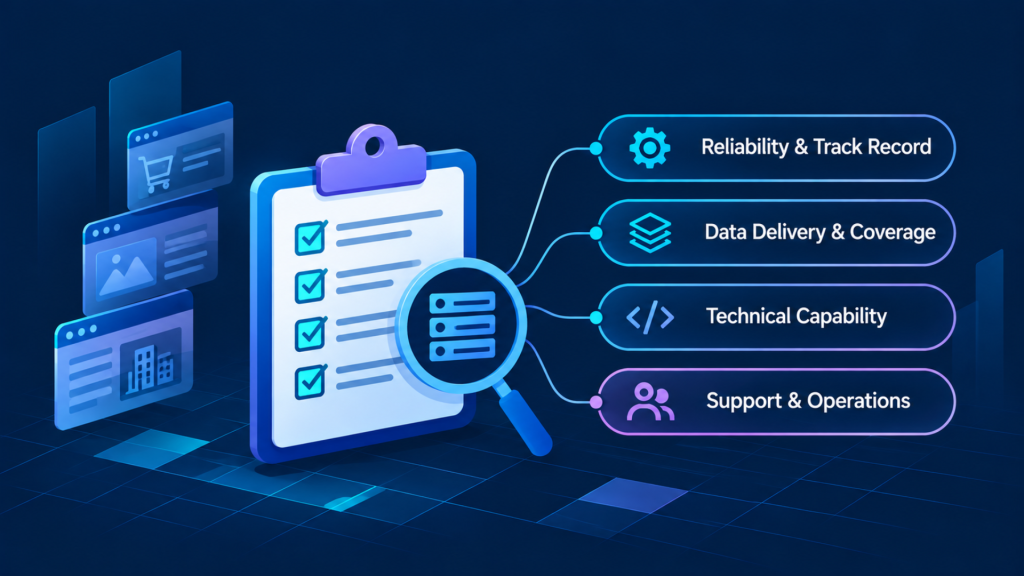
Choosing a web scraping vendor is a risk-allocation decision disguised as a technology purchase. A provider may demonstrate that it can retrieve a difficult page, yet an enterprise needs the correct business record to arrive repeatedly, with its meaning intact, when the receiving system expects it. The strongest web scraping vendor evaluation therefore asks not only *can the supplier collect this?* but also *what evidence proves that the required data will remain usable when sources, workloads, and business rules change?*
This guide is for buyers who have already identified potential suppliers and now need to separate plausible promises from demonstrated operating capability. It is not a list of providers or a substitute for an RFP. It explains what to ask for, how to interpret the answers, and when a controlled proof of concept is justified.
Start With the Decision the Data Must Support
Business record, target population, and acceptable observation age
The first vendor-assessment question belongs to the buyer: Which decision will fail if this data is incomplete, late, or interpreted incorrectly? A price-monitoring team may need competitor offers matched to a reference catalog. A property platform may need a current unit’s availability, not simply a building-level listing. A supplier-intelligence team may need the currently orderable variant rather than a generic product page.
Define one observation at the business grain that matters. For a retailer, that might be a source product, seller, condition, quantity, delivery market, and capture time. For a hotel, it might be property, arrival and departure dates, occupancy, room type, rate plan, cancellation terms, and currency. Count eligible source records separately from accepted matched records; the latter may be smaller for legitimate reasons.
Set an acceptable age at the point of use, not only the collection frequency. A source checked every four hours may still produce a seven-hour-old consumer record if recovery and publication lag behind. Ask the supplier to identify observed_at, published_at, the scheduled window, and what downstream users see when the latest check remains unresolved. These definitions become the basis of a meaningful comparison.
What must be included in the vendor’s responsibility
Ask suppliers to mark each activity as included, customer-owned, shared, or out of scope: source discovery; access assessment; extraction; session management; parser changes; normalization; record matching; validation; scheduling; monitoring; historical retention; incident response; file or API delivery; warehouse ingestion; and correction of previously delivered observations.
A claim to offer ‘fully managed scraping’ does not by itself establish who decides that two private-label products are equivalent, who approves a changed source schema, or who restores a failed destination load. Responsibility should be tied to a deliverable and acceptance point. For example, ‘validated JSON Lines release available in the client’s object-storage bucket by the agreed cutoff’ is different from ‘dataset successfully merged into a customer-controlled warehouse table.’
Check the dependencies as well. Does the provider need the customer to maintain authentication, approve target markets, supply identifier mappings, provision an ingest role, or review disputed product matches? A good answer names those dependencies rather than hiding them in a generic maintenance promise.
Which source cases make the workload genuinely difficult
A supplier should be able to identify difficulty within the proposed population, not only talk about blocked sites. Relevant variations include JavaScript-rendered results, pagination boundaries, geographic or language context, multiple sellers, subscription prices, changing navigation structures, duplicate identifiers, temporarily unavailable pages, and mixed refresh tiers. Access constraints and permitted collection methods must be evaluated source by source.
Build a representative test matrix that includes ordinary records and known edge cases. If a vendor claims coverage of 40 retailers, a test on the easiest one does not validate the entire population. If the catalog includes both branded and private-label goods, exact identifiers alone do not test matching quality. Ask which source families are already understood, which remain subject to feasibility, and what evidence will determine scope changes.
A useful answer also names what the provider will not infer. A page timeout is not evidence that a product is out of stock; an empty response is not proof that no listings exist; an access notice with HTTP 200 is not a valid business record.
Require Evidence That Matches the Vendor’s Claims
Request attempts are not accepted business records
A headline ‘99% success rate’ is uninterpretable without its unit. Possible denominators include HTTP attempts, unique URLs, scheduled observations, source searches, valid parsed records, accepted output partitions, or consumer-visible updates. These units are not interchangeable. A single business search may require several requests and yield multiple records; some completed searches legitimately yield no matching results.
A vendor reporting 99% HTTP success could still extract the wrong price or publish late. Conversely, a failed initial request followed by controlled recovery may produce an accepted observation before the deadline. A stronger evaluation starts with a ledger that follows a scheduled business obligation through retrieval, extraction, validation, publication, and exception handling.
Google’s Site Reliability Engineering guidance on service-level objectives argues for metrics derived from what users actually care about. For a purchased data feed, that is usually accepted coverage, timeliness, and correctness, not the number of successful network responses.
Ask for reporting periods, denominators, and explicit exceptions
Require the supplier to specify the measurement window, eligible population, scheduled workload, acceptance rules, exclusion categories, reporting cutoff, and whether backfilled results count as on time. A monthly rate should not be extrapolated from a conveniently selected hour. Results should be segmentable by source, record class, country, and refresh tier where those dimensions affect the customer’s decision.
A useful operating statement reconciles:
| Operating state | Buyer question | Evidence to request |
| Scheduled | What was due? | Source and job registry with required windows |
| Attempted | What did the system try? | Attempt ledger and source status |
| Accepted | What satisfied the business specification? | Record counts, validation results, accepted timestamps |
| Completed empty | Was absence verified? | Completed-search evidence and eligibility rules |
| Late recovered | What arrived after the cutoff? | Original due time and actual publication time |
| Unresolved | What remains unknown? | Exception reason, age, ownership, and next action |
The sum of terminal outcomes should reconcile to the scheduled population under the agreed accounting convention. If a vendor cannot explain how its percentages are derived, the buyer cannot interpret the claimed reliability.
Inspect audited examples rather than a single headline percentage
Ask for sample operating evidence from more than one source state: normal release, incomplete source, schema change, delayed recovery, and a reviewed correction. Sensitive customer information can be redacted while preserving the structure of the evidence. A credible packet may contain a run manifest, time-window ledger, exception categories, schema version, reviewed sample records, and an incident timeline.
Datamam’s documented HTML acquisition project illustrates the difference between a numerical result and a defined result. For 25,000 input URLs, the archived output included 24,250 accepted target pages and 750 reason-coded exceptions. The resulting 97% acquisition acceptance was a metric for that specific HTML archive, not an enterprise-wide data-accuracy or uptime claim. Challenge notices and unrelated redirects were not accepted simply because a server responded successfully.
A buyer should ask whether a vendor’s cited figure follows comparable rules, which types of output it covers, and whether it was achieved across a source population resembling the proposed workload. A strong number becomes useful only when its boundary is visible.
Test Whether the Data Is Commercially Correct
Identity and comparable-record logic
Data quality is not just whether required columns contain values. It is whether rows refer to the right business entities and comparable conditions. Product title similarity can conflate different pack quantities or versions. Company names can merge separate legal entities. A property listing can move between source URLs without becoming a different property. These errors can survive schema validation and look plausible in dashboards.
Ask the supplier to explain its record grain, stable keys, mapping states, and correction process. Separate exact matches from approved equivalents and unresolved candidates. Require a small review set of near-matches, deliberate negatives, reused URLs, and records that need human judgment. The vendor should show how later mapping revisions affect historical analysis, rather than silently rewriting past comparisons.
Datamam’s documented retail collection program managed 1.2 million client SKUs and 4.8 million accepted product-to-retailer mappings across 12 integrations. The matching layer carried match type, evidence, rule version, and review state. That design matters to evaluation because an accepted mapping is a business assertion, not an automatic consequence of finding a product page.
Currency, seller, room, pack, or policy context
Evaluate the smallest context that changes the business decision. For prices, ask about currency, unit of measure, quantity basis, tax inclusion, seller, membership conditions, and destination. For travel, distinguish a nightly rate from a total-stay price, and an unrestricted fare from one with baggage or cancellation limitations. Also, for job or property data, retain location and effective dates.
Use explicit non-equivalence cases in supplier review. A $24 12-unit pack is $2 per unit, while a $21 10-unit pack is $2.10 per unit; ranking the two displayed totals without quantity normalization would invert their value. This is a mathematical example of why the dataset must preserve quantity and source evidence. It does not imply that every provider should make buying decisions for the customer.
The ISO/IEC 25012 data-quality model can help frame requirements for data held in structured systems. The useful buyer step is to turn abstract characteristics into accepted field meanings, context checks, and documented review outcomes for the specific feed.
Sample review methods and correction ownership
Ask how review samples are selected. A handful of handpicked successful records does not measure production accuracy. Sampling should include ordinary items, high-value sources, empty results, difficult variants, and records affected by recent parser changes. Define whether reviews compare against retained source evidence, a new live page capture, a trusted reference system, or analyst judgment; each answers a different question.
Require the vendor to document disputed observations with the original capture, parser or rule version, reviewer outcome, and any correction issued. A corrected row should retain its business identity and carry a revision or supersession marker. Otherwise, a downstream analyst may mistake a data-quality fix for a real market event.
Make the allocation of work clear. Does the supplier correct parser errors within the operating scope? Who decides ambiguous product equivalence? Who replays corrected rows to the warehouse? A supplier can pass a quality demonstration while leaving these costs entirely with the customer.
Make the Vendor Explain a Failure, Not Just a Success
A template change with retained evidence
Ask a vendor to walk through a real, suitably anonymized source change. The answer should identify the first observable symptom, how the team distinguished access failure from parser regression or changed field semantics, which evidence was retained, and how a corrected extractor was validated before release.
A page can keep the same layout while changing the meaning of its price. In that case, a repaired selector is insufficient; the extraction rule and the consumer-facing field contract may need revision. Source captures, fixture tests, and source-level field distributions are useful because they let engineers distinguish newly observed market changes from defects introduced by software changes.
Request an incident artifact, not an assurance that a team is available 24/7. Availability of staff is not the same as a demonstrated diagnosis and recovery process. Confidential source details may be redacted, but the sequence and accepted outcomes should remain inspectable.
How one failing source avoids blocking others
Multi-source reliability depends on failure isolation. If one supplier website changes its search flow, healthy publishers should not necessarily be held behind a global release that waits for every source to recover. The provider must also prevent partial publication from being mistaken for complete coverage.
In Datamam’s documented weekly portfolio of 200 websites, the agreed full sweep contained 4.6 million records. The service used source-level adapters, distinct recovery states, and release manifests. When a redesign affected one collector, deliveries from the other 199 sources continued, while the missing source release remained visible for later recovery. That observation supports a practical diligence question: can the vendor show per-source completeness and selective replay when one component fails?
A supplier might appropriately use whole-release gating for some tightly coupled datasets. The evaluation point is not that partial publication is always best, but whether the chosen behavior is explicit, safe for the customer, and supported by evidence.
Recovery timelines, stale-data handling, and root-cause reporting
Ask what happens between the missed window and recovery cutoff. Can the provider retry within source-appropriate limits, use retained captures to reparse, or issue a corrected release? Will a late result preserve its actual observation time? What is reported when an earlier timestamp cannot be recovered from the source?
An incident report should name affected sources and periods, scope of missing or rejected records, status of the consumer view, root-cause category, corrective action, and whether the incident changed the previously accepted interpretation. A rate that rises after late recovery must not be retroactively described as on-time performance.
Demand a definition of stale data. Retaining the last accepted record may be useful, but consumers need its age and source-refresh status. ‘No new output’ can otherwise be misread as ‘no change in the market.’
Inspect the Actual Delivery Interface
Schema, manifest, keys, and versioning
Ask to inspect the file or API contract actually delivered to customers. It should define typed fields, null conventions, stable record identity, source provenance, observation timestamps, release version, and permitted schema changes. For batch delivery, the manifest should reconcile expected and accepted files, counts, checksums, and exception states.
The W3C PROV model provides a vocabulary for linking data entities to activities and source evidence. A scraping vendor need not implement that ontology to satisfy the buyer; the practical requirement is the ability to trace a business value back to an observation, a transformation, and a release.
A CSV of clean-looking rows tells the buyer little about failed partitions, origin of corrections, or whether the release is complete. Demand the accompanying contract that explains how those states are represented.
How the client handles replay without duplicate observations
Data feeds are frequently re-delivered: a consumer retries after a timeout, a source finishes late, or a parser correction regenerates a partition. A provider should explain how the same accepted observation is recognized across deliveries. Stable business keys, capture windows, release identifiers, and revision semantics help the receiving system apply idempotent loads.
Ask for a controlled replay of a previously accepted batch. The expected result is no duplicate business observations and no regression to stale data. If the design uses append-only history, the vendor should identify the consumer view that selects the current revision. If it uses upserts, the supplier should explain the key and update rules.
Replay support is not established merely by saying files are retained. It requires a documented selection unit, ordering semantics, and a way for the customer to reconcile the final state.
Proof that the dataset loads in the target warehouse
A valid JSON file can still be incompatible with a specific application. Test the handoff using the destination’s real schema and loader, including nested fields, time zones, nulls, and encoding. For example, the BigQuery batch-loading documentation distinguishes supported formats, load jobs, and write dispositions; a successful file upload does not independently prove that the customer’s tables or transformations are correct.
The minimum acceptance demonstration should include ordinary records, one intentionally empty result, one missing-but-permitted field, one corrected record, and a replay. Confirm that row counts and revisions match the release manifest after loading. Where the buyer uses Snowflake, BigQuery, PostgreSQL, or an internal API, the test must use that specific receiving workflow rather than a vendor’s preferred sample viewer.
The diligence question is practical: who owns the failure if valid vendor output cannot be ingested under the agreed contract? The answer must be included in the proposed operating boundary.
Verify Staffing, Maintenance, and Scope Boundaries
Who repairs source adapters and maintains mappings
A robust vendor response identifies roles and escalation paths without requiring an unrealistic promise that one person owns every system. Ask who maintains collectors, parser fixtures, schema mappings, identity rules, validation tests, deployment, incident communication, and release manifests. Separate technical repair from business-policy approval.
Review maintenance history: what changed, why it changed, which sources were affected, and how previous output was protected. Compare the scope of ordinary corrective maintenance with changes that require a new project. A managed engagement should not treat every routine website redesign as a surprise commercial change, but neither can it promise unrestricted collection of every future source under unknown conditions.
Ask what happens to operational knowledge if key personnel leave. Versioned source contracts, fixtures, exception taxonomies, and documented release procedures are stronger continuity evidence than a staffing chart alone.
Which source, country, and field changes require a new quote
Ask suppliers to classify variation before signing. Adding a new country may introduce localized price displays, consent requirements, or currency rules. Adding a source can require new discovery and parsing. Also, adding a field may be straightforward on one website and a substantial new workflow on another. Increasing refresh frequency can multiply work rather than merely change a setting.
Require a plain-language price/scope matrix: new website, new market, new page family, new field, new record relationship, greater retention, increased frequency, additional destination, and source migration. The important evidence is not a universal rate card, but a documented method for deciding whether an item is corrective maintenance or changed scope.
Watch for proposals that promise broad coverage while excluding the hardest source variants or charging separately for data validation and source repairs. Such models may still be appropriate, but they must be compared on the total obligation the buyer actually needs.
What the customer must still build or operate
Even an end-to-end managed provider does not automatically own the customer’s canonical entities, analytical business rules, identity and access management, dashboard logic, or downstream model behavior. A self-service API leaves even more operational work with the customer, including scheduling, quality checks, reconciliation, and destination processing, unless these services are explicitly included.
When comparing web scraping service providers, businesses should evaluate which responsibilities each vendor assumes, including data extraction, scraper maintenance, validation, incident response, and reliable data delivery.
During selection, ask the vendor to clearly define the boundaries between source access, accepted delivery, customer ingestion, and business use. Record who supplies credentials where authorized, who approves legal and privacy decisions, and who carries an incident through to resolution. This prevents a successful extraction demonstration from becoming an integration dispute later.
Compare Proposals Without Confusing Service Categories
Managed feed versus collection API versus tooling
A managed feed sells an agreed, operated output. A scraping API exposes collection capabilities to a customer’s engineering team. Software tooling may supply a crawler framework or a development interface. The categories overlap technically but differ commercially: who defines records, writes transformations, monitors quality, repairs sources, and publishes data?
| Buyer requirement | Managed data feed | Collection API | Scraping software/tooling |
| Collect source content | Included if in scope | Customer builds calls around API | Customer operates connectors or code |
| Business normalization | Specified deliverable if contracted | Usually customer responsibility | Usually customer responsibility |
| Source-change repair | Provider for contracted output | Shared or provider-specific, check terms | Often customer’s maintenance burden |
| Schedule and accepted release | Contracted operating responsibility | Customer commonly orchestrates | Customer commonly orchestrates |
| Best fit | Recurring business-critical data with agreed schema | Teams with strong downstream data engineering | Teams prioritizing customization and direct control |
These are operating-model distinctions, not universal vendor claims. Some APIs provide structured fields and some tooling includes managed options. Evaluate the actual contract rather than assume category labels determine features.
One acceptance scenario across all shortlisted suppliers
Give shortlisted vendors the same business scenario and ask for a comparable response. For instance, define a set of product offers across multiple retail sites, a mix of exact and private-label matches, two refresh tiers, a source-layout change, and a customer warehouse destination. Ask each provider to show how it would represent the accepted observation, the missing value, a late update, and a corrected mapping.
Assess not only whether a supplier can execute the scenario but also which work it excludes and who will do that work. Use a common evidence rubric so that a polished live demo does not outrank a less theatrical but more verifiable production design.
The scenario at this stage can be documentary: sample records, design artifacts, and incident walkthroughs. If a material uncertainty remains, move to a bounded proof of concept rather than pretend a presentation established production performance.
Use the cost model separately to test total ownership expense
Request itemized recurring charges and the assumptions behind them, but do not choose solely on a request rate. In-house collection, software subscriptions, managed operations, and raw request credits are costed on different bases. A low unit charge can be outweighed by customer work for parsing, validation, monitoring, or error correction.
Compare total ownership for the same accepted business output. Include source onboarding, changes, engineering support, rendering or premium access costs where permitted, storage and transfer, data normalization, reprocessing, retention, and destination integration. Make volume and refresh assumptions explicit; otherwise, providers can appear cheaper by bidding on different workloads.
Cost modeling is a separate economic decision. Vendor due diligence determines whether the promised operating capability is credible; a total-cost comparison determines whether it is economically attractive for the buyer’s constraints.
A Decision Scorecard Based on Evidence, Not Marketing
Must-pass criteria for coverage, quality, and delivery
Start with disqualifying requirements: sources must be eligible for the proposed method, required fields must be definable, commercially essential context must be preserved, scheduled observations must have explicit outcomes, and the receiving format must be technically compatible.
Document these as web scraping project requirements before comparing vendors. A clear specification enables businesses to evaluate providers against consistent expectations for source coverage, data quality, collection frequency, delivery formats, and acceptance criteria. Security or permitted-use requirements may also be mandatory. Do not let a high score for attractive optional features offset a critical failed acceptance criterion.
A useful evidence-based decision sheet looks like this:
| Assessment area | Must-see evidence | Failure signal |
| Scope and coverage | Eligible-source inventory and unresolved-source list | Blanket coverage promise with no boundaries |
| Semantic quality | Reviewed records with keys, conditions, and corrections | Valid fields but wrong business interpretation |
| Timeliness | Scheduled-to-accepted timeline by source | Only HTTP success or unspecified refresh claims |
| Continuity | An incident timeline and source-level recovery | No isolation or unknown recovery ownership |
| Integration | Loadable batch, schema, manifest, replay test | Screenshot in place of consumer acceptance |
| Commercial clarity | Responsibilities, assumptions, exclusions, change treatment | Ambiguous maintenance and customer costs |
The scoring approach should match business risk rather than rely on a universal weight. A mission-critical source may be a must-pass even if it is a small share of total rows.
Document evidence gaps and claims not reproduced
Maintain an evaluation record containing the supplier’s statement, the artifact requested, what was observed, what remains unverified, and the decision consequence. Useful statuses include demonstrated, documented but not reproduced, plausible with dependency, and unsupported. Do not mark a claim as failed merely because the supplier cannot disclose a private client’s data; offer redacted evidence or a controlled test as alternatives.
Security due diligence should similarly ask about the handling of credentials, retention, subcontractors, incident access, and data deletion without inventing a requirement for a particular certification. The updated NIST supply-chain risk-management guidance provides a general supplier-risk framework, not a scraping-specific certification or a mandated score.
Record disagreement between reviewers. A procurement team may assess contract completeness while the data engineer finds an unresolved identity problem. A documented gap is preferable to averaging the two opinions into an unjustified ‘pass.’
Escalate unresolved technical questions to a scoped proof of concept
Move to a proof of concept when the remaining question is observable but cannot be settled by documents: can a source family be collected under the agreed conditions; can ambiguous products be matched at acceptable quality; can a source change be repaired within the required window; can batches load idempotently into the customer’s pipeline?
Define a bounded test population, acceptance rules, time window, and required evidence before execution. Include difficult but representative cases; make measurement distinct from the supplier’s proposed implementation. An unsuccessful test should produce useful findings about the source or contract, not just a binary marketing outcome.
The final decision should connect capabilities, proof quality, cost, and residual risk. A vendor with transparent limitations can be a better fit than one offering complete coverage but no defensible acceptance method.
For a recurring external-data requirement, discuss the sources, output contract, and operating responsibilities with Datamam to assess whether a managed delivery model fits your team.
Frequently Asked Questions
What questions should I ask a web scraping provider first?
Begin with the business record to be delivered, the exact source and country scope, who owns normalization and maintenance, what constitutes an accepted observation, how late and missing work is reported, and how the data reaches your application. These answers reveal the proposed operating boundary more quickly than feature lists.
How can I verify a vendor’s claimed success rate?
Ask for the measurement period, denominator, eligible population, acceptance conditions, and separate counts for completed-empty results, late recoveries, and unresolved work. Examine redacted job and release ledgers. A request success rate cannot independently establish accepted-data accuracy or timeliness.
What does a sample dataset fail to reveal?
An isolated sample may omit production source changes, rare variants, duplicate identifiers, stale-record behavior, missing partitions, backfills, schema evolution, and consumer loading failures. Ask for release manifests, exception states, and recovery evidence as well as sample records.
How do I know whether a vendor owns scraper maintenance?
Look for explicit contract language on source-template repair, semantic field changes, incident response, validation regression, and who operates the collector after launch. Distinguish corrective maintenance of agreed output from customer-requested new sources or fields.
Should provider selection prioritize price per request?
Not by itself. Requests are an input cost, while the business buys an accepted, usable observation or dataset. Compare all-in operating responsibility, data quality, integration, maintenance, and failure handling for an identical scope. The cheapest request may create the most expensive downstream work.
When is a vendor proof of concept necessary?
Use a proof of concept when a material risk is feasible to test but remains unresolved after diligence, such as source access, difficult matching, refresh windows, or warehouse compatibility. The pilot should have predefined evidence and acceptance rules; it should not become an open-ended substitute for a precise contract.