
Key Takeaways
- A web scraping proof of concept should prove a business data contract, not just parse a page. The essential output is accepted, usable information in the buyer’s actual environment.
- Define the pass/fail rules before seeing the vendor’s sample. State eligible populations, required fields, acceptable errors, deadlines, and destination requirements in advance.
- Make the sample representative of risk. Include difficult templates, market or session contexts, legitimate empty outcomes, and records that require entity matching, not only easy pages.
- Test repeatability and controlled failure. A pilot should preserve scheduled-job identity through retries, demonstrate duplicate-safe replay, and recover a source without corrupting history.
- Do not turn pilot results into unsupported scale guarantees. Use observed outcomes, denominators, identified bottlenecks, and explicit capacity assumptions to decide what still needs engineering validation.
- Go-live should be conditional on consumer acceptance. Accurate extraction that cannot load into the receiving warehouse or application is not an accepted enterprise delivery.
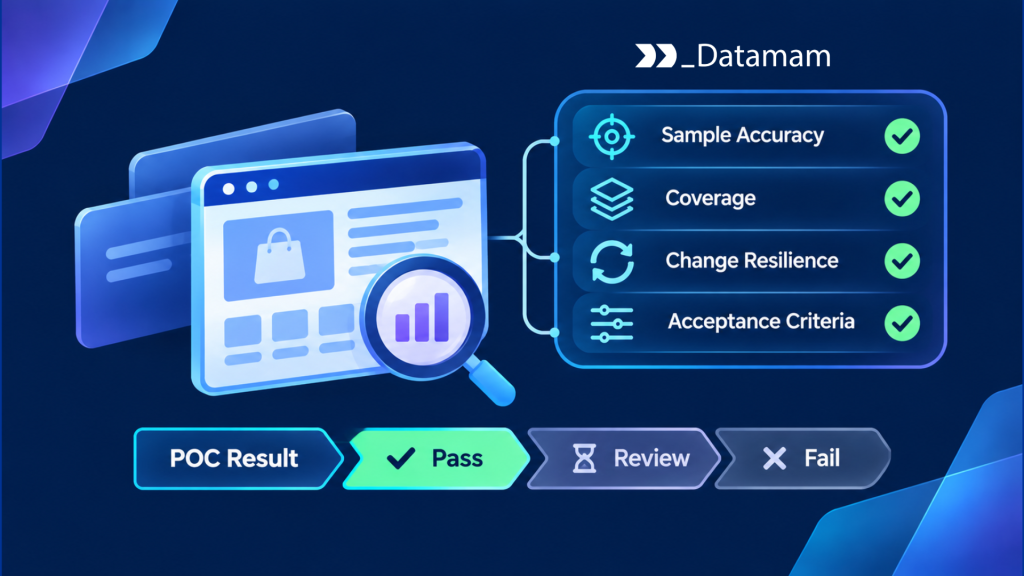
A vendor can show an attractive spreadsheet extracted from fifty web pages and still be unable to operate a dependable daily feed. The easy pages may be unrepresentative. The source identifiers may not match the buyer’s catalog. A hotel price may omit its cancellation terms. The data may be correct in JSON Lines but incompatible with the buyer’s reader. And no one may have tested what happens when a worker stops midway through publication.
A web scraping proof of concept (POC) is a bounded, evidence-producing evaluation of whether an acquisition approach can satisfy a defined business need under representative source, quality, operational, and integration conditions. Its purpose is not to prove that scraping is possible in principle. Its purpose is to reduce specific uncertainties before the buyer funds a recurring production service.
For an enterprise buyer, the decisive question is: can this provider repeatedly deliver the right records, under the right conditions, to the right system, while making failures visible and recoverable?
Why a Successful Demo Is Not a Successful Scraping Pilot
One extracted page versus the approved business population
A one-page demo demonstrates that one page, at one time and in one context, can be interpreted. It does not establish that the provider can discover the full eligible population, preserve identity across sources, handle pagination, or maintain recurring updates. The difference between a demonstration and a pilot is the presence of a pre-agreed denominator and acceptance boundary.
A retail buyer may require comparable offers across a defined catalog, sellers, countries, and package conditions. A travel buyer may require route-date-source searches that sometimes return no qualifying result. A directory buyer may require all approved specialties or geographic regions. Sampling must acknowledge which groups are represented and which remain untested.
A convincing pilot therefore reports required source or search units, attempted units, accepted complete outcomes, legitimate empty outcomes, and unresolved units. The number of records emitted is a separate measure. A data-rich easy page cannot compensate for missing an entire required source category.
Test a consuming application, not only the scraper output
Parsing a page into syntactically valid JSON is an intermediate technical result. The buying organization needs a dataset that its analysts, application, or data warehouse can ingest and interpret. That means agreeing on schema, record grain, identifiers, nullable fields, timestamp semantics, partitions, encoding, and how corrections are delivered.
Datamam’s documented national physician-data engagement illustrates the risk. Collection produced 26 alphabet-partitioned files, but the receiving application expected a JSON-array contract rather than the original JSON Lines framing. Three nested fields then required a string-compatible projection for the consumer’s schema. Datamam revised the export, and the receiving engineer accepted the format later the same day. The underlying profile content was useful; actual delivery acceptance depended on how the consumer read it.
A pilot should include the receiving engineer as an acceptance owner. If the buyer cannot load the sample using its intended workflow, the pilot has not finished its end-to-end test, regardless of how well the scraping demonstration looked.
Separate the pilot’s evidence from unsupported scale forecasts
A pilot can prove that a tested set of sources and conditions worked during its observation window. It does not automatically prove the same success rate, cost, or throughput at one thousand times the workload. At production scale, source-specific rate limits, changing session behavior, longer queues, browser requirements, downstream ingestion, and maintenance load can become dominant.
Use pilot throughput to build a capacity model only with explicit assumptions. Separate accepted jobs per hour from raw requests per second; account for multiple attempts per business job, different page families, source access restrictions, and the required completion window. Record which assumptions were observed and which still need controlled validation.
A useful pilot conclusion may be “the integration met the tested scope, with source C still needing a throughput evaluation,” rather than a misleading claim that the full production service has already been proven.
Freeze the Decision and the Acceptance Contract
Define eligible records and required context
Start by writing the business question. Is the buyer comparing retailer prices, monitoring current flight offers, maintaining a property inventory, or building a provider directory? Then define the eligible record grain: one product offer, one route-date-market search, one room-rate observation under a stay configuration, or one physician and its related facts.
Specify mandatory context rather than just mandatory fields. Price without currency, quantity, seller, date, or point of sale may be unsuitable for a comparison. Hotel rates may require occupancy, room equivalence, cancellation policy, and mandatory fee treatment. A product title may not establish product identity if pack size and variant differ.
Agree on how unknown values, missing source information, rejected records, and non-qualifying results will appear. The acceptance definition must not pressure the vendor to fill missing business facts with defaults such as price = 0 or availability = false.
Source count, difficult cases, and refresh windows
The pilot scope should name its sources or source categories, search-market combinations, page templates, language and geography requirements, and the planned recurrence. Include known hard cases and uncertain cases, not merely the easiest available websites.
The right sample size depends on the number of materially different failure modes, business grains, and source families. It is not a fixed percentage of the future catalog. One source with several distinct session and page-template behaviors may deserve more attention than several uncomplicated sources with almost identical structure.
Set a bounded test calendar that includes more than one refresh when recurring delivery is the goal. If the planned service has multiple priority tiers, exercise the important windows. Do not set a deadline so short that the project only proves a manual first extraction and no recovery behavior.
What must arrive in the destination to pass
Define completion at the consumer boundary. The required deliverable may include normalized rows, explicit search-status results, source evidence references, a release manifest, and a loaded application or warehouse view. The receiving party should be able to query the accepted population and reproduce the acceptance counts.
Write down the acceptance clock: due time, final permitted acceptance time, and recovery cutoff where appropriate. Specify how late success, accepted empty outcomes, and unresolved work are represented. The pilot should not score a file transfer as successful if a required downstream schema projection fails.
Google’s SRE service-level guidance recommends choosing indicators that reflect what users actually care about. For a scraping POC, this means measuring accepted business results at the intended destination rather than treating worker uptime or HTTP success as the principal outcome.
Choose a Representative Source and Record Sample
Simple templates and the hardest variants
Include easy pages to establish a baseline, but deliberately add pages with variant selectors, different product conditions, listings with incomplete information, reused URLs, nested relationships, and alternative templates. Test records should represent the problems most likely to make the eventual data unusable.
For product comparison, include exact manufacturer matches and a category that requires approved equivalence rules. For travel, include both comparable and noncomparable fares. Also, for directories, include entities with multiple affiliations, duplicate names, or changed source identifiers. These cases reveal whether the provider understands the buyer’s business meaning, not just parsing syntax.
Track which scenarios were deliberately selected. A curated stress sample cannot be presented as a random accuracy sample of all records; it is valuable because it exercises known risk, not because it estimates population-wide error rates.
Different sessions, markets, pagination, and empty-result cases
A source may expose different results depending on a permitted session configuration, requested country, language, currency, filters, or pagination path. Include the contexts materially required in production. A browser that successfully displays the default English page may still fail to retrieve the intended market’s prices.
For search-oriented sources, include legitimate empty outcomes and a way to confirm that the search finished. A blank page before rendering completes is not the same as an accepted search with no qualifying listing. Also test failures or restricted access states separately from business no-result outcomes.
Datamam’s initial hotel pricing discussion began with 50 hotels to define property identity and whether rooms and rates were genuinely comparable across channels. That documented starting scope illustrates the value of using a bounded population to settle the comparison definition before expansion. It is not a universal recommendation that every POC should contain fifty hotels or fifty websites.
Population coverage with traceable source keys
List the test population with stable identifiers, expected sources, effective scope dates, and record categories. Preserve source-native identifiers and the buyer’s canonical identities where matching is required. The pilot output should explain how every accepted record maps back to the source observation and how ambiguous candidates were handled.
Track coverage by business segment rather than collapsing it into one percentage. If the sample contains ten sources but all failures come from a single critical source, the buyer needs to see that source explicitly. A high overall record count can mask unacceptable holes in source or market coverage.
Do not silently replace a failed hard case with an easier page after the pilot has started. Scope changes can be legitimate, but they must be documented separately from the original acceptance denominator.
Make Data Quality Tests Part of the Pilot
Identity and commercially correct field interpretation
A source price parsed as 29.99 is not necessarily a correct commercial offer. The price may apply to a different pack size, a membership tier, a different currency, or an unavailable delivery market. Data quality tests must inspect the original source context and the exact business meaning of the accepted fields.
Define which errors are blocking: wrong entity identity, wrong unit or currency, missed mandatory fee, mixed hotel occupancy, missing seller, or other material conditions that make the business decision unsafe. Less critical fields can have separate review or informational classifications, but the choice should be agreed before the sample is scored.
Link each reviewed discrepancy to a stable source record and a ruleset version. If the vendor corrects it during the pilot, retain the original failed result and the accepted correction rather than presenting the corrected output as if the error never occurred.
Completeness, required fields, and semantic review samples
Run three distinct checks: population completeness against expected jobs, field completeness within accepted records, and semantic agreement against appropriately reviewed source evidence. Each has a different denominator. A high required-field presence rate is compatible with an incorrect product match; a high sample agreement rate says nothing about an omitted region unless that region was in scope.
A robust sample-review plan combines a representative random or stratified sample for an error-rate estimate, when feasible, with targeted difficult cases for risk discovery. Preserve sample selection criteria, source distribution, review date, disagreement reasons, and how adjudication was performed. Never generalize a convenience sample to the entire future production population.
Where a field can legitimately be undisclosed at the source, the test should verify that the result remains unknown rather than counting a fabricated default as complete.
Explicit errors, exclusions, and accepted no-result outcomes
Every scheduled job should resolve to an accepted output, an accepted no-result outcome, a documented exclusion, or a specific unresolved exception. The pilot must not convert missing work into no-result records or remove failed jobs from its completion denominator.
Use controlled error categories such as acquisition failed, unexpected page family, parsing failed, business context invalid, identity ambiguous, and destination load failed. Define what evidence is retained and who can review it. Exclusions should have a recorded reason and approver so the vendor cannot make the results look better by quietly shrinking the test population.
The final result should allow the buyer to reproduce both the numerator and denominator for every published pilot completion or quality percentage.
Run the Entire Delivery Path, Not a Standalone Extractor
Manifest, schema, timestamps, and accepted partition
Require a release artifact with a schema version, source and run identities, accepted record counts, exception counts, collection interval, and the files or objects that belong together. A checksum or equivalent content identity supports integrity verification and replay. If output is split into multiple partitions, the consumer must know which partitions constitute one accepted release.
A stable observation key should distinguish source or search identity from the individual attempt. Retried acquisition should not create a second business observation for the same scheduled check. The output should preserve actual source observation time, acceptance time, and publication time where those distinctions matter.
The manifest is an acceptance control, not just a packaging convenience. It lets the buyer compare what the vendor promised to produce with what the destination actually received.
Ingest into the actual warehouse or application
Exercise the same reader configuration, authentication boundary, table schema, partitions, and downstream transformations intended for production. The goal is to expose incompatible formats and relationship assumptions early, not to demonstrate that a file opens in a text editor.
The physician-data case shows why this matters: 26 alphabet files needed a JSON-array framing and later compatibility changes to three nested fields before the receiving workflow accepted the data. A POC can incorporate a small version of the actual consumer-load test without reproducing the entire production population.
For BigQuery users, the documented `INFORMATION_SCHEMA.JOBS` view can provide evidence that warehouse jobs ran and where errors occurred. That is not the final business acceptance check; the required rows and relationships must also be queryable.
Prove duplicate-safe replay and corrections
Interrupt or repeat a delivery under controlled test conditions and verify that replay does not multiply accepted business records. Preserve the same scheduled-job identity and use stable record keys or versioned upserts. For a correction, ensure the receiving system can distinguish a revised interpretation from a newly observed market change.
File-level duplicate protection is not enough by itself. Snowflake’s data-loading documentation describes load history and file reloading behavior; a batch repackaged into new files can still require record-level idempotency. Likewise, Google Cloud’s Dataflow documentation explains that exactly-once processing guarantees do not automatically extend to arbitrary external side effects.
A POC should show the actual receiving records before and after replay, not merely assert that the design is “idempotent.”
Test Failure, Website Change, and Recovery
Retained evidence and parser regression checks
Choose source examples that reveal the intended page family and field interpretation. When a parser is modified, reprocess retained authorized source evidence with the previous and proposed rules. Compare accepted fields, identity mappings, missing values, and exceptions. A code diff or a successful single page execution does not demonstrate semantic compatibility.
Do not assume the pilot can cause or control a live publisher’s redesign. A controlled test can instead replay known alternative templates, malformed permitted fixtures, or previously observed source variations. Label synthetic fault injection as a test rather than claiming that a real publisher outage occurred.
The decision criterion is whether the team can detect a changed source contract, identify the affected population, prevent unacceptable publication, and demonstrate a verified correction.
Interrupted collection or delivery with preserved job identity
Pause or terminate a test worker after it records source evidence but before the complete destination commit. The recovered process should retain the original business-job ID, distinguish the new acquisition attempt from the scheduled unit, and publish at most one current accepted outcome for that unit. Attempt history can legitimately contain duplicates; the business result cannot.
Datamam’s documented ten-day airline engineering evaluation covered 6,471,938 scheduled searches across four sources before the separate 30-day operating cohort. Among the evaluation’s tests, the team interrupted workers after evidence capture and replayed delivery batches to check that one scheduled search retained a stable identity and that repeated delivery did not duplicate the fare records. Those observations demonstrate the kind of failure scenario an enterprise pilot should investigate; the project’s scale is not a recommended minimum or typical POC size.
Source-specific degradation without portfolio-wide outage
When multiple websites are involved, test that one broken source does not prevent the publication of healthy sources unless the approved delivery contract deliberately requires an all-or-nothing release. Simulate a validation failure on one adapter and verify that the other source releases remain identifiable, complete, and safe to ingest.
Datamam’s separate 200-website weekly collection project provides a production operating example: one redesigned source entered a recovery state while 199 healthy source deliveries continued. Its source-level release was explicitly missing from the portfolio manifest rather than silently counted as complete.
A pilot for a smaller estate can test the same isolation principle without claiming that its results prove fleet-scale reliability. The architecture should expose whether shared credentials, one global queue, or one unversioned manifest could turn a local problem into a portfolio-wide failure.
Measure Pilot Results With Honest Denominators
Jobs due, attempts made, and accepted observations
Count the pilot’s due business jobs, actual acquisition attempts, accepted completed jobs, completed no-result jobs, late recovered jobs, unresolved jobs, and accepted observation records. Attempts may exceed jobs, and records may exceed successful jobs. Treat each relationship explicitly.
A transparent report can state: “Of 500 scheduled source-search units, 480 completed within the agreed window, 10 completed during recovery, and 10 remained unresolved; the accepted nonempty searches produced 1,730 observations.” These figures are illustrative, not Datamam results. The on-time completion rate is 480/500 = 96%; completion through recovery is 490/500 = 98%. The 1,730 records are output volume, not the completion denominator.
Break results down by source and difficult-case class. A provider can perform well overall while failing every session-dependent page in the test.
Deadline completion separately from late recovery
An eventually successful search is not necessarily on time. Define the original deadline for each job and a separate recovery cutoff. In pilot reporting, show on-time accepted, late recovered, and unresolved as mutually exclusive terminal cohorts at the reporting boundary. The recipient can then evaluate whether the recovered output remained useful for the actual business decision.
Likewise, distinguish capture completed before the deadline from accepted results that were queryable in the destination before the deadline. The buyer may care about the latter; a collector-only timing report would be insufficient.
Review whether sample sizes support meaningful interpretation of low-frequency failures. A one-day pilot with no source redesign cannot estimate annual source-change frequency, however complete its daily job count may be.
What a sample can and cannot predict about production
A pilot can establish the feasibility of the tested data model, show how difficult records are handled, demonstrate consumer compatibility, and estimate workloads under the observed source and environment conditions. It cannot guarantee long-term failure rates, future source access, full-estate coverage, or cost at an untested concurrency level.
Document which variables were controlled and which were not: source family, region, session requirements, refresh cadence, selected market, error mix, and destination configuration. Scale projections should state throughput assumptions, expected retries, authorization constraints, operating hours, and required acceptance capacity.
For serious purchasing decisions, treat unresolved production-scale questions as gates for a subsequent controlled load test or staged rollout, not as a reason to disguise assumptions as measured outcomes.
Decide Whether the Pilot Justifies Production
Pass, conditional pass, or fail against pre-agreed criteria
The final decision should follow rules agreed *before* the pilot began. A pass means the required tested business population and destination outcome met the stated acceptance conditions. A conditional pass means core feasibility was demonstrated but named, bounded issues still require specified remediation and retesting. A fail means the pilot did not establish an essential requirement or exposed an unacceptable risk.
A practical scoring record can be organized as follows. The example categories are a procurement design, not a Datamam-specific published standard:
| Acceptance area | Evidence the buyer should receive | Result classification |
| Population coverage | Due-job ledger and coverage by approved source and segment | Pass / conditional / fail |
| Semantic data quality | Reviewed source evidence, discrepancy list, adjudicated samples | Pass / conditional / fail |
| Delivery compatibility | Accepted manifest plus successful real consumer query | Pass / conditional / fail |
| Deadline performance | On-time, late, unresolved outcomes with a fixed denominator | Pass / conditional / fail |
| Failure and replay | Controlled fault tests, retained job identity, no duplicate business records | Pass / conditional / fail |
| Source-specific isolation | Healthy source release while another source is withheld | Pass / conditional / fail |
Not every category should be weighted equally. A wrong-market fare or corrupting replay can be disqualifying even if average throughput is high. A missing noncritical optional field may justify a conditional pass if remediation is bounded and documented.
Remaining risks and assumptions requiring engineering work
Record each unresolved risk with severity, affected source or record population, evidence, owner, planned remedy, and the test that would close it. Common examples include changing source access terms, untested country-specific sessions, identity conflicts, incomplete historic backfill, uncertain browser cost, and a warehouse load path not yet exercised at representative volume.
The commercial proposal should distinguish known operating responsibilities from assumptions. A provider may be responsible for source adapter repair while the buyer owns proprietary entity-matching decisions; another engagement may transfer both. The pilot should expose that responsibility boundary before a contract is signed.
Avoid demanding impossible proof of future website stability. The defensible requirement is to show a credible process for detecting, isolating, diagnosing, repairing, and communicating source change.
Rollout gates, initial support model, and scope-change treatment
A successful pilot should lead to a staged production plan with specific acceptance gates: initial source inventory, first recurring accepted releases, stable identity and schema contracts, tested delivery replay, support escalation, and a method for adding or retiring sources without silently changing the denominator.
Agree how production monitoring will report missed deadlines, schema issues, and stale data to both engineers and business users. Define whether a source redesign is included in ordinary maintenance or triggers scoped engineering work. Separate anticipated operations from genuinely new markets, fields, source families, or refresh frequency.
The final procurement decision is not “did the vendor scrape the site?” It is “which recurring data obligation have we proven, which risks remain, and what evidence will close them before expansion?” That is the standard by which a POC becomes an investment decision rather than a persuasive demonstration.
For teams preparing an enterprise collection pilot with measurable acceptance, integration, and recovery requirements, discuss a scoped proof of concept with Datamam.
Frequently Asked Questions
What should a web scraping proof of concept prove?
It should prove the feasibility of a specified business-data contract under representative source conditions: eligible population coverage, meaningful field accuracy, accepted no-result and failure states, repeatable delivery, consumer compatibility, and a credible recovery path. A parsed sample alone proves much less.
How long should a scraping pilot run?
Long enough to exercise the refresh and recovery behaviors that matter for the intended service. A one-time backfill has different requirements from a daily feed. The evaluation window should be tied to the business collection cycle and relevant source variability, not an arbitrary standard duration.
How many websites or pages should a POC include?
Enough to represent materially different page families, market contexts, and data-quality risks. A smaller carefully stratified scope may be more informative than a large batch of homogeneous easy pages. Specify the source and record selection method before measuring outcomes.
Should the buyer test the output inside its real data warehouse?
Yes, when a warehouse is the intended production destination. Validate the actual reader, schema, permissions, record keys, partitions, refresh visibility, and ability to reconcile published records to the manifest. A file that parses locally may still fail the consumer’s data contract.
How can a pilot expose source-change and recovery risks?
Use retained alternative templates, controlled parser regressions, worker interruptions, failed publication tests, and duplicate-safe replay checks. Distinguish these injected tests from real website incidents. Verify that one source’s failure can be isolated without misreporting the accepted status of healthy sources.
What must be recorded before moving a scraping POC into production?
Record approved sources, record definitions, quality rules, scheduled-job denominators, observed pilot results, exceptions, destination acceptance, replay behavior, remaining risks, source permissions, responsibilities, escalation, and stage-by-stage rollout gates. Preserve the evidence linking those decisions to the pilot’s actual runs.