Key Takeaways
- Freshness is a consumer-time measurement. A record can be collected according to schedule yet be too old for a specific pricing or availability decision.
- Keep different clocks separate. Source-effective time, scheduled check time, actual observation time, validation time, publication time, and query time answer different questions.
- Refresh frequency is not a freshness guarantee. Queues, sessions, retries, validation, and warehouse delivery all affect how old the last accepted observation becomes.
- Population coverage matters as much as percentiles. A short p95 publication lag for completed jobs says nothing about work never completed or still stale at the cutoff.
- Failure does not mean a market change. When a check fails, retain the last valid observation as historical evidence and expose its age; never manufacture a new zero price or out-of-stock state.
- Cross-source comparisons need time alignment. Different observation ages can create an apparent price difference even when no simultaneous disparity existed.
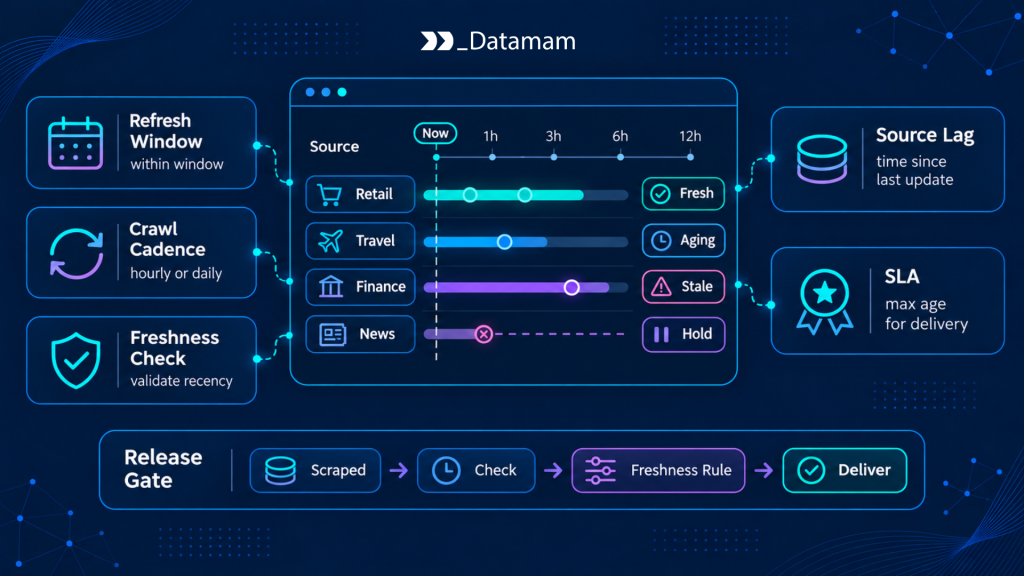
A retailer can collect competitor prices every four hours and still show a price observed eight hours ago. A travel analytics platform can load today’s collection file successfully while a selected source’s latest accepted rate dates from yesterday. Data freshness in web scraping is the elapsed time between the observation that supports a business record and the moment a consumer uses that record, interpreted against the business decision’s maximum acceptable age.
Freshness is not a claim that the source itself has not changed. A scraper does not necessarily know the precise time a website updated a price. It can establish when a particular value was observed, whether the collection completed successfully, and when that evidence became queryable. That distinction is essential for honest price intelligence, inventory analysis, and historical reporting.
What Does Freshness Mean for Scraped Data?
Source event time, capture time, and publish time are different
A website may display an event’s effective date, such as the start of a promotion, the filing date of a public disclosure, or a scheduled travel departure. Source event time describes that business event when the source exposes it accurately. Observation time records when the collector actually saw the relevant information. Publication time records when the validated result became available downstream.
These timestamps must not be substituted for one another. A price observed at 10:00 can have an effective date of midnight and become available in the consumer warehouse at 11:15. Neither midnight nor 11:15 is when the price was actually observed. If the site does not expose when its data changed, do not infer an exact source-change timestamp from managed web scraping workflows or scrape timing. Two travel rates dated the same day may still refer to different check-in dates, currencies, or points of sale.
Observation age versus collection interval
Observation age at query time is consumer_query_time – last_accepted_observed_at. A collection interval is the planned spacing between attempts to check a given business entity. One measures the actual age of available evidence; the other measures scheduling intent.
Suppose an accepted price was observed at 10:00, published at 11:15, and read at 14:00. Its observation age is four hours, and its publication lag is one hour and fifteen minutes. If another check was due at 14:00 but failed, the latest valid record remains four hours old at 14:00 and grows older until a subsequent accepted observation arrives. The mere existence of a new scheduled run does not reset the clock.
This distinction prevents dashboards from labeling a current pipeline execution as newly observed market data. A worker timestamp cannot substitute for an accepted source observation.
The consumer’s decision determines acceptable staleness
Freshness has no universally correct maximum age. A real-time repricing algorithm reacting to inventory changes may require much newer evidence than a weekly category-assortment study. A research analyst may intentionally use a historical snapshot months old because reproducibility, not present-market recency, is the requirement.
Start with the action: what decision will be made, how costly is a wrong or stale decision, and when does that action expire? Define an acceptable observation age for each business use, source, or priority tier. A consumer can then apply rules such as eligible for automatic decision, visible with stale warning, or historical-only without rewriting the underlying source evidence.
A freshness rule can therefore differ across users of the same dataset. Keep the original timestamp in the shared data model so every downstream team can evaluate it consistently.
Four Timestamps a Trustworthy Feed Should Preserve
Scheduled time and actual source observation
Preserve the scheduled due time of the business check and its actual observation time as separate values. Scheduling establishes whether the service met its planned delivery obligation; observation time establishes when the underlying fact was seen. Also retain the job identity and market or search context so that the timestamps describe the same requested population.
A check scheduled at 09:00 but not observed until 10:30 was delayed before source evidence was acquired. An accepted observation made at 09:05 but released at 11:30 had a different problem. Either could be too old for the receiving user by noon, yet the responsible subsystem is not the same.
A source-effective timestamp can be stored separately as a fifth, optional business attribute when the publisher actually provides it. Do not require it where the website provides no reliable effective time.
Validation and acceptance time
The acceptance timestamp marks when the pipeline established that the captured content met the agreed business schema and quality rules. This is important for troubleshooting, but acceptance time does not make the observed content newer. A capture at 09:00 accepted at 10:00 still represents a 09:00 observation.
Keep a validation outcome and schema or rule version alongside acceptance time. If a later parser correction improves a stored observation, retain the original capture time and add a revision or correction timestamp. Otherwise the corrected record could appear to be a fresh market observation when no new source check occurred.
A record should not be considered business-ready merely because parsing emitted valid JSON. Semantic checks may need to confirm seller, price basis, currency, room configuration, and stable identity before it becomes eligible for the consumer view.
Warehouse availability and consumer query time
Publication time indicates when a defined accepted release was made available in the intended storage or warehouse. Query time is when the consumer actually requests the data. Their difference represents how long a delivered observation has been sitting in the consumer environment; the gap from actual source observation to query time is the age relevant to the decision.
Destination availability must be tested rather than inferred from a successful object upload. A transfer can finish while a warehouse load fails, a permissions change blocks the intended table, or a downstream model still points to yesterday’s partition.
This follows the user-centered principle in Google’s SRE guidance: indicators should represent the user’s experienced service, not solely an upstream component’s activity. For data products, the relevant endpoint is often a queryable validated view.
Why a Fast Scraper Can Still Deliver Stale Data
Queue wait, multi-step source sessions, and retries
A source may take milliseconds to return one page but require several interaction and verification steps to complete an accepted business search. Queue wait may dominate time when collection must respect per-site limits or divide work among markets and sessions. A retry after a failed or incomplete response further delays the accepted observation.
Different source populations should retain separate latency distributions. A fast average from simple HTML pages can hide slow critical pages requiring rendering, authorized session setup, or deeper pagination. When a publisher’s access conditions change, availability may deteriorate even if the worker fleet has spare capacity.
Freshness reports should therefore show queue and capture delays, not merely raw response times. These components are operational causes, while the last accepted observation age remains the business impact.
Parsing, QA, and publication latency
After capture, a pipeline may need to normalize currencies, align product identifiers, validate a rate’s occupancy and conditions, deduplicate observations, and assemble a complete release. Those checks add elapsed time but also prevent the publication of misleading data. Simply bypassing them to improve a latency chart can worsen the data product.
Datamam’s airline operating cohort recorded a 95th-percentile publication lag of 5 hours, 48 minutes, and 12 seconds among searches completed inside their twelve-hour window. The measure ran from scheduled dispatch to accepted BigQuery availability and included queuing, collection, validation, and delivery. It did not measure the time the airline originally changed a fare or guarantee that all scheduled searches had completed.
In the separate hotel cohort, the corresponding p95 measure was 4 hours, 17 minutes, and 38 seconds for on-time searches inside an eight-hour window, ending at accepted Snowflake availability. These are distinct source populations and workload definitions; their p95 figures are not a general industry comparison.
Delayed loads after a successful collection
A warehouse staging error can leave an accepted capture invisible to the business application. This is why fresh at the collector and fresh at the consumer are separate states. Record an accepted source observation, an accepted release, a destination-load receipt, and a consumer-view visibility check.
The Snowflake data-loading guidance explains the platform’s file-level load status and repeat-load behavior. Those mechanisms help diagnose ingestion failures, but business-level completeness still requires confirming that the right records were available under the intended keys and schema. A later corrected batch may need explicit record-level version handling beyond file deduplication.
The freshness clock continues to advance while a file is waiting to load. Publishing the old snapshot late does not make the underlying market observation newly captured.
A Freshness Metric Needs a Population and a Boundary
Latest accepted observation age by source and product
Measure freshness at the record grain that the consumer needs. For a retail feed, this might be a catalog-to-retailer mapping for a specific seller, country, and package. For hotel rates, it might be a property, room-equivalence class, check-in date, occupancy, and booking channel. A source-wide latest timestamp is insufficient when one segment is current and another is overdue.
Useful record-level fields include observed_at, accepted_at, published_at, collection_state, source_key, canonical_entity_key, and schedule_tier. A current view should expose the age of the last accepted evidence and whether the latest due check succeeded, failed, or completed with no qualifying result.
A recent record in the table does not prove all records are recent. Always pair age metrics with the expected eligible population for each group.
Percentile lag among on-time completions and its blind spots
Percentiles show the distribution of completion times among the observations included in the calculation. They can be useful for characterizing the long tail, but the denominator must be stated. A p95 publication lag measured only among on-time completions excludes jobs still unresolved or completed after the deadline. It cannot by itself answer how much of the required dataset was available at the promised time.
For Datamam’s airline cohort, the 30-day ledger separately recorded 19,402,184 on-time completions, 130,044 late recovered completions, and 32,439 unresolved searches out of 19,564,667 scheduled searches. The p95 publication-lag statistic applied to the on-time population. The separate deadline result determines how many requested searches met the service window.
Never combine a successful-job lag percentile with a missing-job count into a single, undefined “freshness percentage.” Report the distribution and coverage side by side.
Expected-versus-fresh population coverage
A practical fresh coverage ratio is the number of eligible business records with an accepted observation younger than the specified maximum age divided by the number of eligible business records expected at the measurement cutoff. Explicitly define whether retired, excluded, or completed-no-result entities remain part of that population; different use cases legitimately choose different policies.
Consider a product feed with 100,000 expected active mappings. If 92,000 have accepted observations inside their freshness windows, the fresh coverage is 92%. This is a mathematical illustration, not a Datamam project outcome. A fleet-level 92% may still be inadequate if the missing 8,000 mappings include all high-priority products in a critical category.
For a dashboard, display fresh coverage by business tier and source, plus the identities of overdue records. Freshness is only operationally useful when the affected population can be acted upon.
Refresh Frequency Is Not the Same as Freshness
Four-hour, daily, and weekly retail tiers
Datamam’s documented retail-pricing engagement covered 1.2 million client SKUs and 4.8 million accepted product-to-retailer mappings across twelve integrations. It used three disjoint refresh tiers: 240,000 priority mappings every four hours, 1.2 million regular mappings daily, and 3.36 million stable mappings weekly. This design assigned collection work according to business priorities rather than pretending all products required the same checking interval.
Those tiers generated a scheduled 3.12 million item-level observations per day under the documented plan: 1.44 million priority, 1.2 million regular, and a daily average of 480,000 weekly-tier checks spread through the week. The schedule describes intended workload and cadence. Actual age still depends on completed capture, acceptance, publication, and the moment the consumer queries the result.
A four-hour priority interval cannot be described as four-hour guaranteed freshness without evidence that the due jobs were completed, accepted, and made available on time.
Priority-based observation windows
Prioritization should reflect the cost and urgency of stale decisions. High-margin or volatile products may require shorter observation windows; a stable reference catalog may remain useful on a slower cadence. The scheduling tier should be an explicit field of the data contract so consumers can judge each record against the appropriate expectation.
Spreading weekly work through the week can reduce workload spikes and create a more predictable age distribution. Conversely, if a weekly batch runs every Monday, some records may approach seven days of age before the next observation, plus any collection and publishing delay. Neither pattern is inherently wrong; the acceptable age depends on the business requirement.
Assign specific freshness windows and publish the observed outcomes rather than using an ambiguous “near real time” label.
What changes when a source becomes more volatile
More frequent source changes may justify a shorter observation interval, a targeted high-priority set, or more explicit stale warnings. But volatility alone does not prove that every page must be checked continuously. The cost of a missed change, source restrictions, the available refresh budget, and the downstream decision interval all matter.
One appropriate method is to review historical accepted change events by source and category, identify where stale values caused commercial problems, and adjust the monitoring tiers. Distinguish measured source-change frequency from an estimate based only on observed page differences: multiple changes between scheduled checks can remain unseen.
This article defines how to evaluate resulting data age. The detailed capacity and economic decision about selecting refresh intervals belongs to the separate refresh-frequency article.
Represent Stale, Missing, and Empty Results Differently
A failed refresh should preserve a visibly stale prior observation
A failed current check does not invalidate a previously accepted observation as a historical fact. Keep the old record with its original observation timestamp, last accepted value, and an explicit current collection failure or overdue state. The consumer may be permitted to view it for context but should not treat it as a new market observation.
Datamam’s airline data model separated a LATEST_MARKET_VIEW from historical fare observations. If today’s collection failed, yesterday’s fare remained available but visibly stale. That preserved analytical continuity without representing technical failure as today’s market price.
The same principle applies to retail prices, property listings, and reported inventory. Freshness is a condition on use, not permission to rewrite when something was actually observed.
A completed empty result is a new accepted status
A completed search that finds no qualifying offer is a new business observation about the *search outcome*, not necessarily a new numeric price. Its context must be preserved: source, search parameters, date, market, filters, and the terminal success evidence. It should update the status of the current view without creating a fictitious zero-price row.
Datamam’s hotel project separately identified completed searches with no qualifying available room rate. This meant a new successful search could report “no eligible result under the requested stay conditions” even when a previous successful search contained rates. It did not imply that the property was universally sold out or permanently unavailable.
A consumer should be able to distinguish new accepted empty, old accepted nonempty but stale, and current collection failed. Collapsing these states makes both freshness and availability analysis unreliable.
No inferred price, stock, or availability changes from technical failure
Never transform timeout, access denial, failed parsing, or warehouse load failure into a business event such as price = 0, stock = 0, product removed, or rate unavailable. The appropriate output is an explicit technical state, along with the age of the last accepted evidence if it exists.
A status model can distinguish accepted_with_records, accepted_no_qualifying_result, collection_unresolved, validation_rejected, and publication_delayed. The exact labels are a design choice; the meanings must remain stable across replays and corrections.
This prevents false competitor movements and protects historical analytics against events introduced by the data pipeline itself.
Freshness in Cross-Source Comparisons
Timestamp alignment before comparing prices or rates
Two valid prices are not necessarily comparable if they were observed far apart. A retailer price captured at 09:00 and a competitor price captured at 16:00 may differ because the market changed, not because the two sellers simultaneously offered different prices. A comparison policy should state the maximum allowed observation-time gap and mark excluded pairs explicitly.
Datamam’s documented airline comparison process admitted candidate pairs only when their collection timestamps were no more than 90 minutes apart and their fare conditions were compatible. In a reviewed comparison stage, 140,217 candidate pair checks were excluded for exceeding the timestamp window and 71,607 for incompatible or insufficient fare conditions, leaving 8,201,463 accepted comparisons from 8,413,287 candidate checks. These are case-specific rules and outcomes, not universal travel-industry thresholds.
Timestamp alignment protects the interpretation of a simultaneous price difference. It does not establish how frequently the source changed between checks.
Multiple currencies, markets, and stay contexts
Freshness is necessary but not sufficient for comparability. Price records also require compatible currency treatment, buying location, seller terms, hotel stay configuration, flight passenger details, tax inclusion, and booking conditions. Two prices captured within minutes can still represent materially different products.
Preserve the source amount and currency, requested market, local and UTC observation times, and calculation or equivalence rule versions. When reporting-currency conversions are needed, keep the rate source and effective time distinct from the underlying observed price. Otherwise an updated FX rate can look like a source price movement.
Comparison eligibility should require both semantic and temporal compatibility. A “newest” record with missing conditions may be less useful than an older, fully interpretable record for historical analysis.
Why older accepted observations may remain useful historically
Historical analytics needs faithful records of what was observed, not a stream that overwrites the past whenever a new check completes. Older source observations can support trend analysis, seasonality, auditing, and reconstruction of previous decisions. They only become problematic when presented as current without age or status.
A correction after a parser revision should retain a revision event and the original capture reference. Analysts can then distinguish a true market movement from a corrected interpretation of the earlier source evidence. Keep the market timestamp, data-publication timestamp, and correction timestamp separate.
The right data product often has both a detailed historical observation table and a current business view that applies freshness and comparison rules explicitly.
How to Report Freshness to Business Users
Visible last-observed and last-published times
Expose the last observed at source timestamp and the last published to consumer timestamp. If only one timestamp can be shown prominently, prioritize the timestamp that lets the user judge the age of the market evidence, with a visible collection-status indicator. Label “updated” carefully: a newly reprocessed or loaded record may contain an older observation.
For a multi-time-zone audience, display a consistent time reference or an unambiguous local zone. A human-readable age such as “observed 6 hours ago” should be computed from the original timestamp, not from page cache refresh time.
Keep source effective dates where meaningful, but do not imply that they tell you when an unversioned website changed its content.
Freshness coverage by source and priority tier
A summary should report how many eligible records are fresh relative to each tier’s requirement, not just the newest accepted timestamp in the feed. Group by priority tier, source, geography, product category, and consuming business function where those dimensions drive decisions.
A useful business report might show fresh within policy, accepted but stale, new accepted no-result, due but unresolved, and out of scope populations. Include counts and a denominator so the meaning of percentages is auditable. Follow the summary with a drill-down to affected source or mapping identities.
A small but critical subset should be reported separately rather than hidden in a high global coverage percentage.
Overdue populations, recovery, and correction history
An overdue report should tell the user whether the record missed its observation deadline, the receiving publication deadline, or both. Late recovery may provide useful evidence but does not erase the earlier missed service window. Keep both the original due timestamp and the later accepted observation in the ledger.
When a previously published value is corrected, show that a correction occurred and preserve the earlier version and evidence where appropriate. Otherwise analysts may confuse repair of a parsing rule with a new market event.
The receiving team should be able to reconcile a consumer view to release manifests and back to actual source observations. Freshness reporting without this lineage can become a decorative dashboard metric rather than a trustworthy decision control.
How to Set a Freshness Requirement That Can Be Tested
Use the decision window rather than a generic near-real-time claim
Define the consumer’s permitted maximum age for each record population, the deadline at which the requirement is evaluated, and what constitutes an accepted business observation. A statement such as “critical products must have accepted observations younger than six hours at the hourly business decision cutoff” is more measurable than “near-real-time prices.” The six-hour value here is a generic contractual illustration, not a Datamam promise.
Specify exceptions for approved source outages or exclusions, the status of a completed no-result check, and what must happen when the requirement cannot be met. Where no universal limit is appropriate, use differentiated tiers rather than a single headline number that hides critical gaps.
The requirement should explicitly name the measured clock: age since source observation, end-to-end scheduled-to-publication lag, or both.
Test the receiving dashboard or warehouse view
Test freshness where users read the data. At a controlled evaluation time, query the consumer view, verify the last accepted observed_at, compare record age with the tier-specific limit, and reconcile expected identities with current statuses. Also inspect source and release manifests for missing populations.
dbt’s current freshness documentation describes configurable warning/error thresholds and ways to identify the most recently loaded data. Those checks are useful for warehouse-level timeliness, but the maximum loaded timestamp alone does not prove that every individual source item or required segment is fresh. A robust consumer test uses the actual business grain and eligible population as well.
Test failure states deliberately: an overdue source, a valid empty search, a corrected historical observation, and a delayed destination load. A freshness measure that passes all four without distinguishing them is not yet trustworthy.
Coordinate freshness language with the separately specified SLA
The operational definition becomes contractual only when the parties approve an eligible population, observation-age limit, measurement cutoff, exception treatment, reporting process, and corrective action. Keep service obligations distinct from descriptive production statistics. A 95th-percentile lag observed in one project is not automatically a promised SLA for another source population.
Coordinate the freshness policy with source access conditions, data quality acceptance, maintenance ownership, and the consumer-load boundary. A provider that commits only to producing a file cannot honestly guarantee freshness in a warehouse it does not operate unless the responsibility split and acceptance check are defined.
The separately assigned SLA article covers contract mechanics in depth. Here the essential principle is that freshness must be measurable from the consumer’s decision point back to accepted source evidence.
For teams whose pricing or availability decisions require traceable observation age and explicit stale-state handling, discuss a managed external-data feed with Datamam.
Frequently Asked Questions
Is data collected every day always fresh?
No. A daily schedule describes planned collection frequency. A particular record can be older if its check was delayed, failed validation, or was never made available to the consumer. Freshness is determined by the timestamp of the last accepted observation at the moment of use.
What is the difference between refresh frequency and data freshness?
Refresh frequency is how often the system intends to check an entity or search. Freshness measures the actual age of usable accepted evidence. The first is a schedule; the second is an observed consumer condition.
Which timestamp should a scraped-data dashboard display?
Show last observed at source and last available to the consumer, with the current collection status. The observation time supports the freshness decision, while publication time explains downstream delay. Do not relabel a late load as a new source observation.
Should a failed refresh overwrite the previous value?
No. Retain the previous accepted observation with its original timestamp and mark the current check as failed or overdue. The consumer can then decide whether that visibly stale record remains appropriate for the intended use.
Can old data still be valid for historical analysis?
Yes. Historical validity depends on whether the observation accurately reflects the source at the recorded time and retains its context. An old observation can be unsuitable for today’s repricing yet valuable for research, audit, and trend analysis.
How should teams compare prices observed at different times?
Define a maximum allowed timestamp gap for the particular business use and combine it with product, market, currency, and purchasing-condition compatibility rules. Exclude or label pairs that fail those checks rather than presenting them as simultaneous price differences.