
Key Takeaways
- The hardest scraper failures can look successful. A collector may still return HTML and valid rows while extracting the wrong item, price basis, market, or offer condition.
- Repair starts with diagnosis. Retrieval, page-template, parsing, business-meaning, and downstream-ingestion failures require different fixes. Repeating the request will not repair a mapping defect.
- Every change needs regression evidence. Update the affected source adapter, test retained difficult cases, compare accepted outputs, and release with a rollback path.
- Maintenance should be isolated by source. A failing website need not block healthy collection or force every dataset into one delayed publication batch.
- A repair should not rewrite market history. Preserve observation identity, distinguish data corrections from newly observed events, and replay affected releases without duplicating records.
- Ownership is part of the operating model. Decide who investigates source changes, approves semantic rules, updates collectors, reports incidents, and handles scope expansion before production begins.
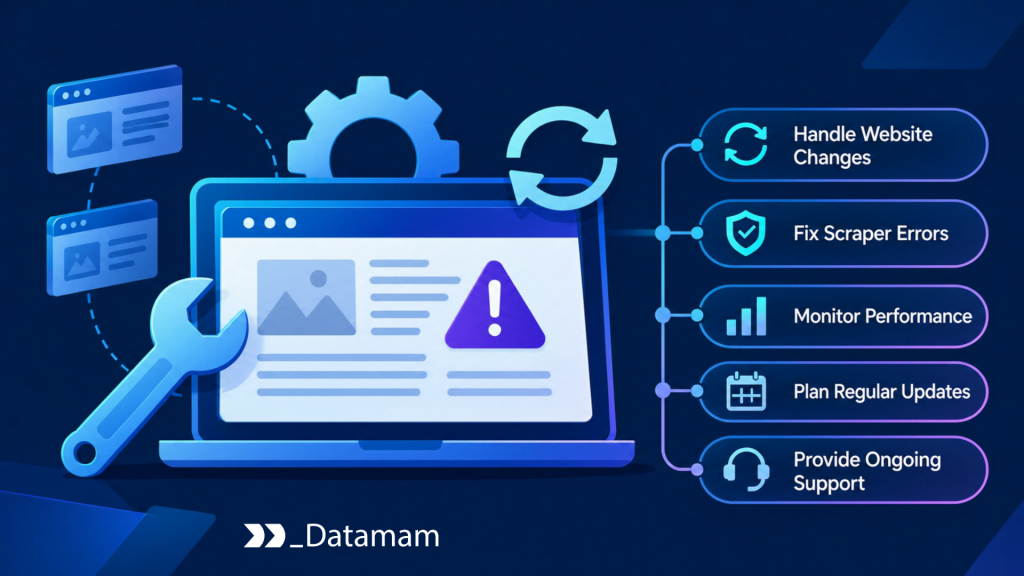
A scraper can run successfully every day for months and then fail after a source updates its catalog template. The obvious symptom is an empty field or an exception. The more dangerous symptom is an apparently healthy feed that now associates the displayed price with the wrong product variant, seller, or unit of measure.
Web scraping maintenance is the recurring engineering work required to keep source collection, interpretation, and data delivery correct as websites and business requirements change. It includes diagnosing failures, modifying collection or parsing logic, reviewing entity mappings, testing revised behavior, recovering affected data, and releasing changes without disrupting unaffected sources.
This is distinct from monitoring, which detects and communicates atypical behavior. Maintenance is the work that establishes the cause and restores acceptable output. A dashboard cannot decide whether a newly displayed “case price” should replace an earlier unit price. An engineer, a documented rule, or an approved matching policy must resolve that change.
Why a Working Scraper Becomes an Unreliable Data Feed
Markup and interface changes
Websites can change element structure, class names, pagination, category navigation, content ordering, and the page families through which records are discovered. A selector that depended on div:nth-child(3) may now point to a related product, a promotional card, or an empty placeholder. A URL that used to resolve directly to an item may begin redirecting through a different template.
The failure is not always a parser exception. An overly permissive selector may continue returning text, but from the wrong section. The job metrics still show completed requests and emitted items; the business feed becomes semantically invalid. This is why extractor checks should verify a recognizable page family and the meaning of critical fields, not just nonempty output.
Playwright’s locator guidance cautions that CSS and XPath expressions tied to a page’s DOM structure can break as implementations change. In source collection, however, engineers generally do not control the target website’s test identifiers or accessible attributes. They must choose and test the most stable available evidence for that site and maintain it as the publisher changes its implementation.
Access, session, and rendering failures
A source may switch from server-rendered content to client-rendered components, alter the sequence needed to load offers, change its session requirements, introduce regional restrictions, or present an access notice instead of the intended page. A simple HTML request that previously exposed product data may now return a shell requiring a different, authorized acquisition approach.
When this happens, distinguish a failed resource request from a successful response containing the wrong material. Effective scraper failure recovery begins by identifying whether the problem involves source access, content rendering, parsing, or data validation.
Recovery procedures should restore accurate records, verify their completeness, and confirm that corrected data meets downstream acceptance requirements rather than simply repeating failed requests. Cloudflare documents an explicit cf-mitigated: challenge response header for its Challenge Pages. That is a useful classifier for a site using that protection, but not every access failure originates with Cloudflare or provides the same evidence. See the Cloudflare Challenge Page response documentation.
Maintenance should respect site access conditions, applicable agreements, and operational rate limits. A changed access boundary may require a revised permission or source strategy; it is not merely an invitation to increase retries. Repairing a queue’s retry policy cannot make inaccessible or unauthorized content an accepted business observation.
Semantic changes that leave the parser apparently healthy
A retailer can introduce a new pack-size label; a travel site can change the default occupancy; a marketplace can shift from public prices to member prices; a directory can move an affiliation into a historical section. The same parser may continue emitting rows with all mandatory fields, but their meanings have changed.
Datamam’s retail-price program explicitly handled reused URLs and changed product packs by returning affected product-to-retailer relationships to review. The collector did not have to rediscover the full catalog to repair one relationship, and historical prices retained the mapping decision that was in force when they were accepted. This is a maintenance principle: fix the smallest incorrect interpretation without creating a false history of source changes.
An apparently healthy scraper therefore requires two kinds of maintenance: operational compatibility with how the site now delivers content and semantic compatibility with the buyer’s data contract.
Classify the Failure Before Choosing the Repair
Retrieval failure, unexpected template, and parser regression
The first diagnostic question is where the result diverged from the accepted contract. A retrieval failure means the expected resource was not acquired; a template failure means a response arrived but did not contain the expected page family or content; a parser regression means recognizable source content was present but extraction produced missing, malformed, or mislocated values.
Keep source evidence and collection metadata tied to the job identity: request configuration, final URL, response status, content type, source capture or permitted diagnostic sample, parser version, and terminal state. Without that trace, engineers may change selectors to treat an access notice as a product page or increase retries for a data-model error.
A repair sequence should avoid unnecessary changes. If the page is recognizable but one field is missing, review the field rule. If all records from one source suddenly disappear, inspect discovery and page completion before rewriting field extraction. Also, if the network response contains the wrong page, parsing changes may be irrelevant.
Wrong identifiers, quantities, conditions, and context
Business-semantic failures require a different classification. Examples include a stable-looking identifier assigned to a new item, a price extracted without its pack quantity, a hotel rate missing the requested occupancy, or a seller’s restricted promotion treated as a public offer. These values may be syntactically valid and even plausible.
A useful incident record identifies the affected business grain. Is the error tied to an entire source, one category, one page template, a subset of product variants, one country, or one mapping rule version? Scope determines whether the remedy is an adapter update, a matching-rule revision, a restricted source release, or reprocessing a historical segment.
Do not automatically accept a sudden commercial difference after a scraper change. Determine whether the source really changed or the extractor began interpreting a different field. In a pricing feed, a change of interpretation can be more damaging than a temporary missing record because it introduces a plausible but incorrect market movement.
Consumer-load failures that originate after collection
Maintenance does not end at the last HTTP response. A collector may produce valid JSON Lines while a warehouse job rejects a schema change, silently truncates a nested field, or appends duplicate observations when a failed batch is retried. These are downstream integration failures with data-quality consequences.
Datamam’s physician-data project illustrates the distinction: the collected and parsed content needed additional export projections before the consumer could load it, including changes to JSON-array representation and three nested fields. Repairing the scraper would not have solved a reader-contract mismatch. Similar issues occur in recurring production when upstream schemas change faster than the receiving application’s ingestion code.
Scraper schema drift can cause field mappings, data structures, or record meanings to change even when collection requests continue to succeed. Without proper detection, these changes may introduce incomplete or incorrect information into downstream systems.
The incident owner should identify the failure at the appropriate boundary: acquisition, parsing, normalization, publication, or consumption. Once identified, the affected processing logic should be corrected and the resulting data validated against the receiving system’s requirements. A delivery-side correction should not be mistaken for a new change at the source website.
Build a Controlled Maintenance Cycle
Triage using source evidence and failure impact
Start by determining which consumer decision is at risk. A missing optional description may justify routine repair. Wrong prices used for automated repricing, incorrect court-case attribution, or broken hotel-room equivalence may require stopping publication for an affected field or source. Severity depends on the *business consequence*, not simply the number of error log lines.
A practical triage record should capture:
1. The affected source, page family, business record type, and first observed failure window.
2. The last known accepted source capture and the first failing or suspect capture.
3. Whether the defect involves retrieval, parsing, interpretation, or consumer ingestion.
4. The potential blast radius: records, release windows, downstream reports, and historical partitions.
5. The temporary publication decision: continue, mark stale, quarantine, or pause the affected output.
Incident templates may differ between operations. The essential requirement is to connect diagnosis to the affected data contract and consumer decision.
Update adapters, extraction rules, and matching logic
Make the correction in the smallest maintainable unit. A source adapter typically encapsulates source-specific discovery, retrieval, page recognition, and extraction. Normalization and business matching may be separate components with their own versioned policies. Not every failure belongs in the adapter, and not every source change should force a shared schema update.
If a page adds a new label for pack quantity, change the extraction or interpretation rule and test old and new labels. If a URL now points to a different product variant, review the identity mapping. Also, if an entire page family is retired, update discovery and source coverage expectations. If the data is now gated by a materially different access condition, review authorization and feasible collection scope rather than layering unbounded retries.
Scrapy’s framework documentation separates spiders, selectors, items, item pipelines, and logging/statistics, which is a useful conceptual reminder that retrieval, extraction, transformation, and export have different maintenance points. The appropriate architecture depends on the production stack; no specific crawler framework is necessary to apply this separation.
Regression against retained examples before release
A repair that fixes today’s page can break yesterday’s accepted template or another product category. Test the revised extractor against retained examples representing both the new failure and previously accepted difficult cases. Assert the full business interpretation: identifier, variant, pack size, currency, status, source context, and output relationships where applicable.
Compare pre-repair and post-repair outputs at the business key and observation level, not only by row count. Look for newly null fields, duplicated keys, shifted distributions, and changes to accepted mappings. When a transformation rule changes, identify whether historical reprocessing is necessary and whether the receiving system can distinguish corrections from new observations.
A safe release should have a narrow rollout, a known previous accepted version, and a rollback procedure. Regression evidence does not remove all risk; it makes the release decision auditable and narrows the impact of a mistake.
Why Source Isolation Matters During Maintenance
Independent adapters, queues, and release identities
When unrelated websites share one global collector configuration or one all-or-nothing publication job, a redesign on one source can delay the entire portfolio. Separating source adapters, collection budgets, failure states, and publication identities allows a maintenance change to affect the intended source without automatically stopping the rest.
Datamam operated a weekly collection portfolio across 200 websites, producing 4.6 million records per full weekly sweep. Each site had a source contract defining page types, required fields, cadence, and acceptance checks. The receiving application used a shared publication model, but the individual sources did not depend on one universal parser.
In that project, a redesign affecting one site’s collector did not hold back the 199 healthy site deliveries. The missing source release remained visible in the portfolio completeness manifest, and its recovered batch could be published later under its own release identity. Such isolation depends on independent source scheduling and source-level publication identities. Portfolios without those controls can still suffer all-or-nothing delays.
Pause only the affected source or field contract
The correct containment boundary depends on the defect. If one source stops returning a valid category page, pause that source’s affected output and preserve other accepted sources. If only the interpretation of “minimum order quantity” has become ambiguous, the safer response may be to quarantine that field or affected offer class rather than halt unrelated source attributes.
In Datamam’s industrial-catalog takeover, a supplier template change affecting one field led to publication being paused for the impacted source and field contract while other managed sources continued on schedule. The case illustrates how narrow containment can preserve useful delivery without knowingly shipping suspect values.
Containment must be explicit to consumers. A portfolio manifest should show accepted, late, omitted, and unresolved source releases, with no false impression that a partial release is complete. Keeping healthy data flowing is valuable only when missing data remains visible.
Keep healthy delivery and portfolio completeness visible
A source-isolated architecture creates a coordination requirement: the buyer must know which source versions make up an accepted portfolio snapshot. Use source-specific release IDs tied to a portfolio manifest, with collection windows, schema versions, row counts, checksums where appropriate, and exceptions.
This gives consumers two valid options. They can ingest only complete releases when their application requires full coverage, or ingest healthy source partitions and later replay a repaired source while retaining an explicit completeness state. Neither should infer that a missing batch contains zero entities or that every source was checked on time.
The monitoring system may detect missing releases, but maintenance owns the repair: investigate the source, change the relevant component, test it, and publish a corrected or recovered source release. That keeps this operating responsibility distinct from dashboard and alert design.
Protect Business History While Fixing Extraction
Stable item and relationship identities
A URL does not always identify a persistent business entity. Product pages can be reused for new variants; hotel descriptions can be renamed; company records can relocate; seller offers can change while their parent product remains stable. A maintenance process must preserve stable business keys separately from source URLs and mutable labels.
Datamam’s retail program maintained 4.8 million active source-product relationships against 1.2 million client SKUs, rather than treating the 14.4 million theoretical SKU-retailer combinations as valid matches. Each accepted relationship carried the source listing, client key, match type, evidence, rule version, and review state. Discovery repaired mappings; recurring refresh reobserved accepted ones.
When a URL was reused or a pack changed, the affected relationship returned to review. The prior observation retained the relationship decision that applied at the time. That separation protects history from accidental identity reassignment during maintenance.
Corrections versus newly observed market events
An operator should be able to answer: did the business source change its offer, or did we discover that our earlier extraction was wrong? Those events must have different semantics in the dataset.
If a scraper begins reading a two-pack price as a per-unit amount, an engineer might correct the parser tomorrow and reprocess yesterday’s retained capture. The correction publication time is tomorrow, but the underlying observed source price belongs to yesterday’s source time. Treating the correction as a new source observation would fabricate a market event and distort trend analysis.
Keep source-observed time, processing time, interpretation version, and correction or supersession reference where the use case requires them. A current view may show the latest accepted interpretation, while historical analysis retains enough provenance to distinguish revised data from genuine changes in the market.
Targeted replay without duplicate consumer records
The goal of a recovery or historical correction is to revise the affected record or release once, even if the job is retried or a delivery object is redownloaded. Preserve unique business observation keys and delivery identifiers; use staging to deduplicate and reconcile before publication. The exact mechanism depends on the warehouse or destination.
In Datamam’s industrial migration, database and file deliveries used consistent source-level release IDs and retained at least 30 days of snapshot and change history. That allowed selective recovery without making every consumer rebuild the entire catalog. The case also describes rollback to the previous accepted delivery route if a source cutover did not meet its acceptance conditions.
For systems using BigQuery, Google Cloud’s `MERGE` documentation describes atomic combinations of inserts and updates and notes the error produced when multiple source rows match one target row during certain updates. The general lesson is not that MERGE alone guarantees safe replay. The pipeline must establish an unambiguous record identity and decide which revision is authoritative.
Maintain Fixtures for the Cases That Actually Break
Changed packs, reused URLs, and conditional offers
A fixture is a retained, reviewable source sample paired with the expected accepted output. Effective fixtures represent difficult business conditions, not merely easy pages. For a retail collector, useful cases include a ten-unit pack versus a 12-unit pack, a reused product URL, an out-of-stock variant, a coupon-only price, a seller change, and a member-restricted offer.
A repair passes when it preserves the meaning of the source record. For example, a revised parser may correctly extract $21 but still fail if it drops the ten-unit basis required to compare that price with a competing 12-pack. Test both raw extraction and normalized business fields where necessary.
Datamam’s retail case documents regression fixtures covering pack changes, reused URLs, restricted offers, and private-label near matches. It also preserves matching decisions in historical records. That combination turns source examples into a maintainable business contract.
Empty, challenged, and partially loaded pages
Many scraping defects arise from treating unexpected content as ordinary data. Test a completed empty search separately from a timeout, a challenge response, an error page with HTTP 200, and a page whose initial HTML lacks the asynchronously loaded offer block. If the parser accepts all of these as “no products found,” the maintenance fix can silently erase real inventory.
Datamam’s separate HTML archive project handled 25,000 submitted URLs, accepted 24,250 target pages, and retained 750 exceptions with reason codes. A response that returned an access notice with HTTP 200 was not accepted as a target page. The case is useful precisely because acquisition success was assessed by content identity, not the network status alone.
Retained failing examples let the maintenance team check whether a revised page-recognition rule now rejects incorrect content without discarding valid page variants. They also help decide which errors are recoverable and which require a source-scope or authorization review.
Versioned evidence covering previous and repaired behavior
A fixture suite should record the source capture, expected data, source or page-family classification, rule version, and the defect it protects against. New cases enter the suite when a real failure reveals a previously unhandled variant. Retired cases should remain accessible when they preserve historical compatibility requirements.
Avoid relying solely on live pages for regression. The website may have changed again, the original offer may have expired, and the source’s current configuration may differ. Archived examples make parser comparison repeatable, while carefully controlled fresh collection checks whether the repaired code is compatible with the present source.
Versioning matters for both parser logic and business meaning. The same HTML can produce a different accepted comparison if the buyer changes eligibility rules. A test must distinguish an intended policy change from an unintended extraction regression.
Assign Maintenance Ownership Before Production
Who investigates incidents and who approves changes
Maintenance ownership is not a single job title. It is a responsibility split between people who control the source integration and people who define the business acceptance rules. A provider may operate adapters, capture evidence, isolate failures, and deploy technical fixes. The customer may need to approve what counts as an equivalent product, a usable rate, an eligible geographic market, or an acceptable historical correction.
A practical responsibility matrix identifies ownership for:
| Maintenance decision | Typical accountable role | Why the assignment matters |
| Source retrieval and parser repair | Collector or managed-service operator | Requires source-specific diagnostics and release control |
| Business-semantic rule approval | Customer data or business owner, supported by operator | Changes what consumers may treat as comparable |
| Incident severity and escalation | Named service owner and receiving-team contact | Connects failure impact to response priority |
| Data replay or correction approval | Agreed delivery and consumer owners | Prevents unauthorized historical rewrites |
| Expansion to new source or country | Commercial and technical scope owners | May require new feasibility, licensing, and effort assessment |
These allocations are a starting point for contract discussions; actual ownership must be agreed in writing. Clear responsibility avoids a recurring dispute: a feed is technically reachable, but nobody has authority to decide whether its new fields mean the same thing.
How new source scope differs from repair of an existing source
An existing source redesign may fall within agreed maintenance obligations, subject to defined access, scope, and change-control terms. Adding an entirely new marketplace, geography, account type, or set of page families is a different request. It may introduce new discovery rules, source access review, extraction logic, identity mapping, language normalization, and validation requirements.
Define the boundary by the data contract, not by whether the work requires writing code. One code change could be routine maintenance; another could amount to rebuilding the feed for a new business problem. A credible managed-service arrangement should name standard repair responsibilities, exceptional changes, and the approval path for material scope expansion.
If a source permanently removes the information that the buyer needs or changes access conditions in a way that prevents authorized acquisition, the operator should report the limitation and evaluate alternatives. Maintenance cannot guarantee that a third party will keep publishing a field or preserving access to it.
Maintenance handoff during vendor migration
A migration is a maintenance event with added continuity risk. A replacement operator must understand source inventory, schema semantics, record keys, historical expectations, known exceptions, source-specific fixtures, reporting obligations, and the consumer’s integration contract. Without them, a new pipeline can look healthy while silently changing important field meanings.
Datamam’s industrial-catalog takeover moved collection across 56 sources covering 6.8 million source items, with 340,000 priority items receiving daily price and availability checks. The team compared legacy and new outputs in controlled source groups before cutover. Parity review covered record coverage, stable identifiers, field meaning, price interpretation, and exception classes rather than just row totals.
The retained migration model allowed rollback to the preceding accepted delivery route when necessary and retained source-specific release identity. The commercial lesson is straightforward: a provider transition should be accepted by the receiving application, not merely by a successful test run from the new scraper.
Evaluate a Scraper’s Maintenance Burden Over Time
Source complexity and incident categories rather than a universal repair frequency
There is no defensible universal answer to “how often does a scraper break?” A static public list, a JavaScript-heavy retail search, and a multi-step travel booking interface have different change exposure. Even within one source, simple category discovery and context-sensitive offer extraction may require different attention.
Track maintenance effort against source and business complexity: page families, rendering or session requirements, currencies and markets, conditional offers, historical continuity, identity matching, and source-specific access constraints. Count incident categories separately. A request timeout, a new template, an incorrect currency, and a failed warehouse load do not represent the same maintenance need.
Scrapy provides built-in collection statistics that can help expose crawler execution behavior, but no generic crawler statistic alone reveals semantic data correctness. Treat recorded source incidents and accepted business-result defects as complementary evidence when evaluating maintenance burden.
Release stability and time-to-correct measurements
More useful than counting parser commits is measuring the effect of maintenance on accepted delivery. Consider the time from first detectable defect to diagnosis, from diagnosis to approved fix, and from approved fix to corrected consumer delivery. Keep separate measures for incidents resolved by retry, code changes, business-rule review, and unavailable sources.
A practical operating review might include:
| Maintenance measure | Meaning | Interpretation caution |
| Repeat incidents by source and failure class | Whether a recurring problem remains unresolved | More logs may reflect better detection, not worse behavior |
| Time to acceptable repair | Elapsed time to restored valid output | Must define start and end events |
| Regression after release | Whether a fix damaged previously accepted behavior | Depends on test coverage and observation window |
| Suppressed or quarantined observation population | Business records withheld due to suspected defects | A narrow quarantine can be responsible behavior |
| Recovery backlog | Affected scheduled units requiring replay or correction | Must distinguish old work from new collection demand |
| Source completeness at publication | Which agreed sources were delivered on time | A healthy partial release is not a complete portfolio |
Google’s Site Reliability Engineering monitoring guidance discusses service latency, traffic, errors, and saturation. Those operating signals are useful for systems generally, but a scraper maintenance review must also test whether the delivered business meaning remained correct. Fast repairs that reintroduce wrong entities or prices are not successful repairs.
Where repeated repair indicates an architectural problem
If the same source breaks after every small interface change, the problem may be a brittle selector strategy, insufficient fixtures, overly broad shared logic, or ambiguous page recognition. If every source failure delays the whole catalog, the issue may be global queueing or release coupling. Also, if corrections repeatedly generate apparent price changes, the problem is likely in observation identity and publication semantics.
Repeated issues warrant a design review, not merely another emergency patch. Possible improvements include clearer page-family adapters, stable business identifiers, retained source fixtures, narrower failure isolation, more explicit acceptance gates, and versioned release contracts. Each should be justified by observed incidents and source requirements rather than added as infrastructure for its own sake.
The strongest long-term maintenance result is not “the scraper never changes.” It is that changes are detected, diagnosed, repaired, validated, and released with bounded business impact, while accepted history remains interpretable. That is the standard against which an in-house or managed operation should be evaluated.
For a recurring feed whose sources, parsers, or business rules require ongoing engineering attention, discuss your web data requirements with Datamam.
Frequently Asked Questions
Why do production web scrapers stop working?
Sources change their markup, navigation, rendering, session behavior, available fields, or commercial terminology. Access conditions and downstream ingestion contracts can change too. Some failures throw explicit errors; others continue emitting plausible but incorrect rows. The remedy depends on which part of the collection-to-delivery contract changed.
Does an HTTP 200 mean no maintenance is needed?
No. HTTP 200 indicates a successful HTTP-level response, not that the requested business content was present or correctly parsed. A page can return an access notice, unrelated redirect content, partially loaded results, or changed field labels. Content recognition and business validation remain necessary.
How often should a web scraper be reviewed?
Review cadence depends on source volatility, business criticality, data refresh frequency, and the history of defects. New or recently repaired sources require closer attention; stable sources may support lighter periodic regression. Review after material incidents and source changes rather than relying on a universal monthly or weekly rule.
Can a website change require historical data corrections?
Yes, when a changed parser or business interpretation reveals that earlier accepted records were wrong. Reprocess the affected retained evidence where authorized, preserve original observation time, and publish a correction or superseding version. Do not present a corrected interpretation as a newly observed market event.
Who owns ongoing maintenance in a managed service?
The contract should identify who operates source adapters, investigates failures, tests fixes, deploys releases, and replays affected deliveries. The customer may retain responsibility for approving business comparisons, acceptable data usage, source additions, and policy changes. Never assume the entire responsibility boundary from the label “managed.”
How can one broken scraper avoid delaying every source?
Use independent source adapters or queues where justified, source-specific failure and release states, and a portfolio manifest showing which sources are accepted or outstanding. A broken source can be paused and repaired while healthy source releases continue. Consumers must still see that the portfolio is partial until the missing source is recovered or formally excluded.