
Key Takeaways
- A running scraper is not proof of a usable feed. Monitoring must reconcile due business jobs with accepted data and with what consumers can actually query.
- Count scheduled searches, attempts, observations, and releases separately. A retry is not a new business obligation, and a completed search with no qualifying result can be a valid outcome.
- Silent failures need semantic signals. Expected coverage, required fields, source distributions, and freshness by priority catch errors that HTTP success rates miss.
- Alert ahead of a deadline. Source-level queue age and remaining work expose risk while remediation is still possible.
- Correlate collector evidence with delivery outcomes. Stable job IDs, run IDs, release manifests, and consumer checks allow teams to diagnose an incident rather than merely detect it.
- Make alerts actionable and audience-specific. Engineers need an incident class and repair owner; business users need affected scope, last accepted data, and the expected recovery status.
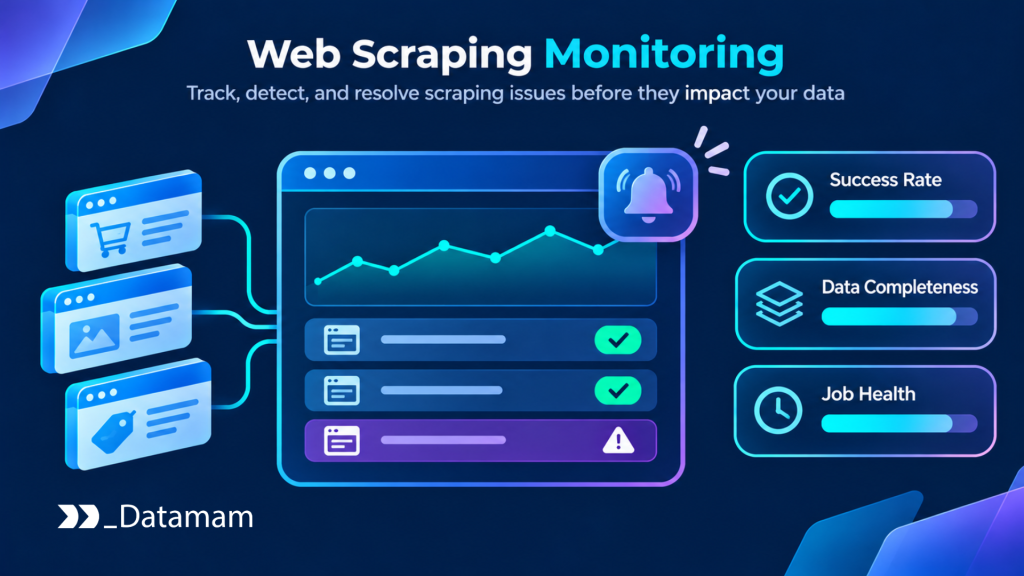
A web scraping pipeline can be green on every infrastructure dashboard while returning an outdated price, omitting an entire category, or publishing a valid-looking empty file. Traditional server metrics answer whether the collector process is alive. Enterprise web scraping monitoring must answer a harder question: did every required observation reach the correct consumer, in a usable form, within its expected window?
The unit of accountability is therefore not the HTTP request. It is the *scheduled business job*, tied to an expected source or record population, an acceptance contract, and a publication deadline. Effective observability follows that job from dispatch through source acquisition, validation, release, and the receiving application.
Monitoring a Scraper Is Not the Same as Monitoring Market Changes
Infrastructure health versus business-job outcomes
Infrastructure telemetry describes CPU load, memory pressure, browser failures, worker restarts, open sessions, and request latency. These signals matter because they help explain an incident, but they do not establish that the accepted business dataset is correct. A fetch that returns HTTP 200 may contain an access notice rather than the product details required by the customer.
Business-job monitoring instead asks whether a specific approved task reached a terminal state: accepted result, accepted no-result outcome, explicit exception, or unresolved failure. A pipeline can have high request success and low accepted-job completion when pages render without the intended content. Conversely, a job that needed three permitted attempts can be a successful business observation, even though its request failure rate was elevated.
Google’s Site Reliability Engineering guidance on service-level objectives starts with indicators that represent what users experience. For a data feed, the analogous user experience is an accepted, queryable observation, not merely a response from the collection worker.
The expected population is the monitoring denominator
A dashboard cannot prove coverage unless it knows what was due. Define the planned source inventory, eligible URLs or search combinations, active mapping IDs, source-specific exclusions, and the schedule version that generated the workload. Count the expected observations at the grain of that contract, rather than dividing returned records by returned records.
For a retail feed, one scheduled job might be a product-to-retailer mapping checked within a refresh window. For an airline feed, it might be one route, departure date, source, and market profile. A single completed job can produce several valid offers, a valid empty result, or an exception. The count of extracted rows is not the denominator for scheduled-job completion.
An effective daily dashboard shows the opening expected population, authorized additions and retirements, canceled jobs with reasons, due jobs, accepted terminal states, and jobs still unresolved. Any unexplained difference is itself an integrity alert.
What downstream teams need to see after a refresh fails
A pricing analyst needs more than a red indicator. The consuming view should show the last accepted observation time, the current collection state, the affected price or availability population, and whether an older value remains visible but stale. A reported zero price or “not available” must not be substituted for a failed collection.
Product teams should receive a business-language incident summary: which countries, categories, brands, routes, or source sites are affected; when the current feed last met the contract; and whether a corrected or backfilled release is expected. SRE and data engineering teams need the same incident connected to source evidence and a repair queue. This separation keeps business users informed without exposing sensitive session diagnostics.
Instrument the Entire Observation Lifecycle
Expected, admitted, attempted, and terminal jobs
Instrument a controlled job ledger with due, admitted, attempted, completed_with_results, completed_no_qualifying_result, validation_failed, collection_failed, and canceled_or_excluded states appropriate to the service. Job states should be mutually exclusive at the measurement cutoff; an attempt record can be many-to-one with a business job.
Datamam’s documented airline fare collection maintained 19,564,667 scheduled searches in a 30-day operating cohort. By its recovery cutoff, 19,532,228 had completed, including 4,769,809 completed searches with no qualifying itinerary. That distinction matters: an alert on “zero records” would misclassify legitimate searches as scraper failures, while an alert on worker uptime alone could miss genuinely incomplete searches.
The ledger should reconcile total due jobs to terminal outcomes and open obligations for each source, period, and priority. Separate the original deadline from the later recovery cutoff, since an eventually successful job can still be late.
Capture, validation, release, and consumer timestamps
Record when each job was scheduled, admitted to the queue, first attempted, actually observed at the source, accepted by validation, included in a published release, and confirmed in the consumer environment. These timestamps divide an overdue job into queue delay, source acquisition time, validation latency, delivery latency, and warehouse-load delay.
A data pipeline may collect a correct observation on time and then miss the business deadline because the publication stage stalls. Without distinct timestamps, the team may misdiagnose that event as a slow website. The reverse is also possible: a prompt warehouse load does not make the underlying observation current when it was acquired yesterday.
Every timestamp should have a documented meaning and time zone. Keep event or effective dates exposed by the website distinct from the time Datamam observed the page; the publisher’s event time is not always available or verifiable.
Trace IDs linking a failed output to its original source evidence
Assign a stable scheduled-job ID and propagate it into attempts, accepted records, source-capture references, parser or ruleset versions, validation decisions, release manifests, and consumer receipt records. A trace ID helps connect execution stages, while the business-job ID persists across retries and replays. Those identities solve different problems.
OpenTelemetry’s signals model distinguishes traces, metrics, and logs; its logging specification describes correlation through trace and span identifiers. The same approach can be applied to a scraper, without assuming every scraper has the same instrumentation stack.
Store only diagnostic evidence appropriate to the source and privacy contract. Preserve enough metadata to explain why an output was accepted or rejected; do not put credentials, personal browsing details, or confidential session tokens into general-purpose dashboards.
The Operational Metrics That Detect Silent Degradation
Source coverage and required-field completion
Coverage belongs in a matrix, not just one global percentage. Track expected and accepted jobs by source, region, product group, page family, and priority. For each accepted population, monitor required-field presence and validated meaning: identifiers, units, currencies, dates, contexts, and relationship keys. An unusually high non-null rate is not a sufficient quality indicator if a source starts filling a field from the wrong page component.
Datamam’s 200-website weekly collection portfolio illustrates source-level coverage. The documented release covered 4.6 million records per weekly sweep and included a manifest connecting source releases, counts, schema versions, and checksums. When one site was redesigned, its collection remained visibly incomplete while the other 199 sites continued. A single green or red portfolio status would have hidden that difference.
For executive reporting, show coverage weighted by the agreed business population or criticality, but always preserve the unweighted source count and detailed exception list. A weighted metric must not make a missing small-but-critical source disappear.
Valid empty outcomes versus unexpected missing populations
An empty result needs a terminal reason. An airline search completed with no qualifying flight is different from a timed-out airline search. An empty product category could be a real inventory state, a changed filter, an inaccessible listing template, or a broken pagination rule.
Track the ratio of completed valid empty outcomes by source and search context, alongside normal historical variation. Flag abrupt deviations for investigation. If a source’s no-result rate jumps from its ordinary pattern across one market while other markets remain stable, the team should inspect that market’s collection contract and retained evidence before changing the business data.
Do not automatically treat an anomaly as proof of source failure; the underlying market may have genuinely changed. Monitoring produces a review signal, and acceptance logic determines whether the result can be published.
Unexpected value distributions and semantic anomaly signals
The most dangerous error often produces plausible values. Watch for price distributions that change abruptly after a parser deployment, currencies inconsistent with the requested market, recurring zero or missing values, product pack-size shifts, duplicate source identities, and unusually large changes in record-to-source ratios.
Design anomaly checks around source and product semantics. Comparing hotel rates without consistent stay length and occupancy creates noisy alarms. Comparing retailer prices without package quantity creates false movements. A useful detection rule evaluates the price *and its basis*: amount, currency, quantity, market, seller, and eligibility conditions.
Baseline windows should account for promotions, travel seasonality, and actual market movements. A statistical anomaly is an investigation trigger, not a replacement for a source-specific acceptance test.
Watch Queues Before Delivery Deadlines Are Missed
Queue age, remaining work, and source-level throughput
The earliest deadline warning is often an overdue queue, not a failed request. For each source and priority tier, track the oldest due work, admission lag, number of unfinished jobs, and recently achieved accepted-job throughput. Compare this with time left before the deadline.
A simple capacity-risk estimate is remaining_jobs / recently_accepted_jobs_per_minute, then compare the resulting minutes with the remaining service window. It is a planning estimate, not a guaranteed completion forecast: source restrictions, record complexity, session reuse, and retry rates can change throughput during the run. Where rates vary, use conservative recent throughput and flag uncertainty.
A fleet average can conceal one integration with a growing backlog. Queue panels must remain filterable down to the source and market profile whose deadline is at risk.
Retries, response latency, and session failures
Track attempts per scheduled job, permitted retries, terminal failure reasons, response latency distributions, browser or session restarts, unexpected redirects, and recognized challenge responses. These explain why backlog grows and where investigation belongs. Attempt rates also inform capacity and cost, but should not be confused with business-job volumes.
Cloudflare documents a cf-mitigated: challenge header for its Challenge Page responses. When a source uses that protection, the header can help classify the response. Other sources require their own validated classification rules. An HTTP 200 or a successful browser page load cannot by itself establish that the requested business content was acquired.
Response to access changes must respect applicable permissions, source terms, and operational limits. Monitoring should make restrictions visible rather than simply escalating request intensity.
Critical populations and approaching deadlines
Use separate queues and thresholds for workloads with genuinely different business impact. A high-volatility price subset may have a four-hour window while a stable catalog receives weekly coverage. The same amount of queue delay has different consequences in those two populations.
Assign alerts based on time to contract deadline, estimated work still due, and recoverability. For example, a critical source with 30 minutes left and two hours of conservatively estimated work is a more urgent operational problem than a low-priority weekly source with a similar raw backlog but several days remaining.
Use source-specific calendars when collection is allowed only in certain windows. A dashboard that assumes 24/7 unrestricted requests can make unrealistic recovery predictions.
Classify Alerts by What the Team Can Actually Repair
Network and challenge incidents
A network or access incident should present the affected domain, market context, recent response classes, first observed time, retry exhaustion, authorized collection mode, and the earliest due job at risk. The responding team can then determine whether to wait within policy, check the source’s published status, escalate access conditions, or revise an approved integration.
Avoid paging an extraction engineer for a warehouse permission error or a compliance review issue. Alert routing should follow the failure domain and the accountable owner, not the software component that happened to notice it first.
Parser and schema regressions
A parser alert should identify the expected page family, mandatory fields, parser version, failed fixture or schema check, and the smallest affected output population. A release that turns populated price fields into nulls across one template is actionable evidence. A broad “scraping failed” message does not provide enough information to identify the cause of a failure or determine which data deliveries are affected.
A reliable workflow for recovering failed web scraping jobs should distinguish between temporary request errors, broken parsers, validation failures, and downstream delivery issues. Recovery procedures should identify the affected source, determine whether retries or reprocessing are necessary, and verify that corrected records meet acceptance requirements.
A healthy repair workflow can pause publication for one invalid source adapter while allowing unaffected sources to continue delivering valid data. Retain representative difficult source evidence to verify the proposed repair; do not blindly change production selectors solely because row count decreased. The detailed repair process belongs to a maintenance playbook, while monitoring owns the detection and handoff.
Identity, market context, or delivery failures
Business-meaning alerts should identify the violated contract. Examples include a price paired with the wrong pack, a fare associated with the wrong origin market, a hotel rate missing its required stay conditions, or a file accepted upstream but absent from a consumer table.
Route these defects to the person who owns the relevant semantic rule or receiving schema, not automatically to the network operator. The issue may require quarantining affected records, revalidating a mapping version, or replaying a corrected release. Preserve the source capture and earlier accepted state so the correction can be distinguished from an actual market change.
Build Alerts That Lead to an Action
Early warning versus missed service obligation
An early-warning alert says a deadline or data-quality obligation is at risk while the team still has options; a breach alert says a measured obligation was missed. Both should identify the cohort, denominator, current status, evidence window, and accountable owner. The first is predictive and may be uncertain; the second depends on the service contract’s measurement rules.
Do not turn the same delayed job into repeated unrelated incidents at attempt, validation, and publication stages. Link alerts to the business-job identity and aggregate them into one incident with the appropriate technical sub-events.
Source-specific thresholds and error-budget burn
Google’s SRE workbook explains error-budget burn rates and multiwindow alerting for defined service-level objectives. That model is useful when a scraping feed has a genuinely measurable eligible population, due windows, and acceptable exceptions. For instance, a rising share of late critical jobs can consume the available monthly on-time budget faster than expected.
Apply the technique to accepted on-time business jobs, not raw HTTP responses. A legitimate empty outcome belongs in the completed numerator; an excluded job belongs outside the denominator only when the exclusion is contractually defined and auditable. Low-volume critical sources may be better served by direct missing-job alerts than a noisy percentage calculation.
The correct thresholds depend on the buyer’s requirements. Published generic SRE thresholds are methods to adapt, not a claim about Datamam’s contractual SLA.
Avoid noisy fleet-level alarms that hide critical source failures
A fleet-wide percentage may remain healthy while a strategically important source is completely unavailable. Conversely, many minor errors from one low-priority source may overwhelm on-call engineers. Use both fleet totals and source-level severity, with grouping and suppression for related symptoms.
Rate-limit repetitive notifications while leaving the underlying events in the ledger. Preserve a route for critical source failure even when aggregate metrics look acceptable. Review alert noise alongside missed incidents: reducing pages is not a success if the team no longer detects silently wrong data.
Design Dashboards for Both Engineers and Data Consumers
One source and its current acceptance state
A source-detail view should display active scope, expected due work, latest accepted run, the current terminal-state distribution, required-field validation, oldest outstanding job, relevant response classifications, and a link to permitted diagnostic evidence. Show parser and source-contract version to connect changes in behavior with deployments.
The view should answer whether the source has *accepted useful output*, not just whether a collector ran. Keep a clear difference between an empty but complete run, an unresolved exception, a late recovery, and a release awaiting the destination.
Portfolio completeness and at-risk delivery windows
A portfolio view should reconcile expected jobs and accepted jobs by source, priority, business market, and deadline. It should identify missing sources rather than masking them behind a global average. In Datamam’s weekly 200-site collection, source-specific manifests allowed the client to load healthy sites while one redesign-affected source remained visible as a separate exception.
The most useful executive summary is often a small set of numbers: due sources, on-time accepted sources, accepted late sources, unresolved sources, at-risk near-term windows, and the business populations exposed to each exception. All numbers should lead to underlying source lists and contract definitions.
Stale record flags and last accepted publication
Consumers should see both the last accepted observation time and the latest publication status. If the current scheduled check fails, an older accepted price may remain available for historical comparison but should be clearly marked stale for a time-sensitive decision. An accepted empty result represents a new completed state and must not silently inherit yesterday’s availability.
Different teams may define different maximum accepted ages for the same source. The dashboard can expose factual timestamps and status once, then let approved consumer views apply their own eligibility policy. This is a presentation requirement separate from selecting the pipeline’s refresh schedule.
Monitor the Destination, Not Just the Collector
Release-manifest reconciliation
Each accepted release should list its source or cohort, schema version, time window, file/object identities, checksums, record counts, and publication state. Reconcile the manifest with destination tables and ingestion receipts. A successful object upload is not evidence that the buyer’s required data was loaded and usable.
For multi-source workloads, independently reconcile source releases before publishing a portfolio summary. If one source is withheld, the manifest must say which source and why. A consumer should never have to infer completeness from the number of files in a storage folder.
Load failures, duplicates, and schema projections
Watch failed or delayed warehouse jobs, incompatible field types, truncated nested structures, duplicates after retry, and later corrections. Snowflake’s data-loading documentation describes file-level load metadata and its duplicate-protection boundaries. That does not replace a business-key strategy: a repackaged file or corrected batch can still require record-level idempotency.
Monitor both physical file ingestion and logical record reconciliation. A file can load successfully while a downstream model duplicates the same business observation due to a join or replay problem. The receiving team should be able to identify the accepted business key and schema version behind each current record.
Can the real consumer query the accepted records?
Close the monitoring loop with the actual consumer interface or a representative acceptance query. Check permission to read the intended table, presence of the expected partition, usable record count, key integrity, and the correct latest-view status. Monitoring an ETL success notification is weaker than verifying a data product’s queryable result.
For BigQuery, the official `INFORMATION_SCHEMA.JOBS` view provides metadata about executed jobs. Job metadata is useful for detecting load or query failures, but the business acceptance check still requires querying the right datasets and validating the resulting population and fields.
Review Incidents and Improve the Monitoring Contract
False-negative silent errors and false-positive alerts
Post-incident review should ask two questions: why did the bad output pass acceptance? and which warning would have been useful before publication? A semantic price error not caught by a required-field check calls for a new contract-aware validation fixture. An alert triggered by a genuine seasonal market change may need a better context-aware baseline, not a lower tolerance for real variation.
Record whether alerts fired before consumer impact, whether the owner could act, whether source evidence was sufficient, and whether the corrected release reached consumers. This assesses the monitoring system itself, not only the scraper’s performance.
Which recurring failures deserve permanent tests
Promote repeat incident patterns into regression fixtures, accepted-page-family rules, expected-population controls, and destination reconciliation tests. A repeated wrong-market response should lead to a market-context check; a recurring silent loss of a product category should lead to a discovery distribution check.
Review the permanent tests during source changes so that legitimately revised page structures do not generate endless false alarms. The aim is to convert human detective work into repeatable acceptance evidence while retaining expert review for genuinely ambiguous business semantics.
Separate operational signals from retrospective benchmark reporting
Operations monitoring answers what is wrong *now*, who must respond, and whether the current delivery is at risk. Retrospective benchmark reporting studies completed cohorts with fixed measurement windows and definitions. The same job ledger can support both, but they have different purposes.
A current-day alert may use queue-age forecasts and unsettled states; a published reliability statistic should use a completed cohort with explicitly declared deadlines and recovery cutoffs. Mixing the two produces inconsistent numbers and weakens trust. The monitoring contract should preserve the raw events so both views can be reconstructed from the same evidence.
For teams defining a recurring external-data feed, discuss source-level monitoring and accepted-delivery requirements with Datamam.
Frequently Asked Questions
What should a production web scraping dashboard measure?
It should reconcile scheduled business jobs, accepted terminal outcomes, source coverage, required-field and semantic validation, queue and deadline risk, actual observation age, release completeness, and consumer load status. Infrastructure telemetry should explain those results rather than substitute for them.
How can monitoring catch a scraper that returns HTTP 200 but no valid data?
Verify the expected page family, meaningful body content, required fields, source context, and plausible record distribution before accepting the response. Keep recognized challenge, redirect, incomplete-render, and validation-failure states distinct from a legitimate empty business result.
What is the difference between scraper monitoring and website change monitoring?
Scraper monitoring checks the health of acquisition, interpretation, validation, and delivery operations. Website change monitoring observes changes in the underlying market or content. A page redesign can cause a scraper incident, while a real price change can be a valid observation; one event should not be confused with the other.
Which metrics provide early warning of missed delivery deadlines?
The oldest unfinished scheduled jobs, due-work backlog, recent accepted-job throughput, source retry rates, and time remaining before each priority deadline are especially useful. Report the predicted completion risk as an estimate and the actual deadline result as a measured outcome.
How should source-level alerts work in a large scraper fleet?
Every source should have its own acceptance state, incident classification, and criticality. Aggregate incidents for fleet awareness without hiding source-specific failures. Route alerts to the team responsible for access, parsing, semantic rules, or downstream delivery as appropriate.
Should monitoring continue after files have been uploaded?
Yes. Verify file manifests, warehouse ingestion, record-level idempotency, schema compatibility, and queryable consumer views. The service is not complete merely because an object reached cloud storage.