Key Takeaways
- MAP Monitoring should separate offer observation, product identity, seller identity, policy applicability, policy evaluation, and human review.
- Minimum advertised price monitoring requires market- and policy-specific rules because MAP treatment differs across jurisdictions.
- MAP violation tracking should preserve displayed prices, coupons, cart prices, bundles, product condition, seller identity, timestamps, and evidence rather than reducing every offer to one price.
- Seller identity can be observed publicly, but authorization status normally requires an internal brand or channel reference.
- Refurbished products, bundles, uncertain matches, and out-of-scope sellers can still be valid observations even when a particular MAP policy does not apply to them.
- A policy threshold should be stored with its policy version, currency, effective dates, product scope, channel rules, exclusions, and market.
- Evidence should support review without being treated as conclusive proof of a policy or legal violation.
- MAP compliance software workflows should measure match quality, policy-reference coverage, seller resolution, evidence completeness, review outcomes, and false-positive rates rather than record volume alone.
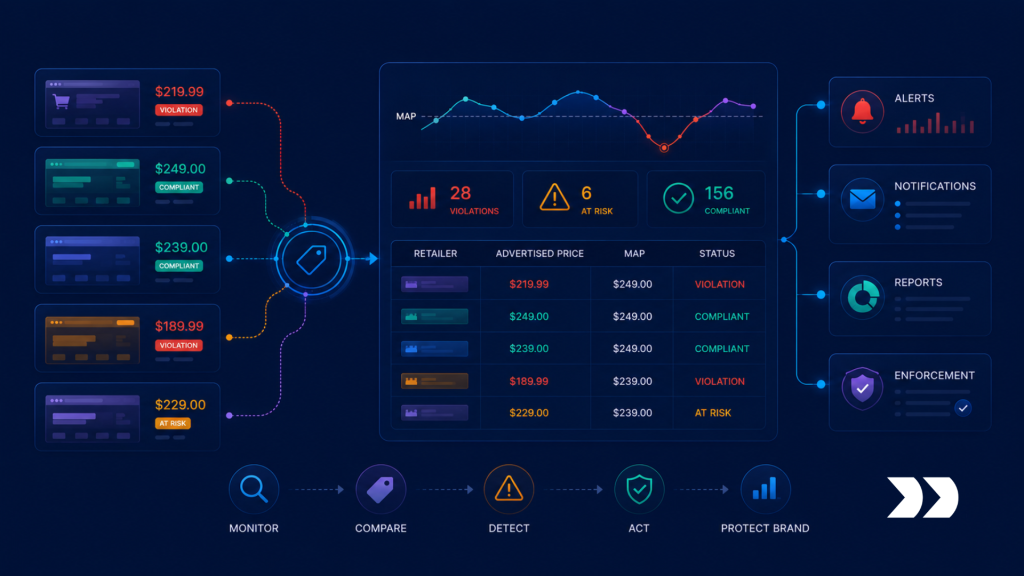
Electronics brands can encounter the same product across major retailers, marketplaces, third-party sellers, regional storefronts, bundles, refurbished listings, and promotion-heavy channels.
Finding a low advertised price is the easy part.
The harder problem is determining whether the offer matches the policy-covered product, whether the item is new or refurbished, how coupons or cart discounts are treated, which market and policy version apply, and whether the captured evidence is sufficient for review.
MAP Monitoring helps structure those observations, but MAP policies are jurisdiction-sensitive. A monitoring system should evaluate offers against legally reviewed, market-specific policies rather than assume that one MAP framework applies globally.
In this article, a potential MAP violation means an observed offer that appears inconsistent with an applicable brand policy and requires review. It does not by itself establish a violation of law.
Why MAP Monitoring Requires More Than a Price Threshold
Electronics offers can differ in ways that materially change whether they are comparable.
A laptop may differ by:
- storage;
- RAM;
- processor;
- generation;
- region;
- connectivity;
- operating system;
- included accessories.
A television may differ by screen size or regional model.
A router may differ by hardware generation or included service.
A camera listing may combine the camera body with lenses, memory cards, batteries, cases, or warranties.
The same model can also appear as:
- new;
- refurbished;
- renewed;
- open box;
- used;
- damaged box.
That means a rule such as:
advertised_price < map_price
is not enough to determine whether an offer should enter a MAP review workflow.
The system first needs to establish what the offer actually represents.
Match the Policy-Covered Electronics Product
Electronics often provide useful identity signals such as:
- model number;
- manufacturer part number;
- UPC;
- GTIN;
- EAN;
- manufacturer SKU;
- storage configuration;
- color;
- generation;
- region code.
But strong identifiers do not eliminate matching errors.
A product family may contain several configurations with similar titles. Marketplace sellers may omit model information. Retailers may group variants onto one parent page. Bundles may reuse the primary product’s name while adding other components.
A useful classification model can distinguish:
- exact policy-covered product;
- same product family, different variant;
- bundle containing the product;
- accessory-only listing;
- previous-generation product;
- refurbished or other condition variant;
- non-comparable product;
- unresolved match.
The monitoring system should preserve the relationship rather than forcing every offer into exact-match or failure status.
A refurbished exact product, for example, can be a correctly matched and valid observation even if the applicable policy covers only new products.
Seller Identity Is Not Seller Authorization
Marketplaces add another layer because the same product page can contain offers from several sellers.
MAP Monitoring may capture:
- marketplace;
- seller name;
- seller ID where exposed;
- seller storefront URL;
- fulfillment method;
- offer position;
- product condition;
- advertised price;
- shipping terms;
- timestamp.
Those are observable facts.
Whether a seller is authorized is a different question.
Public marketplace information normally does not establish the seller’s contractual relationship with the brand. Seller authorization should therefore come from an approved internal reference such as:
- authorized reseller list;
- distributor records;
- channel-management system;
- market-specific seller classification.
The resulting model is:
observed seller identity + internal seller reference → seller authorization status
A seller not found in the reference should not automatically be declared unauthorized. It may instead be classified as:
authorization_status = unknown
until the brand resolves it.
Condition and Bundle Status Should Remain Separate From Data Validity
A common monitoring mistake is to reject every non-new or bundled offer as invalid.
That mixes up two different questions.
Is the observation valid?
Was the product, seller, price, condition, and timestamp captured correctly?
Does the policy apply?
Does the relevant MAP policy cover:
- this SKU;
- this product condition;
- this seller or channel;
- this market;
- this bundle configuration?
A refurbished listing can therefore be:
observation_valid = true
policy_applicable = false
Likewise, a bundle can be correctly observed but require policy-specific review before any price comparison is made.
Advertised Price and Effective Price Are Different Fields
Electronics retailers use many promotion mechanics:
- visible price reductions;
- instant coupons;
- checkbox coupons;
- promo codes;
- cart discounts;
- member pricing;
- financing offers;
- rebates;
- gift cards;
- trade-in credits;
- shipping discounts;
- bundles.
These should not be flattened into one effective_price field.
A useful observation might preserve:
- displayed price;
- cart price where observable;
- coupon value;
- coupon-adjusted price;
- member price;
- trade-in value;
- shipping charge;
- promotion type;
- promotion terms;
- bundle status.
The applicable policy then determines which of those fields matters.
For example, a product advertised at the policy threshold but accompanied by a coupon that produces a lower checkout price may require different treatment from a product whose visible advertised price is already below the threshold.
A trade-in credit may be treated differently again.
The monitoring system should capture the price mechanics first and apply policy interpretation second.
The Policy Reference Is Part of the Data Model
map_price should not be treated as a timeless number attached to a product.
The applicable threshold can depend on:
- policy version;
- market;
- jurisdiction;
- SKU;
- currency;
- effective date;
- seller or channel scope;
- condition;
- bundle treatment;
- coupon rules;
- cart-price rules;
- exclusions.
A structured policy reference may contain:
policy_id
policy_version
market
effective_from
effective_to
product_id
map_threshold
currency
channel_scope
condition_scope
promotion_rules
exclusions
That allows an observation collected today to be evaluated against the policy that was actually in effect at the time, rather than whatever policy happens to be current when the record is reviewed later.
For U.S. programs, the Federal Trade Commission’s guidance on manufacturer-imposed requirements is an important reminder that vertical pricing practices are evaluated within a particular legal framework and that state and international approaches can differ.
A Better MAP Monitoring Model
The central workflow can be represented as:
offer observation + product reference + seller reference + jurisdiction-specific policy version → policy evaluation → evidence-backed human review
Offer Observation
The public observation may include:
- observation ID;
- source URL;
- retailer or marketplace;
- seller name;
- seller ID where exposed;
- product title;
- model number;
- displayed price;
- currency;
- coupon or promotion text;
- cart price where observable;
- shipping;
- condition;
- bundle information;
- stock status;
- observed timestamp.
Product Reference
The product reference establishes:
- internal product ID;
- policy-covered SKU;
- model number;
- manufacturer part number;
- GTIN or UPC where available;
- configuration;
- market;
- match rules.
Seller Reference
The internal seller reference may establish:
- resolved seller ID;
- authorization classification;
- retailer or channel relationship;
- market;
- review status.
Policy Reference
The policy reference establishes which rule, if any, applies to that product, seller, channel, condition, promotion mechanic, and market.
The resulting evaluation can then be classified as:
- no applicable policy;
- insufficient information;
- within policy threshold;
- potential policy exception;
- requires policy interpretation.
That is more defensible than treating every below-threshold number as a violation.
Validate Observations Separately From Policy Evaluation
A simplified workflow might look like this:
OBSERVATION_REQUIRED_FIELDS = [

    "observation_id",

    "product_match_id",

    "retailer",

    "seller_id",

    "displayed_price",

    "currency",

    "condition",

    "observed_at",

]


def validate_offer_observation(observation):

    missing = [

        field

        for field in OBSERVATION_REQUIRED_FIELDS

        if observation.get(field) is None

    ]


    if missing:

        return {

            "valid": False,

            "reason": "missing_observation_fields",

            "fields": missing,

        }


    return {

        "valid": True,

        "quality_status": "validated",

    }


def evaluate_map_policy(observation, policy):

    if policy is None:

        return {

            "policy_applicable": False,

            "status": "no_applicable_policy",

        }


    if observation["currency"] != policy["currency"]:

        return {

            "policy_applicable": True,

            "status": "requires_currency_review",

        }


    if observation["condition"] not in policy["condition_scope"]:

        return {

            "policy_applicable": False,

            "status": "condition_out_of_scope",

        }


    evaluated_price = observation["displayed_price"]


    if evaluated_price < policy["map_threshold"]:

        return {

            "policy_applicable": True,

            "status": "potential_policy_exception",

        }


    return {

        "policy_applicable": True,

        "status": "within_policy_threshold",

    }
This is intentionally simplified.
In a production workflow, the applicable price may depend on policy rules covering coupons, carts, membership offers, shipping, bundles, or other mechanics.
The important principle is that observation validation happens before policy interpretation.
Evidence Should Support Review
MAP Monitoring differs from ordinary competitor price tracking because review may depend on reconstructing exactly what was observed.
A useful evidence record can preserve: Retail market trends in New York are continuously evolving, influenced by consumer preferences and economic fluctuations. Analyzing these trends can provide valuable insights for businesses looking to adapt their strategies. Staying informed about the latest developments is crucial for maintaining a competitive edge in such a dynamic environment. Grocery competitor monitoring techniques can help businesses stay ahead by providing real-time data on pricing strategies and product offerings. Implementing these techniques allows companies to quickly identify shifts in consumer behavior and adjust their marketing tactics accordingly. Ultimately, leveraging effective monitoring can lead to improved customer satisfaction and increased market share.
- evidence ID;
- source URL;
- capture timestamp;
- screenshot or page capture where appropriate;
- product title;
- model or SKU;
- seller identity;
- displayed price;
- currency;
- promotion text;
- condition;
- bundle status;
- stock status;
- product match ID and confidence;
- policy ID and version;
- policy threshold used;
- market or jurisdiction.
This provides evidence supporting the review.
It should not be described as conclusive proof by itself.
A screenshot can show that a price was displayed at a certain time. It does not by itself establish seller authorization, policy applicability, contractual status, or a legal conclusion.
Preserve Review History and Policy Decisions
A MAP compliance workflow should also preserve what happened after detection.
Useful review fields include:
- detected at;
- reviewed at;
- reviewer;
- review result;
- policy version;
- escalation status;
- notes;
- follow-up date;
- resolution status.
This matters when the same seller or retailer produces repeated potential policy exceptions.
Rather than labeling a seller a “repeat offender” automatically, the system can record:
repeated observations classified as potential policy exceptions
and allow the channel, compliance, or legal team to determine what those observations mean.
Jurisdiction Must Stay Attached to the Record
A global electronics program should never assume that one MAP policy can simply be copied from one market to another.
The legal treatment of vertical pricing restrictions differs significantly across jurisdictions.
In the European Union, the European Commission’s Vertical Guidelines identify minimum advertised prices as an indirect means of resale price maintenance within the EU competition-law framework.
That makes jurisdiction a core data field rather than a footnote.
A monitoring system should preserve:
- market;
- jurisdiction;
- applicable policy ID;
- policy version;
- legal-review status where maintained internally.
The monitoring layer can identify observations and apply approved rules. It should not invent legal conclusions.
MAP Treatment Can Differ Across Markets
International monitoring is not simply a matter of converting prices and matching regional SKUs.
The underlying policy itself may require different treatment.
For example, the UK Competition and Markets Authority’s guidance on resale price maintenance explains that restrictions preventing retailers from advertising prices below a specified level can constitute indirect resale price maintenance.
That means an electronics brand should not assume that a MAP framework used for one market can be transferred unchanged to another.
The system should instead consume policies that have already been reviewed for the relevant jurisdiction.
Freshness Should Match the Review Need
Not every electronics product requires the same monitoring frequency.
Refresh cadence may depend on:
- product importance;
- launch stage;
- promotional event;
- marketplace volatility;
- seller activity;
- channel priority.
A high-visibility product during a major promotional event may require much fresher observations than a stable legacy SKU.
Real-time monitoring is therefore not automatically necessary.
The appropriate question is:
How recent must the evidence be for the business workflow it supports?
The observation should preserve observed_at so downstream teams can apply their own freshness rules.
How to Measure MAP Monitoring Quality
The number of below-threshold prices found is not a sufficient quality measure.
More useful metrics include:
| Area | Example Measure |
| Channel coverage | Share of required retailers, marketplaces, or markets observed |
| Offer coverage | Share of required offers or sellers captured |
| Product matching | Exact-match precision and unresolved-match rate |
| Seller resolution | Share of offers linked to a resolved seller identity |
| Authorization reference | Share with an approved internal authorization classification |
| Condition classification | Share with usable new/refurbished/open-box/used status |
| Bundle classification | Share with known standalone or bundle status |
| Promotion parsing | Share with usable coupon, cart, member, or promotion context |
| Policy coverage | Share linked to the correct policy and version |
| Evidence completeness | Share containing the fields required for review |
| Freshness | Share meeting the required observation window |
| Review outcomes | Share confirmed, dismissed, or unresolved after human review |
| False-positive rate | Share of automated flags dismissed after review |
| Traceability | Share reproducible from source, observation, policy, and review records |
Match accuracy should be calculated against a reviewed reference set rather than inferred from the number of automated matches.
Commercial outcomes should be evaluated separately rather than assumed. Product comparison techniques without skus can provide a clearer understanding of customer preferences. They enable businesses to assess product features and benefits more holistically. This approach can lead to more informed purchasing decisions and foster greater brand loyalty.
How to Evaluate MAP Monitoring Readiness
A MAP monitoring readiness review should determine whether the workflow can produce reliable, policy-aware evidence rather than simply locate low prices.
Useful questions include:
- Are offers resolved to the exact product or configuration covered by the policy?
- Are bundles, accessories, previous-generation products, and condition variants classified separately?
- Is observed seller identity separated from internal seller-authorization status?
- Can an unknown seller remain a valid observation without being automatically classified as unauthorized?
- Are displayed price, cart price, coupon-adjusted price, member price, trade-in value, and shipping stored separately where observable?
- Is the applicable price mechanic determined by the policy rather than the collection layer?
- Is every policy threshold tied to a policy ID, version, currency, effective period, market, and SKU?
- Are condition, bundle, seller, channel, and promotional exclusions represented explicitly?
- Is jurisdiction preserved on every policy evaluation?
- Can a valid refurbished or bundled offer remain in history even if the applicable policy does not cover it?
- Does the evidence record preserve the source URL, timestamp, product, seller, price, promotion, condition, and policy reference?
- Are potential policy exceptions separated from confirmed internal review outcomes?
- Can reviewers reconstruct which policy version produced a flag?
- Are recurring observations tracked without automatically labeling sellers as violators?
- Are automated flags routed to human review when policy interpretation is ambiguous?
These questions reveal whether a system is merely collecting prices or producing defensible MAP monitoring records.
Conclusion
MAP Monitoring for electronics is not a simple comparison between an observed price and a threshold.
The product reference establishes what is being sold.
The seller reference establishes what the brand knows about the seller.
The public observation records the price, condition, bundle, promotion, and marketplace context.
The policy reference determines which rules apply in the relevant market and period.
The evidence record preserves what was observed.
And human review determines what action, if any, should follow.
Keeping those layers separate helps electronics brands identify potential policy exceptions without turning every low price, refurbished listing, coupon, bundle, unknown seller, or regional offer into an automatic violation.
It also keeps MAP monitoring aligned with a more important principle: collect the market facts accurately, apply the correct jurisdiction-specific policy, preserve the evidence, and avoid stronger conclusions than the data and applicable rules support.