Retail teams usually understand their own business better than they understand the market around it.
Internal systems can show sales, margin, stock, conversion, promotions, customer behavior, and historical performance. They cannot fully explain what competitors changed overnight, which marketplace sellers entered a category, whether a lower price is actually comparable, where assortments are expanding, which variants are unavailable, or whether a promotion is meaningful enough to require a response.
That gap is where Retail Market Intelligence becomes useful.
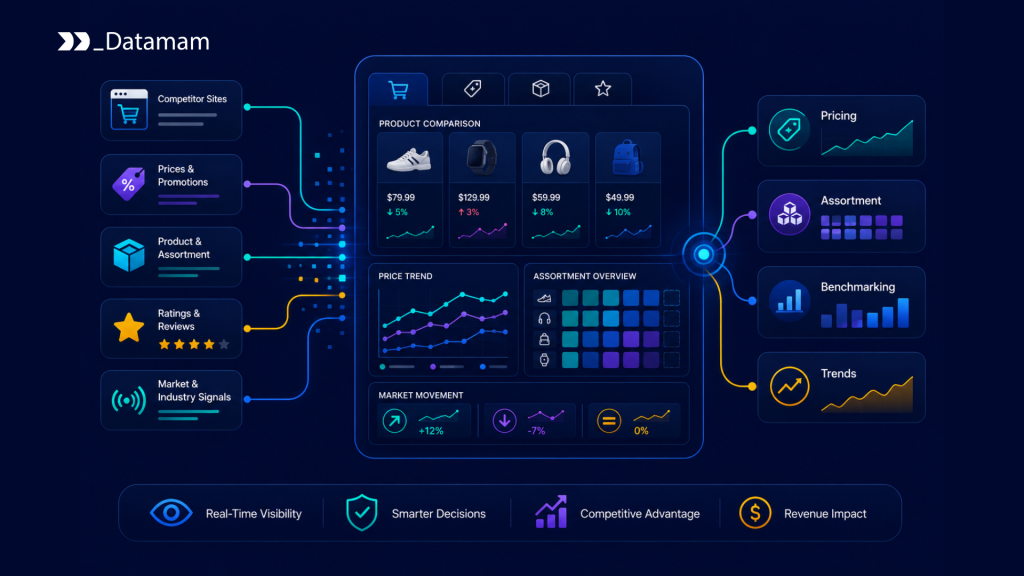
Retail Market Intelligence is the process of turning external pricing, product, seller, promotion, availability, assortment, and marketplace signals into structured information that commercial teams can use. The difficult part is not simply collecting competitor data. It is determining what is comparable, what changed, how reliable the signal is, and which changes matter to a pricing, merchandising, category, marketplace, or strategy decision.
A competitor price without stock status can mislead. A marketplace price without seller identity can mislead. A product comparison without pack size or variant context can mislead. A cross-country comparison without local assortment, currency, tax, or fulfillment context can mislead.
What Retail Market Intelligence Actually Means
Retail Market Intelligence creates an external view of the market that complements internal performance data.
A useful intelligence program may monitor:
- competitor prices;
- regular and promotional prices;
- product availability;
- new and discontinued products;
- assortment depth;
- marketplace sellers;
- shipping conditions;
- product variants;
- pack sizes;
- bundles;
- loyalty offers;
- product content;
- ratings and reviews;
- category placement;
- regional differences.
The exact mix depends on the commercial question.
A pricing team does not need the same intelligence as a category manager. A marketplace team monitoring unexpected or unauthorized sellers, where relevant, does not need the same structure as a merchandising team comparing assortment breadth. A multinational retailer comparing markets needs different normalization rules from a brand monitoring five competitors in one country.
The purpose is not to collect every observable retail signal. It is to create a reliable external-data model around the decisions that matter.
Why Internal Retail Data Is Not Enough
Internal data answers questions about what happened inside the organization.
It may reveal that:
- conversion declined;
- a category lost revenue;
- a product’s margin improved;
- inventory accumulated;
- promotion performance weakened;
- sales shifted between channels.
But internal data often cannot explain what changed in the external environment.
A category may lose sales because demand fell. It may also lose sales because a competitor introduced a lower-priced substitute, increased promotional intensity, expanded its assortment, improved delivery terms, or returned a previously unavailable product to stock.
A brand may see declining marketplace performance while third-party sellers are simultaneously offering the same product at lower prices.
Without external market context, several explanations remain plausible.
Retail market analysis becomes more useful when internal performance is interpreted alongside evidence about competitors, sellers, products, availability, and market movement.
Deloitte’s 2025 U.S. Retail Industry Outlook discusses retail executives’ expectations for broader use of data and AI in areas including pricing, inventory, demand, and competition. That does not mean every retailer needs the same intelligence architecture, but it illustrates why reliable market inputs matter as commercial decisions become more data-driven.
The Hard Part Is Making Retail Data Comparable
Retail data often looks structured before it is actually comparable.
Two pages may both contain a product name, price, availability label, and image. That does not mean they describe equivalent offers.
A reliable retail intelligence workflow has to resolve several layers of ambiguity.
Exact Products, Variants, Multipacks, and Substitutes Are Different
Product matching should not be treated as a single yes-or-no decision.
A useful hierarchy of comparison types is:
- exact product match;
- variant-level match;
- pack-equivalent match;
- bundle or configuration match;
- comparable or substitute product.
These represent different levels and types of comparability. Not every product necessarily passes through each stage.
Exact Product Match
An exact match may be established through a shared identifier such as a UPC, EAN, GTIN, manufacturer part number, or another reliable product identifier.
Where identifiers are consistent and trustworthy, comparison is relatively straightforward.
But identifiers are not always exposed, consistent, or available across retailers.
Variant-Level Match
The base product may be the same while the variant differs.
Examples include:
- color;
- size;
- storage capacity;
- fragrance;
- shade;
- material;
- configuration.
A shoe discounted only in size 5 should not automatically determine the competitive price for the full size range.
A cosmetics product available in three remaining shades is not equivalent to a competitor carrying the complete shade assortment.
Variant availability often changes the commercial meaning of the price.
Pack-Equivalent Match
Pack sizes create another common source of false comparison.
A grocery item sold as:
- 4 × 250 ml;
- 6 × 200 ml;
- one 1-liter package;
may require normalization before prices can be compared.
Retail market data may therefore need both the displayed price and a normalized unit price.
The same issue appears in household goods, supplements, batteries, building materials, office supplies, and many other categories.
Bundle and Configuration Match
Some products are offered with additional accessories, services, warranties, or bundled items.
A lower headline price may represent a materially different configuration.
The comparison model should preserve those differences rather than forcing every offer into one price field.
Comparable or Substitute Products
Sometimes the commercial question is not whether products are identical.
A retailer may instead want to understand which alternatives compete for the same customer and use case.
That becomes a similarity problem rather than an identifier-matching problem.
Relevant dimensions might include:
- brand;
- category;
- specifications;
- size;
- materials;
- features;
- use case;
- style;
- price band.
Furniture is a clear example. Two sofas may compete directly even though they do not share an identifier or manufacturer.
Retail intelligence should distinguish exact matching from comparable-product analysis because the confidence and interpretation of the result are different.
One Product Can Have Many Marketplace Offers
Traditional retail analysis often assumes a simple model:
product → price
Marketplace environments frequently require a different model:
product → variant → seller → offer
One product may be offered by:
- the marketplace itself;
- the brand;
- an authorized retailer;
- a third-party seller;
- multiple fulfillment providers.
Each offer can differ in price, stock, shipping, delivery time, seller rating, fulfillment method, promotion, and condition.
If those offers are collapsed into one number, important market information disappears.
Consider a product with three marketplace offers:
| Seller | Item Price | Shipping | Availability | Delivery |
| Seller A | $89 | Free | In stock | 2 days |
| Seller B | $82 | $12 | In stock | 6 days |
| Seller C | $76 | Free | Backordered | Unknown |
The lowest observed price is $76.
The lowest currently fulfillable total offer may be $89.
Those are different competitive signals.
Seller-level monitoring is therefore important when teams need to understand marketplace pricing rather than simply observe the lowest displayed number.
Retail Price Is Not One Number
Price intelligence becomes unreliable when every visible number is interpreted as the same type of price.
Retail offers may include:
- regular price;
- sale price;
- clearance price;
- loyalty-member price;
- coupon price;
- subscription price;
- quantity discount;
- bundle price;
- marketplace seller price;
- unit price;
- shipping-inclusive total.
A pricing team evaluating a competitor’s standard position may not want a loyalty-only price treated as the normal market price.
A marketplace team may care about the customer’s total delivered cost rather than the item price alone.
A grocery team may need normalized unit pricing.
The data model should therefore preserve price type and conditions rather than reducing every offer to a single price field.
Promotion Mechanics Matter
A promotion can also be conditional.
Examples include:
- buy one, get one free;
- spend $100 and receive $20 off;
- loyalty-member discount;
- coupon required;
- multi-buy pricing;
- category-wide markdown;
- free shipping above a threshold.
A competitor may appear substantially cheaper without offering that price to every customer or every order.
Promotion intelligence needs to capture enough of the condition to prevent false comparisons.
Availability Is Not Binary
“In stock” and “out of stock” are useful labels, but many retail environments require more detail.
Possible availability states include:
- available for shipping;
- available for store pickup;
- available at selected locations;
- limited stock;
- preorder;
- backorder;
- temporarily unavailable;
- marketplace seller available;
- unavailable in one variant but available in another.
For a local pricing workflow, store-level availability may matter.
For a national e-commerce comparison, shipping availability may be enough.
Also, for marketplace monitoring, third-party availability may need to be separated from first-party inventory.
Availability should therefore be modeled as part of the offer rather than treated as a decorative field beside price.
Assortment Changes Often Reveal More Than Price Changes
Retail market trends do not appear only through pricing.
Competitor assortment can reveal:
- category expansion;
- category contraction;
- new brand relationships;
- private-label investment;
- seasonal transitions;
- premiumization;
- value positioning;
- new product launches;
- discontinued lines.
Suppose a competitor substantially expands one category while increasing private-label representation and reducing premium third-party brands.
That is a strategic signal even if prices barely move.
For category and merchandising teams, assortment intelligence may therefore be as important as price intelligence.
Useful assortment measures can include:
- number of active products;
- new-product rate;
- discontinued-product rate;
- brand share of assortment;
- private-label share;
- variant depth;
- price-band coverage;
- category breadth.
The Operating Model Behind Retail Market Intelligence
A mature Retail Market Intelligence program needs more than a collection system.
A practical operating model can be divided into six stages:
| Stage | Main Question |
| Market definition | Which competitors, channels, sellers, products, and regions matter? |
| Collection | How will the relevant external signals be captured? |
| Entity resolution | Which products, variants, sellers, and offers correspond to one another? |
| Normalization and validation | Are prices, units, availability states, promotions, and product attributes comparable? |
| Delivery | Where and when do business teams need the intelligence? |
| Monitoring | Is the intelligence still complete, fresh, and trustworthy? |
1. Define the Market Before Collecting It
Coverage should follow commercial importance rather than technical convenience.
A retailer may have hundreds of possible competitors, but only a subset may matter for a particular category.
Coverage decisions can consider:
- category overlap;
- geography;
- customer segment;
- price positioning;
- marketplace importance;
- brand relevance;
- sales volume;
- strategic importance.
More sources do not automatically produce better intelligence.
A smaller, carefully defined competitive set can be more useful than a large dataset filled with weakly relevant retailers.
2. Collect the Signal at the Right Level
The relevant source may be:
- product detail pages;
- category pages;
- marketplace listings;
- seller offers;
- store-specific pages;
- promotional pages;
- search results;
- retailer APIs;
- public catalogs;
- other accessible retail sources.
Different source types answer different questions.
A product page may provide price and stock. A category page may reveal assortment positioning. A marketplace offer section may reveal seller competition.
Collection design should follow the analytical requirement.
3. Resolve Products, Variants, Sellers, and Offers
This is where raw retail data becomes comparable.
Matching can combine:
- product identifiers;
- titles;
- brand;
- specifications;
- attributes;
- pack counts;
- variants;
- model numbers;
- images;
- category context.
The objective is not to force every record into a match.
The system should distinguish high-confidence matches from uncertain comparisons.
In many competitive analyses, a false match can be more damaging than leaving a record unresolved because it creates misleading precision.
4. Normalize Without Erasing Important Differences
Normalization may include:
- currency;
- units;
- pack sizes;
- seller identity;
- shipping terms;
- price types;
- availability labels;
- product attributes;
- timestamps.
But normalization should not make different offers appear identical.
The objective is comparability, not uniformity.
If two offers differ materially, the data model should retain that difference.
5. Deliver Intelligence Where Decisions Happen
Retail intelligence creates limited value if analysts have to manually move it into another workflow.
Depending on the organization, delivery may include:
- data warehouse tables;
- BI dashboards;
- pricing systems;
- category scorecards;
- marketplace monitoring tools;
- internal APIs;
- scheduled files;
- analytical models.
The format and cadence should reflect the decision.
Executive category reviews may work with weekly intelligence. Competitive pricing may require daily or more frequent refreshes. Some marketplace use cases may justify higher-frequency monitoring.
Real-time collection should not be treated as automatically superior. It introduces additional cost and complexity and should be used when the decision genuinely requires it.
6. Monitor the Intelligence Itself
External retail environments change continuously.
A source can redesign a page, remove fields, change product identifiers, introduce new promotion structures, or alter availability labels.
Monitoring should therefore cover the intelligence pipeline as well as the market.
Useful controls may include:
- source success rate;
- freshness;
- missing-field rate;
- unexpected price movement;
- match-confidence distribution;
- availability capture;
- promotion detection;
- seller identification;
- delivery success;
- schema-change alerts.
Without monitoring of the underlying data operation, teams may continue using intelligence after its quality has deteriorated.
Cross-Country Retail Intelligence Requires Additional Normalization
Retail Market Intelligence becomes more complicated when comparisons cross borders.
Currency conversion is only one part of the problem.
The same brand may use:
- different retailer-specific SKUs;
- different pack sizes;
- different catalog structures;
- different product names;
- different promotional mechanics;
- different tax presentation;
- different fulfillment models;
- different units of measurement;
- different product variants.
A product available in the United States may not have an exact equivalent in Germany, Japan, the United Kingdom, Australia, or another market.
Even where an equivalent exists, the displayed price may reflect different tax treatment or local commercial conditions.
Cross-market analysis should therefore separate:
- directly comparable products;
- locally adapted variants;
- approximate substitutes.
Currency-normalized price is useful only after the product and offer are determined to be meaningfully comparable.
This is particularly important for global brands evaluating regional pricing strategy or retailer execution across countries.
How Retail Market Intelligence Supports Pricing Decisions
Pricing intelligence should help teams answer more precise questions than “Who is cheapest?”
More useful questions include:
- Which competitors changed price?
- Was the change temporary or persistent?
- Is the product actually in stock?
- Does the price require membership?
- Is the competing offer an exact match?
- Is a marketplace seller driving the observed low price?
- Does shipping change the total customer cost?
- Is the movement category-wide or isolated?
The objective is not to automatically follow every competitor price. That can create unnecessary discounting.
The purpose is to identify market movements that are commercially relevant enough to review.
NRF’s discussion of data-driven retail pricing describes the role of data analytics in competing on price, managing inventory, and responding to consumer demand, while also distinguishing routine data-driven pricing from deceptive or discriminatory practices. The exact legal and commercial considerations vary by market, but the broader principle is useful: price decisions require context, not merely a competitor number.
How Retail Intelligence Supports Assortment and Merchandising
Assortment intelligence helps explain how competitors are positioning categories.
Teams may monitor:
- product introductions;
- discontinued items;
- brand expansion;
- private-label growth;
- variant depth;
- category coverage;
- price-band distribution;
- promotional concentration.
A category manager can then compare internal performance with external structure.
For example, declining performance in one price band may coincide with competitors expanding alternatives in the same segment.
The external signal does not prove causation, but it gives the team a specific hypothesis to investigate.
That is more useful than treating the sales decline as an isolated internal event.
How Retail Intelligence Supports Marketplace Monitoring
Marketplace environments create a different competitive landscape from traditional retailer websites.
Teams may need to understand:
- how many sellers offer the product;
- seller-level prices;
- first-party versus third-party availability;
- fulfillment method;
- shipping cost;
- featured-offer changes where applicable;
- seller entry and exit;
- offer volatility.
A brand may discover that its recommended retail position is less relevant online because third-party sellers dominate available inventory.
A retailer may find that the lowest visible price comes from a seller with slow delivery or limited stock.
Offer-level intelligence helps separate those scenarios.
Where manufacturer-advertised price policies or similar commercial policies are relevant, monitoring should preserve jurisdictional and contractual context rather than assuming one universal standard.
Category Requirements Change the Intelligence Model
Retail intelligence cannot be designed around one generic schema.
Grocery and CPG
Important dimensions may include:
- pack size;
- unit price;
- loyalty pricing;
- multi-buy offers;
- substitutions;
- local availability;
- promotion timing.
Fashion and Apparel
Important dimensions may include:
- size;
- color;
- season;
- markdown stage;
- style;
- collection;
- variant availability.
A discounted product with only one uncommon size remaining should not be interpreted the same way as a full-assortment markdown.
Beauty and Personal Care
Important dimensions may include:
- shade;
- size;
- formulation;
- product content;
- ratings;
- promotion;
- stock by variant.
A listing can remain technically active while commercially important shades are unavailable.
Electronics
Important dimensions may include:
- model;
- storage;
- generation;
- configuration;
- bundle;
- seller;
- warranty;
- fulfillment;
- applicable manufacturer pricing policies.
Home Improvement and Furniture
Important dimensions may include:
- dimensions;
- material;
- pack count;
- finish;
- local-store availability;
- delivery;
- comparable-product similarity.
These differences are why a generic price scraper and a retail intelligence system are not the same thing. Custom web scraping solutions for businesses can provide tailored data extraction that meets specific needs. They allow companies to capture real-time information to gain a competitive edge in their markets. Investing in such solutions can lead to enhanced decision-making and improved operational efficiency.
Internal, Platform-Based, Managed, or Hybrid?
There is no universally correct operating model for retail intelligence.
| Model | Where It Can Work Well | Main Tradeoff |
| Internal | Narrow or strategic categories, strong analyst and engineering capability, proprietary decision logic | Organization owns collection, QA, maintenance, monitoring, and source changes |
| Retail intelligence platform | Standardized requirements, rapid deployment, self-service analysis | Coverage, matching logic, or customization may be constrained by the platform model |
| Managed intelligence | Complex recurring workflows requiring customized coverage, normalization, monitoring, and delivery | Requires clear provider governance, service expectations, and quality controls |
| Hybrid | Internal commercial interpretation combined with external collection, engineering, or specialized data operations | Requires clear ownership between internal and external teams |
When an Internal Model Makes Sense
Internal retail intelligence can work well when the competitive set is small, product volume is manageable, refresh frequency is limited, category expertise is highly specialized, and sufficient technical capacity already exists.
The important question is whether recurring data operations remain manageable as scope grows.
When a Platform Makes Sense
A retail intelligence platform can work well when the organization’s requirements align with standardized source coverage, dashboards, and analytical workflows.
Teams should still ask how products are matched, marketplace sellers are represented, promotions are normalized, availability is captured, source changes are handled, and underlying data can be integrated into existing workflows.
A strong interface cannot compensate for weak underlying comparability.
When Managed Intelligence Makes Sense
A managed model may be appropriate when an organization wants another party to own substantial parts of the recurring operation, such as source monitoring, collection maintenance, matching, normalization, QA, delivery, and exception handling.
The tradeoff is the need for clear governance, documentation, service definitions, and transition planning.
When a Hybrid Model Makes Sense
A hybrid model can keep pricing strategy, merchandising judgment, category expertise, business rules, and decision ownership inside the organization while using external specialists for complex collection, product matching, source maintenance, normalization, or recurring delivery.
The model works best when responsibilities between internal and external teams are explicit.
How to Evaluate a Retail Intelligence Platform or Partner
Enterprise buyers should evaluate the quality of the intelligence operation, not only the number of sources or dashboard features.
1. How Is Coverage Defined?
Ask which retailers, marketplaces, sellers, countries, categories, and product types are covered and why.
Coverage should correspond to the competitive market that actually matters.
2. How Are Products Matched?
Determine how the system distinguishes exact products, variants, packs, bundles, and comparable products.
Also ask how match confidence is represented and how uncertain matches are handled.
3. How Are Marketplace Offers Modeled?
Determine whether the data preserves seller, price, shipping, fulfillment, availability, and promotion.
A single lowest-price field may be insufficient.
4. How Are Promotions Interpreted?
Ask whether the system distinguishes standard discounts, loyalty prices, coupons, bundles, multi-buy offers, clearance, and other conditional promotions.
5. How Is Availability Captured?
Clarify whether availability represents online shipping, store pickup, individual locations, third-party sellers, specific variants, or some combination of these.
6. How Are International Comparisons Normalized?
For multinational programs, ask how the system handles currencies, taxes, units, pack sizes, local catalogs, retailer-specific identifiers, promotions, and regional variants.
7. What Happens When a Source Changes?
Ask how structural changes are detected, missing data is flagged, broken collection is escalated, and historical continuity is maintained.
8. What Quality Metrics Are Available?
A provider should be able to discuss quality in measurable terms rather than simply claim high accuracy.
Relevant measures may include:
- match precision;
- freshness;
- price completeness;
- availability completeness;
- seller identification;
- promotion capture;
- delivery reliability;
- exception rates.
Measuring Retail Market Intelligence Quality
The number of records collected is rarely the best measure of intelligence quality.
More useful operational KPIs include:
| Area | Example Measure |
| Coverage | Share of commercially relevant retailers and products monitored |
| Product matching | Match precision and unresolved-match rate |
| Price data | Price completeness and validation exception rate |
| Freshness | Percentage of records meeting required refresh windows |
| Availability | Percentage of monitored offers with usable availability status |
| Marketplace | Seller identification and offer coverage |
| Promotions | Promotion detection and classification completeness |
| Delivery | Successful delivery rate and latency |
| Operations | Source failure and recovery rate |
| Adoption | Use of the intelligence in pricing, BI, merchandising, or marketplace workflows |
Business outcomes should be evaluated separately.
Useful questions include:
- Are analysts spending less time manually checking competitors?
- Are pricing teams reviewing important market changes sooner?
- Are category teams seeing assortment changes earlier?
- Are marketplace teams gaining better seller visibility?
- Is external market data being used consistently across teams?
These outcomes are organization-specific and should be measured rather than assumed.
Retail Intelligence as an Input to BI and AI
Retail market data can also be combined with internal data in analytics and AI workflows.
Internal data might include:
- sales;
- inventory;
- margin;
- customer behavior;
- promotion performance.
External intelligence can add:
- competitor prices;
- competitor availability;
- seller behavior;
- assortment changes;
- promotion intensity;
- market positioning.
Together, these datasets can support analysis of relative price position, category movement, promotional effectiveness, demand, assortment opportunities, and competitive exposure.
The quality of the result still depends on the quality of the underlying data and modeling.
Retail Market Intelligence should not be treated as a guarantee that an AI model or pricing system will make better decisions. Its role is more specific: provide structured, timely, and explainable external market signals that those systems can use.
McKinsey’s 2026 research on retail merchandising reports that many surveyed merchants had seen limited impact from AI merchandising tools and identifies fragmented systems and difficult-to-use data among the obstacles. Advanced decision tools do not remove the need for reliable data foundations.
Governance and Traceability Matter
Retail intelligence influences commercial decisions, so teams should be able to explain where the data came from and how it was processed.
Useful governance records may include:
- source;
- capture timestamp;
- product-match method;
- normalization rules;
- quality status;
- transformation history;
- delivery status;
- owner.
For external-data programs, legal and policy requirements also depend on source, jurisdiction, data type, contractual arrangements, and intended use.
OECD’s 2025 work on data access and sharing in the age of AI discusses the need to balance data access with legal, technical, and organizational safeguards. Its guidance is broader than retail intelligence specifically, but the general principle is relevant: data entering enterprise decision systems should have clear provenance, controls, and accountability.
Retail Market Intelligence Should Reduce Uncertainty, Not Create False Precision
Retail data can look deceptively precise.
A dashboard may display:
- competitor price: $72.49;
- product match: yes;
- availability: in stock.
But each value can hide important questions.
Was the competitor item the same pack size?
Was the price loyalty-only?
Also, was the product available for delivery to the relevant region?
Did the price come from the retailer or a third-party seller?
Was the matched product actually the same variant?
Reliable retail intelligence keeps enough context to answer those questions.
That is the difference between collecting retail data and building a market view that commercial teams can trust.
Conclusion
Retail Market Intelligence is most useful when it makes the external market easier to interpret, not merely easier to observe.
Pricing teams need more than competitor prices. They need comparable offers.
Marketplace teams need more than product listings. They need seller-level visibility.
Category teams need more than internal sales history. They need to understand assortment movement around them.
Global teams need more than currency conversion. They need locally comparable products and offers.
Building that intelligence requires a disciplined process for defining coverage, matching products, modeling offers, normalizing prices and availability, validating data, delivering it at the right cadence, and monitoring the system as retail sources change.
The result is not simply a larger retail dataset. It is a more reliable basis for pricing, assortment, marketplace, merchandising, BI, and strategic decisions.