Key Takeaways
- Grocery Price Monitoring should distinguish item price from normalized unit price when pack configurations differ.
- Supermarket price monitoring needs promotion context because base prices, loyalty prices, coupons, multibuy offers, and temporary markdowns represent different commercial signals.
- Grocery competitor pricing requires a clear product taxonomy covering exact products, pack-normalized comparisons, close comparables, private-label alternatives, and category substitutes.
- Availability should retain location and fulfillment context rather than using a single universal in-stock flag.
- Grocery promotion tracking should preserve promotion eligibility, required quantity, effective price, and duration where available.
- Pricing observations should be validated independently from the downstream decision to use them in analysis or repricing.
- Monitoring quality should be measured through comparability, coverage, freshness, promotion classification, stock capture, and exception rates rather than record volume alone.
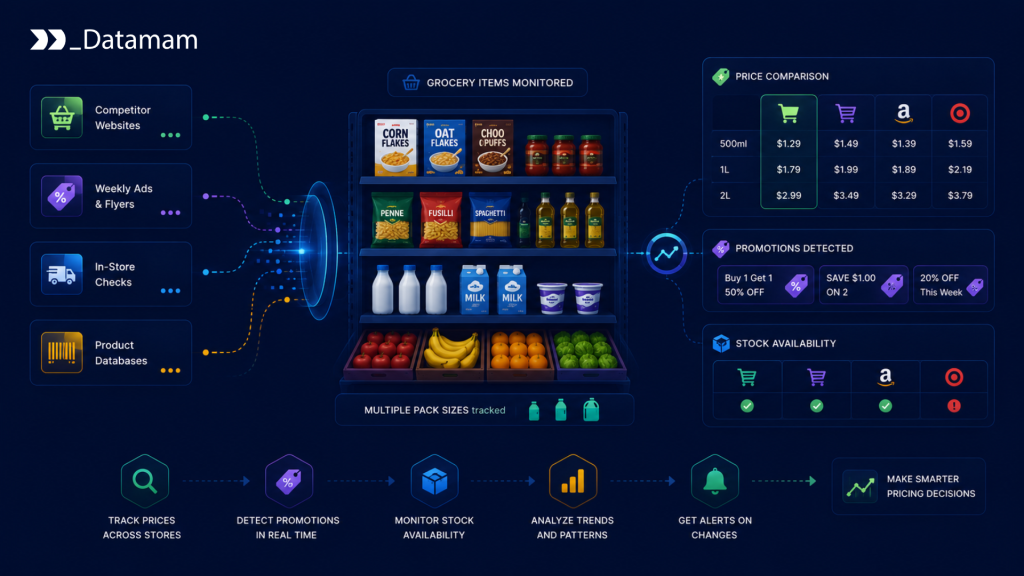
Grocery prices are difficult to compare because supermarkets rarely compete on simple one-to-one product prices.
The same product may appear as a single unit, multipack, family size, club pack, loyalty offer, promotional bundle, private-label alternative, or locally unavailable listing depending on the retailer, market, and store.
Grocery Price Monitoring turns those observations into comparable market information.
The challenge is not simply determining whether one supermarket displays a lower price. Pricing and category teams need to know whether the products are actually comparable, whether pack sizes distort the difference, whether a promotion has conditions, whether the item can currently be purchased, and whether the observation applies nationally or only to a specific store or delivery area.
Without that context, an apparently precise competitor price can lead to the wrong conclusion.
Why Grocery Prices Are Difficult to Compare
Grocery pricing combines several problems that are less pronounced in many other retail categories.
Pack sizes change.
Promotions rotate frequently.
Private-label alternatives compete with branded products.
Availability can vary by store or delivery area.
The same item may have different prices depending on membership, quantity purchased, or fulfillment method.
A retailer may sell a 12 oz cereal box while another promotes an 18 oz family pack. One supermarket may show a regular shelf price while another leads with a loyalty-member price. A third may advertise “2 for $5.”
Comparing those three displayed prices directly can produce a false competitive signal before an analyst even reviews the data.
Recent North American grocery research from McKinsey also shows why these distinctions matter commercially. Its 2026 research found consumers continuing to compare prices, use promotions, shift toward private labels, and make deliberate trade-offs across pack sizes, brands, categories, and retailers. Those findings are specific to the United States and Canada, but they illustrate how several dimensions of value can interact in grocery purchasing rather than price operating in isolation.
Product Matching in Grocery Needs More Than SKU Identity
Grocery competitor pricing starts with product identity, but not every commercially useful comparison is an exact match.
A useful grocery taxonomy can distinguish:
- exact product;
- pack-normalized exact product;
- close comparable;
- private-label alternative;
- category substitute;
- non-comparable product.
Exact Product
A branded product may be identified using a GTIN, UPC, EAN, manufacturer identifier, product name, flavor, size, or other attributes.
Where reliable identifiers align, direct comparison is relatively straightforward.
Pack-Normalized Exact Product
The underlying product may be the same while the pack configuration differs.
For example:
- 6 × 330 ml;
- 4 × 500 ml.
These are not the same pack.
But they can still support a unit-price comparison because:
- 6 × 330 ml = 1.98 L;
- 4 × 500 ml = 2.00 L.
The system should preserve both the pack configuration and the normalized quantity rather than turning the two offers into identical products.
Close Comparable
Products can compete directly without being identical.
Relevant attributes may include:
- flavor;
- formulation;
- organic or conventional status;
- package format;
- size;
- dietary characteristics;
- product type.
The comparison should remain labeled as a comparable relationship rather than an exact match.
Private-Label Alternative
A retailer’s private-label peanut butter may compete with a branded peanut butter of similar type and size, but the two products are not exact equivalents.
Private-label relationships should therefore remain separate from exact matching.
This allows category teams to analyze substitution and value positioning without making the underlying product identity look more certain than it is.
Pack Size and Unit Price Need Their Own Data Model
Pack normalization is one of the most important controls in Grocery Price Monitoring.
A product priced at $3.99 is not necessarily cheaper than one priced at $4.49 if the first contains substantially less product.
A grocery observation may need to distinguish: Home improvement price comparison strategies can provide significant insights into the true value of products. By evaluating multiple retailers and factoring in the total cost of materials and labor, homeowners can make more informed decisions. Additionally, leveraging online tools for these comparisons can save time and money, ultimately leading to better project outcomes.
- number of packages;
- units per package;
- net quantity per unit;
- total comparable quantity;
- source unit of measure;
- normalized unit of measure;
- displayed unit price;
- calculated unit price.
For example:
| Offer | Pack Configuration | Total Quantity | Item Price | Normalized Comparison |
| Retailer A | 6 × 330 ml | 1.98 L | $7.49 | price per liter |
| Retailer B | 4 × 500 ml | 2.00 L | $6.99 | price per liter |
The original pack structure should still be preserved.
A 24-count package and a 12-count package may have similar unit economics while serving different purchasing missions.
NIST’s 2025 Unit Pricing Guide provides current U.S. best-practice guidance intended to improve the accuracy, uniformity, and usability of unit pricing information across physical retail and ecommerce. Its requirements should not be treated as a universal international standard, but the guide is a useful reference for structuring unit-price information consistently.
Grocery Promotion Tracking Needs More Than a Discount Flag
A grocery promotion is not one data type.
Retailers can use:
- temporary price reductions;
- loyalty-member prices;
- digital coupons;
- multibuy offers;
- buy-one-get-one mechanics;
- bundle promotions;
- subscription discounts;
- app-only offers;
- store-specific promotions.
Each mechanic changes how the observed price should be interpreted.
A useful promotion record may include:
- base price;
- displayed promotional price;
- promotion type;
- eligibility requirement;
- required purchase quantity;
- coupon value;
- loyalty requirement;
- effective item price;
- effective unit price;
- promotion start time where available;
- promotion end time where available.
Keep Base Price and Loyalty Price Separate
A loyalty price should not overwrite the normal observed price.
A feed might instead preserve:
base_price
loyalty_price
loyalty_required = true
That distinction lets pricing teams decide whether to compare everyday price position, member value, or promotional intensity.
The UK Competition and Markets Authority’s review of supermarket loyalty pricing demonstrates how material this distinction can become. The CMA examined loyalty-pricing practices across major UK supermarkets and found loyalty pricing had become widespread enough to represent a substantial portion of sales for participating retailers. The findings are UK-specific, but they provide strong evidence for treating member and non-member prices as separate observations rather than collapsing them into one generic price field.
Model Multibuy Offers Explicitly
“2 for $5” should not automatically become:
price = $2.50
The $2.50 effective item price depends on buying two units.
A useful record should preserve:
- displayed multibuy offer;
- required quantity = 2;
- promotional total = $5;
- effective unit price = $2.50;
- condition = purchase two.
That allows downstream systems to distinguish an unconditional $2.50 item price from a conditional multibuy offer.
Promotion Duration Changes Interpretation
A one-day promotion and a four-week promotion may create the same observed discount on one particular day but carry different historical meaning.
Monitoring should therefore record when a promotion is first observed, when its terms change, and when it disappears.
That allows teams to distinguish:
- temporary events;
- recurring promotional patterns;
- longer-term price changes.
Availability Needs Location and Fulfillment Context
Stock status changes the meaning of a competitor price.
A low price on an unavailable product may still be useful historically, but it should not necessarily influence an active pricing decision in the same way as a purchasable offer.
Grocery availability can also be local.
An observation may need to distinguish:
- national or general web availability;
- selected store;
- delivery area;
- pickup location;
- region;
- shipping availability;
- delivery availability;
- pickup availability.
Possible stock states may include:
- in stock;
- out of stock;
- limited availability;
- preorder;
- temporarily unavailable;
- unknown.
The observation should also retain its geographic scope.
For example:
location_scope = selected_store
is materially different from:
location_scope = national_web
A price available from one store should not automatically be interpreted as the retailer’s national competitive position.
Substitution Matters When Exact Products Are Unavailable
Grocery customers often have alternatives when an exact product is unavailable.
Those alternatives may include:
- another pack size;
- another brand;
- private label;
- organic or conventional alternatives;
- similar formulations;
- nearby category substitutes.
Monitoring only exact SKUs can therefore miss useful competitive context.
But substitution should not be confused with identity.
A monitoring system should preserve whether an observed relationship is:
- exact;
- pack-normalized;
- close comparable;
- private-label alternative;
- substitute.
Pricing teams can then decide which relationship types belong in each analysis.
A Grocery Monitoring Data Model
At scale, the monitoring workflow should separate raw retail observations from normalized intelligence.
A practical sequence is:
collection → location resolution → product matching → pack normalization → promotion parsing → availability normalization → validation → historical storage → delivery Monitoring map violations for retailers is crucial in maintaining competitive pricing. It allows businesses to identify discrepancies in their pricing strategies quickly. Additionally, leveraging data insights from these violations can guide retailers in optimizing their promotional efforts.
Raw Observation
Raw source data may include:
- source URL;
- retailer;
- raw product title;
- displayed price text;
- pack description;
- promotion text;
- stock message;
- selected location;
- timestamp.
Normalized Observation
The structured record may then contain:
- internal product ID;
- competitor product ID;
- product match ID;
- match type;
- pack quantity;
- total normalized quantity;
- unit of measure;
- base price;
- promotional price;
- loyalty price;
- promotion type;
- stock status;
- location scope;
- observed timestamp;
- quality status.
Collection technology can vary. What matters to the pricing workflow is that these semantics remain stable regardless of how a particular retailer exposes the information.
Validate the Observation Separately From the Pricing Action
Data validity and downstream action should not be the same decision.
An out-of-stock price can still be a valid historical observation even if a repricing workflow should ignore it.
Likewise, an ambiguous promotion may be worth retaining while being excluded from automation.
An illustrative validation approach might look like this:
REQUIRED_GROCERY_FIELDS = [

    "internal_product_id",

    "competitor_product_id",

    "product_match_id",

    "retailer",

    "observed_item_price",

    "pack_quantity",

    "total_normalized_quantity",

    "unit_of_measure",

    "stock_status",

    "location_scope",

    "observed_at",

]


def validate_grocery_observation(observation):

    missing = [

        field

        for field in REQUIRED_GROCERY_FIELDS

        if observation.get(field) is None

    ]


    if missing:

        return {

            "valid": False,

            "reason": "missing_required_fields",

            "fields": missing,

        }


    if (

        observation.get("promotion_type") == "multibuy"

        and observation.get("required_purchase_quantity") is None

    ):

        return {

            "valid": False,

            "reason": "multibuy_terms_missing",

        }


    return {

        "valid": True,

        "stock_status": observation["stock_status"],

        "quality_status": "validated",

    }
This example deliberately does not make the pricing decision.
A separate downstream policy can determine whether an observation is eligible for:
- BI analysis;
- analyst review;
- promotion analysis;
- automated repricing.
For example, a valid out-of-stock observation can remain in historical analysis while being excluded from automated pricing.
Freshness Should Match the Grocery Decision
Not every grocery category needs the same monitoring frequency.
Refresh requirements may depend on:
- promotion cadence;
- category volatility;
- product importance;
- store-level variation;
- decision frequency.
A weekly category review may not require the same freshness as a pricing workflow monitoring high-visibility products during an active promotion.
Real-time collection is therefore not automatically better.
The appropriate question is:
How fresh must the observation be for the decision it supports?
The feed should record observed_at so downstream systems can enforce their own freshness requirements.
How to Measure Grocery Monitoring Quality
The number of prices collected should not measure the quality of Grocery Price Monitoring.
More useful operational measures include:
| Area | Example Measure |
| Coverage | Share of required retailers, products, stores, or regions observed |
| Product matching | Exact-match precision and unresolved-match rate |
| Pack normalization | Share of relevant products with usable normalized quantity |
| Unit pricing | Share of comparable offers with valid unit-price calculation |
| Promotions | Promotion classification and terms completeness |
| Availability | Share of observations with usable stock and fulfillment context |
| Location | Share of observations with known geographic scope |
| Freshness | Share meeting the required observation window |
| Data quality | Validation and exception rates |
| Delivery | Successful delivery into BI or pricing workflows |
Commercial outcomes should be measured separately rather than assumed.
Relevant questions include:
- How long does it take to detect an important competitor change?
- How much analyst work is spent correcting pack or promotion data?
- How often do unavailable offers reach pricing review?
- How many comparisons are rejected because the products are not sufficiently comparable?
- Which categories generate the highest rate of data exceptions?
This creates a measurable improvement program without promising that monitoring itself will produce a particular margin or revenue outcome.
How to Evaluate Grocery Price Monitoring Readiness
A readiness review should determine whether collected prices are commercially usable, not merely whether they exist.
Useful questions include:
- Are exact matches separated from alternatives and substitutes?
- Are pack quantity and total normalized quantity captured separately?
- Can the system compare prices by weight, volume, or count where appropriate?
- Are retailer-displayed and calculated unit prices distinguishable?
- Are base prices, loyalty prices, coupons, and multibuy offers stored separately?
- Is availability tied to a defined store, region, delivery area, or other location scope?
- Are promotion eligibility and quantity requirements preserved?
- Can out-of-stock observations remain in history without entering automated pricing?
- Are observation timestamps available for freshness controls?
- Are product, promotion, pack, and source exceptions routed to the appropriate review process?
- Can analysts trace a normalized price back to the original source observation?
- Do BI and pricing systems receive the comparison type and quality context alongside the price?
These questions reveal whether the process is producing competitor prices or actual grocery pricing intelligence. A competitive analysis for retail strategies can provide insights into pricing models and consumer behavior. Understanding these dynamics allows retailers to adjust their offerings to better meet market demands. Moreover, effective strategies can enhance competitiveness and improve overall profitability in the retail landscape.
Conclusion
Grocery Price Monitoring is difficult because the price displayed on a supermarket page is only one part of the comparison.
Pack configuration determines whether item prices are comparable.
Promotion mechanics determine who can actually receive the displayed discount.
Availability determines whether the offer can currently be purchased.
Location determines where the observation applies.
Product relationships determine whether the comparison is exact, normalized, approximate, or substitutive.
A reliable monitoring workflow preserves those distinctions instead of compressing them into one competitor-price field.
That gives pricing, category, merchandising, and BI teams a clearer basis for deciding which market changes matter, which require review, and which should not influence a pricing decision at all.