Key Takeaways
- Home Improvement Price Monitoring should separate product identity from pack, quantity, coverage, and other measurement differences.
- Pack-count price normalization is only one form of normalization. Home improvement products may need comparison by count, weight, volume, length, area, coverage, or individual unit.
- Store-level home improvement pricing should preserve whether an observation applies to a selected store, postal code, delivery zone, region, or general online offer.
- Local retail price comparison should distinguish item price from pickup, delivery, minimum-order, and other fulfillment conditions.
- A valid out-of-stock observation can remain useful historically even when it should not influence an active pricing decision.
- Contractor packs, bulk pricing, cases, pallets, and bundles should remain distinct commercial configurations.
- Project quantities can change the comparison because many materials must be purchased in whole packs or cases.
- Monitoring quality should be measured through comparability, coverage, normalization success, location context, availability, freshness, and exception rates rather than price-record volume alone.
Home improvement prices are difficult to compare because the number displayed on a product page is often only one part of the offer.
A box of screws may contain 50 pieces at one retailer and 100 at another. Flooring may be priced by case while coverage is expressed per square foot. Wire may be sold by roll or linear length. Paint may vary by container size, base, finish, and local availability.
The same product can also have different prices or fulfillment options depending on the selected store, delivery location, regional assortment, or available inventory.
Home Improvement Price Monitoring therefore needs to answer more than:
Which retailer has the lower price?
The more useful question is:
Are these products comparable on product identity, quantity, measurement basis, location, availability, and fulfillment?
Without those distinctions, an apparently lower competitor price can create the wrong pricing signal.
Why Home Improvement Prices Are Difficult to Compare
Home improvement retail spans categories with very different commercial units.
A power tool can often be compared using an exact manufacturer model.
A screw may require:
- diameter or gauge;
- length;
- material;
- coating;
- head type;
- drive type;
- pack quantity.
Flooring may require:
- material;
- dimensions;
- thickness;
- wear layer;
- finish;
- installation type;
- coverage per case.
Paint may require:
- brand;
- product line;
- finish or sheen;
- base;
- container size;
- tinting context.
Mulch or soil may require volume.
Wire may require gauge, conductor type, and length.
Insulation may require area or coverage.
A single universal comparison rule therefore does not work.
The monitoring system has to identify both what the product is and how the commercial quantity is expressed.
Product Identity and Measurement Comparability Are Different Questions
Two products can be the same underlying item while being sold in different pack quantities.
They can also have the same normalized measurement basis without being the same product.
For example:
- a 50-count and 100-count pack of the same screw specification may represent the same underlying product in different commercial packs;
- two 100-count screw packs from different brands may have the same count but different specifications.
A useful product relationship taxonomy can distinguish:
- exact product and pack;
- exact underlying product, different pack or quantity;
- close specification match;
- contractor or bulk configuration;
- bundle or kit;
- category substitute;
- non-comparable product;
- unresolved match.
The relationship should remain available downstream rather than being reduced to a simple matched/not-matched flag.
Start With the Measurement Basis
Home improvement products should not all be forced into a pack_count model.
A better approach starts by identifying the measurement basis.
Common examples include:
| Measurement Basis | Example Categories |
| Count | Screws, anchors, blades, batteries |
| Weight | Soil amendments, compounds, some hardware |
| Volume | Paint, liquids, mulch |
| Length | Wire, pipe, trim |
| Area | Flooring, tile, sheet materials |
| Coverage | Insulation, roofing, coatings |
| Each | Tools, appliances, fixtures |
| Pack / case | Flooring cartons, tile cases, contractor packs |
A normalized observation may then preserve fields such as:
- package quantity;
- quantity per package;
- source quantity;
- source unit;
- normalized quantity;
- normalized unit;
- coverage per package;
- displayed unit price where available;
- calculated unit price.
The NIST 2025 Unit Pricing Guide provides a useful U.S. reference for structuring unit-price information consistently across retail and ecommerce. Its broader unit-pricing framework reinforces the importance of comparing commodities using an appropriate measurement basis rather than headline package price alone. Retail pricing strategy insights are essential for businesses aiming to enhance their competitive position. By analyzing current market trends and customer behavior, companies can adjust their pricing strategies to better meet consumer expectations. Additionally, implementing data-driven approaches will allow retailers to maximize both sales and profit margins. Fashion pricing strategies in retailers can vary significantly based on market conditions and consumer demand. Successful retailers continuously adapt these strategies to address shifts in consumer preferences and emerging trends. By leveraging advanced analytics, businesses can gain deeper insights into effective pricing that aligns with their overall brand positioning.
Pack-Count Price Normalization
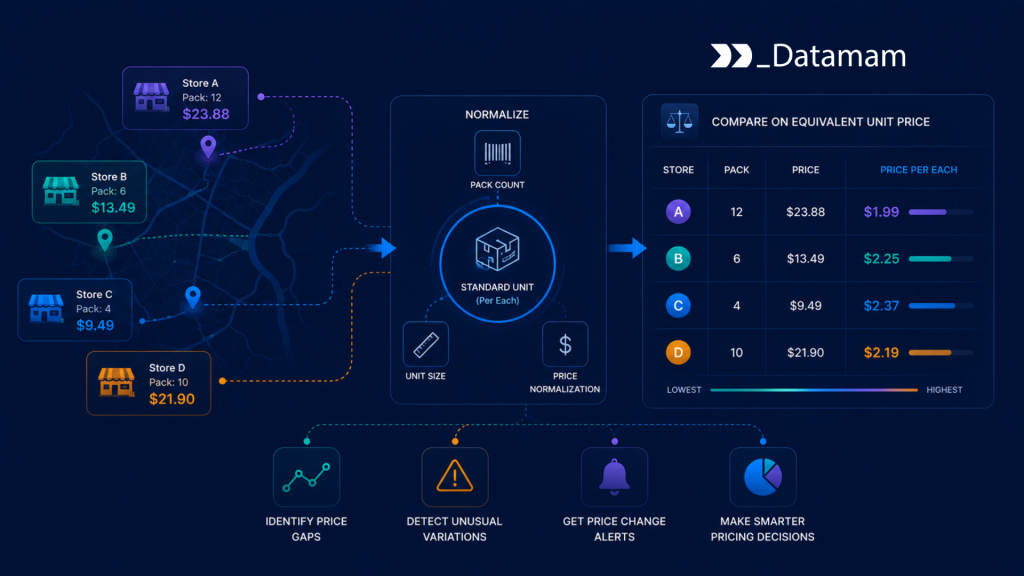
Consider two packs of otherwise comparable screws:
| Offer | Pack Count | Pack Price | Price per Screw |
| Retailer A | 50 | $7.98 | $0.1596 |
| Retailer B | 100 | $12.98 | $0.1298 |
Retailer B has the higher pack price.
But after pack-count price normalization, its price per screw is lower.
The original pack size should still be retained because a customer purchasing only a small quantity may care about total package cost as well as unit economics.
That is why normalized price should complement the observed commercial offer rather than replace it.
Coverage Can Reverse a Flooring Price Comparison
Flooring provides another useful example.
Suppose two otherwise comparable products are offered as:
| Offer | Case Price | Coverage per Case | Calculated Price per sq ft |
| Retailer A | $42.00 | 18.5 sq ft | $2.27 |
| Retailer B | $47.00 | 22.0 sq ft | $2.14 |
Retailer A appears cheaper by case.
Retailer B is cheaper after coverage normalization.
Both values matter:
- case price represents the amount actually paid for one case;
- price per square foot supports normalized comparison.
The monitoring record should preserve both.
Unit Price Is Not Always Project Cost
Home improvement purchases are often driven by projects rather than individual items.
Suppose a flooring project requires 250 square feet.
If a case covers 18.5 square feet:
cases_required = ceil(250 / 18.5) = 14
At $42 per case:
project_material_cost = 14 × $42 = $588
For a competing product covering 22 square feet:
cases_required = ceil(250 / 22) = 12
At $47 per case:
project_material_cost = 12 × $47 = $564
The second product has:
- a higher case price;
- a lower normalized price per square foot;
- a lower material cost for this specific project quantity.
This is a different analytical question from ordinary unit-price comparison.
A useful project model can preserve:
- required project quantity;
- coverage per sellable unit;
- number of whole packs or cases required;
- pack or case price;
- calculated material cost;
- configured overage where supplied by the business.
The system should not invent a universal waste or overage percentage. That parameter depends on category, project, and business rules.
Location Scope Should Be Explicit
Store-level home improvement pricing should not assume every observation represents one physical store.
A useful location model can distinguish:
- national_web;
- selected_store;
- postal_code;
- delivery_zone;
- region;
- online_only.
If the observation applies to a selected store, store ID and store location become relevant.
If it reflects a delivery area, the delivery location may be more important than a physical store.
Also, if it is a general online price, the system should not invent local specificity.
This distinction matters because actual retailer offers can vary by location. For example, Lowe’s notes that prices, promotions, styles, and availability may vary and that local-store and online pricing are not necessarily the same.
That is a retailer-specific example rather than a universal rule, but it illustrates why the location attached to an observed price should be preserved.
A Single Default Price May Not Represent the Local Market
A national or default-location product-page snapshot can hide meaningful variation.
An item might be:
- available for pickup in one store;
- unavailable in another;
- delivery only in another area;
- priced differently under a regional promotion.
A reliable observation should therefore connect:
product → location scope → price → fulfillment → availability → timestamp
For store-level observations, fields may include:
- retailer;
- store ID;
- postal code;
- region;
- local price;
- stock status;
- pickup availability;
- delivery availability;
- observed timestamp.
For non-store observations, those fields should adapt to the location scope rather than forcing a store ID onto the record.
Fulfillment Is Part of the Offer
A lower item price does not always mean a lower usable offer.
One retailer might offer:
- $450 item price;
- free pickup;
- no local delivery.
Another might offer:
- $430 item price;
- delivery available;
- $60 delivery charge.
A third could offer delivery only above a minimum basket threshold.
The monitoring model should preserve:
- item price;
- fulfillment mode;
- pickup availability;
- delivery availability;
- observed delivery charge;
- delivery-charge scope;
- minimum-order condition where exposed;
- estimated delivery timing where relevant.
Delivery charges should not automatically be assigned to one item because they may apply to an entire order, threshold, route, or basket.
The collection layer should record the fulfillment terms. Downstream analysis can determine how they should affect the comparison.
Availability Needs More Than a Universal In-Stock Flag
Availability can be particularly important for project-driven purchases.
Useful states may include:
- in stock;
- limited stock;
- out of stock;
- available nearby;
- delivery only;
- backordered;
- special order;
- unknown.
Some retailers may expose an actual quantity.
Others may expose only:
Limited stock
or:
In stock
The monitoring system should not invent numerical inventory depth when the retailer does not provide it.
Where quantity is explicitly exposed, it can be preserved as an observation.
For project-based categories, available quantity can sometimes be more decision-relevant than a binary stock flag. A project requiring 20 identical items has different requirements from a shopper needing one. Grocery stock analysis for retailers can provide valuable insights into inventory management. Understanding the nuances of stock levels helps businesses optimize their supply chain strategies. Accurate data on available items can empower retailers to make informed decisions based on consumer demand.
Contractor Packs and Bulk Pricing Need Separate Classification
Home improvement retailers frequently sell several commercial configurations of similar products:
- consumer pack;
- contractor pack;
- bulk pack;
- case;
- carton;
- pallet;
- bundle;
- kit.
A contractor pack should not automatically be treated as an ordinary pack with a lower price.
The system should preserve:
- configuration type;
- pack quantity;
- applicable quantity threshold;
- total price;
- normalized unit price.
This allows pricing teams to choose the appropriate comparison.
For example:
standard pack vs standard pack
may support direct shelf-price comparison.
contractor pack vs consumer pack
may be more useful as a normalized unit-price comparison while preserving the different purchase commitment.
Promotions Also Need Their Conditions
Home improvement promotions can include:
- volume discounts;
- rebates;
- loyalty prices;
- buy-more-save-more offers;
- seasonal discounts;
- bundle pricing;
- installation promotions;
- clearance;
- contractor pricing.
These are different commercial mechanisms.
A useful promotion record may preserve:
- base price;
- promotional price;
- promotion type;
- required quantity;
- rebate amount;
- loyalty requirement;
- minimum spend;
- start/end where available.
A rebate-adjusted price should not automatically replace the visible purchase price because the rebate may require a separate post-purchase process.
Similarly, a quantity discount should retain the quantity required to receive it.
Promotion Timing Is an Observation, Not Proof of Strategy
Seasonal timing matters in home improvement, but the relevant season depends on market and climate.
Garden, heating, cooling, storm preparation, snow-related products, outdoor equipment, and other categories can follow different local calendars.
Monitoring can establish:
- when a promotion appeared;
- how long it remained visible;
- which products were included;
- whether the discount changed;
- whether the offer returned later.
Those patterns can support category analysis.
They do not by themselves establish why the competitor launched the promotion or whether it was intended as a traffic-driving strategy.
The monitoring system should record the pattern first and leave strategic interpretation to the business team.
A Home Improvement Price Monitoring Data Model
A practical workflow can be organized as:
collection → location resolution → product matching → measurement-basis classification → pack/coverage normalization → fulfillment normalization → availability mapping → promotion parsing → validation → history → delivery
Raw Observation
Raw source information may include:
- source URL;
- retailer;
- raw product title;
- displayed price;
- pack description;
- coverage text;
- unit text;
- selected store or delivery location;
- stock message;
- fulfillment text;
- promotion text;
- timestamp.
Normalized Observation
A structured record may include:
- observation ID;
- internal product ID;
- competitor product ID;
- product match ID;
- match type;
- measurement basis;
- source quantity;
- source unit;
- normalized quantity;
- normalized unit;
- package quantity where applicable;
- coverage where applicable;
- item price;
- normalized unit price;
- location scope;
- store ID where applicable;
- postal code where applicable;
- fulfillment mode;
- stock status;
- observed timestamp;
- source URL;
- quality status.
Not every observation needs every measurement or location field.
The required fields should depend on the product category, measurement basis, and location scope.
Validate the Observation Separately From Pricing Eligibility
A simplified validation model could look like this:
BASE_REQUIRED_FIELDS = [

    "internal_product_id",

    "competitor_product_id",

    "product_match_id",

    "retailer",

    "price",

    "measurement_basis",

    "location_scope",

    "stock_status",

    "observed_at",

]


MEASUREMENT_FIELDS = {

    "count": ["normalized_quantity", "normalized_unit"],

    "volume": ["normalized_quantity", "normalized_unit"],

    "length": ["normalized_quantity", "normalized_unit"],

    "area": ["normalized_quantity", "normalized_unit"],

    "coverage": ["coverage_quantity", "coverage_unit"],

    "each": [],

}


def validate_home_improvement_observation(observation):

    required = BASE_REQUIRED_FIELDS + MEASUREMENT_FIELDS.get(

        observation.get("measurement_basis"),

        [],

    )


    if observation.get("location_scope") == "selected_store":

        required.append("store_id")


    missing = [

        field

        for field in required

        if observation.get(field) is None

    ]


    if missing:

        return {

            "valid": False,

            "reason": "missing_required_fields",

            "fields": missing,

        }


    return {

        "valid": True,

        "quality_status": "validated",

        "stock_status": observation["stock_status"],

    }
This determines whether the observation is structurally usable.
It does not decide whether a price should be matched.
A separate downstream pricing policy can determine whether the observation is eligible for:
- BI analysis;
- normalized competitor comparison;
- analyst review;
- automated repricing.
For example, an out-of-stock offer may remain a valid historical observation while being excluded from active repricing.
Freshness Should Match the Decision
Not every home improvement category requires the same refresh frequency.
Freshness may depend on:
- promotional cadence;
- store-level volatility;
- product importance;
- project season;
- stock variability;
- decision frequency.
A high-visibility local promotion may require fresher observations than a stable category review.
Real-time monitoring is therefore not automatically better.
The useful question is:
How recent must the observation be for the decision it supports?
The record should preserve observed_at so downstream workflows can enforce their own freshness requirements.
When a Lower Competitor Price Is Not Comparable
One of the most useful outputs of Home Improvement Price Monitoring is knowing when not to react to a lower visible price.
A lower competitor price may reflect:
- smaller pack quantity;
- lower area coverage;
- different specification;
- contractor quantity;
- bulk threshold;
- regional offer;
- out-of-stock product;
- pickup-only availability;
- rebate rather than immediate discount;
- different bundle or kit.
Those distinctions should remain attached to the observation.
When an exact comparable product has a genuinely lower local price, appropriate measurement basis, relevant fulfillment option, and usable availability, the comparison becomes much stronger.
How to Measure Home Improvement Price Monitoring Quality
The number of prices collected is not a sufficient quality measure.
More useful metrics include:
| Area | Example Measure |
| Retailer coverage | Share of required competitors observed |
| Location coverage | Share of required stores, regions, or delivery markets observed |
| Product matching | Exact-match precision and unresolved-match rate |
| Measurement classification | Share assigned to the correct comparison basis |
| Pack normalization | Share of applicable products with usable normalized quantity |
| Coverage normalization | Share of area/coverage products with usable normalized price |
| Location context | Share with a defined location scope |
| Fulfillment context | Share with usable pickup/delivery classification |
| Availability | Share with usable stock status |
| Promotion parsing | Share with usable promotion terms |
| Freshness | Share meeting the required observation window |
| Data quality | Validation and exception rates |
| Traceability | Share traceable to source URL and timestamp |
Matching-quality metrics should be calculated against a reviewed reference set rather than inferred from automated match volume.
Commercial outcomes should be measured separately rather than assumed.
How to Evaluate Home Improvement Price Monitoring Readiness
A readiness review should determine whether competitor prices are comparable at the level where actual pricing decisions are made.
Useful questions include:
- Are exact products separated from close specification matches and substitutes?
- Are different packs of the same underlying product identified separately?
- Does each category use the appropriate measurement basis?
- Are count, weight, volume, length, area, and coverage handled separately where required?
- Are retailer-displayed and internally calculated unit prices distinguishable?
- Can project quantities be converted into whole-pack or whole-case requirements?
- Are project overage assumptions supplied by business rules rather than invented by the monitoring layer?
- Is every price tied to a clear location scope?
- Is store_id required only for store-specific observations?
- Are item price and fulfillment conditions stored separately?
- Are delivery charges preserved with their scope rather than automatically assigned to one product?
- Is numerical inventory used only when explicitly exposed?
- Are contractor packs, bulk packs, cases, pallets, bundles, and consumer packs classified separately?
- Are promotions stored with their quantity, rebate, loyalty, or other eligibility conditions?
- Can valid out-of-stock observations remain in history without automatically entering repricing?
- Can analysts trace normalized comparisons back to the original product page, location, and timestamp?
These questions reveal whether a workflow is merely collecting home improvement prices or producing genuinely comparable local pricing intelligence.
Conclusion
Home Improvement Price Monitoring is difficult because a competitor price only becomes useful when the comparison basis is clear.
Product identity determines what is being compared.
Measurement basis determines whether the relevant comparison is by count, volume, length, area, coverage, or another unit.
Location scope determines where the price applies.
Fulfillment determines how the product can actually be purchased.
Availability determines whether the offer is currently usable.
And project quantity can change the economics again when materials have to be purchased in whole packs or cases.
Keeping those dimensions separate prevents a lower headline price from being mistaken for a better comparable offer.
That gives pricing, merchandising, category, ecommerce, and BI teams a clearer basis for deciding which competitor prices matter, which require normalization, and which should not influence a pricing decision at all.