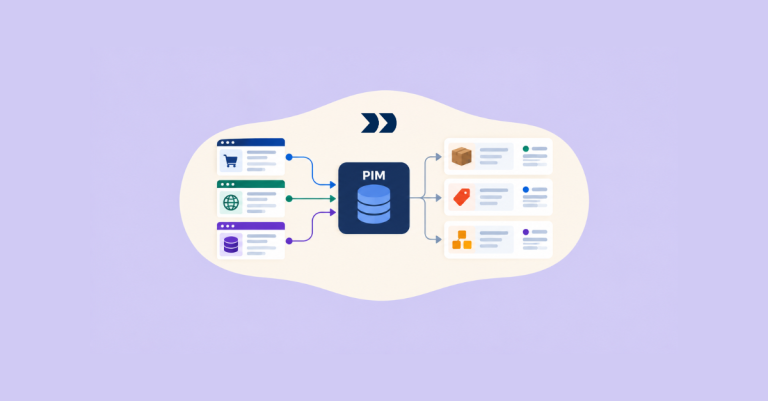
Key Takeaways
- Product Information Management can use competitor product data to identify missing attributes, conflicting values, taxonomy differences, variant-structure issues, and content-completeness gaps.
- Competitor observations should create enrichment candidates, not directly overwrite approved PIM fields.
- A PIM can maintain approved, shareable product content even when authoritative values originate in supplier, manufacturer, ERP, PLM, MDM, compliance, or other systems.
- Exact product identity and product comparability should remain separate. Comparable products may support benchmarking but should not supply factual field values.
- Source provenance does not establish source authority. A competitor page can reveal a discrepancy without being authoritative for the correct value.
- Durable product content should be separated from external market-state observations such as competitor price, availability, promotion, and seller status.
- Competitor titles, descriptions, and images can be benchmarked for structure and coverage, but observation does not automatically create rights to reuse protected creative content.
- Compliance-sensitive fields such as ingredients, certifications, safety claims, compatibility, warranty, or country of origin require appropriate authoritative verification before approval.
- Review status, field authority, product-match quality, and content completeness should be modeled separately rather than collapsed into one confidence score.
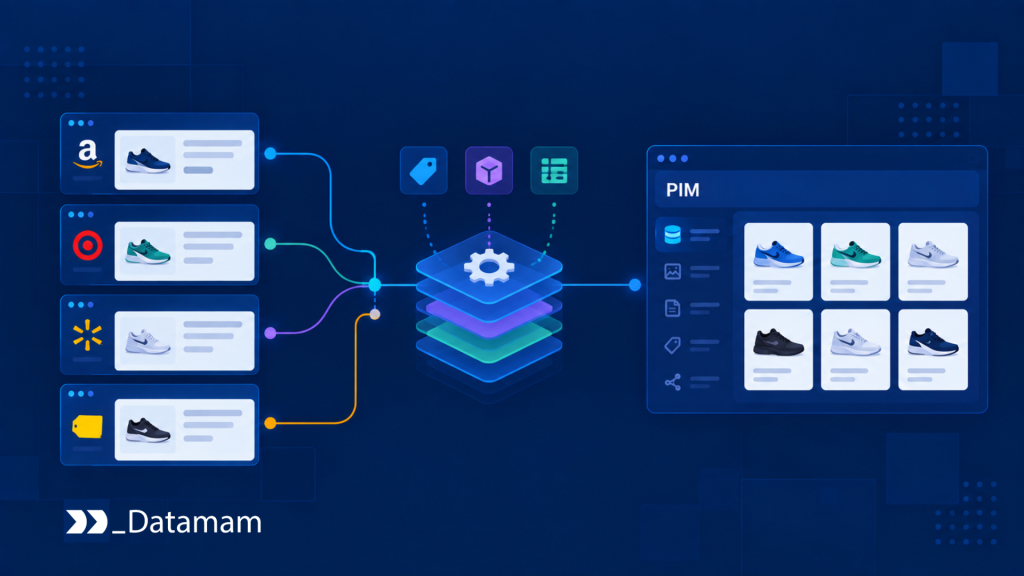
PIM Should Manage Approved Product Content, Not Blindly Import External Data
A competitor product page may expose a specification that is missing internally.
Another may organize variants more clearly.
Several competitors may use an attribute that the retailer’s own catalog does not currently capture.
Those observations can be valuable to Product Information Management teams, but they should not flow directly into approved product records.
A competitor page can tell the retailer that something deserves investigation. It does not automatically establish what the approved internal value should be.
The stronger workflow is:
observe competitor content → resolve product identity → detect a content difference → create an enrichment candidate → verify against an authoritative source → review → approve → publish
This preserves the role of competitor data as external evidence while keeping approved product content under internal governance.
Gartner describes Product Information Management solutions as systems that help product, commerce, and marketing teams create and maintain an approved, shareable version of rich product content for multichannel commerce and data exchange.
That does not mean every authoritative product value originates inside the PIM.
Depending on the retailer and product category, authoritative information may come from:
- manufacturer data;
- supplier feeds;
- ERP;
- PLM;
- MDM;
- compliance systems;
- technical specifications;
- approved internal product documentation;
- digital asset management systems.
The PIM may govern, enrich, approve, and distribute those values.
Competitor product data belongs outside that authority hierarchy.
Its role is usually to show:
something about this product record may deserve review.
That distinction is fundamental.
Competitor Observation and Approved Product Content Are Different Data Layers
A useful architecture separates at least four stages.
1. External Observation
What was observed on the competitor source:
- competitor;
- source URL;
- raw product title;
- description;
- displayed specifications;
- category path;
- variant presentation;
- visible images;
- availability;
- seller where applicable;
- observed timestamp.
2. Normalized Competitor Record
What the processing layer resolved:
- competitor product entity;
- relationship to internal product;
- normalized attribute name;
- normalized unit;
- normalized value where appropriate;
- mapped category;
- variant relationship;
- source quality status;
- extraction status.
3. Enrichment Candidate
What the comparison workflow identified:
- internal field missing;
- internal and external values conflict;
- external source exposes an attribute not modeled internally;
- variant representation differs;
- category mapping deserves review;
- content coverage differs.
4. Approved PIM Content
The value that passed the retailer’s required:
- authority check;
- validation;
- stewardship;
- compliance review where applicable;
- approval process.
This prevents:
external observation
from silently becoming:
approved product content.
Product Identity Comes Before Field Comparison
A retailer should not compare field values until it knows which products are being compared.
Matching may use:
- GTIN;
- UPC or EAN;
- manufacturer part number;
- model number;
- brand;
- size;
- color;
- pack quantity;
- dimensions;
- configuration;
- material;
- category-specific identifiers.
Useful product relationships can include:
- exact product;
- same product family, different variant;
- close comparable;
- broader substitute;
- non-comparable;
- unresolved.
The relationship matters because different workflows require different identity standards.
For example:
exact product
may justify investigating why two sources report different dimensions.
A:
close comparable
may be useful for studying which attributes competitors expose, but its specification values should not be transferred to the retailer’s product.
A useful rule is:
identity can support factual verification; comparability supports benchmarking
Match Confidence Should Not Replace Relationship Semantics
A single score such as:
match_confidence = 0.94
does not explain the relationship by itself.
The workflow should preserve:
- relationship type;
- evidence used;
- calibrated confidence where applicable;
- matching model or rule version;
- review outcome.
Image similarity, for example, can strengthen matching evidence.
It should not prove product identity on its own.
This is especially important in categories such as:
- furniture;
- apparel;
- private label;
- home decor;
where visually similar products can still differ materially.
A Competitor Field Can Reveal a Gap Without Supplying the Correct Value
Suppose an internal furniture record contains:
- width;
- height;
- material;
while several exact competitor matches also expose:
- seat depth.
The competitor evidence can establish:
seat depth may be a useful field missing from the retailer’s current product record or schema.
It does not automatically establish that the competitor’s observed seat-depth value should be copied.
The approved value might instead need verification from:
- manufacturer specifications;
- supplier documentation;
- internal product setup data;
- engineering documentation.
This distinction allows competitor monitoring to improve field completeness without weakening data authority.
Define Field Authority Before Building Enrichment Workflows
Not every field should use the same verification rules.
| Field Type | Competitor Observation Can Help With | Potential Authoritative Source |
| Dimensions | Identify missing or conflicting dimensions | Manufacturer, supplier, approved technical specification |
| Pack quantity | Identify a discrepancy or missing field | Manufacturer, supplier, approved product master |
| Material | Reveal a missing or inconsistent value | Manufacturer or approved specification |
| Ingredients | Identify missing coverage | Approved manufacturer or compliance source |
| Compatibility | Reveal missing comparison information | Manufacturer technical documentation or approved internal source |
| Warranty | Identify different customer-facing wording | Applicable retailer/manufacturer warranty documentation |
| Certification | Reveal a claimed certification | Issuer, regulatory record, approved certification documentation |
| Country of origin | Identify missing/conflicting information | Approved supplier/compliance documentation |
| Marketing description | Identify concepts competitors communicate | Retailer’s own approved content workflow |
This creates an explicit distinction between:
evidence source
and:
authority source.
Source Provenance Does Not Equal Source Authority
A competitor page may be perfectly traceable:
source_url = known
observed_at = known
raw_value = known
and still be wrong.
A marketplace seller may publish an outdated specification.
A competitor may have matched the wrong variant.
A product description may simplify technical information.
Traceability answers:
Where did this value come from?
Authority answers:
Which source is permitted or trusted to establish the approved value?
PIM governance needs both.
Durable Product Content and Market-State Data Should Stay Separate
Not everything collected from a competitor belongs in the same PIM enrichment workflow.
Durable Product Information
Examples:
- dimensions;
- material;
- size;
- model;
- compatibility;
- ingredients;
- technical specification;
- variant relationship.
These may generate PIM review candidates.
External Market-State Observations
Examples:
- competitor price;
- current stock;
- seller;
- promotion;
- delivery condition;
- marketplace position.
These are usually time-sensitive market observations.
They may be useful alongside the PIM for:
- digital shelf analysis;
- competitive intelligence;
- pricing;
- availability monitoring;
- assortment analysis.
But they should not automatically become durable master attributes in the approved product record.
A stronger architecture links the datasets without pretending they represent the same thing.
Normalize Competitor Attributes Before Comparing Them
Competitors rarely use identical field names.
The same concept might appear as:
- Material;
- Fabric;
- Construction Material;
- Upholstery;
- Finish Material.
Values can differ as well:
- 12 in
- 12 inches
- 30.48 cm
Before comparing completeness or conflicts, the workflow needs a common semantic layer.
Normalization may include:
- canonical attribute names;
- units;
- controlled values;
- brand names;
- product identifiers;
- category mapping;
- variant relationships.
The normalized value should remain linked to the original observation.
For example:
raw_value = “12 inches”
normalized_value = 30.48
normalized_unit = “cm”
source_url = …
That preserves lineage.
Product Matching and Taxonomy Mapping Solve Different Problems
Product matching asks:
Which product is this?
Taxonomy mapping asks:
Where does this product belong in the retailer’s classification system?
A competitor may place the same product under:
Outdoor Seating
while the retailer places it under:
Patio Chairs.
That difference can be useful for taxonomy review.
It does not establish that either taxonomy is universally correct.
Competitor category structures should therefore support:
- benchmarking;
- mapping;
- exception detection;
- navigation review.
The retailer’s internal taxonomy remains governed by its own merchandising and catalog rules.
Competitor Text Can Be Benchmarked Without Being Copied
Competitor titles and descriptions can reveal useful differences in content coverage.
For example, competitor titles may consistently include:
- pack quantity;
- dimensions;
- compatibility;
- material;
- shade;
- model generation.
That can generate a review question:
Should this information also be represented in our product schema or title template?
The workflow should not become:
competitor phrase looks better → copy phrase into PIM.
Instead:
observe content concept → determine whether information is useful → verify factual basis → write retailer-approved content
This protects both content quality and governance.
Competitor Images Are Also Benchmarking Inputs
Image comparison can reveal structural differences such as:
- image count;
- product angles;
- detail shots;
- technical diagrams;
- variant-specific images;
- packaging images;
- lifestyle imagery.
These are measurable observations.
A retailer may decide that its own product imagery deserves review.
That does not mean competitor imagery should be imported into the retailer’s DAM or PIM.
Online images and written content may remain protected by copyright or other rights even when publicly accessible. Rights, licenses, and applicable legal exceptions need to be considered separately from competitor-data observation.
The useful distinction is:
benchmark competitor presentation ≠ reuse competitor creative assets
Use a Governed Staging and Review Layer
External competitor data should first enter a governed staging or review environment.
That environment does not have to live inside the PIM.
It might be:
- a warehouse table;
- enrichment service;
- product-data workbench;
- PIM extension;
- review queue;
- catalog operations application.
The important requirement is separation from approved published content.
A staging record might include:
- internal product ID;
- competitor product ID;
- relationship type;
- competitor URL;
- field name;
- raw external value;
- normalized external value;
- current internal value;
- authoritative-source status;
- verification status;
- reviewer;
- workflow status.
Enrichment Candidates Need Explicit Workflow States
A candidate should not be called “approved” while review is still required.
Useful states can include:
- observed;
- normalized;
- candidate_created;
- verification_required;
- pending_review;
- approved;
- rejected;
- deferred;
- unresolved.
For example:
def evaluate_enrichment_candidate(candidate, field_policy):

    if candidate["product_relationship"] != "exact":

        return {

            "status": "benchmark_only",

            "reason": "field_level_enrichment_requires_exact_identity",

        }


    if candidate["external_value_status"] != "observed":

        return {

            "status": "unresolved",

            "reason": "external_value_not_available",

        }


    if field_policy["authoritative_verification_required"]:

        if candidate["authority_status"] != "verified":

            return {

                "status": "verification_required",

                "reason": "authoritative_source_not_verified",

            }


    return {

        "status": "pending_review",

        "reason": "candidate_ready_for_steward_review",

    }
The function never makes the competitor value an approved PIM value automatically.
It determines which workflow stage comes next.
Attribute Enrichment Should Focus on Missing Coverage and Conflicts
Useful enrichment signals include:
- internal attribute missing;
- external attribute exists;
- internal/external values conflict;
- unit inconsistency;
- incomplete variant attributes;
- schema field missing for a category.
Examples can vary by category.
Grocery
Potential review fields include:
- pack count;
- volume;
- ingredients;
- dietary attributes;
- storage information.
Beauty
Potential review fields include:
- shade;
- formulation;
- size;
- finish;
- ingredients;
- product-line relationships.
Fashion
Potential review fields include:
- size;
- fit;
- material;
- care information;
- color;
- variant structure.
Furniture
Potential review fields include:
- dimensions;
- seat depth;
- material;
- finish;
- assembly;
- configuration.
Home Improvement
Potential review fields include:
- units;
- dimensions;
- pack count;
- material grade;
- compatibility;
- installation context.
The workflow should determine both:
Is this information missing?
and:
Which source can authoritatively supply the approved value?
Compliance-Sensitive Fields Need Stronger Controls
Some content requires more than normal catalog review.
Examples may include:
- ingredients;
- safety language;
- health-related claims;
- certifications;
- regulatory identifiers;
- compatibility claims;
- warranty terms;
- country of origin;
- performance claims.
Requirements vary by product category and jurisdiction.
Competitor observations can flag:
- missing information;
- inconsistent wording;
- conflicting values.
They should not independently establish the approved claim.
A field-sensitive workflow can therefore route different candidate types to:
- catalog operations;
- product data stewardship;
- supplier management;
- technical teams;
- brand review;
- compliance or legal review where appropriate.
Conflicts Should Trigger Investigation, Not Automatic Replacement
Suppose the internal product record says:
width = 120 cm
while an exact competitor listing says:
width = 118 cm
Several possibilities exist:
- the internal value is wrong;
- the competitor value is wrong;
- different variants are being compared;
- one value represents packaged dimensions;
- the match is incorrect.
The competitor observation establishes a conflict.
It does not resolve it.
A useful conflict record can preserve:
- internal value;
- external value;
- authoritative reference value when available;
- relationship type;
- source URL;
- field;
- reviewer;
- resolution.
This gives catalog teams an auditable explanation of the final approved value.
Variant Representation Can Be Reviewed Without Becoming Assortment Planning
Competitor data may also reveal that similar product families are represented differently.
One retailer might show all colors under one parent.
Another may split colors across individual pages.
A beauty line may expose shade relationships clearly while the retailer’s records do not.
This is relevant to PIM when the problem is:
- parent-child structure;
- variant consistency;
- field inheritance;
- channel representation.
It becomes Assortment Planning when the question changes to:
Should the retailer carry additional variants?
Keeping that boundary prevents overlap between the two workflows.
Review Queues Should Present Evidence, Not Pretend to Know the Answer
Useful review queues may include:
- missing attribute;
- conflicting attribute;
- taxonomy difference;
- variant-structure issue;
- incomplete content;
- compliance-sensitive discrepancy.
A reviewer might see:
| Field | Example |
| Internal product | SKU-4821 |
| Relationship | Exact |
| Issue | Missing seat depth |
| Competitor observation | 61 cm |
| Source | Competitor product URL |
| Authority status | Manufacturer verification required |
| Workflow | Verification required |
| Owner | Product data steward |
This is more useful than a queue saying:
Recommended new seat depth: 61 cm.
The system should surface the evidence and required next action without confusing a competitor observation with an approved correction.
Monitor Content Drift as a Review Signal
Competitor product content changes over time.
Teams may observe:
- new attributes;
- changed specifications;
- revised titles;
- different variant structures;
- new image types;
- taxonomy changes.
These changes can create review signals.
For example:
A previously absent compatibility field is now visible across several exact competitor matches.
That may justify checking whether the retailer’s schema or source data should also represent compatibility.
It does not mean every competitor content change deserves an internal update.
Monitoring should focus on changes relevant to:
- comparison;
- filtering;
- discovery;
- product understanding;
- channel requirements;
- compliance-sensitive content.
AI and Search Readiness Increase the Value of Structured Product Content
Product data increasingly supports more than traditional product-detail pages.
It can feed:
- onsite search;
- filters;
- recommendations;
- marketplace feeds;
- commerce interfaces;
- AI-assisted product discovery.
Deloitte’s 2026 Global Retail Industry Outlook advises retailers to ensure product and pricing data are accurate, accessible, and optimized for AI readability as AI intermediaries become more important in product discovery.
Competitor product data can contribute to this work by exposing differences in: Retail pricing strategies for competitors can reveal valuable insights that help retailers adjust their offerings. By closely monitoring these strategies, businesses can identify pricing trends and variances that may impact their market positioning. Understanding how competitors price their products allows retailers to make informed decisions that enhance their competitiveness. Competitor pricing strategies in retail can also highlight opportunities for differential pricing. By analyzing these strategies, retailers can find gaps in the market that may be addressed with targeted promotions. This proactive approach can significantly enhance profit margins and customer loyalty amidst fierce competition.
- attribute coverage;
- structured specifications;
- variant representation;
- content completeness.
But the goal remains to improve the retailer’s own governed product information, not to reproduce competitor content.
How to Measure Competitor-Driven PIM Workflow Quality
The number of external fields collected is not a useful success metric by itself.
| Area | Example Measure |
| Product resolution | Share of competitor observations linked to usable product relationships |
| Exact-match quality | Precision of reviewed exact relationships |
| Attribute normalization | Share mapped to defined internal attributes and units |
| Candidate precision | Share of reviewed candidates confirmed as legitimate content differences |
| Authority coverage | Share of candidate fields with a defined authoritative verification source |
| Verification completion | Share of required verifications completed |
| Conflict resolution | Share of value conflicts resolved with documented evidence |
| Review outcome | Approval, rejection, deferral, and unresolved rates |
| Compliance routing | Share of sensitive fields routed through required review |
| Traceability | Share linked to source observation, transformation logic, and reviewer decision |
| Resolution time | Time from candidate creation to final workflow disposition |
| Repeat issue rate | Frequency of recurring gaps in the same field/domain |
These metrics evaluate whether the process produces reliable, reviewable enrichment work.
They do not by themselves prove improvements in sales, conversion, or customer behavior.
How to Evaluate PIM Readiness for Competitor Product Data
A retailer considering competitor data in Product Information Management should be able to answer:
- Is competitor data stored separately from approved PIM content before review?
- Are exact products distinguished from variants, comparables, substitutes, and unresolved matches?
- Are comparable products prevented from supplying factual field values?
- Does every external value preserve its raw source and observed timestamp?
- Are normalized values linked back to the original observation?
- Does each enrichment candidate distinguish source provenance from source authority?
- Is an authoritative verification source defined for important product fields?
- Are compliance-sensitive fields subject to stronger field-specific review?
- Are competitor prices, stock, promotions, and seller observations separated from durable product-master content?
- Are competitor titles and descriptions used for benchmarking rather than automatic copy reuse?
- Are competitor images treated as presentation evidence rather than automatically reusable assets?
- Are product matching and taxonomy mapping evaluated separately?
- Can content differences become review candidates without automatically becoming corrections?
- Does the workflow distinguish verification_required, pending_review, approved, and rejected states?
- Can reviewers compare internal, competitor-observed, and authoritative values side by side?
- Can the retailer trace every approved change to its authority source and approval decision?
- Are variant-structure issues kept separate from decisions about whether additional variants should be stocked?
- Are workflow metrics treated as process-quality evidence rather than automatic proof of commercial improvement?
These questions reveal whether competitor product data is genuinely supporting governed PIM operations or merely adding unverified external fields to the product catalog.
Conclusion
Competitor product data can make Product Information Management more externally aware without weakening internal governance.
The strongest model does not copy competitor fields into approved product records.
It uses competitor observations to identify: Competitor catalog data strategies can enhance the understanding of market trends and consumer preferences. These insights enable organizations to refine their product offerings and stay competitive. Leveraging this information can lead to improved pricing strategies and better-targeted marketing efforts.
- missing content;
- conflicting values;
- attribute-schema differences;
- taxonomy discrepancies;
- variant-representation issues;
- content-completeness questions.
Those findings become enrichment candidates.
Product identity is resolved first.
Field values are then checked against the appropriate authoritative sources.
Sensitive or uncertain changes move through stewardship and approval workflows.
Only approved values become part of the retailer’s governed product content.
The useful sequence is:
observe → resolve identity → detect difference → classify candidate → verify authority → review → approve → publish
That allows competitor product data to improve catalog operations while preserving the most important PIM boundary:
external market observation is evidence for review, not product truth by default.