
A competitor lowers a price for six hours.
A marketplace seller runs a temporary promotion.
A grocery item appears cheaper because its pack size is smaller.
A rival shows a low price but has no local stock.
None of those observations automatically means a retailer should change its own price.
Dynamic Pricing works best when competitor data is treated as evidence about the market, not as an instruction to react.
In this article, Dynamic Pricing means adjusting prices in response to changing market, demand, inventory, cost, competitive, and other business conditions. The important operating question is not simply how quickly competitor prices can be collected. It is whether each observation is comparable, current, relevant, and strong enough to influence a pricing workflow.
That requires a sequence:
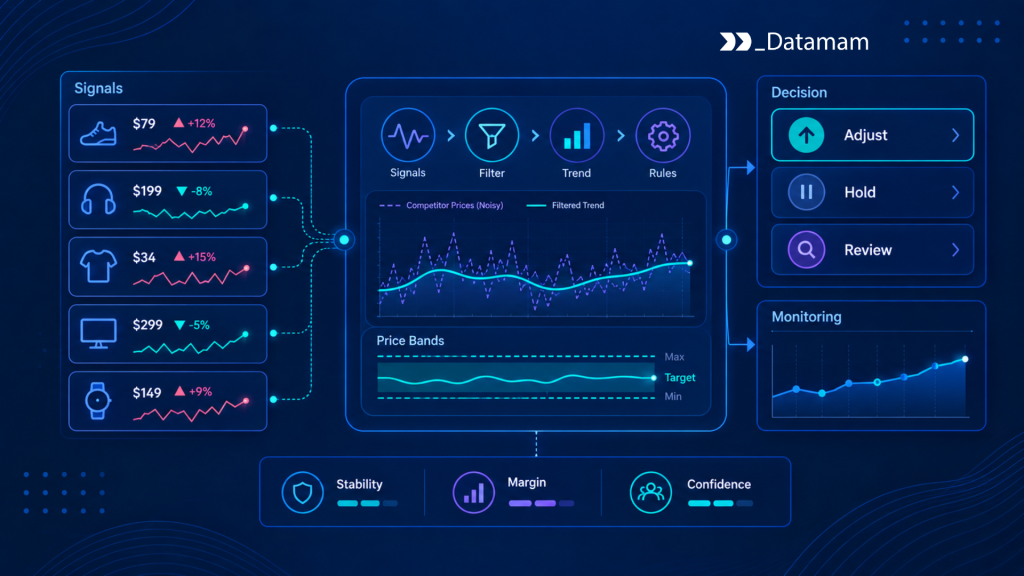
competitor observation → validation and normalization → signal classification → internal pricing relevance → governed decision
Key Takeaways
- Dynamic Pricing should use competitor prices as inputs, not automatic price-change triggers.
- A dynamic pricing strategy should distinguish a valid competitor observation from a signal that is relevant to a particular pricing decision.
- Retail dynamic pricing should interpret prices with product-match quality, promotion type, availability, seller or retailer identity, location, and price history.
- Short-lived price movements are not automatically noise, and persistent movements are not automatically actionable.
- Real-time pricing collection should be separated from pricing-decision frequency.
- Competitor relevance, category role, margin rules, inventory objectives, and strategic product classifications usually come from internal reference data rather than the external feed itself.
- Dynamic pricing software should preserve the provenance and context of competitor signals instead of consuming one unexplained competitor-price field.
- Dynamic Pricing should also be distinguished from personalized pricing, where individual consumer data influences the price offered to a specific person.
Faster Competitor Data Does Not Automatically Create Better Pricing
Retailers can now observe competitor prices at much higher frequency than manual price checks allowed.
But collection speed and decision quality are different things.
A price may change because of:
- a base-price adjustment;
- a coupon;
- a loyalty offer;
- a marketplace seller;
- a regional promotion;
- clearance;
- a temporary stock imbalance;
- a different variant;
- a different pack quantity;
- a delivery condition.
If those distinctions are lost, a pricing system may receive a technically fresh signal that is commercially misleading.
Deloitte’s 2025 Retail Industry Outlook reported that eight in ten surveyed retail executives expected greater price competition, while three-quarters expected AI to assist dynamic pricing based on demand, competition, and other factors. That increases the importance of competitor data quality, but it does not make every competitor movement equally relevant.
A Competitor Price Is an Observation Before It Is a Signal
The first useful distinction is between what was observed and what the retailer decides that observation means.
An observation might record:
- competitor;
- seller;
- product;
- displayed price;
- promotional price;
- price mechanic;
- stock status;
- location;
- fulfillment condition;
- timestamp.
Those are source-level facts.
The next layer evaluates whether those facts form a usable pricing signal.
For example:
competitor_price = 79.99
is weak on its own.
A more useful record might show:
product_relationship = exact
price_type = promotional
stock_status = in_stock
promotion_type = loyalty_price
observed_at = …
competitor_relevance = primary
signal_persistence = short
The price itself did not change. The interpretation did.
“Noise” Depends on the Pricing Decision
It is tempting to divide competitor movements into:
real signals
and:
noise
But a competitor event does not have one universal meaning.
A four-hour promotion might be irrelevant to a retailer with stable weekly pricing.
The same promotion could matter to a marketplace seller whose pricing model responds to intraday competition.
Likewise, a competitor price that remains unchanged for seven days may still be irrelevant if:
- the product match is weak;
- the competitor is outside the monitored market;
- the item is unavailable;
- the offer uses a different pack;
- the price belongs to a different seller type.
Noise is therefore better understood as:
a valid observation that does not meet the relevance rules for a specific pricing workflow.
That makes signal classification configurable rather than universal.
Product Comparability Comes Before Price Reaction
A dynamic pricing system should not ask whether the competitor price is lower until it knows whether the products are sufficiently comparable.
Depending on category, matching may require:
- brand;
- model;
- manufacturer identifier;
- UPC or GTIN;
- size;
- color;
- pack quantity;
- configuration;
- bundle composition;
- product condition;
- category-specific attributes.
The relationship should be preserved explicitly.
Useful classifications can include:
- exact product;
- same underlying product, different quantity or configuration;
- close comparable;
- broader substitute;
- non-comparable;
- unresolved.
A low price on an unresolved match should not be treated the same way as a lower price on an exact product.
Match confidence should also be calibrated to the matching model and category. There is no universal score at which a product automatically becomes safe for pricing action.
Price Type Matters as Much as Price Level
Retail competitor pages can expose several different prices for one product.
Depending on the channel, an observation may contain:
- standard displayed price;
- promotional price;
- loyalty price;
- coupon-adjusted price;
- cart price;
- member price;
- multi-buy price;
- marketplace offer;
- unit-normalized price;
- shipping or fulfillment charge.
These should not automatically collapse into one competitor_price.
Consider two competitor offers:
Offer A
base_price = $100
loyalty_price = $85
Offer B
base_price = $89
promotion = none
Both may display a price below the retailer’s own $95 price, but they represent different market conditions.
The pricing workflow should know which price mechanism produced the observation before deciding what it means.
Promotion Detection Helps Separate Structural Changes From Temporary Offers
Promotion context is one of the strongest filters for competitor data.
Useful promotion states can include:
- no detected promotion;
- visible markdown;
- coupon;
- loyalty offer;
- multi-buy;
- clearance;
- marketplace-specific discount;
- temporary campaign;
- promotion status unknown.
A promotion does not automatically mean the price should be ignored.
Instead, the mechanism becomes one input to pricing relevance.
A short promotion from a major competitor on a strategically monitored product may matter.
A longer promotion from a low-relevance seller may not.
Duration by itself cannot determine which is more important.
Price History Adds Persistence Context
A single point-in-time observation cannot show whether a competitor movement is new, recurring, or sustained.
Price history can help distinguish:
- first observed change;
- repeated short-term change;
- sustained new price level;
- recurring promotion;
- unusually volatile pattern;
- return to previous price.
Persistence can increase the relevance of a signal, but only when combined with other context.
For example:
Three direct competitors moving comparable products lower for several days
may deserve more attention than:
One marketplace seller briefly moving lower.
But even broad movement should still be evaluated against internal pricing rules.
Cross-Competitor Confirmation Can Strengthen a Market Signal
Competitor movement becomes more informative when several relevant market participants move in the same direction.
A signal model can preserve:
- number of relevant competitors observed;
- number moving higher or lower;
- median or weighted price change;
- duration of movement;
- percentage of comparable offers affected;
- category breadth;
- stock availability among the moving competitors.
This helps distinguish one isolated observation from a broader pattern.
It still does not tell the retailer what price to set.
It tells the retailer that the external market evidence has become stronger.
Availability Changes Pricing Relevance, Not Observation Validity
An out-of-stock competitor price can still be valid data.
It may be useful for:
- historical analysis;
- understanding a recent stockout;
- promotion history;
- assortment monitoring;
- explaining previous price pressure.
What changes is its relevance to a current pricing decision.
For example:
observation_valid = true
stock_status = out_of_stock
current_pricing_relevance = low
This is more precise than discarding the observation.
Availability can also require more detail than one binary field:
- in stock;
- limited stock;
- out of stock;
- delivery only;
- pickup only;
- backordered;
- unknown.
Seller Identity Is Not the Same as Competitor Relevance
Marketplaces complicate dynamic pricing because several sellers may offer the same product.
External monitoring can observe:
- seller name;
- seller ID where available;
- marketplace;
- offer position;
- fulfillment method;
- seller rating;
- price;
- shipping;
- stock.
But those fields do not establish how important that seller should be to the retailer’s pricing strategy.
Competitor relevance may require internal classifications such as:
- primary competitor;
- secondary competitor;
- marketplace seller;
- strategic account;
- liquidation channel;
- seller relevance unknown.
Likewise, whether a seller is contractually authorized usually requires brand or channel reference data rather than inference from the public marketplace page.
A stronger model is:
observed seller identity + internal competitor/channel reference → pricing relevance
Internal Category Strategy Comes After External Signal Validation
External competitor data can establish what the market is showing.
It cannot determine whether an internal product is:
- a key value item;
- traffic-driving item;
- premium-positioned product;
- clearance priority;
- inventory-sensitive SKU;
- strategic private-label item.
Those classifications come from the retailer’s own pricing and merchandising strategy.
That leads to an important separation:
external signal quality
from:
internal pricing relevance
A competitor signal can be perfectly valid but still receive little weight because the retailer’s strategy does not call for close price alignment on that item.
One Dynamic Pricing Workflow, Four Different Stages
A useful operating model separates four stages.
1. Competitor Observation
Capture what appeared publicly:
- source;
- competitor;
- seller;
- product;
- price type;
- price;
- promotion;
- stock;
- location;
- fulfillment;
- timestamp.
2. Validation and Normalization
Determine:
- product relationship;
- unit or pack comparability;
- currency;
- price mechanic;
- promotion classification;
- availability state;
- source freshness;
- data quality.
3. Pricing Relevance
Combine validated external evidence with internal context:
- competitor importance;
- category role;
- product strategy;
- inventory objective;
- pricing guardrails;
- margin requirements;
- promotion calendar.
4. Governed Pricing Decision
Possible outcomes might include:
- monitor;
- send to pricing review;
- consider adjustment;
- ignore for current pricing;
- hold for more observations.
The important point is that no individual competitor observation automatically becomes a price change.
A Configurable Signal-Classification Example
Signal logic should use business-configured rules rather than arbitrary universal thresholds.
def classify_competitor_signal(observation, policy):
if observation[“observation_valid”] is False:
return {
“status”: “invalid_observation”,
“pricing_relevance”: “none”,
}
if observation[“product_relationship”] not in policy[“accepted_relationships”]:
return {
“status”: “valid_non_comparable_observation”,
“pricing_relevance”: “none”,
}
if observation[“freshness_status”] != “current”:
return {
“status”: “stale_observation”,
“pricing_relevance”: “review”,
}
if observation[“competitor_id”] not in policy[“relevant_competitors”]:
return {
“status”: “valid_low_relevance_signal”,
“pricing_relevance”: “low”,
}
if observation[“stock_status”] in policy[“non_actionable_stock_states”]:
return {
“status”: “valid_non_actionable_availability”,
“pricing_relevance”: “low”,
}
if observation[“promotion_type”] in policy[“review_promotion_types”]:
return {
“status”: “promotion_requires_context”,
“pricing_relevance”: “review”,
}
return {
“status”: “validated_pricing_signal”,
“pricing_relevance”: “candidate”,
}
The thresholds and accepted states in policy should be calibrated for the retailer, category, market, matching model, and workflow.
The code does not decide what the final selling price should be.
It determines whether a competitor observation is suitable for the next pricing stage.
Dynamic Pricing Software Needs Context-Rich Inputs
Even sophisticated dynamic pricing software can produce weak recommendations when its competitor inputs are poorly matched or misclassified.
McKinsey’s guidance on dynamic pricing in retail warns against excessive price changes and specifically cautions retailers against allowing bad data to dictate pricing. It recommends pricing guardrails and alignment with the desired customer experience.
A competitor feed should therefore preserve enough information to explain the signal.
A useful record may include:
- source URL;
- competitor ID;
- seller entity;
- internal product ID;
- competitor product ID;
- product relationship;
- observed price;
- price type;
- promotion type;
- stock status;
- location or market;
- fulfillment context;
- observed timestamp;
- persistence classification;
- competitor relevance;
- match model or rule version;
- signal-classification rule version.
This supports auditability as well as pricing analysis.
Real-Time Collection Is Not the Same as Real-Time Price Adjustment
The phrase real-time pricing can imply that prices should change whenever new market data arrives.
That is not necessarily the right operating model.
A retailer might:
- collect selected competitor prices hourly;
- validate and normalize signals continuously;
- calculate category-level market movement several times per day;
- approve actual price changes once per day.
Another category may require much slower or faster review.
The relevant distinction is:
collection frequency
versus:
decision frequency
versus:
price-publication frequency
These can be different.
The correct cadence depends on category volatility, business risk, customer expectations, internal governance, and pricing strategy.
Dynamic Pricing Is Not Personalized Pricing
Dynamic pricing and personalized pricing should not be treated as synonyms.
Dynamic pricing generally changes prices as market or business conditions change.
Personalized pricing uses information about an individual consumer to influence the price offered to that person.
That distinction matters because the data, governance, and regulatory questions are different.
In August 2026, the U.S. Federal Trade Commission sought public comment on a proposed enforcement policy statement regarding personalized pricing, defining the practice as the use of personal data to set prices based on what a company believes an individual consumer is willing to spend.
A competitor-data dynamic pricing workflow does not need individual consumer data to perform the market-signal functions described in this article.
Keeping the concepts separate improves both technical and governance clarity.
Pricing Governance Should Focus on Decision Rules
Once a competitor signal is validated, internal pricing governance determines what can happen next.
Possible controls include:
- margin floors;
- maximum price-change limits;
- product/category rules;
- competitor relevance;
- inventory constraints;
- promotion exclusions;
- price-change approval requirements;
- customer-facing consistency rules;
- manual-review conditions;
- audit logs.
These are internal business rules.
The external competitor feed should not invent them.
The pricing system should instead connect validated market observations to approved internal policies.
Transparency Matters When Prices Change Dynamically
Dynamic pricing governance is not only an internal data-quality issue.
Customer-facing pricing practices can also require transparency.
The UK Competition and Markets Authority’s 2025 guidance for businesses using dynamic pricing advises businesses to be transparent about changing prices, avoid giving consumers the impression that a dynamic price is fixed, explain important terms clearly, and avoid changing the price while a customer is in the payment process.
Those recommendations concern the customer-facing pricing experience rather than competitor-data collection itself.
They reinforce a broader principle: faster pricing capability should operate inside clearly defined commercial and governance boundaries.
How to Measure Competitor-Signal Quality for Dynamic Pricing
The number of prices collected or price changes detected is not enough.
More useful measures include:
| Area | Example Measure |
| Product comparability | Share of observations with usable relationship classification |
| Match quality | Precision of reviewed exact/comparable matches |
| Price-type coverage | Share with base, promotional, loyalty, or other price mechanic identified |
| Promotion classification | Share with usable promotion context |
| Availability | Share with usable stock state |
| Competitor resolution | Share linked to a known competitor or seller entity |
| Location context | Share tied to the relevant market or location |
| Freshness | Share meeting the workflow’s required observation window |
| Persistence | Share with sufficient price history for persistence classification |
| Cross-competitor confirmation | Share of significant movements observed across relevant competitors |
| Signal relevance | Share classified as candidate, low relevance, review, or non-actionable |
| Review outcomes | Share confirmed or dismissed after analyst review |
| Traceability | Share linked to source data and rule/model versions |
These measures evaluate whether competitor data is useful for pricing decisions without assuming that more automated price changes are inherently better.
How to Evaluate Dynamic Pricing Readiness
A retailer considering competitor data for Dynamic Pricing should be able to answer:
- Are competitor observations separated from pricing recommendations?
- Can exact products, close comparables, substitutes, and unresolved matches be distinguished?
- Are match-confidence scores calibrated to the relevant model and category?
- Are base prices, promotions, loyalty prices, coupons, and other price mechanics stored separately?
- Can out-of-stock observations remain valid historical data without automatically influencing current pricing?
- Is seller identity separated from internal competitor relevance or channel classification?
- Are internal category roles and strategic product classifications kept separate from external observations?
- Can the system distinguish isolated price moves from persistent or cross-competitor movement?
- Are promotion duration and price volatility treated as evidence rather than universal noise rules?
- Is collection frequency separated from pricing-decision frequency?
- Does every signal preserve source, market, timestamp, product relationship, price type, availability, and rule/model provenance?
- Can analysts explain why a competitor signal was considered relevant or ignored?
- Are final price actions governed by approved internal rules rather than the external feed itself?
- Are dynamic and personalized pricing treated as separate operating concepts?
- Can the retailer audit which competitor observations contributed to a pricing review or recommendation?
These questions reveal whether the retailer has a dynamic pricing strategy or simply a faster competitor-price feed.
Conclusion
Dynamic Pricing does not become more disciplined simply because competitor prices arrive faster.
A competitor price is first an observation.
Product matching, price mechanics, promotion status, availability, location, seller identity, and freshness determine whether that observation is trustworthy and comparable.
Persistence and movement across relevant competitors can strengthen the market signal.
Internal category, inventory, margin, and competitor strategy determine whether the signal matters to the retailer.
Pricing rules and governance determine whether any action follows.
That means the strongest dynamic pricing workflow is not:
competitor lowers price → retailer lowers price
It is:
observe → validate → classify → establish relevance → apply pricing rules → decide
Real-time pricing data can improve decision speed, but only when the retailer preserves enough context to know when a market movement deserves attention and when it does not.