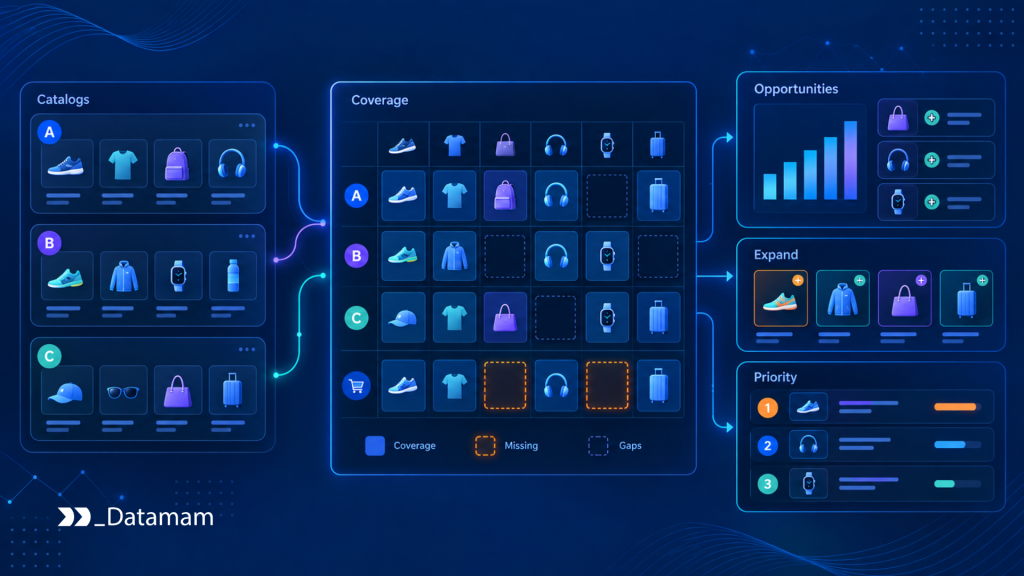
A competitor may carry more sizes, additional pack formats, another price band, a broader shade range, or product types that do not appear in a retailer’s own catalog.
Those differences are useful signals, but they are not automatically assortment gaps.
A retailer may intentionally exclude a brand. A missing variant may have little internal demand. A competitor listing may be unavailable, duplicated across marketplace sellers, or outside the retailer’s target segment. An apparent assortment expansion may even come from improved collection coverage rather than a real catalog change.
Assortment Planning therefore needs a disciplined sequence:
define comparison scope → normalize catalog entities → measure coverage differences → classify candidate gaps → combine with internal evidence → prioritize → review
The objective is not to copy competitor catalogs. It is to determine which observed differences deserve commercial investigation.
Key Takeaways
- Assortment Planning should distinguish a competitor coverage difference from a validated assortment opportunity.
- Competitor catalog data can show what selected rivals offer, but it does not by itself establish unmet demand or lost sales.
- Product counts should be based on normalized entities rather than raw URLs, listings, or marketplace offers.
- Catalog lifecycle and stock availability should remain separate. An out-of-stock product can still belong to a competitor’s observed assortment.
- Exact product matching, comparable-product matching, category mapping, and attribute normalization answer different questions.
- Price-band, brand, product, and variant coverage should be measured against a defined competitor, market, channel, and observation scope.
- External evidence can establish that a coverage difference exists. Internal demand, economics, strategy, and operational feasibility determine whether it matters.
- Evidence confidence and business priority should be stored separately.
- Longitudinal assortment comparisons require consistent source coverage and collection completeness.
Start by Defining the Comparison Scope
An assortment gap only exists relative to a defined comparison set.
Before comparing catalogs, teams should specify:
- competitors;
- market or country;
- store, region, or delivery area where relevant;
- channel;
- category and subcategory;
- observation period;
- first-party versus marketplace coverage;
- product relationship rules.
For example, a retailer may appear to have a large assortment gap when compared with an open marketplace containing hundreds of third-party sellers.
The result may look very different when the comparison is limited to:
- three direct retail competitors;
- first-party products;
- the same country;
- the same subcategory;
- products available during the same observation window.
Assortment analysis should preserve that scope with every resulting metric.
Otherwise, statements such as:
Competitor assortment is 30% broader.
are difficult to interpret.
Broader than what, where, and under which inclusion rules?
Competitor Catalog Data Shows Coverage, Not Demand
Internal data and competitor catalog data answer different questions.
Internal retail data may show:
- sales;
- searches;
- inventory;
- margin;
- returns;
- conversion;
- internal promotions;
- category performance.
Competitor catalog monitoring can show:
- observed products;
- brands;
- variants;
- price points;
- attributes;
- promotions;
- listing states;
- availability.
The second group provides external coverage evidence.
It does not establish that customers wanted the products the retailer did not carry.
For example, if three competitors offer 12-pack products and the retailer only carries 6-packs, the defensible conclusion is:
The selected competitors have broader observed pack-count coverage.
That does not yet establish:
Customers want a 12-pack and the retailer is losing sales because it does not offer one.
Internal search data, transactions, shopper evidence, category economics, and strategy may strengthen or weaken that hypothesis.
This distinction keeps assortment optimization from turning competitor copying into a substitute for merchandising judgment.
The Deloitte 2026 Global Retail Industry Outlook discusses targeted assortment shifts alongside pricing, product mix, promotions, operational discipline, and customer value. Competitor catalogs can contribute external evidence to those decisions, but they remain one input among several.
Normalize the Catalog Before Measuring Gaps
Competitor websites rarely structure catalogs in the same way.
One retailer may represent every color as a separate page.
Another may place ten colors under one parent product.
A marketplace may show the same product through several sellers.
Category names may also differ:
- Outdoor Storage;
- Garden Organization;
- Patio Storage;
- Outdoor Accessories.
Raw listing counts therefore provide a weak basis for assortment comparison.
The goal is not to mirror competitor websites.
The goal is to make their catalogs comparable.
A normalized catalog may preserve:
- product entity;
- product family;
- brand;
- category;
- subcategory;
- variant;
- size or pack;
- material;
- configuration;
- price;
- price band;
- listing lifecycle;
- availability;
- retailer or seller;
- market;
- timestamp;
- source URL.
Measure Product Entities, Not URLs
Suppose a competitor moves from 500 URLs to 550.
It would be incorrect to conclude automatically that its assortment expanded by 10%.
The additional pages might represent:
- variants split into separate URLs;
- duplicate marketplace offers;
- newly indexed seller pages;
- pagination improvements;
- restored collection after a source failure.
Entity resolution should happen before assortment-growth calculations.
Useful coverage measures can include:
- unique observed product entities;
- product-family coverage;
- brand coverage;
- size or pack coverage;
- attribute coverage;
- defined price-band coverage;
- first-party product coverage;
- marketplace seller coverage.
This allows teams to compare commercial coverage rather than website structure.
Product Matching and Category Mapping Should Stay Separate
Product matching answers:
What product is this, and how does it relate to another product?
Category mapping answers:
Where does this product belong in the retailer’s comparison taxonomy?
The two processes can produce different levels of certainty.
A product may clearly belong to:
Dining Tables
while exact or comparable-product matching remains unresolved.
Likewise, two branded products may be exact matches even when competitors place them in different category hierarchies.
Assortment analysis should preserve both:
- product relationship;
- category mapping.
Useful product relationships may include:
- exact product;
- same family, different variant;
- close comparable;
- broader substitute;
- non-comparable;
- unresolved.
This is important because the absence of an exact match does not necessarily indicate missing commercial coverage.
A retailer may already carry a strong substitute.
Separate Catalog Lifecycle From Availability
One of the most important distinctions in assortment monitoring is:
Is the product part of the observed catalog?
versus:
Can a customer buy it right now?
These are not the same question.
A useful catalog lifecycle can include:
- first observed;
- observed;
- no longer observed;
- reappeared;
- confirmed removed or retired where evidence supports that conclusion.
Availability can be stored separately:
- in stock;
- limited stock;
- out of stock;
- backordered;
- pickup only;
- delivery only;
- unknown.
A product can therefore be:
catalog_state = observed
and:
availability = out_of_stock
at the same time.
An out-of-stock product may still matter for catalog breadth, historical assortment analysis, or monitoring for future availability.
Listing Disappearance Does Not Prove Product Removal
A product that disappears from one observation should not automatically become:
removed_from_assortment = true
Possible explanations include:
- temporary source failure;
- URL migration;
- variant consolidation;
- region change;
- marketplace seller exit;
- search/indexing changes;
- actual product removal.
A safer lifecycle state is:
no longer observed
until stronger evidence supports a more specific conclusion.
This prevents technical collection changes from becoming merchandising conclusions.
Longitudinal Assortment Analysis Requires Stable Coverage
Even normalized product entities can produce misleading trend metrics when collection scope changes.
Before comparing assortment between two periods, teams should check:
- competitor set;
- first-party versus marketplace scope;
- category scope;
- market/location;
- pagination coverage;
- collection completeness;
- product-resolution rules;
- source configuration.
For example, an assortment increase from 800 to 950 products is not comparable if the second observation includes an additional marketplace seller population that the first did not.
The safer model is:
comparable observation scope + stable entity rules + sufficient collection completeness → assortment-change metric
not simply:
new count − old count = assortment change
Classify Coverage Differences Before Calling Them Gaps
Once catalogs are comparable, teams can identify several kinds of coverage differences.
| Coverage Difference | What External Data Can Establish | What Internal Evidence Determines |
| Brand coverage | Competitors carry brands not observed internally | Whether those brands fit category and brand strategy |
| Product-type coverage | Competitors carry product formats the retailer lacks | Whether the format deserves range consideration |
| Variant coverage | Competitors offer additional sizes, colors, shades, packs, or configurations | Whether customers need the additional variants |
| Price-band coverage | Competitors cover price bands not represented internally | Whether the retailer wants or needs that price position |
| Attribute coverage | Competitors carry additional materials, features, compatibility options, or claims | Whether the attributes align with demand and assortment strategy |
| Availability coverage | Competitors currently have more purchasable options | Whether availability differences affect internal priorities |
The external layer establishes the coverage difference.
A candidate gap exists when that difference survives comparison and quality checks.
A validated opportunity requires internal evidence that the difference is commercially relevant.
Variant Coverage Can Reveal Gaps Inside Existing Product Families
Variant analysis is especially useful because product-family counts can hide important differences.
Examples include:
- shoe width and size;
- beauty shade;
- furniture dimensions;
- grocery pack count;
- fashion color and size;
- home improvement unit or contractor quantity.
A retailer and competitor may each carry one product family, yet the competitor may offer substantially deeper variant coverage.
For example:
Retailer
- Product A
- Black
- Sizes S, M, L
Competitor
- Product A
- Black, Navy, Beige
- Sizes XS, S, M, L, XL
The product-family count is identical.
The commercial coverage is not.
The correct conclusion is:
The competitor has greater observed color and size coverage for this product family.
Whether the retailer should add those variants still requires internal evidence.
Define Price Bands Before Looking for Price-Tier Gaps
Terms such as:
- entry level;
- mid-tier;
- premium;
should not be assigned casually.
A higher price does not automatically make a product premium.
Price coverage can instead be modeled using:
- documented category price bands;
- category percentiles;
- internally defined good/better/best tiers;
- approved merchandising segments.
For example:
| Defined Price Band | Retailer Coverage | Competitor Coverage |
| $0–49 | 12 products | 28 products |
| $50–99 | 35 products | 31 products |
| $100–199 | 21 products | 25 products |
| $200+ | 8 products | 17 products |
This establishes a coverage difference.
It does not automatically tell the retailer that the $200+ range should expand.
That requires internal strategy and economics.
In its 2026 North American grocery analysis, McKinsey reports expected increases in collaboration between retailers and suppliers across areas including product innovation and assortment/category planning. The evidence is specific to North American grocery, but it illustrates how assortment decisions can intersect with broader product, supplier, pricing, and commercial planning.
Availability Changes the Meaning of Coverage
Catalog breadth and currently purchasable breadth should not be treated as identical metrics.
A competitor might have:
- 1,000 observed products;
- 820 currently available products.
Another might have:
- 900 observed products;
- 870 currently available products.
The first competitor has broader observed catalog coverage.
The second has broader currently purchasable coverage.
Both metrics can be useful.
They answer different questions.
This is especially important in categories where availability varies by:
- store;
- size;
- shade;
- seller;
- region;
- fulfillment method.
First-Party and Marketplace Coverage Should Be Reported Separately
Marketplace catalogs can create the appearance of enormous assortment breadth.
One retailer may directly merchandise 5,000 products while third-party sellers add another 40,000 listings.
Those should not automatically become one assortment number.
A useful model distinguishes:
- first-party retail assortment;
- marketplace third-party coverage;
- unique seller coverage;
- duplicate offers;
- product condition;
- fulfillment model.
A marketplace listing may also represent:
- a duplicate product;
- refurbished condition;
- used condition;
- seller-specific bundle;
- imported version where stated;
- different regional configuration.
These observations may still matter, but they require separate comparison rules.
first-party catalog coverage ≠ marketplace seller coverage
Promotion and Assortment Signals Should Also Stay Separate
Competitor catalog analysis may capture promotions because they affect how an assortment is presented commercially.
Useful fields can include:
- base price;
- promotional price;
- promotion mechanic;
- eligibility;
- observed duration;
- affected products;
- recurrence.
But repeated promotions do not establish why the competitor chose them.
External data can show:
- which products were promoted;
- by how much;
- how frequently;
- for how long.
It generally cannot establish internal competitor intent.
Promotion signals should therefore enrich assortment analysis without becoming evidence of strategy by themselves.
From Coverage Difference to Candidate Gap
A useful assortment workflow can classify findings in stages.
Stage 1: Observed Coverage Difference
Example:
Three selected direct competitors offer 1 kg and 2 kg formats, while the retailer currently offers only 1 kg.
Stage 2: Evidence Quality Review
Check:
- comparable market and channel;
- stable observation scope;
- product/category mapping;
- attribute completeness;
- listing lifecycle;
- availability;
- source traceability.
Stage 3: Candidate Gap
The normalized difference is sufficiently reliable to investigate.
Example:
Candidate pack-size coverage gap: 2 kg format.
Stage 4: Internal Validation
Review internal evidence such as:
- site search;
- sales patterns;
- customer requests where available;
- current range performance;
- category role;
- margin/economics;
- inventory implications;
- supplier feasibility;
- brand strategy.
Stage 5: Commercial Priority
Possible outcomes:
- investigate sourcing;
- test in selected markets;
- monitor;
- intentionally exclude;
- insufficient evidence;
- reject as non-strategic.
This separates external evidence from the actual assortment decision.
Demand Evidence, Economics, and Strategy Play Different Roles
Internal evidence should not be grouped into one generic “commercial impact” score.
Different inputs answer different questions.
Demand or Interest Evidence
May include:
- internal search behavior;
- transactions;
- customer requests where available;
- relevant market or shopper evidence.
Commercial Evidence
May include:
- sales;
- margin;
- returns;
- expected economics;
- cannibalization considerations.
Operational Evidence
May include:
- supplier availability;
- minimum order quantities;
- fulfillment requirements;
- storage;
- inventory complexity.
Strategic Evidence
May include:
- category role;
- private-label strategy;
- price architecture;
- brand position;
- planned range direction.
A coverage difference becomes more actionable when several forms of evidence support the same decision.
Gap Confidence and Gap Priority Are Different
Teams should avoid collapsing every factor into one opaque gap score.
Two different questions need answers:
How certain are we that the coverage difference exists?
Evidence may include:
- match quality;
- category-mapping quality;
- attribute completeness;
- stable source coverage;
- competitor observations;
- lifecycle continuity.
How important is the difference to the retailer?
That may depend on:
- internal demand evidence;
- category priority;
- expected economics;
- operational feasibility;
- brand fit.
A highly certain gap can have low commercial priority.
A potentially important opportunity can still require additional evidence.
evidence confidence ≠ business priority
Category-Specific Assortment Logic Matters
Different categories require different comparison attributes.
Grocery
Useful coverage dimensions may include:
- pack size;
- unit basis;
- dietary claim;
- brand;
- private label;
- format;
- local availability.
Beauty
Useful dimensions may include:
- shade;
- formulation;
- size;
- bundle;
- product-line coverage;
- availability by variant.
Fashion
Useful dimensions may include:
- size;
- color;
- fit;
- collection;
- material;
- variant availability.
Furniture
Comparable-product analysis may rely more heavily on:
- dimensions;
- material;
- finish;
- configuration;
- function;
- defined price band.
Home Improvement
Useful dimensions may include:
- unit size;
- pack count;
- compatibility;
- material;
- local store availability;
- commercial configuration.
A single global assortment-gap rule cannot represent all of these categories well.
Source Traceability Should Travel With Every Candidate Gap
A candidate gap should be explainable.
Useful provenance can include:
- competitor;
- market;
- channel;
- source URL;
- product entity;
- observed timestamp;
- product relationship;
- normalized attributes;
- category mapping;
- availability state;
- lifecycle state;
- source/collection status;
- rule or model version;
- review status.
Gartner’s 2026 research on competitive and market intelligence platforms identifies data aggregation, validation, insight creation, and actionable outputs among important platform capabilities. Assortment analysis similarly benefits from preserving the evidence chain between source observations and the resulting candidate gap.
That does not mean every gap requires manual review.
It means teams should be able to reconstruct why the gap was identified.
Review Decisions Should Be Retained
Category teams may:
- approve a candidate gap;
- reject it;
- classify it as intentional;
- request more evidence;
- mark it for monitoring.
Those decisions should be retained with the underlying evidence.
This supports:
- consistent future reviews;
- quality evaluation;
- rule refinement;
- model training where an explicit learning process exists;
- auditability.
Simply storing reviewer decisions does not automatically make the matching or gap-detection system learn from them.
How to Measure Assortment Gap Quality
The number of detected gaps is not a useful success metric on its own.
| Area | Example Measure |
| Competitor coverage | Share of required competitors, markets, and channels observed |
| Collection continuity | Share of comparison periods with comparable source coverage |
| Product resolution | Share mapped to usable product entities |
| Match quality | Precision of reviewed product relationships |
| Category mapping | Share correctly mapped to the comparison taxonomy |
| Attribute completeness | Coverage of category-required comparison fields |
| Duplicate control | Duplicate or seller-offer resolution rate |
| Lifecycle quality | Accuracy of observed/no-longer-observed/reappeared states |
| Availability coverage | Share with usable stock or fulfillment state |
| Candidate-gap precision | Share of reviewed candidate gaps accepted as valid coverage differences |
| Traceability | Share linked to source observations and rule/model versions |
| Review rate | Share requiring category-team intervention |
Separate metrics should evaluate commercial prioritization.
For example:
- share supported by internal demand evidence;
- share passing strategy review;
- share passing economic/feasibility review.
This prevents technical gap detection and business opportunity assessment from becoming one metric.
How to Evaluate Assortment Planning Readiness
A retailer using competitor catalogs for Assortment Planning should be able to answer:
- Is every analysis tied to a defined competitor, market, channel, category, and time scope?
- Are first-party and marketplace assortments separated?
- Are product entities normalized before assortment counts are calculated?
- Are exact matches, variants, comparables, substitutes, and unresolved relationships distinguished?
- Are product matching and category mapping separate?
- Are listing lifecycle and availability stored separately?
- Does a disappeared listing remain “no longer observed” unless stronger evidence supports removal?
- Are assortment changes calculated only across comparable collection scopes?
- Are brand, product, variant, attribute, and price-band coverage differences measured separately?
- Are price bands defined rather than inferred from vague labels such as “premium”?
- Can an out-of-stock product remain part of historical or observed catalog coverage?
- Are marketplace duplicates and seller-level offers resolved before breadth is calculated?
- Are competitor coverage differences distinguished from validated assortment opportunities?
- Is external evidence separated from internal demand, economics, operations, and strategy?
- Are evidence confidence and commercial priority stored separately?
- Can category teams trace every candidate gap to source observations and normalized comparison data?
- Are reviewer decisions retained without assuming they automatically train the system?
These questions reveal whether competitor catalog monitoring is actually supporting assortment decisions or merely generating lists of products the retailer does not carry.
Conclusion
Assortment Planning should not begin with the assumption that every competitor product missing from the retailer’s catalog represents an opportunity.
The process starts by defining the correct competitor and market scope.
Catalog entities must then be normalized so that retailer websites, variants, marketplace sellers, and category taxonomies become comparable.
Only then can teams measure genuine coverage differences across products, brands, variants, attributes, price bands, and availability.
Those differences become candidate gaps when the external evidence is reliable.
Internal demand, economics, operational feasibility, and category strategy determine whether a candidate gap deserves action.
The useful model is:
scope → normalize → compare → identify coverage difference → classify candidate gap → validate internally → prioritize → review That allows competitor catalog data to strengthen assortment optimization without confusing competitor coverage with customer demand or treating competitor catalogs as templates that should simply be copied.