Key Takeaways
- Retail Merchandising should use competitor assortment, pricing, promotion, and availability data as external evidence rather than automatic instructions.
- External observations can generate merchandising hypotheses, but internal demand, inventory, economics, lifecycle, and strategy determine whether action is justified.
- Competitor data has different value during pre-season planning, in-season trading, promotion and markdown management, and end-of-life review.
- Merchandising decisions should consider both assortment width and inventory depth. A product can be present in the range but underrepresented through shallow stock, limited variants, or weak allocation.
- Candidate assortment gaps should come from normalized assortment analysis rather than raw competitor product counts.
- Price-band and promotion evidence should inform internally defined merchandising and pricing frameworks rather than redefine them automatically.
- Markdown timing is more meaningful when compared relative to product or seasonal lifecycle rather than calendar date alone.
- Evidence confidence and merchandising priority should remain separate.
- Normalized merchandising signals should remain traceable to raw source observations, timestamps, product relationships, and transformation rules.
- Competitor-informed merchandising works best when different signal types have clear owners across merchandising, category, pricing, inventory, marketplace, and data teams.
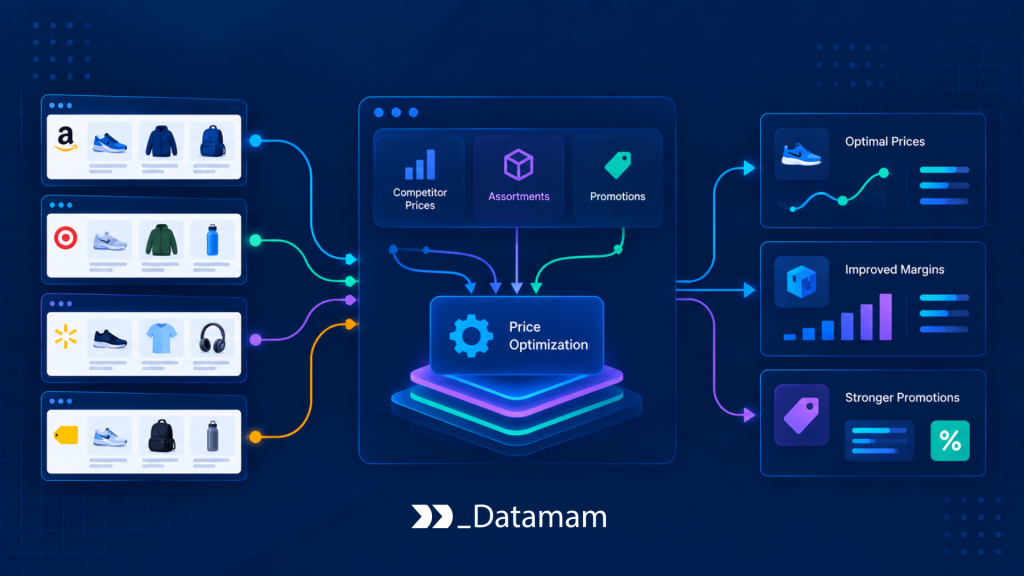
Merchandising teams make decisions across product range, inventory depth, pricing position, promotions, markdowns, seasonal timing, and category presentation.
Internal data explains how the retailer’s own assortment is performing. Competitor data adds another perspective: what selected competitors are carrying, promoting, discounting, stocking, launching, or removing from visible sale.
That external evidence is useful, but it should not be treated as an explanation by itself.
Retail Merchandising Is a Decision Cycle, Not a Competitor Dashboard
A competitor may have broader variant coverage while internal demand remains weak. Several competitors may begin markdowns earlier without proving that the retailer should follow. A lower competitor price may reflect a different product, pack, condition, market, or promotion.
The stronger Retail Merchandising model is:
define the merchandising decision → establish comparable external evidence → combine it with internal sales, inventory, margin, lifecycle, and strategy → form a merchandising hypothesis → evaluate trade-offs → take action → monitor the outcome
This keeps competitor intelligence useful without turning merchandising into competitor imitation.
Competitor data becomes useful only when tied to a merchandising decision.
The same external observation can matter differently depending on the planning horizon.
For example:
Competitors are expanding 12-pack formats.
Before the season, that may support range-planning review.
During the season, it may be compared with internal search, sales, and stock data.
Near the end of the lifecycle, it may have little relevance if the retailer is already exiting the category.
This is why competitor intelligence should be organized around merchandising decisions rather than simply displayed as more market data.
Deloitte’s Future of Merchandising describes merchandising as moving away from periodic resets toward more continuous, data-driven orchestration of product, price, and experience. External market observations can contribute to that model when they are connected to the retailer’s own planning and trading context.
Pre-Season Merchandising: Planning the Range and Initial Commitment
Before products launch or a season begins, merchandising teams make decisions about:
- assortment breadth;
- product families;
- variant coverage;
- brand mix;
- price-band coverage;
- initial buy depth;
- seasonal allocation;
- promotional role;
- category positioning.
Competitor data can provide external context for those decisions.
It can show that selected competitors are carrying: Competitor product data integration strategies can reveal trends in consumer preferences that may not be immediately apparent. They also allow companies to identify gaps in their own offerings that competitors are capitalizing on. By utilizing these insights, businesses can refine their product development and marketing efforts to better align with market demands.
- additional formats;
- different pack sizes;
- broader size or shade coverage;
- different brand mixes;
- more products in defined lower or higher price bands;
- alternative bundles;
- different seasonal collections.
The external evidence does not establish that the retailer should copy those choices.
It creates questions for the merchandising plan.
For example:
Several direct competitors provide a larger-format pack that is absent from the proposed range.
That can become a merchandising hypothesis:
Does internal search, historical demand, customer research, category strategy, or supplier economics justify testing a larger-format pack?
The useful sequence is:
external coverage difference → merchandising hypothesis → internal evaluation → range decision
Assortment Width and Inventory Depth Are Different Decisions
A retailer may carry the right product but commit too little inventory.
Another may carry broad assortment but shallow depth.
These situations should not be treated as the same merchandising problem.
Assortment Width
Assortment width concerns which:
- categories;
- products;
- brands;
- formats;
- variants;
are represented.
Inventory Depth
Inventory depth concerns how much commitment sits behind those products.
Useful internal measures may include:
- units on hand;
- planned buy quantity;
- weeks of supply;
- sell-through;
- replenishment status;
- allocation by store or market.
Competitor data generally cannot reveal the competitor’s complete inventory position.
But observable availability and variant presence can provide context.
For example:
A competitor consistently shows several sizes available across a product family while the retailer repeatedly sells through the same sizes early.
The useful merchandising question is not:
Should we copy the competitor’s stock?
It is:
Does our internal size-level demand and sell-through evidence justify changing buy depth, allocation, or replenishment policy?
Candidate Assortment Signals Should Come From Normalized Coverage
Raw competitor counts should not become merchandise-planning recommendations.
Competitor catalogs may contain:
- duplicate URLs;
- multiple marketplace sellers;
- inactive listings;
- products represented differently by variant;
- unavailable products;
- taxonomy differences.
Assortment comparison should therefore rely on normalized product entities, attributes, categories, variants, and clearly defined competitor scope.
Retail Merchandising does not need to repeat the full assortment-gap methodology.
Instead, it can consume outputs such as:
- candidate brand coverage difference;
- candidate product-type difference;
- candidate variant difference;
- candidate price-band difference;
- candidate attribute coverage difference.
The merchandising team then evaluates whether those differences matter for:
- planned range;
- inventory commitment;
- category role;
- vendor strategy;
- timing;
- economics.
candidate coverage difference ≠ approved range expansion
In-Season Trading: Combining Market Movement With Internal Performance
Once products are live, the merchandising question changes.
The team now has internal evidence such as:
- sales;
- sell-through;
- inventory;
- stock-outs;
- replenishment;
- margin;
- conversion;
- traffic;
- returns;
- promotion performance.
Competitor observations can then provide market context around:
- new launches;
- assortment additions;
- price movement;
- promotions;
- visible availability;
- variant changes;
- marketplace activity.
The important distinction is:
competitor movement can explain the environment around performance, but it does not establish why internal performance changed.
For example:
Internal sell-through weakened while several competitors began promoting comparable products.
That supports a hypothesis:
Competitive promotion may be one factor worth investigating.
It does not establish:
Competitor promotions caused the decline.
Internal performance, seasonality, marketing, availability, product changes, and other factors may also matter.
The merchandising workflow should therefore preserve:
observed external change → internal performance context → hypothesis → review
Replenishment and Allocation Decisions Need Internal Evidence
External availability can help merchants understand market context, but replenishment and allocation should remain grounded in internal inventory and demand.
Suppose:
- competitors continue showing broad availability;
- the retailer repeatedly sells out in selected stores;
- demand remains strong.
That may justify reviewing:
- replenishment frequency;
- allocation;
- store-level depth;
- regional inventory.
A different situation might show:
- strong competitor availability;
- weak internal sell-through;
- high internal weeks of supply.
The same competitor signal would not justify additional inventory.
This is why competitor availability should not be interpreted independently of internal stock and demand.
Competitor Price Data Should Inform Merchandising Position, Not Control Price
Merchants need price context because assortment, product role, and price architecture are connected.
But Retail Merchandising should not reproduce the full Price Optimization workflow.
The merchandising question is broader:
Does the current range occupy the intended price positions relative to the defined market?
Competitor data may reveal:
- more products in a lower defined price band;
- additional premium-priced products;
- different pack-value structures;
- greater private-label presence;
- different bundle configurations.
These observations can trigger review of the retailer’s internally defined:
- opening-price position;
- good/better/best structure;
- premium role;
- private-label positioning;
- pack strategy.
A lower competitor price does not automatically indicate that an internal product is overpriced.
It may represent:
- a different pack;
- different condition;
- different brand;
- different configuration;
- promotion;
- marketplace seller;
- different fulfillment terms.
The stronger merchandising relationship is:
normalized competitor price-band evidence + internal price architecture → merchandising review
McKinsey’s retail pricing strategy guidance provides foundational discussion of purposeful pricing, category roles, reference competitors, economics, and guardrails. Its methodology is older, but the core principle remains useful: competitive pricing evidence should operate inside a retailer-defined commercial strategy rather than replace it.
Private-Label Presence Is a Positioning Signal, Not an Automatic Opportunity
Competitor catalogs can show how private label and exclusive brands are positioned.
Merchants may observe:
- private-label share within a category;
- price-band placement;
- pack formats;
- variant coverage;
- promotion frequency.
Those observations can be strategically useful.
But:
competitor private-label presence ≠ private-label opportunity
A retailer still needs to evaluate:
- customer demand;
- sourcing feasibility;
- margin economics;
- brand strategy;
- category role;
- supplier relationships;
- operational requirements.
A stronger section therefore asks:
How does competitor private-label positioning compare with our intended category proposition?
not:
Which competitor private-label products should we copy?
Promotion Data Should Be Classified Before Merchandising Teams Use It
Promotions can differ materially in structure.
Useful external promotion fields may include:
- standard price;
- promotional price;
- discount depth;
- coupon;
- loyalty requirement;
- multi-buy;
- bundle;
- clearance label;
- observed start/end where available;
- availability during promotion.
A public sale is not equivalent to a loyalty-only offer.
A bundle is not equivalent to a straight markdown.
A clearance event should not automatically be compared with an ordinary seasonal promotion.
Merchandising teams therefore need promotion classification before comparing activity across competitors.
Promotional Intensity Needs a Defined Measurement
“Promotional intensity” should not be treated as one universal metric.
Teams may instead measure components such as:
- share of comparable products on promotion;
- average or median discount depth;
- observed promotion frequency;
- promotion duration;
- share of relevant competitors participating;
- category-level promotional coverage.
If these components are combined into one index, the calculation should be documented.
This makes statements such as:
competitor promotional activity increased
more interpretable.
Markdown Timing Should Be Compared Relative to Lifecycle
Calendar dates alone can create false conclusions.
Suppose Competitor A marks down a seasonal product on September 10 while the retailer marks it down on September 20.
That does not automatically mean the competitor marked down earlier in lifecycle terms.
The products may have:
- launched on different dates;
- entered different markets at different times;
- followed different seasonal calendars;
- had different stock positions.
A stronger merchandising comparison asks:
At what point in the product or seasonal lifecycle did markdown begin?
Useful reference points may include:
- launch date;
- planned selling window;
- weeks since launch;
- end-of-season date;
- observed sell-through stage where internal data is available.
This allows markdown timing to become a merchandising signal rather than just a calendar comparison.
McKinsey’s apparel pricing analytics research discusses promotion ROI, markdown optimization, competitor pricing, and integration of analytical pricing with merchandising processes. The research is older, but it remains useful as methodological background for lifecycle-oriented retail decision-making.
Deep Markdown Plus Low Availability Is a Hypothesis, Not Proof of Clearance
A competitor may show:
- substantial discount;
- limited remaining sizes;
- lower availability.
That pattern can be consistent with end-of-life selling.
It does not establish the competitor’s internal intent.
The correct merchandising output is:
possible lifecycle or clearance pattern for review
rather than:
competitor is clearing inventory.
This distinction matters whenever external observations are used to infer strategy.
End-of-Life Merchandising: Markdown, Exit, and Carryover
Toward the end of a product or seasonal lifecycle, competitor intelligence can contribute to decisions around: Retail market trends in London indicate shifting consumer preferences towards sustainable products. This shift presents an opportunity for brands to innovate and align their offerings with the values of environmentally conscious shoppers. Additionally, monitoring these trends can help businesses stay competitive in an ever-evolving marketplace.
- markdown;
- clearance;
- continued replenishment;
- carryover;
- product exit;
- seasonal transition.
Again, competitor evidence is only one layer.
An internal product with:
- strong sell-through;
- limited remaining stock;
- healthy margin;
may not need to follow competitor markdowns.
Another product with:
- weak sell-through;
- high inventory;
- narrowing selling window;
may warrant more aggressive review even if competitors are holding price.
The useful decision model combines:
competitor lifecycle evidence + internal inventory + sell-through + margin + remaining selling window → merchandising decision
Product Content Is a Merchandising Signal, but PIM Should Own Enrichment Governance
Merchandising teams may notice that competitors present products differently through:
- attributes;
- images;
- variant structure;
- category placement;
- product content.
Those differences can affect merchandising review.
But deep product-content enrichment belongs in the Product Information Management workflow.
Retail Merchandising should use these observations to ask:
- Is this product harder to compare?
- Is variant presentation inconsistent?
- Is important category information missing from the shopping experience?
- Does the presentation support the intended product role?
It should not duplicate the field-authority, verification, or PIM approval process.
That keeps the cluster architecture clean.
Marketplace Signals Need Separate Interpretation
Marketplace-heavy categories can make competitor assortment and price comparisons misleading.
Third-party sellers may create: Using competitor prices for better decisions can help sellers navigate these complexities. It allows them to optimize their pricing strategies and enhance their market positioning. By understanding the pricing landscape, businesses can make informed choices that ultimately benefit their customers.
- duplicate offers;
- used/refurbished conditions;
- seller-specific bundles;
- additional regional variants;
- highly variable availability;
- prices that differ from the retailer’s own first-party offer.
Merchandising teams should therefore distinguish:
first-party retailer assortment
from:
third-party marketplace coverage
and preserve seller context where relevant.
Marketplace breadth does not automatically represent the retailer’s directly merchandised range.
Build a Merchandising Signal Layer, Not a Raw Data Dashboard
External observations should be normalized before they reach merchandising dashboards.
Useful normalization may include:
- product relationship;
- category mapping;
- price basis;
- pack/unit normalization;
- promotion type;
- availability;
- seller context;
- variant relationship;
- market/location;
- observation time.
Dashboards should consume structured fields.
But raw observations should still be retained for:
- lineage;
- reprocessing;
- debugging;
- review;
- auditability.
The stronger architecture is:
raw source observation → normalized market signal → merchandising evidence → hypothesis/decision workflow
Evidence Confidence and Merchandising Priority Are Different
A technically strong signal is not automatically important.
For example:
exact match, current observation, clearly classified promotion
may be high-confidence evidence.
But the product may be strategically irrelevant.
Conversely, an emerging category pattern may deserve investigation even if individual product relationships require more review.
Merchandising systems should therefore separate:
Evidence Confidence
Questions such as:
- Is the product relationship reliable?
- Is the signal current?
- Is the promotion classification clear?
- Is category mapping usable?
- Is the source observation complete?
Merchandising Priority
Questions such as:
- Is the category important?
- Is internal inventory exposed?
- Is the product in a critical lifecycle stage?
- Does the signal affect an upcoming decision?
- Is supplier or operational action feasible?
evidence confidence ≠ merchandising priority
Different Exceptions Need Different Owners
A merchandising workflow is inherently cross-functional.
A simple routing model might look like this:
MERCHANDISING_EXCEPTION_ROUTING = {

    "product_relationship_issue": {

        "owner": "product_data_team",

        "action": "review_product_relationship",

    },

    "price_signal_anomaly": {

        "owner": "pricing_team",

        "action": "review_market_price",

    },

    "promotion_classification_unclear": {

        "owner": "merchandising_team",

        "action": "review_promotion_type",

    },

    "candidate_range_signal": {

        "owner": "category_manager",

        "action": "evaluate_range_relevance",

    },

    "inventory_exposure": {

        "owner": "merchandising_team",

        "action": "review_depth_or_markdown_plan",

    },

}


def route_merchandising_exception(exception):

    route = MERCHANDISING_EXCEPTION_ROUTING.get(exception["type"])


    if not route:

        return {

            "owner": "merchandising_operations",

            "action": "manual_triage",

        }


    return {

        "category": exception.get("category"),

        "product_id": exception.get("product_id"),

        "type": exception["type"],

        "owner": route["owner"],

        "action": route["action"],

    }
The workflow deliberately routes a candidate range signal rather than assuming an assortment gap has already been validated.
That distinction keeps external evidence separate from the merchandising decision.
Review Cadence Requires Comparable Observation Scope
Recurring competitor monitoring can help teams distinguish temporary events from persistent changes.
But repeated observations are only comparable when the measurement basis remains stable.
Teams should preserve:
- competitor set;
- category scope;
- market;
- channel;
- first-party/marketplace rules;
- product-resolution logic;
- collection completeness;
- observation cadence.
Otherwise:
- adding a new competitor;
- expanding pagination;
- fixing collection coverage;
- adding marketplace sellers;
can look like market movement when it is actually a measurement change.
Merchandising Decisions Vary by Category
The core decision framework remains consistent, but the relevant attributes vary.
Grocery
External merchandising signals may include:
- pack size;
- unit price;
- promotion;
- private label;
- dietary variants;
- store-level availability.
Internal validation may focus on:
- rate of sale;
- replenishment;
- margin;
- local demand;
- promotion performance.
Beauty
External signals may include:
- shade coverage;
- bundles;
- product-line launches;
- promotion;
- variant availability.
Internal merchandising questions may focus on:
- shade-level demand;
- sell-through;
- range completeness;
- lifecycle;
- presentation.
Fashion
External signals may include:
- size/color coverage;
- collection timing;
- markdown timing;
- promotion depth;
- visible availability.
Internal decisions may involve:
- buy depth;
- replenishment;
- allocation;
- markdown;
- exit timing.
Furniture
External signals may require comparable-product grouping across:
- dimensions;
- material;
- finish;
- style;
- defined price band.
The merchandising question is usually broader category positioning rather than exact SKU comparison.
Home Improvement
Useful signals may include:
- pack count;
- unit basis;
- contractor quantities;
- private-label alternatives;
- local availability;
- material/specification.
Regional and store-level context may be especially important.
How to Measure Merchandising Signal and Decision Quality
The number of competitor products or promotions collected is not a useful success metric by itself.
| Area | Example Measure |
| Competitor coverage | Share of required competitors, categories, markets, and channels observed |
| Observation continuity | Share of periods with comparable source scope |
| Product relationship quality | Precision of reviewed product relationships |
| Category mapping | Share mapped to usable comparison taxonomy |
| Promotion classification | Share assigned to usable promotion types |
| Availability context | Share with usable stock-state observations |
| Variant coverage | Share with category-required variant attributes |
| Signal traceability | Share linked to raw source observations and timestamps |
| Hypothesis acceptance | Share of candidate merchandising signals considered valid enough for internal evaluation |
| Exception rate | Share requiring data, pricing, marketplace, or merchandising review |
| Decision traceability | Share of decisions linked to external evidence and internal context |
| Review cycle time | Time from relevant signal to merchandising disposition |
These metrics evaluate the quality of the merchandising intelligence process.
They do not establish that the resulting action caused stronger sales, margin, or customer outcomes.
How to Evaluate Competitor-Informed Merchandising Readiness
A merchandising team should be able to answer:
- Is every competitor signal tied to a specific merchandising decision or planning horizon?
- Are pre-season, in-season, promotion/markdown, and end-of-life decisions treated differently?
- Are raw competitor product counts normalized before assortment comparisons are used?
- Are candidate assortment differences separated from approved range decisions?
- Are assortment width and inventory depth treated as different merchandising problems?
- Are internal sales, inventory, margin, lifecycle, and promotion data available alongside external evidence?
- Are external observations used to generate hypotheses rather than declare causes?
- Are price-band observations interpreted through an internally defined price architecture?
- Is competitor private-label presence treated as positioning evidence rather than an automatic opportunity?
- Is promotional intensity defined through transparent component metrics?
- Is markdown timing compared relative to lifecycle where possible?
- Are catalog presence and availability stored separately?
- Are first-party assortment and marketplace seller coverage separated?
- Are normalized dashboard signals traceable to raw observations?
- Are evidence confidence and merchandising priority stored separately?
- Are signal owners defined across merchandising, category, pricing, inventory, marketplace, and data teams?
- Are recurring observations compared only when competitor, category, channel, and collection scope remain compatible?
- Can merchandising teams distinguish a market observation, a merchandising hypothesis, and an approved action?
- Are product-content issues routed into appropriate PIM/catalog workflows rather than solved informally in merchandising?
- Are executed merchandising actions reviewed against internal outcomes without assuming simple before-and-after movement proves causality?
These questions show whether competitor data is genuinely improving merchandising operations or simply adding another dashboard to the planning process.
Conclusion
Retail Merchandising should not use competitor assortment, pricing, and promotion data as a list of actions to copy.
Its value is in giving merchants external evidence at the moments when commercial decisions are being made.
Before the season, that evidence can inform range, price-band, vendor, and inventory-commitment review.
During the season, it can provide context for sell-through, replenishment, allocation, promotion, and market movement.
Near the end of the lifecycle, it can inform markdown and exit review.
At every stage, the same discipline applies:
external observation → merchandising hypothesis → internal validation → trade-off → action → monitoring
Competitor data shows what is happening outside the retailer.
Internal sales, inventory, margin, lifecycle, product role, and strategy determine what the retailer should do about it.
That is the difference between competitor monitoring and competitor-informed Retail Merchandising.