Key Takeaways
- A Location Data API gives enterprise systems on-demand access to business locations, places, addresses, categories, coordinates, and place metadata.
- A business location API supports lookup, enrichment, nearby search, validation, store locator workflows, CRM enrichment, and application-level location intelligence.
- A location intelligence API should return confidence scores, timestamps, source context, business status, category data, and stable identifiers where available.
- A point of interest API is useful for real-time workflows, while bulk POI data is usually stronger for large-scale market analysis and site selection modeling.
- Reliable API delivery requires latency controls, schema stability, authentication, rate-limit planning, logging, licensing clarity, and data quality governance.
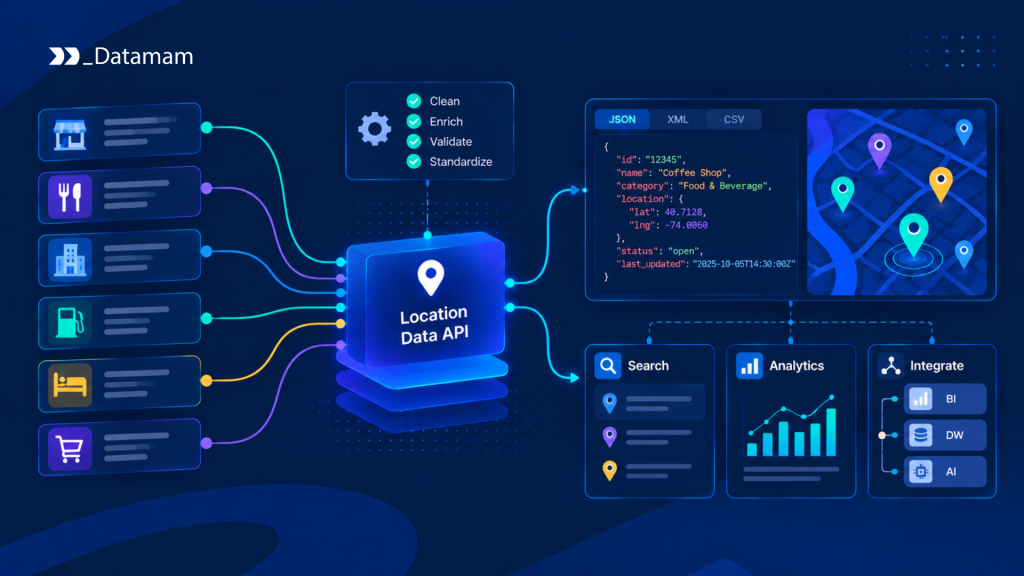
A Location Data API delivers place information when an enterprise system needs it. Instead of loading an entire POI database into a warehouse, an application or workflow can request a business, address, category, nearby place, or location enrichment result in real time.
This matters for store locators, CRM enrichment, field sales tools, delivery workflows, search products, customer onboarding, local market apps, and internal location intelligence systems. The API becomes the live access layer between enterprise applications and business location data.
However, real-time access does not automatically mean reliable data. A location API must return structured, validated, and explainable place information, not just a name and coordinate.
Why Location Data APIs Matter
Location Data APIs matter because many enterprise workflows need targeted place information at the moment of use. A sales rep may need to enrich one account. A mobile app may need nearby businesses. A CRM workflow may need to validate a location. A store locator may need current branch status.
Deloitte’s geospatial analytics research describes location-based use cases across site selection, supply chains, public services, operations, and risk. API delivery supports these workflows when systems need location data embedded directly into applications and operational processes.
Real-Time Access Solves Targeted Lookup
A business location API works best when the query is specific. Examples include searching for a company location, validating an address, retrieving nearby POIs, checking whether a business is active, or enriching a record with category and coordinates.
This is different from bulk analysis. The API answers a current request rather than delivering a full dataset for modeling.
The advantage is flexibility. Teams can retrieve the place information they need without storing every possible location internally.
API Responses Must Still Be Decision-Ready
A fast response is not enough. Enterprise systems need usable fields: business name, address, latitude, longitude, category, business status, phone, website, source timestamp, place ID, and confidence score.
Without those fields, the API creates downstream ambiguity. A CRM enrichment workflow may not know whether to accept the result. A search product may not know whether the category is reliable. A field sales tool may show a location that is closed or duplicated.
A Location Data API should therefore return quality context with the place record.
Core Location Data API Workflows
A location intelligence API can support several workflows. The strongest use cases are lookup, enrichment, search, validation, and nearby place discovery.
Each workflow needs slightly different response logic.
Business Location Lookup
Business location lookup retrieves a specific place based on name, address, phone, website, place ID, or coordinates. This supports account enrichment, store validation, vendor checks, and internal location search.
Lookup should handle ambiguity. If several candidates match, the API should return candidate scores rather than forcing one result.
For example, a chain business may have multiple branches in one city. A mall tenant may share an address with dozens of other businesses. A franchise may use local branding strategies that differ from the corporate brand.
POI Search and Nearby Places
A point of interest API can return places near a coordinate, within a radius, or matching a category. This supports store locators, mobile apps, delivery workflows, field sales planning, and local market discovery.
A POI search api should include filters for category, distance, business status, confidence, source freshness, and possibly brand or chain.
Nearby search should not only return the closest points. It should return relevant, active, and correctly classified places.
API Data Quality Controls
Location APIs need quality controls because real-time workflows can spread bad place data quickly. A wrong result may immediately appear in an app, CRM record, map, or operational decision.
Quality controls should be part of the response model.
Confidence Scores and Status Fields
A Location Data API should expose confidence scores for match quality, address quality, coordinate precision, category classification, and business status where possible.
A basic API response validation pattern can look like this:
LOCATION_API_RULES = {

    "required_fields": ["name", "address", "latitude", "longitude", "category"],

    "blocked_statuses": ["closed", "duplicate", "unverified"],

    "minimum_confidence": 0.85,

}


def approve_location_api_response(response):

    missing = [field for field in LOCATION_API_RULES["required_fields"] if not response.get(field)]


    if missing:

        return {"approved": False, "reason": "missing_required_fields", "fields": missing}


    if response.get("business_status") in LOCATION_API_RULES["blocked_statuses"]:

        return {"approved": False, "reason": "blocked_business_status"}


    if response.get("confidence", 0) < LOCATION_API_RULES["minimum_confidence"]:

        return {"approved": False, "reason": "low_confidence_result"}


    return {"approved": True}
This prevents low-confidence or incomplete API responses from being accepted automatically.
Freshness and Source Context
Real-time access should include freshness context. A business record should show last seen date, last verified date, source timestamp, or update status where available.
Freshness matters because businesses close, move, rebrand, or change categories. An API response that looks current but lacks timestamp context can create false confidence.
For operational workflows, source freshness should be visible enough for the consuming system to decide whether to accept, refresh, or review the result.
Integration With Enterprise Systems
A business location API becomes useful when it integrates cleanly with the systems that need place data.
The API should be easy for developers to call, but also stable enough for enterprise data teams to govern.
CRM, BI, and Application Workflows
Location APIs often support CRM enrichment, store locator tools, field sales apps, local search products, onboarding forms, partner validation, and internal analytics portals.
A CRM may use the API to enrich accounts with coordinates and categories. A field app may use nearby search to show prospects. A store locator may use the API to retrieve active branch details. A BI workflow may call the API for targeted enrichment rather than full-dataset ingestion.
Each workflow should define acceptable quality thresholds.
API Schema and Versioning
Schema stability matters. If field names, allowed values, response structures, or category labels change without notice, downstream applications can break.
A reliable API should support versioning, documentation, authentication, error codes, pagination, rate-limit information, and deprecation rules.
This makes the API easier to manage as an enterprise dependency.
Real-Time API Versus Bulk POI Data
A Location Data API is not always the right delivery model. APIs are strong for targeted access. Bulk data is stronger for broad analytics.
The best choice depends on the workload.
When API Delivery Fits
API delivery fits when the system needs live lookup, individual record enrichment, nearby search, address validation, or application-level place retrieval.
Examples include customer-facing search, CRM enrichment, mobile workflows, delivery validation, field sales tools, and partner onboarding.
The API model reduces internal storage needs and gives systems access to current records when queries are specific.
When Bulk Data Is Better
Bulk POI data is better when teams need full-market visibility, historical comparison, site selection models, trade area analysis, territory planning, or competitor density mapping.
A data science team cannot efficiently run large market scans through isolated API calls forever. Bulk delivery gives teams more control over joins, refreshes, repeatable analytics, and historical snapshots.
In practice, many enterprises use both: APIs for live workflows and bulk data for analytical infrastructure.
Governance, Licensing, and Observability
Location Data APIs must be governed because responses may enter customer-facing products, internal systems, or decision workflows.
The OECD’s data governance work emphasizes trust, data quality, ownership, stewardship, and responsible use. Location APIs need the same discipline because real-time place information can influence operational decisions immediately.
Access Control and Usage Rights
API governance should define who can access the service, which applications can call it, how responses can be stored, whether data can be displayed externally, and whether enrichment outputs can be reused.
Usage rights are especially important when location data supports customer-facing apps, derived datasets, AI workflows, or partner systems.
A technically available API may still be restricted by licensing terms.
Monitoring and Reliability
API operations should be monitored. Teams should track latency, uptime, error rates, rate-limit usage, failed lookups, low-confidence responses, schema errors, and unusual query patterns.
Gartner’s 2025 data and analytics trends highlight governance and AI-ready data as priorities. For location APIs, monitoring and governance help ensure that real-time place data remains reliable enough for analytics, applications, and automation.
What Location Data APIs Enable
A Location Data API gives enterprise systems a live connection to business and place information. The value is not only retrieval. It is operational readiness.
Better Application Experiences
Search tools, store locators, onboarding forms, field sales apps, and delivery workflows become more useful when they can retrieve active, relevant, and structured places in real time.
A good API reduces manual entry and improves location-based user experiences.
More Responsive Location Intelligence
Location intelligence workflows can use APIs for targeted enrichment, validation, and review. Teams can verify specific locations, enrich missing records, or retrieve nearby businesses during analysis.
This makes location data more responsive without replacing bulk analytical datasets. How foot traffic data informs strategies can significantly enhance understanding consumer behavior. By analyzing patterns in foot traffic, businesses can determine optimal locations for stores and tailor their marketing efforts. This data-driven approach allows for more strategic decision-making and can ultimately lead to increased sales.
Conclusion
Location intelligence solutions provide real-time business and place information through lookup, enrichment, POI search, validation, and nearby place discovery. A business location API is strongest when enterprise systems need targeted place access at the moment of use.
A reliable location intelligence API should return more than a name and coordinates. It should provide structured fields, confidence scores, freshness context, category data, business status, stable identifiers, and clear response logic. A point of interest API also needs governance around authentication, logging, licensing, rate limits, schema stability, and usage rights.
The capability matters because real-time place data can immediately affect applications, CRM records, search results, delivery workflows, and operational decisions. With governed API delivery, enterprises can use location data as reliable infrastructure rather than one-off lookup results.
A structured review can help evaluate whether current workflows have reliable Location Data API, business location API, location intelligence API, and point of interest API controls. You can run a location data infrastructure audit with our team to review your current API delivery workflows and understand what is required to build reliable enterprise POI infrastructure.