
Key Takeaways
- Franchise Site Selection improves when location data connects demand, competitor presence, existing units, trade areas, and territory boundaries
- Franchise location analysis should identify true white space, not simply areas without current franchise units
- Franchise territory planning depends on accurate POI data, business locations, demographics, drive-time logic, competitor mapping, and cannibalization analysis
- Franchise expansion strategy fails when territories are designed from outdated, duplicated, or poorly geocoded location data
- Reliable franchise growth planning requires validation, lineage, governance, sourcing controls, and integration into GIS, BI, CRM, and real estate workflows
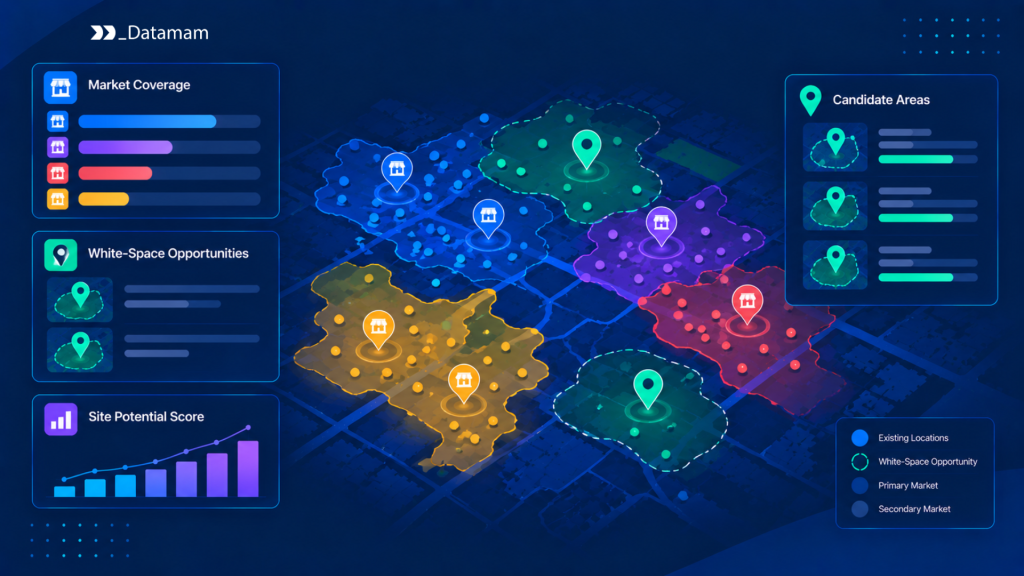
Franchise growth depends on identifying markets where customer demand, territory availability, operator economics, and competitive conditions align. Franchise Site Selection becomes risky when brands rely only on inbound franchisee interest, broker recommendations, demographic summaries, or broad regional targets. Location data gives franchise development, real estate, finance, operations, and strategy teams realtime market insights to evaluate where new units can grow without over-saturating existing markets. The commercial challenge is not simply finding empty space on a map. It is determining whether that white space contains enough demand, the right customer profile, manageable competitive pressure, suitable territories, and operational feasibility. For franchise brands expanding across regions, location intelligence makes franchise expansion strategy more disciplined and less dependent on opportunistic site selection.
The Operational Problem in Franchise Expansion
Franchise brands need to grow without weakening the network they already built. A new territory may look attractive because no existing franchise unit operates there, but that does not automatically make it white space. The market may have weak demand, heavy competitor concentration, poor access, low category fit, or limited real estate availability.
By contrast, a market near existing units may still contain expansion potential if trade areas do not overlap heavily and demand is strong enough to support another operator. Franchise Site Selection requires a market-level view, not only a unit-level map.
Why White Space Is Not Empty Space
White space is a commercially viable opportunity. Empty space is simply an area without current units. The distinction matters because franchise development teams can over-prioritize blank regions on a map while ignoring whether those regions can support franchise economics.
A useful franchise location analysis should evaluate population, household profile, income, commercial density, traffic generators, category demand, competitor count, existing unit proximity, service radius, and territory coverage. Only then can a brand identify whether a market is truly underpenetrated.
Where Manual Territory Planning Breaks
Manual franchise territory planning often combines spreadsheets, demographic reports, broker feedback, franchisee interest, and static maps. This process becomes inconsistent as the network grows. One territory may be evaluated with detailed competitor mapping. Another may rely on outdated demographic assumptions. A third may miss recently opened competitors or closed anchors.
At scale, franchise teams need repeatable rules for territory design, site prioritization, and market comparison. Otherwise, expansion decisions become difficult to explain to leadership, franchisees, and operators.
Location Data as a Franchise Intelligence Layer
Location data becomes valuable when it operates as a franchise intelligence layer, providing franchise market insights between raw market geography and expansion decisions. The goal is not only mapping existing units. The goal is to classify market opportunity, competitive pressure, trade area overlap, and territory feasibility.
This layer should answer practical questions. Which markets are underpenetrated? Which territories are overextended? Where are competitors concentrated? Which existing units are at risk of cannibalization? Which franchise candidates are located in markets with real expansion potential?
Mapping Existing Units and Competitor Networks
Franchise brands should map company-owned units, franchise units, planned openings, closed locations, competitor locations, complementary businesses, and local anchors together. This helps teams understand market structure before approving new territories.
For example, a fitness franchise may track gyms, wellness studios, apartments, offices, universities, and healthcare centers. A home services franchise may track households, commercial properties, competitor branches, and service-area density. A restaurant franchise may track cuisine competitors, daypart anchors, delivery zones, and drive-time patterns.
Measuring Cannibalization and Territory Fit
A new franchise territory should not only appear available. It should fit the brand’s operating model. Territory boundaries should consider drive time, delivery radius, customer density, competitor presence, local demand drivers, and overlap with existing units.
Cannibalization analysis is especially important. If a proposed location or territory pulls demand from nearby franchisees, the short-term unit growth may create long-term network conflict. Location intelligence helps teams distinguish expansion that grows the network from expansion that only redistributes revenue.
def route_franchise_market(market):

    if market["quality_status"] == "validated":

        return {"action": "publish_to_expansion_pipeline", "market_id": market["market_id"]}

    if market["quality_status"] == "failed":

        return {"action": "send_to_territory_review", "market_id": market["market_id"]}

    return {"action": "hold_for_review", "market_id": market["market_id"]}


REQUIRED_MARKET_FIELDS = [

    "market_id",

    "territory_name",

    "latitude",

    "longitude",

    "existing_unit_count",

    "competitor_count",

    "quality_status",

]


def validate_franchise_market(market):

    missing = [field for field in REQUIRED_MARKET_FIELDS if not market.get(field) and market.get(field) != 0]

    if missing:

        return {"valid": False, "reason": "missing_fields", "fields": missing}

    if market.get("poi_freshness_days", 999) > 90:

        return {"valid": False, "reason": "poi_data_stale"}

    if market.get("cannibalization_risk_score", 1) > 0.70:

        return {"valid": False, "reason": "high_cannibalization_risk"}

    return {"valid": True}


market = {

    "market_id": "FRAN-48192",

    "territory_name": "Candidate expansion territory",

    "latitude": 35.2271,

    "longitude": -80.8431,

    "existing_unit_count": 0,

    "competitor_count": 5,

    "poi_freshness_days": 24,

    "cannibalization_risk_score": 0.38,

    "quality_status": "validated",

}


print(route_franchise_market(market))

print(validate_franchise_market(market))
This logic reflects the operating principle. A franchise market should not enter the expansion pipeline unless territory context, competitive pressure, existing unit coverage, freshness, and cannibalization risk are validated.
Data Requirements for Franchise Territory Planning
Franchise territory planning depends on accurate and current location data. Useful records include franchise unit ID, brand, ownership type, address, latitude, longitude, store format, opening status, trade area, territory boundary, competitor locations, anchor POIs, market category, source, last updated date, and confidence score.
Poor data quality can distort expansion decisions. A closed unit may still appear active. A duplicate competitor may exaggerate saturation. A weak geocode may place a location in the wrong territory. A missing franchise unit may make a market appear available when it is already protected. Accurate poi data matching techniques ensure that businesses can identify potential franchise locations effectively. Implementing robust data validation processes can mitigate the risks associated with poor data quality. Companies that invest in advanced matching techniques often see improved market assessments and strategic planning.
Geocoding, Boundaries, and Drive-Time Logic
Franchise territories often depend on geography, but geography alone is not enough. ZIP codes, counties, and radius-based territories can be too blunt for real market behavior. Drive time, natural barriers, road networks, customer density, and service areas often matter more.
Geocoding precision is the foundation. If unit coordinates, competitor locations, or anchor POIs are inaccurate, territory overlap and white-space scoring become unreliable. Franchise location analysis should preserve coordinate confidence and boundary assumptions.
Competitor and Anchor Classification
Competitor locations should be classified by direct competitors, indirect competitors, substitutes, local independents, regional chains, and national brands. Complementary anchors should also be categorized by relevance to the franchise concept.
For a childcare franchise, schools, residential density, family-oriented retail, and workplaces may matter. For a boutique fitness franchise, apartments, offices, health retailers, and wellness services may matter. Also, for a home services franchise, property density and service-area structure may matter more than pedestrian traffic.
Infrastructure Application Model for Franchise Expansion Strategy
At scale, franchise expansion strategy requires repeatable location data infrastructure. Franchise units, competitor networks, POI layers, demographics, territory boundaries, market scores, CRM leads, and real estate opportunities must be connected consistently.
ETL and ELT pipelines can move raw location, POI, and territory data into structured staging tables. Airflow can orchestrate refresh schedules, validation checks, geocoding updates, and territory scoring. Spark can process large geospatial joins, competitor networks, and market opportunity models. dbt can transform raw records into normalized franchise unit, competitor, territory, and white-space tables. Snowflake, BigQuery, or Databricks can support analytics, historical tracking, and delivery into GIS, CRM, BI, or franchise development dashboards.
Validation, Observability, and Lineage
Validation controls should check missing addresses, invalid coordinates, duplicate units, stale competitor records, closed locations, weak category mapping, and territory overlap errors. Great Expectations or similar frameworks can test completeness, uniqueness, accepted values, and freshness. Data observability systems can monitor source failures, abnormal unit counts, geocoding errors, and unexpected market score changes.
Lineage matters because franchise teams need to explain why a territory was approved, rejected, or held for review. If a market is marked as white space, leaders should know which data sources, scoring rules, and location assumptions produced that conclusion.
Governance and Franchise Compliance Controls
Franchise workflows need governance because territory decisions can affect franchisee relationships, legal agreements, development rights, and long-term network economics. Teams should document approved sources, refresh cadence, territory logic, boundary definitions, scoring methodology, audit logs, access controls, and review ownership.
Cross-market expansion adds complexity because address formats, competitor coverage, territory norms, local regulations, and franchise structures vary by country. Governance helps keep expansion recommendations consistent and defensible.
Commercial Impact of Location-Driven Franchise Site Selection
The commercial impact of location data appears when franchise brands can identify expansion markets with stronger confidence and lower network risk. Better location intelligence can improve territory design, market prioritization, franchisee approval workflows, competitor visibility, and cannibalization prevention.
For franchise development and real estate teams, location analysis can move from manual market review to repeatable scoring across candidate territories. Analyst time spent building maps, competitor counts, and market summaries can fall materially when location data is validated and integrated into dashboards.
Better White-Space Prioritization
Location data helps franchise brands rank white-space markets by commercial potential. A territory with no current units, strong demand drivers, manageable competition, and low cannibalization risk may receive higher priority than a larger but weaker region.
This improves expansion sequencing. Instead of reacting only to franchisee inquiries, brands can proactively identify markets that fit the operating model.
Stronger Franchisee and Territory Decisions
Franchisees need confidence that territories are designed fairly and commercially. A poorly defined territory can create overlap, conflict, weak economics, or undercoverage. Location intelligence supports better territory design by showing where demand exists and where existing operators may already serve the market.
This strengthens franchise expansion strategy because growth decisions become more evidence-based.
Risk Avoidance and Strategic Advantage
Without reliable location data, franchise brands risk approving territories that appear attractive but weaken the network. A market may be too saturated. A new location may cannibalize existing units. A competitor may dominate the local category. A territory may lack enough demand to support franchise economics.
These errors can affect franchisee performance, brand reputation, support costs, and long-term expansion capacity. Franchise Site Selection should therefore be treated as an operating discipline, not a one-time mapping exercise.
Governance Gaps in Franchise Expansion
Governance gaps appear when teams cannot explain how territories were scored, which competitors were counted, how boundaries were drawn, or when location data was refreshed. This creates internal risk and can weaken trust with franchisees.
Audit logs, metadata, and lineage support accountability. Franchise leadership needs to know whether expansion recommendations are based on current, validated, and approved location intelligence.
AI and Automation Risk
As franchise brands use AI for market scoring, territory planning, lead routing, and expansion forecasting, location data quality becomes more important. Models trained on stale POI records, weak geocodes, or duplicated competitor locations can recommend poor markets.
Location data must be structured enough for human review and reliable enough for automated analytics. Otherwise, automation may scale bad expansion assumptions.
Evaluating Franchise Site Selection Readiness
A franchise site selection readiness review should assess whether current workflows produce trusted, comparable, and timely location intelligence. The review should not only ask whether territory maps exist. It should ask whether the underlying location data is accurate enough to support franchise approvals.
Useful evaluation areas include unit coverage, competitor mapping, POI freshness, geocoding precision, territory boundaries, cannibalization logic, category taxonomy, duplicate resolution, lineage, and integration into CRM, GIS, BI, or franchise development systems.
What a Franchise Location Data Audit Should Reveal
A structured location data audit should show where franchise expansion risk accumulates. It may reveal stale competitor records, duplicate unit locations, weak territory boundaries, missing anchors, imprecise coordinates, inconsistent market scoring, or unclear franchisee overlap.
The output should clarify which markets have reliable white-space signals, which territories require review, which competitors need better tracking, and which workflows can safely use automated expansion scoring.
When Infrastructure Review Becomes Necessary
A location intelligence infrastructure consultation becomes useful when franchise brands are expanding into new regions, redesigning territories, building white-space models, or integrating location data into franchise CRM workflows. At that point, the key question is not only “where can we open next?” The stronger question is “can we trust the market and territory intelligence enough to approve expansion?”
An architecture review should evaluate source strategy, location data model design, geocoding workflows, territory logic, validation coverage, observability, governance, and integration pathways.
Conclusion: Franchise Site Selection as Location Intelligence Infrastructure
Franchise site selection depends on more than blank spaces on a map. It requires accurate visibility into demand drivers, competitors, existing units, territory boundaries, cannibalization risk, and market feasibility. Location data makes this analysis more consistent when it is validated, normalized, deduplicated, and connected to franchise development workflows.
Franchise Site Selection becomes commercially valuable when location data turns fragmented market geography into structured expansion intelligence. It helps brands identify true white-space opportunities, protect franchisee economics, prioritize markets, and avoid growth that weakens the network. Franchise brands that treat location data as expansion infrastructure will be better positioned to scale with discipline.