Key Takeaways
- POI Data Matching resolves duplicate and conflicting business location records across sources, formats, and systems.
- Place matching compares names, addresses, coordinates, phone numbers, websites, categories, brands, and source identifiers.
- Business location matching must avoid both under-matching, which leaves duplicates, and over-matching, which incorrectly merges separate locations.
- Entity resolution for locations requires confidence scores, conflict rules, source traceability, and human review for ambiguous cases.
- Strong matching improves POI accuracy for mapping, search, site selection, territory planning, market analysis, and location intelligence.
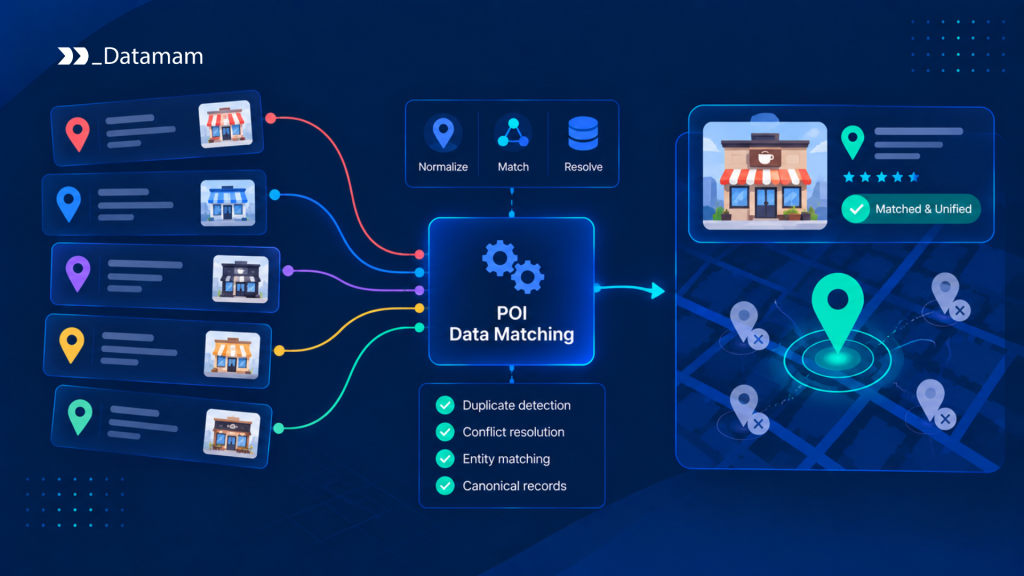
POI Data Matching determines whether two or more business location records describe the same real-world place. This sounds simple until the same business appears with different names, slightly different addresses, separate phone numbers, missing websites, inconsistent coordinates, and conflicting categories.
A restaurant may appear as “Joe’s Pizza,” “Joes Pizzeria,” and “Joe’s Pizza Downtown.” A store inside a mall may be listed at the mall address, the unit address, and the shopping center centroid. A chain branch may appear as both a corporate location and a franchise listing.
At enterprise scale, duplicate and conflicting POIs distort mapping, search, trade area analysis, competitor density, site selection, and sales territory planning. Matching is the control layer that turns fragmented place records into usable location data.
Why POI Data Matching Matters
The significance of POI Data Matching lies in its crucial role in addressing the data quality impact, as place data usually comes from multiple sources. Each source may describe the same business differently.
Deloitte’s geospatial analytics research describes location-based use cases across site selection, logistics, risk, operations, and public services. These use cases depend on reliable spatial data because duplicate or conflicting locations weaken the analysis before business decisions are made. Geographic data for market analysis is essential for understanding consumer behavior in different regions. Accurate data allows businesses to target their strategies effectively and leverage local market insights to adjust to local market conditions. Without it, companies risk misallocating resources and missing out on key growth opportunities.
Duplicate Records Inflate Market Density
Duplicate POIs can make a market look more crowded than it is. If one coffee shop appears three times, a competitor density model may overstate saturation. If one medical clinic appears under multiple names, healthcare access analysis may overstate provider availability.
Duplicates also affect search and mapping. Users may see repeated results, inconsistent business details, or several points for one location.
For enterprise planning, duplicates are not cosmetic errors. They change market interpretation.
Conflicting Records Reduce Trust
Conflicts occur when records disagree. One source may mark a business as open, another as closed. One may classify it as a grocery store, another as a convenience store. One may place the coordinate at the entrance, another at the parcel centroid.
A matching system must decide whether these records describe the same place and which fields should be trusted.
Without conflict resolution, downstream teams inherit uncertainty without knowing it.
How Place Matching Works
Place matching compares records across multiple fields. No single field is reliable enough in every case.
The strongest systems combine deterministic identifiers, fuzzy matching, geospatial proximity, address logic, and category consistency.
Strong and Weak Matching Signals
Strong signals include phone number, website, official place ID, brand identifier, tax or registry ID where available, and exact normalized address. Weak signals include similar names, nearby coordinates, broad categories, or partial addresses.
A place matching process should weigh signals differently. Two locations with the same name but different addresses may be separate branches. Two records with different names but the same phone, website, and address may be the same business.
The workflow should preserve the evidence used for the match.
Distance and Address Logic
Coordinates help matching, but distance alone can mislead. Two businesses may share one building. A shopping center may contain dozens of stores at nearby coordinates. A chain may operate two branches within the same district.
Address logic should compare street, unit, city, postal code, country, and normalized formatted address. Unit numbers and mall locations are especially important because two businesses can share the same street address.
Place matching must know when proximity supports a match and when it creates risk.
Business Location Matching Rules
Business location matching should produce one of several outcomes: matched, not matched, duplicate candidate, conflict candidate, or manual review.
The output should not be a simple yes-or-no decision when the evidence is uncertain.
Matching Confidence
Confidence scoring helps teams decide how to use a match. A high-confidence match may merge automatically. A medium-confidence match may route to review. A low-confidence match should remain separate.
A basic matching pattern can look like this:
POI_MATCHING_RULES = {

    "strong_identifiers": ["phone", "website", "place_id"],

    "comparison_fields": ["name", "address", "coordinates", "category"],

    "manual_review_threshold": 0.78,

    "auto_merge_threshold": 0.93,

}


def classify_poi_match(candidate):

    if candidate.get("identifier_match") is True and candidate.get("address_conflict") is False:

        return {"match_status": "matched", "reason": "strong_identifier_match"}


    if candidate.get("match_score", 0) >= POI_MATCHING_RULES["auto_merge_threshold"]:

        return {"match_status": "matched", "reason": "high_confidence_score"}


    if candidate.get("match_score", 0) >= POI_MATCHING_RULES["manual_review_threshold"]:

        return {"match_status": "review", "reason": "manual_review_required"}


    return {"match_status": "not_matched", "reason": "low_confidence"}
This prevents uncertain records from being merged automatically while still allowing high-confidence duplicates to be resolved.
Avoiding Over-Matching
Over-matching happens when separate locations are incorrectly merged. This is common with chain businesses, mall tenants, franchises, hospitals, campuses, and store-within-store formats.
For example, two bank branches in one city may share the same brand and category but serve different addresses. A coffee shop inside a bookstore may share some address details with the bookstore but remain a distinct POI.
Over-matching is dangerous because it removes real locations from the dataset.
Resolving Conflicting Business Records
After a match is detected, the system must decide how to resolve conflicting fields.
This requires source ranking, freshness checks, field-level confidence, and review workflows.
Name, Category, and Status Conflicts
Name conflicts may result from abbreviations, local naming, rebrands, legal names, storefront names, or source errors. Category conflicts may reflect broad versus specific classification. Status conflicts may happen when one source updates faster than another.
A good matching system should not overwrite fields blindly. It should choose values based on source reliability, recency, confidence, and business rules.
For example, a recently verified official website may be stronger evidence than an old directory listing.
Coordinate Conflicts
Coordinate conflicts need careful handling. One source may provide a rooftop point. Another may provide a street-level estimate. Another may provide a shopping center centroid.
A coordinate should be selected based on precision and confidence. If two high-confidence coordinates are far apart, the record should route to review instead of being merged silently.
This protects mapping, routing, territory design, and site selection models.
Entity Resolution for Locations
Entity resolution for locations is the broader discipline behind POI matching. It connects fragmented records into a single, governed place identity.
This is especially important for enterprise datasets built from many sources.
Creating a Golden Location Record
A golden location record is the approved version of a business location. It may include canonical name, normalized address, coordinates, category, phone, website, brand, business status, source links, confidence scores, and update history.
The golden record should also preserve source variants. If one source used a different name or address, that information should not disappear. It may be useful for audit, search aliases, or future conflict resolution.
Entity resolution should create clarity without destroying lineage.
Maintaining Persistent IDs
Persistent IDs allow teams to track a business location over time. If every refresh creates new IDs, enterprises cannot reliably detect openings, closures, relocations, duplicates, or historical change.
A matched POI should maintain a stable identifier even when name, category, website, or status changes.
This is essential for analytics, mapping systems, CRM enrichment, and location intelligence workflows.
Governance and Quality Controls
POI Data Matching should be governed because merge decisions affect downstream systems. A wrong merge can remove a real location. A missed merge can inflate density.
The OECD’s data governance work emphasizes trust, data quality, ownership, stewardship, and responsible data use. POI matching requires the same discipline because entity-resolution decisions shape the place layer used across enterprise systems.
Source Traceability
Each match decision should preserve raw source records, normalized fields, match score, matched fields, conflicting fields, selected canonical values, reviewer decision, and timestamp.
Traceability allows teams to explain why records were merged or kept separate.
This matters when location data supports site selection, market mapping, territory planning, search, or customer-facing applications.
Review Queues for Ambiguous Matches
Ambiguous records should route to review. Category conflicts, coordinate conflicts, missing unit numbers, similar chain branches, and inconsistent business status should not be resolved silently.
A routing model can look like this:
POI_MATCH_EXCEPTION_ROUTING = {

    "coordinate_conflict": {"owner": "geospatial_team", "action": "verify_location"},

    "category_conflict": {"owner": "taxonomy_owner", "action": "review_category"},

    "possible_duplicate": {"owner": "data_quality_team", "action": "review_entity_match"},

    "status_conflict": {"owner": "data_operations", "action": "verify_business_status"},

}


def route_poi_match_exception(exception):

    route = POI_MATCH_EXCEPTION_ROUTING.get(exception.get("exception_type"))


    if not route:

        return {"owner": "data_operations", "action": "manual_triage"}


    return {

        "poi_id": exception.get("poi_id"),

        "exception_type": exception.get("exception_type"),

        "severity": exception.get("severity"),

        "owner": route["owner"],

        "action": route["action"],

    }
This creates operational accountability for matching uncertainty.
What POI Data Matching Enables
Strong POI Data Matching improves the reliability of every system that depends on business location records.
It reduces duplicate noise and creates a more stable place layer.
Cleaner Mapping and Search
Maps become clearer when duplicate points are removed and conflicting records are resolved. Search improves when aliases, categories, coordinates, and status fields are consolidated into a reliable place identity.
This reduces repeated results, wrong categories, and inconsistent location details.
Better Site Selection and Market Analysis
Site selection, trade area analysis, and competitor mapping become more accurate when duplicate businesses do not inflate density and real locations are not mistakenly merged.
Deloitte’s site selection guidance notes that serious location decisions require rigor, objectivity, and multidisciplinary analytics. POI matching supports that rigor by controlling duplicates and conflicting business records before they enter location models.
More Reliable AI and Analytics Workflows
POI matching also improves analytics and AI workflows that depend on place identity. If one business appears under several records, models may overcount activity. If separate locations are merged incorrectly, models may lose real geographic variation.
Gartner’s 2025 data and analytics trends highlight governance and AI-ready data as priorities. Matched and traceable POI records support that requirement by making place data more consistent and explainable.
Conclusion
POI Data Matching resolves duplicate and conflicting business locations by comparing names, addresses, coordinates, phone numbers, websites, categories, source identifiers, and business status. Strong place matching separates real duplicates from nearby branches, store-within-store locations, franchises, and multi-tenant businesses.
The capability matters because duplicate and conflicting POIs distort mapping, search, market density, territory planning, and site selection. Entity resolution for locations creates a cleaner, more stable place layer with persistent IDs, confidence scores, source traceability, and review workflows.
With governed business location matching, enterprises can reduce false density, improve place data accuracy, and build more reliable location intelligence infrastructure.
A structured review can help evaluate whether current workflows have reliable POI Data Matching, place matching, business location matching, and entity resolution for locations. You can run a location data infrastructure audit with our team to review your current place-data workflows and understand what is required to build reliable enterprise POI infrastructure.