Key Takeaways
- Foot Traffic Data helps teams evaluate real-world movement around stores, competitors, trade areas, and candidate locations
- Pedestrian traffic data adds behavioral context that POI records, demographics, and broker notes cannot show alone
- Retail foot traffic analytics can reveal visit trends, daypart patterns, competitor draw, cannibalization risk, and market opportunity
- Location traffic analysis depends on accurate POI matching, geospatial boundaries, device-signal quality, normalization, and validation
- Reliable foot traffic workflows require governance, lineage, sourcing controls, privacy awareness, and integration into GIS, BI, or site selection systems
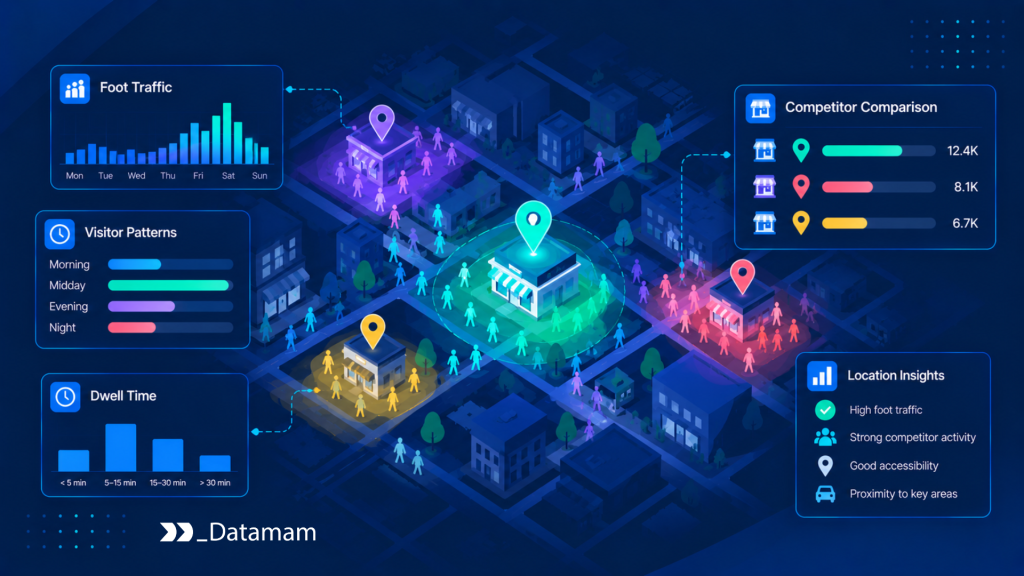
Location decisions become stronger when teams understand not only where businesses exist, but how people move around them. Foot Traffic Data helps retailers, restaurants, real estate teams, franchise brands, and market analysts evaluate visit patterns, trade area behavior, competitor draw, and site potential. A location may sit near many businesses but still have weak pedestrian activity. Another may have modest population density but strong daily movement from offices, transit, schools, entertainment venues, or shopping corridors. The commercial value of foot traffic is not only about counting visits. It is understanding whether movement around a site supports the brand’s format, customer journey, operating hours, and competitive position.
The Operational Problem in Location and Competitive Analysis
Location analysis often begins with demographics, nearby businesses, road access, and available properties, using various location intelligence resources. These inputs matter, but they do not fully explain how people behave in a market. A site may be surrounded by relevant points of interest but still receive limited visits. A competitor may look small by store count but dominate local traffic. A shopping center may appear strong on tenant mix but show declining visit patterns.
Foot Traffic Data fills this gap by adding behavioral movement signals. It helps teams understand where people actually go, when they visit, how long patterns persist, and whether nearby competitors or anchors create meaningful traffic.
Why Static Location Data Is Not Enough
POI data can show that a coffee shop, grocery store, pharmacy, gym, or competitor exists near a candidate site. Demographic data can show who lives nearby. However, neither fully shows whether the area attracts movement during relevant hours.
A breakfast concept may need morning commuter activity. A fashion retailer may depend on weekend shopping flows. A pharmacy may benefit from consistent neighborhood visits. A restaurant may need evening and weekend demand. Foot Traffic Data adds this timing and movement context to location traffic analysis.
Where Manual Observation Breaks Under Scale
Manual observation can help validate a small number of sites. Teams may visit locations, count pedestrians, review parking lots, and observe nearby businesses. However, this does not scale across hundreds of candidate sites, competitor stores, regions, and time periods.
Observation is also inconsistent. One analyst may visit during peak hours while another visits during a slow window. Weather, events, construction, holidays, or temporary promotions can distort one-time checks. Retail foot traffic analytics helps standardize the view by tracking patterns across time.
Foot Traffic Data as a Location Intelligence Layer
Foot Traffic Data becomes valuable when it operates as a location intelligence layer, leveraging realtime location insights between physical market activity and business decisions. The goal is not simply to report visit counts. The goal is to understand whether movement patterns support expansion, competitive analysis, trade area planning, or store network optimization.
This layer should answer practical questions. How much traffic does a competitor location attract? Is traffic growing or declining? Which dayparts matter? Does a shopping center have strong weekday or weekend flow? Does a candidate site sit near high-traffic anchors? Could a new store cannibalize existing locations?
Measuring Visits, Patterns, and Trade Areas
Foot traffic analysis should capture visits by location, time period, daypart, weekday, weekend, season, and event window where available. It should also connect movement patterns to trade areas and nearby POIs.
For example, a retailer evaluating a candidate site may compare visits to nearby shopping centers, direct competitors, transit hubs, and complementary businesses. A restaurant brand may evaluate lunch versus dinner movement. A franchise team may compare traffic across existing territories to identify white-space opportunities.
Comparing Competitor Draw
Competitor analysis becomes stronger when teams can compare not only competitor count, but competitor draw. Two competitors may operate in the same trade area, but one may attract far more visits. A smaller store network may outperform a larger competitor locally if its locations sit in stronger corridors.
Foot Traffic Data helps teams evaluate which competitors are gaining attention, which sites act as traffic anchors, and which markets may already be over-served. This supports better site selection, pricing context, merchandising strategy, and expansion prioritization.
def route_traffic_signal(signal):

    if signal["quality_status"] == "validated":

        return {"action": "publish_to_location_dashboard", "location_id": signal["location_id"]}

    if signal["quality_status"] == "failed":

        return {"action": "send_to_geospatial_review", "location_id": signal["location_id"]}

    return {"action": "hold_for_review", "location_id": signal["location_id"]}


REQUIRED_TRAFFIC_FIELDS = ["location_id", "poi_name", "latitude", "longitude", "period", "visit_count"]


def validate_traffic_signal(signal):

    missing = [field for field in REQUIRED_TRAFFIC_FIELDS if not signal.get(field)]

    if missing:

        return {"valid": False, "reason": "missing_fields", "fields": missing}

    if signal.get("visit_count", 0) < 0:

        return {"valid": False, "reason": "invalid_visit_count"}

    if signal.get("boundary_confidence", 0) < 0.75:

        return {"valid": False, "reason": "low_boundary_confidence"}

    return {"valid": True}


signal = {

    "location_id": "LOC-48192",

    "poi_name": "Candidate retail corridor",

    "latitude": 40.7128,

    "longitude": -74.0060,

    "period": "2026-W36",

    "visit_count": 18420,

    "boundary_confidence": 0.91,

    "quality_status": "validated",

}


print(route_traffic_signal(signal))

print(validate_traffic_signal(signal))
This simple logic reflects the operating principle. A traffic signal should not move into location dashboards unless the location, time period, visit count, and geospatial boundary confidence are validated.
Data Requirements for Retail Foot Traffic Analytics
Retail foot traffic analytics depends on clean location matching and consistent measurement. Foot traffic signals must be tied to the correct POI, store, venue, shopping center, or trade area. If the location boundary is wrong, visit counts may include nearby businesses or exclude part of the actual site.
A strong data model should include location ID, POI name, address, latitude, longitude, polygon or boundary reference, category, brand, visit count, time period, source, confidence score, and update timestamp. It should also separate location-level traffic from broader area traffic.
Boundary Accuracy and POI Matching
Boundary accuracy matters because many retail locations sit close together. A restaurant in a strip center, a store inside a mall, or a coffee shop beside a transit stop can be difficult to separate. Weak boundary logic can assign visits to the wrong business.
POI matching helps connect movement signals to the right business entity. Store names, addresses, coordinates, chain affiliation, and category taxonomy should be normalized before traffic signals are used in site scoring or competitor analysis.
Normalization Across Time and Markets
Traffic patterns vary by season, weather, holidays, local events, and market structure. A coastal market may behave differently from a commuter suburb. A tourist area may show strong seasonal peaks. A university town may shift during school terms.
Foot Traffic Data should be normalized by comparable periods and market context. Teams should avoid comparing one site’s holiday peak against another site’s normal week. Good location traffic analysis separates durable movement patterns from temporary spikes.
Infrastructure Application Model for Foot Traffic Analysis
At scale, foot traffic workflows depend on repeatable data infrastructure. Mobility signals, POI datasets, store locations, geospatial boundaries, trade areas, and internal performance data must be connected consistently. Raw movement data is not useful for site selection until it is mapped, cleaned, normalized, and validated.
ETL and ELT pipelines can move traffic, POI, and internal store data into structured staging tables. Airflow can orchestrate refresh schedules, validation checks, boundary updates, and dashboard publication. Spark can process large movement datasets, geospatial joins, and time-window aggregations. dbt can transform raw traffic signals into location, competitor, and trade area analytics models. Snowflake, BigQuery, or Databricks can support historical tracking and delivery into GIS, BI, or real estate workflows.
Validation, Observability, and Lineage
Validation controls should check missing coordinates, invalid visit counts, duplicate locations, stale periods, weak boundary confidence, mismatched POIs, and abnormal traffic changes. Great Expectations or similar frameworks can test completeness, uniqueness, accepted values, and freshness. Data observability systems can monitor source delays, coverage gaps, unusual visit movements, and geospatial matching errors.
Lineage matters because location teams need to understand how traffic scores were produced. If a competitor appears to gain traffic, teams should know which source, boundary, time period, and normalization rules produced the signal.
Governance and Privacy Controls
Foot traffic data requires governance because movement signals can be sensitive. Teams should document approved sources, aggregation standards, retention rules, access controls, privacy requirements, and permitted use cases. Data should be handled at an appropriate aggregation level for business analysis rather than individual tracking.
Cross-border monitoring adds complexity because privacy expectations, data availability, market behavior, and mobility source coverage vary by country. Governance helps ensure that foot traffic insights are used responsibly and consistently.
Commercial Impact of Foot Traffic Data
The commercial value of Foot Traffic Data appears when teams can evaluate markets based on observed movement, not only assumptions. Better traffic intelligence can improve site prioritization, competitor benchmarking, trade area analysis, network planning, and cannibalization review.
For retail, restaurant, franchise, and real estate teams, traffic analysis can reduce dependence on manual observation and static reports. It can also help identify which locations are gaining or losing market relevance before revenue data alone explains the change.
Better Site Prioritization
Foot traffic helps rank candidate locations by real-world activity. A site with strong nearby anchors, steady visit patterns, and relevant daypart movement may deserve higher priority than a site with similar demographics but weaker traffic.
This supports more disciplined expansion planning. Real estate teams can compare sites using consistent behavioral indicators rather than relying only on local opinion or property availability.
Stronger Competitive Analysis
Competitor store count does not always show competitive strength. A competitor with fewer locations may attract stronger traffic. A nearby anchor may pull visits away from surrounding businesses. A shopping center may decline even while tenant lists remain attractive.
Retail foot traffic analytics helps teams compare competitor draw, market momentum, and traffic concentration. This improves location strategy and competitive planning.
Risk Avoidance and Strategic Advantage
Without Foot Traffic Data, organizations risk approving locations based on incomplete market evidence. A site may look strong because of demographics but lack movement. A competitor may be underestimated because store count is low. A trade area may be overestimated because nearby POIs do not generate visits during relevant hours.
Location mistakes are expensive because leases, buildouts, staffing, inventory, and launch campaigns are hard to reverse. Foot Traffic Data does not replace real estate judgment, but it reduces avoidable blind spots.
Governance Gaps in Traffic-Based Decisions
Governance gaps appear when teams cannot explain how visits were measured, which boundaries were used, how POIs were matched, or whether traffic was normalized. This weakens trust in site recommendations.
Audit logs, metadata, and lineage support commercial accountability. Real estate and finance leaders need to know whether traffic scores are based on validated, recent, and comparable signals.
AI and Automation Risk
As teams use AI for site scoring, demand forecasting, and market prioritization, traffic data quality becomes more important. Models trained on weak boundaries, stale signals, or inconsistent POI matching can recommend poor locations.
Foot traffic inputs must therefore be structured enough for human review and reliable enough for automated analytics. Otherwise, automation may scale incorrect location assumptions.
Evaluating Foot Traffic Data Readiness
A foot traffic data readiness review should assess whether current workflows produce trusted, comparable, and timely movement intelligence. The review should not only ask whether visit data exists. It should ask whether the traffic signals are accurate enough to support location decisions.
Useful evaluation areas include source coverage, POI matching, boundary confidence, aggregation level, refresh cadence, time-period normalization, competitor mapping, trade area logic, validation rules, lineage, privacy controls, and integration into GIS or BI tools.
What a Foot Traffic Audit Should Reveal
A structured foot traffic data audit should show where location analysis risk accumulates. It may reveal weak POI matching, poor boundary accuracy, stale traffic periods, missing competitor coverage, abnormal visit movements, or inconsistent normalization across markets.
The output should clarify which markets have reliable movement signals, which POIs require better matching, which boundaries need review, and which workflows can safely use automated traffic-based scoring.
When Infrastructure Review Becomes Necessary
A location intelligence infrastructure consultation becomes useful when teams are expanding site selection models, comparing many markets, benchmarking competitors, or integrating foot traffic signals into BI and real estate workflows. At that point, the key question is not only “do we have traffic data?” The stronger question is “can we trust this movement intelligence enough to act?”
An architecture review should evaluate data sources, POI matching, boundary design, validation coverage, observability, privacy governance, and integration pathways.
Conclusion: Foot Traffic Data as Location Intelligence Infrastructure
Foot traffic data improves location and competitive analysis by showing how people move around stores, competitors, anchors, and trade areas. It adds behavioral context that POI data, demographics, and manual research cannot provide alone. When validated and connected to location workflows, it helps teams prioritize sites, understand competitor draw, reduce cannibalization risk, and identify market opportunity.
Foot Traffic Data becomes commercially valuable when it is treated as location intelligence infrastructure, not a standalone visit chart. Retailers, restaurants, franchise brands, and real estate teams that combine pedestrian traffic data with accurate POI records, geospatial boundaries, governance, and analytics workflows to extract market data insights will be better positioned to make location decisions with discipline and confidence.