Key Takeaways
- A Competitor Price API turns external price observations into structured records that BI, pricing, and repricing systems can consume consistently.
- A pricing observation should preserve product-match context, raw price components, availability, promotion, seller context where relevant, currency, timestamps, provenance, and quality status.
- Repricing data integration requires stricter eligibility controls than dashboard reporting because an analysis-safe observation is not automatically safe for automated pricing.
- A competitive pricing API needs a stable data contract, including durable identifiers, schema versioning, freshness metadata, pagination or incremental retrieval, and explicit error or quality states.
- Price normalization should preserve the original observation and document transformations such as currency conversion rather than replacing raw values.
- A valid competitor signal is an input to pricing logic, not a pricing decision by itself. Margin rules, inventory, strategy, approvals, and other internal controls remain separate.
- Enterprise retailers need clear ownership for product matching, feed quality, exception handling, API changes, repricing eligibility, and downstream consumption.
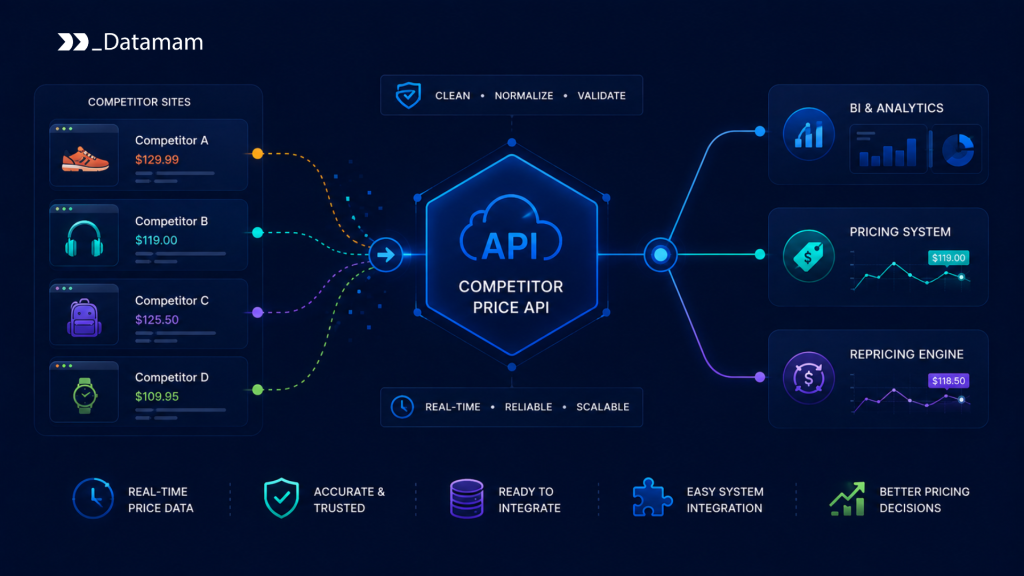
Enterprise retailers often collect competitor prices before they have a reliable way to operationalize them.
A pricing analyst may review competitor prices in a spreadsheet. A BI team may load external pricing tables into a dashboard. A category team may want alerts when key competitors move. A repricing engine may need machine-readable signals that can influence automated decisions.
Each use case depends on the same underlying problem: competitor pricing data has to arrive consistently, with enough context to explain what was observed and enough quality control to determine how the observation can safely be used.
A Competitor Price API addresses that delivery layer.
It should not simply expose raw scraped prices. It should provide structured, validated, timestamped competitor observations that downstream systems can interpret without having to reconstruct product matches, promotion conditions, availability, seller context, or normalization logic from the original page.
In enterprise retail, that makes the API or pricing data feed a controlled interface between external market observations and internal pricing operations.
Why Competitor Price APIs Matter in Enterprise Retail
Competitor Price APIs matter because pricing decisions increasingly depend on external market signals that need to move between systems.
Retailers may use competitor data in: Retail competitor analysis techniques help businesses identify pricing strategies that can enhance their market position. By leveraging these techniques, companies can track competitors’ promotions and adjust their own pricing in real-time. This proactive approach not only improves competitiveness but also helps in maximizing profit margins. Monitoring price variations across marketplaces is essential for retailers to stay informed about their competition. By doing so, businesses can identify trends and adjust their strategies accordingly. This enables them to not only respond to market changes swiftly but also to anticipate future pricing movements.
- BI dashboards;
- price-position reporting;
- pricing analyst workflows;
- promotion analysis;
- category review;
- price optimization;
- repricing systems;
- alerting and exception workflows.
Deloitte’s 2026 global retail industry outlook discusses retailers using measures such as dynamic pricing, data-led promotions, targeted assortment changes, automation, and tighter operating discipline. Those activities increase the value of external market data that can be consumed reliably rather than interpreted manually each time it is used.
Why Raw Competitor Data Is Not Enough
Raw extraction may produce fields such as:
- title;
- visible price;
- URL;
- stock label;
- promotion badge;
- timestamp.
That is useful evidence, but it is not yet a reliable enterprise pricing signal.
A downstream system may also need to know:
- Is the competitor product an exact match?
- Is it a variant, bundle, multipack, or comparable substitute?
- Is the observed item new, used, or refurbished?
- Does the visible price require membership or a coupon?
- Is shipping separate?
- Is the offer currently available?
- Is the price associated with a marketplace seller?
- Which currency is displayed?
- Which region or store was observed?
- How recent is the observation?
- Did the record pass quality checks?
Without this context, different teams can interpret the same price differently.
A BI dashboard may compare unlike products. An analyst may treat a loyalty-only price as a normal market price. An automated system may respond to an unavailable or stale offer.
How Poor Integration Distorts Pricing Operations
The risk becomes greater as competitor data moves closer to automated pricing.
A mismatched product can create a false price gap.
An out-of-stock competitor can appear to establish a market position that customers cannot actually buy.
A marketplace offer with a low item price and high shipping can look artificially attractive if only the item price is transmitted.
A short-lived promotion can be treated as a persistent market move.
These are not necessarily collection failures. They are often failures of interpretation, validation, or delivery.
Gartner’s 2026 research on competitive and market intelligence platforms identifies capabilities such as data aggregation, validation, insight creation, enterprise integration, and actionable outputs. While Gartner is not defining retail pricing API architecture specifically, the same disciplines are relevant when external price observations are converted into operational data.
Competitor Price API Architecture
A Competitor Price API should separate collection logic from consumption logic.
Downstream teams should not need to understand every competitor website structure, marketplace layout, promotion label, extraction rule, or matching method to use the data.
Instead, the delivery layer should expose standardized pricing observations with explicit semantics.
Define the Pricing Observation
A pricing observation is a point-in-time record describing a competitor offer.
A useful observation may contain:
- observation ID;
- internal product ID;
- competitor product ID;
- product match ID;
- match type;
- match confidence;
- competitor name;
- seller ID or seller name where relevant;
- observed item price;
- displayed list price where available;
- shipping price;
- buyer-visible fees where available;
- displayed total price where explicitly exposed;
- promotion type;
- availability;
- offer condition;
- currency;
- market or region;
- source URL;
- observed timestamp;
- delivered or updated timestamp;
- quality status;
- schema version.
The objective is not to maximize the number of fields.
It is to ensure that a downstream consumer can determine what was observed, what the price means, how the product relationship was established, when the observation was made, and whether it passed the controls required for that workflow.
Separate Product Match From Price Observation
Product matching and price observation should be related but distinct entities.
A product match defines the relationship between:
the retailer’s product → the competitor’s product
That relationship may remain valid for weeks or months.
A price observation describes:
what the competitor’s offer looked like at a specific moment
Prices, promotions, availability, shipping, and seller offers can change much more frequently than the product relationship itself.
Separating the two allows downstream consumers to filter by match type without duplicating matching logic inside every system.
An exact product match may be appropriate for direct price comparison.
A comparable substitute may be useful for category analysis but inappropriate for automated repricing.
Validate the Observation Before Delivery
A simplified validation pattern could look like this:
COMPETITOR_PRICE_FIELDS = {

    "required_fields": [

        "observation_id",

        "internal_product_id",

        "competitor_product_id",

        "product_match_id",

        "match_type",

        "match_confidence",

        "competitor_name",

        "observed_item_price",

        "currency",

        "availability",

        "observed_at",

        "source_url",

        "quality_status",

    ],

    "blocked_quality_statuses": [

        "product_unmatched",

        "price_missing",

        "source_unavailable",

        "validation_failed",

    ],

}


def validate_competitor_price_record(record):

    missing = [

        field

        for field in COMPETITOR_PRICE_FIELDS["required_fields"]

        if record.get(field) is None

    ]


    if missing:

        return {

            "valid": False,

            "reason": "missing_required_fields",

            "fields": missing,

        }


    if (

        record["quality_status"]

        in COMPETITOR_PRICE_FIELDS["blocked_quality_statuses"]

    ):

        return {

            "valid": False,

            "reason": "blocked_quality_status",

        }


    return {

        "valid": True,

        "observation_id": record["observation_id"],

    }
This is illustrative rather than production software.
The important control is that missing quality status cannot silently become an accepted record. Required commercial and provenance fields should be present before the observation enters a production feed.
Design the API as a Stable Data Contract
A pricing API is more than a JSON representation of a competitor table.
Consumers need predictable behavior over time.
Use Stable Observation and Entity IDs
Source URLs are valuable for provenance, but URLs can change.
Downstream systems should have stable identifiers for entities such as:
- competitor product;
- product match;
- seller where applicable;
- observation.
The source URL should remain attached to the record as evidence rather than serving as the only relational key.
Stable observation IDs also help consumers detect duplicate records.
Separate observed_at From Delivery Time
Two timestamps answer different questions:
observed_at
When did the source actually show this price?
delivered_at or updated_at
When did the record become available to the downstream consumer?
The difference can matter when sources are delayed, reprocessed, validated later, or backfilled.
A repricing workflow should evaluate source freshness from the observation timestamp, not merely from the time the API returned the record.
Support Incremental Retrieval
Large retailers may accumulate millions of competitor observations.
Consumers should not need to download the complete history every time they request new data.
A Competitor Price API can support incremental retrieval using mechanisms such as:
- updated_since;
- observation timestamp ranges;
- continuation cursors;
- change tokens.
For example:
GET /v1/price-observations?updated_since=…
or:
GET /v1/price-observations?cursor=…
The exact interface can vary. The important principle is that consumers can retrieve new or changed observations predictably.
Use Predictable Pagination
Large result sets need deterministic pagination or cursor behavior.
Consumers should know:
- how many records can be returned;
- how the next page is requested;
- whether result ordering is stable;
- whether new observations can shift page boundaries.
Cursor-based retrieval can be useful where observations change frequently, but the appropriate design depends on the system.
Version the Contract
Schema changes can break pricing applications even when the underlying data remains correct.
A competitive pricing API should have a defined approach to:
- endpoint versioning;
- field additions;
- field removals;
- enum changes;
- type changes;
- deprecation periods.
Additive changes may be easy for some consumers to tolerate. Renaming a field or changing its meaning is more disruptive.
The contract should distinguish technical backward compatibility from changes in business semantics.
Define Error and Quality States Explicitly
An API failure is not the same thing as an unavailable competitor price.
Useful states should remain distinguishable.
Examples include:
- product unmatched;
- price unavailable;
- source temporarily unavailable;
- observation stale;
- promotion unclear;
- seller condition unknown;
- validation failed;
- API request invalid;
- service unavailable.
If every problem becomes null, downstream systems cannot determine whether the source had no usable price or whether the integration itself failed.
Prevent Duplicate Processing
Repeated delivery of an existing observation should not necessarily create a new pricing event.
Stable observation IDs allow consumers to deduplicate records and make processing idempotent where required.
This is particularly important when:
- requests are retried;
- jobs are replayed;
- historical data is backfilled;
- failed deliveries are reprocessed.
API Delivery Is One Part of the Pricing Data Layer
Not every consumer needs REST delivery.
An enterprise pricing-data architecture may support several interfaces.
API or service interface
Useful for applications that need programmatic retrieval, filtering, or frequent access.
Warehouse or managed-table delivery
Useful for BI, analytics, and historical modeling in systems such as enterprise data warehouses.
Object-storage delivery
Useful for larger batch datasets or downstream processing.
File delivery
CSV, JSON, or similar files may remain appropriate for some scheduled workflows.
SFTP or another managed transport
Useful where existing enterprise processes already depend on scheduled file transfer.
These concepts should not be conflated.
REST and SFTP are delivery interfaces or protocols.
CSV and JSON are formats.
Snowflake, BigQuery, Databricks, or object storage are destinations or data platforms.
The right model depends on the consumer. The underlying pricing semantics should remain consistent across them.
Pricing Data Feed Design
A pricing data feed needs both technical consistency and commercial meaning.
Stable columns alone do not make a price comparable.
Normalize Price Components Without Losing the Raw Observation
Pricing records should separate components where the source exposes them.
These may include:
- observed item price;
- displayed list price;
- sale price;
- shipping;
- buyer-visible fees;
- coupon;
- loyalty price;
- displayed discount;
- displayed total price where the source explicitly provides one.
Avoid creating a generic total_offer_price unless its definition is unambiguous.
For example:
observed_item_plus_shipping
can clearly mean:
observed_item_price + shipping_price
That does not imply that the field includes:
- buyer-specific taxes;
- membership discounts;
- cart-level promotions;
- location-specific charges;
- fees not exposed before checkout.
Explicit semantics are safer than a field name that suggests more completeness than the data supports.
Include Availability and Promotion Context
Price without availability can be misleading.
Useful states may include:
- in stock;
- out of stock;
- limited stock;
- preorder;
- backorder;
- temporarily unavailable;
- unknown.
Promotion context should also remain distinct.
A price may represent:
- standard price;
- markdown;
- coupon;
- loyalty price;
- subscription discount;
- bundle promotion;
- limited-time promotion;
- cart-level condition.
Downstream systems should be able to choose which promotion types are relevant rather than receiving all discounts as equivalent prices.
Preserve Currency and Normalization Provenance
Cross-market pricing requires more than storing a converted number.
If a pricing feed normalizes currencies, it should preserve fields such as:
- raw observed price;
- original currency;
- normalized price;
- target currency;
- FX rate;
- FX-rate timestamp;
- conversion method or source;
- tax-inclusion status where known.
This allows analysts to reproduce historical comparisons.
A normalized USD value generated today may differ from a normalized value calculated using the exchange rate that was available when the competitor price was observed.
Raw observations should therefore remain available alongside normalized values.
OECD’s work on data flows and governance discusses the importance of enabling data to move, be shared, analyzed, and protected through appropriate governance. While it does not prescribe retail pricing-feed design, the broader principle applies: once external observations move into enterprise systems, their meaning and handling need to remain controlled.
Repricing Data Integration Requires Stricter Controls
Repricing is one of the highest-risk consumers of competitor pricing data because a signal can influence an automated or semi-automated price change.
That does not mean every competitor observation should be excluded unless it is perfect.
It means the eligibility requirements should be stricter than they are for exploratory analysis.
Filter by Match Quality and Commercial Context
A repricing consumer may consider:
- match type;
- match confidence;
- observation freshness;
- availability;
- offer condition;
- seller eligibility according to internal rules;
- currency validity;
- promotion type;
- price anomaly status;
- quality status.
Seller classification should remain separate from offer type.
For example:
Offer condition
- new;
- used;
- refurbished;
- open-box;
- unclear bundle.
Seller eligibility
- eligible for configured repricing workflow;
- review required;
- excluded by internal rule.
These are different dimensions.
Apply Freshness to Repricing Eligibility
A valid competitor observation can become stale.
The acceptable age depends on:
- category;
- product importance;
- market volatility;
- pricing cadence;
- source behavior.
There is no universal freshness threshold.
An illustrative eligibility check can accept the threshold as a workflow-specific parameter:
REPRICING_ELIGIBILITY_RULES = {

    "minimum_match_confidence": 0.95,

    "allowed_match_types": ["exact"],

    "allowed_availability": ["in_stock"],

    "blocked_offer_conditions": [

        "used",

        "refurbished",

        "open_box",

        "bundle_unclear",

    ],

}


def approve_repricing_signal(signal, max_signal_age_seconds):

    if signal.get("quality_status") != "validated":

        return {

            "approved": False,

            "reason": "signal_not_validated",

        }


    if (

        signal.get("match_confidence", 0)

        < REPRICING_ELIGIBILITY_RULES["minimum_match_confidence"]

    ):

        return {

            "approved": False,

            "reason": "low_match_confidence",

        }


    if (

        signal.get("match_type")

        not in REPRICING_ELIGIBILITY_RULES["allowed_match_types"]

    ):

        return {

            "approved": False,

            "reason": "match_type_not_allowed",

        }


    if (

        signal.get("availability")

        not in REPRICING_ELIGIBILITY_RULES["allowed_availability"]

    ):

        return {

            "approved": False,

            "reason": "availability_not_allowed",

        }


    if (

        signal.get("offer_condition")

        in REPRICING_ELIGIBILITY_RULES["blocked_offer_conditions"]

    ):

        return {

            "approved": False,

            "reason": "blocked_offer_condition",

        }


    if signal.get("seller_eligibility") != "eligible":

        return {

            "approved": False,

            "reason": "seller_not_eligible_for_workflow",

        }


    age_seconds = signal.get("age_seconds")


    if (

        age_seconds is None

        or age_seconds > max_signal_age_seconds

    ):

        return {

            "approved": False,

            "reason": "stale_observation",

        }


    return {

        "approved": True,

        "reason": "signal_eligible_for_repricing_logic",

    }
The 0.95 match threshold is illustrative, not a universal standard. Actual thresholds should be validated against known match outcomes and the risk tolerance of the downstream workflow.
The same applies to signal age.
A fast-moving category may require much fresher observations than a slower strategic pricing workflow.
Signal Eligibility Is Not the Pricing Decision
Passing validation does not mean:
set our price to the competitor price.
It means:
this competitor observation is eligible to enter the pricing decision process.
The actual pricing system may still consider:
- margin floors;
- cost;
- internal inventory;
- demand;
- category strategy;
- product lifecycle;
- promotional plans;
- pricing guardrails;
- approval requirements;
- other competitors;
- applicable commercial or legal constraints.
A Competitor Price API should deliver trustworthy market evidence.
It should not silently become the retailer’s pricing strategy.
Preserve Historical Price Context
Repricing systems should not necessarily react to one isolated observation.
Historical context can help identify:
- temporary promotions;
- anomalous price drops;
- extraction errors;
- unusual marketplace offers;
- stock-clearance behavior;
- persistent competitor movement.
A single low observation may be valid but short-lived.
The feed should therefore allow consumers to retrieve recent history or maintain their own time series using stable observation records.
BI and Pricing Systems Need Different Views of the Same Data
A strong pricing data layer should maintain one set of semantics while allowing different consumers to apply different eligibility rules.
BI Dashboards and Market Analysis
BI teams may want broad coverage.
Useful analytical dimensions include:
- competitor;
- category;
- brand;
- internal product;
- competitor product;
- match type;
- match confidence;
- market;
- region;
- seller;
- availability;
- promotion;
- time.
A BI dashboard can legitimately display lower-confidence or comparable-product observations if they are clearly labeled.
That does not mean the same observations should enter automated repricing.
Pricing Analyst Workflows
Analysts often need exception queues.
Examples include:
- new product matches;
- large price gaps;
- unusual price drops;
- stale observations;
- competitor products becoming unavailable;
- unresolved promotions;
- low-confidence matches;
- new marketplace sellers.
The API should preserve enough provenance for analysts to inspect the signal.
Useful evidence can include:
- source URL;
- observed timestamp;
- product match;
- raw price components;
- normalization status;
- quality reason;
- historical observations.
This reduces the need to reconstruct the entire observation manually.
Repricing Engines
Repricing engines should consume machine-readable eligibility context, not ambiguous raw observations.
A downstream repricing record might therefore include fields such as:
- observation ID;
- product match ID;
- match confidence;
- match type;
- observed price;
- availability;
- seller eligibility;
- offer condition;
- observation age;
- quality status;
- repricing eligibility;
- eligibility reason.
The strongest principle is simple:
The same competitor observation may be useful for analysis but unsafe for automation.
Data Quality, Governance, and Monitoring
External retail data changes continuously.
Competitor websites redesign pages. Products disappear. Promotions change. Sellers rotate. Availability shifts. Product relationships become stale.
A pricing API therefore needs controls around both data quality and delivery quality.
Measure Coverage and Freshness Separately
Coverage asks whether the required:
- competitors;
- products;
- categories;
- markets;
- regions;
were observed.
Freshness asks whether the observations arrived within the time window required by the use case.
A feed can have excellent freshness but poor coverage.
It can also have strong coverage but stale prices.
Those should remain separate quality dimensions.
Monitor Schema and Contract Stability
Production consumers depend on field semantics as much as field names.
A pricing API should maintain:
- schema documentation;
- field types;
- allowed values;
- version history;
- deprecation policy;
- change communication;
- validation tests.
A field that keeps the same name but changes meaning can be more dangerous than a field that disappears completely.
Contract management should therefore cover semantics, not only syntax.
Preserve Source Evidence and Auditability
Each pricing observation should be traceable to the evidence and processing context behind it.
Useful provenance may include:
- competitor;
- source URL;
- observed timestamp;
- extraction status;
- raw observed values;
- product match ID;
- match confidence;
- normalization method;
- quality status;
- schema version.
NIST’s glossary describes data governance as processes through which enterprise data assets are formally managed, including authority and decision-making parameters around those assets.
A competitor pricing feed is one practical example of why those controls matter. Teams should be able to explain why a record was accepted, rejected, transformed, or routed for review.
Manage API Errors Separately From Data Exceptions
Operational monitoring should distinguish two classes of problem.
API or delivery errors
Examples include:
- authentication failure;
- invalid request;
- rate-limit condition;
- service unavailable;
- timeout;
- malformed response.
Data exceptions
Examples include:
- competitor product unmatched;
- price missing;
- source unavailable;
- observation stale;
- promotion unclear;
- currency invalid;
- validation failed.
A consumer should not have to infer the difference from an empty response.
This makes monitoring and recovery considerably easier.
Operating Model for Competitive Pricing APIs
The API contract is only one part of the operating model.
Retail teams also need ownership for the decisions behind the feed.
A practical model can separate responsibilities:
| Area | Example Responsibility |
| Collection | Maintain source coverage and extraction |
| Product matching | Define and review competitor product relationships |
| Price normalization | Maintain price and promotion semantics |
| Data quality | Validate completeness, freshness, and anomalies |
| API contract | Own schema, versions, documentation, and deprecations |
| Pricing policy | Define downstream business thresholds |
| Repricing eligibility | Determine which signals can enter automated workflows |
| BI consumption | Maintain analytical interpretation |
| Exception handling | Route source, match, and pricing anomalies |
| Governance | Maintain provenance, ownership, and auditability |
The exact organizational owners can vary.
The important requirement is that responsibility is explicit.
Exception Handling Is Part of the Feed
Exceptions are normal.
A competitor page may disappear.
A product may become unmatched.
A price may fail validation.
A promotion may be ambiguous.
A source may return stale information.
A seller may appear whose status requires review.
A large price movement may trigger an anomaly rule.
The system should classify these conditions rather than silently dropping them.
Some exceptions can be retried automatically.
Others may require:
- source investigation;
- product-match review;
- category review;
- pricing analyst review;
- business-rule adjustment.
This is how a pricing feed remains trustworthy as the external market changes.
Measure Feed Performance
Record count alone is not enough.
Useful measures may include:
- expected-source coverage;
- product coverage;
- observation freshness;
- match-confidence distribution;
- validated-price rate;
- exception rate;
- stale-record rate;
- delivery success;
- API error rate;
- schema-related consumer incidents;
- downstream rejection rate.
These measures help identify which layer is deteriorating.
A rise in unmatched products is different from a rise in API failures.
A rise in stale records is different from a rise in invalid prices.
Operational metrics should make those differences visible. Matching furniture styles across retailers can provide consumers with a more cohesive shopping experience. It allows them to easily find complementary pieces without having to navigate through different design aesthetics. This alignment also simplifies the decision-making process by reducing the number of mismatched items in their space.
What Competitor Price APIs Enable
A Competitor Price API turns external pricing observations into structured operational inputs.
Consistent Pricing Visibility
Pricing teams can compare competitor positions across products, categories, regions, and time periods without manually rebuilding the source context for every observation.
More Controlled Repricing Integration
Automated systems can receive signals with explicit information about:
- match quality;
- availability;
- condition;
- seller eligibility;
- freshness;
- quality status.
That allows automation rules to reject observations that are suitable for analysis but unsuitable for repricing.
Shared Data Across Commercial Teams
BI, pricing, ecommerce, and merchandising teams can work from the same underlying observation model while applying different business filters.
That reduces the risk of each team maintaining its own definition of:
- competitor price;
- product match;
- promotion;
- availability;
- freshness.
Better Auditability
Stable observation IDs, source evidence, normalization metadata, schema versions, and quality statuses make pricing signals easier to investigate after they have entered downstream systems.
Conclusion: Turning Competitor Prices into Operational Retail Intelligence
A Competitor Price API should do more than expose competitor prices through an endpoint.
It should create a stable, explainable contract between external market observations and the systems that consume them.
That requires reliable product relationships, explicit price semantics, timestamps, provenance, quality states, stable identifiers, incremental retrieval, schema control, exception handling, and downstream eligibility rules.
The most important distinction is between a valid competitor observation and a pricing decision.
BI systems may use broad market evidence. Pricing analysts may review exceptions and lower-confidence signals. Repricing systems may accept only a tightly controlled subset.
For teams evaluating an existing competitor-pricing workflow, useful starting points include product-match quality, price semantics, observation freshness, API contract stability, provenance, exception handling, repricing eligibility, and ownership across downstream systems.