Key Takeaways
- Fashion Price Monitoring should preserve size, color, fit, collection, channel, stock, and markdown status at the variant level.
- A parent product can appear discounted even when most commercially relevant variants remain at full price.
- Fashion markdown tracking should distinguish base price, visible markdown, promo-code price, final-sale status, markdown stage, and availability.
- Apparel competitor pricing requires different relationship types for exact products, variants, close style comparables, retailer-brand alternatives, and category substitutes.
- Size-curve and color availability should be measured rather than inferred from one product-level stock flag.
- Markdown timing is an observable market signal, but it does not by itself prove why a competitor discounted an item.
- A valid competitor observation should remain separate from the decision to use that observation in pricing or automation.
- Monitoring quality should be evaluated through variant coverage, markdown completeness, freshness, availability context, match quality, and exception rates.
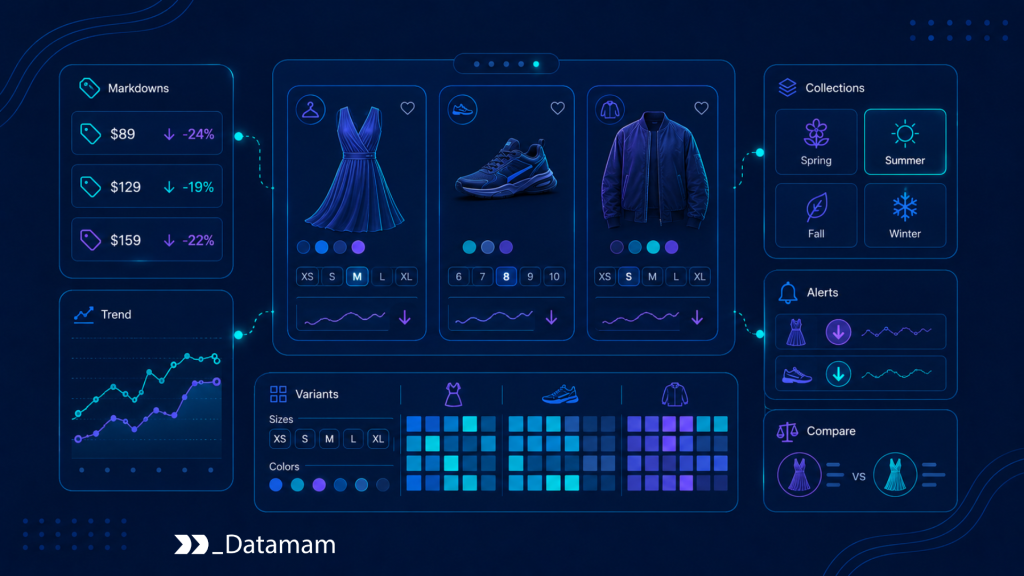
Fashion prices are difficult to compare because a product rarely has one clean competitive price.
The same style may be full price in one color, discounted in another, unavailable in several sizes, marked final sale in one channel, and promoted differently across a brand site, department store, outlet, and marketplace.
A product page can even advertise a price “from $49.99” when only one remaining variant is available at that price.
Fashion Price Monitoring has to preserve that detail.
The important question is not simply whether a competitor reduced a product’s price. Pricing and merchandising teams need to know which variant changed, which sizes remain available, whether the markdown applies to the current collection, what promotion conditions apply, and whether the lower price represents a broad competitive move or a narrow inventory situation.
Without that context, headline markdowns can create misleading pricing signals.
Why Fashion Prices Are Difficult to Compare
Fashion combines product identity, variant structure, inventory state, seasonality, and markdown timing.
A competitor may reduce one color while protecting another.
Core or carryover variants may remain at full price while seasonal variants move into markdown.
Some sizes may sell through while others remain heavily stocked.
Outlet inventory may be priced differently from mainline inventory.
A promotional code may create a lower checkout price without changing the visible product-page price.
All of these cases can appear under the same parent product.
This is why product-level price monitoring alone is insufficient.
McKinsey and The Business of Fashion’s State of Fashion 2025 discusses the industry’s continuing inventory challenges, markdown pressure, stock imbalances, and the difficulty of managing products through rapid trend and demand cycles. Those industry conditions do not explain the cause of any individual competitor markdown, but they reinforce why inventory and lifecycle context matter when fashion prices are interpreted.
Fashion Product Matching Needs Several Relationship Types
Apparel competitor pricing starts with product matching, but the matching relationship should be explicit.
A useful fashion taxonomy can distinguish: Competitor analysis in retail strategy is essential for understanding market position. It helps brands identify their strengths and weaknesses relative to their rivals. Through this analysis, retailers can adapt their pricing, marketing, and product offerings to better meet consumer demands.
- exact product;
- exact parent product, different variant;
- close style comparable;
- retailer-brand or private-label alternative;
- category substitute;
- non-comparable product.
Exact Product
An exact product may be identified using combinations of:
- brand;
- product or style code;
- GTIN, UPC, or another identifier where available;
- product name;
- material;
- model;
- image;
- retailer product ID.
The same underlying branded item sold by two retailers may support direct price comparison once variant differences are also resolved.
Exact Parent Product, Different Variant
The parent style may match while the commercial variant differs.
Examples include: Home improvement pricing comparisons can offer valuable insights into the best deals available. Shoppers often find that even minor differences in product specifications can lead to significant price variations. Understanding these comparisons can empower consumers to make informed purchasing decisions.
- size;
- color;
- width;
- fit;
- material;
- finish;
- configuration.
A black medium jacket and a red small jacket may belong to the same product family but should not automatically become equivalent offers.
The matching model should preserve both the parent relationship and the variant relationship.
Close Style Comparable
Fashion retailers frequently compete with products that are similar rather than identical.
Useful comparison dimensions may include:
- silhouette;
- material;
- fit;
- pattern;
- dimensions;
- construction;
- feature set;
- price tier;
- intended use.
A close style comparable is useful for positioning and assortment analysis.
It is not product identity and should remain labeled separately from an exact match.
Variant-Level Pricing Is the Core Fashion Requirement
The parent product is often the wrong level for pricing analysis.
A reliable fashion observation should connect:
parent product → variant → commercial state → availability → point-in-time observation
Parent Product
The parent represents the broader style or product family.
Useful fields may include:
- brand;
- style code;
- product name;
- category;
- material;
- collection;
- channel.
Variant
Variant information may include:
- variant ID or SKU where exposed;
- internally assigned stable variant ID where necessary;
- size;
- color;
- fit;
- width;
- material variation;
- configuration.
Not every fashion product requires every field.
An apparel item may require size and color.
Footwear may require size, width, and color.
A handbag may have color but no meaningful apparel size.
A one-size accessory may require neither.
Variant requirements should therefore depend on category.
Commercial State
The same variant can move through several pricing states:
- full price;
- promotional discount;
- first markdown;
- deeper markdown;
- clearance;
- final sale.
These states should not be collapsed into a generic sale = true flag.
Availability
Availability should remain attached to the variant.
A lower price matters differently when:
- all target sizes remain available;
- only a small subset remains;
- the variant is out of stock;
- the product has moved to outlet;
- the offer is available only in one market or channel.
Parent-Level Sale Prices Can Mislead
Suppose a competitor product page displays:
From $49.99
The underlying variants might actually look like this:
| Variant | Price | Availability |
| Black / M | $79.99 | In stock |
| Black / L | $79.99 | In stock |
| Navy / M | $79.99 | In stock |
| Red / XS | $49.99 | Limited |
| Red / XL | $49.99 | Out of stock |
The parent product is technically advertised “from $49.99.”
But the commercially important interpretation may be that core variants remain at $79.99 while a limited subset of one color has been marked down.
A pricing system that stores only:
competitor_price = 49.99
loses that distinction.
Size-Curve Coverage Should Be Measured
Fashion teams often talk about a product having a “full size curve,” but the term needs an operational definition.
The relevant size set varies by:
- brand;
- category;
- market;
- customer segment;
- product.
Instead of assuming that particular sizes are universally core or fringe, a monitoring system can preserve:
- target size set;
- number of sizes observed;
- number of sizes currently available;
- share of target sizes available;
- available sizes before markdown;
- available sizes after markdown;
- markdown status by size.
This allows teams to distinguish a broad markdown from a lower price attached only to limited residual inventory.
For example:
80% of target sizes available and discounted
is a different competitive signal from:
20% of target sizes available and discounted.
The thresholds themselves should be defined by the retailer and category rather than treated as universal fashion standards.
Color-Level Pricing Needs Product Context
Color can also change the meaning of a markdown.
A retailer may protect its carryover colors while marking down seasonal variants.
The system should therefore avoid assuming that black, navy, white, denim, or any other color is universally “core.”
Instead, colors can be classified using retailer or assortment context:
- core/carryover;
- seasonal;
- limited edition;
- unknown.
A markdown concentrated in seasonal colors may represent a different commercial pattern from a markdown applied across the full product family.
Monitoring should record the observation first.
The business team can then interpret what the pattern means.
Fashion Markdown Tracking Needs More Than a Sale Price
Fashion retailers use several discount mechanics:
- visible markdown;
- promo code;
- member discount;
- category-wide promotion;
- outlet price;
- marketplace discount;
- clearance;
- final-sale markdown.
Each has different semantics.
A useful markdown record may contain:
- base price;
- current displayed price;
- promo-code price where determinable;
- discount amount;
- markdown percentage where calculable;
- markdown stage;
- final-sale status;
- promotion terms;
- first observed markdown date;
- latest observed price;
- channel;
- variant availability.
Do Not Require an Original Price for Every Valid Sale Observation
A retailer may expose a valid current sale price without exposing a reliable original price.
That observation should not automatically be discarded.
Instead, the system can preserve:
current_price = 89.00
original_price = unknown
markdown_depth_status = unavailable
The price remains useful for market monitoring.
It should simply be excluded from analyses that require verified markdown depth.
Track the Markdown Lifecycle
A snapshot answers:
What price is visible now?
A markdown history answers:
How did this product move through its selling lifecycle?
Useful lifecycle events may include:
- first observed at full price;
- first markdown;
- subsequent markdown;
- final-sale designation;
- variant sell-through;
- assortment exit.
This creates a richer view than one sale-price observation.
However, markdown timing should not be treated as proof of competitor intent.
An early markdown can be consistent with factors such as:
- inventory imbalance;
- promotional strategy;
- changing demand;
- product lifecycle decisions;
- assortment transition.
External monitoring establishes that the markdown happened.
Determining why it happened generally requires additional evidence.
The State of Fashion 2026 also discusses the use of market and competitor information alongside inventory, demand, and sell-through signals to support more granular pricing and promotional decisions. That reinforces the distinction between observing a competitor’s action and inferring the business reason behind it.
Final Sale and Promotion Terms Need Separate Fields
A final-sale markdown is not necessarily equivalent to a standard sale.
Final-sale conditions can change:
- return eligibility;
- exchange conditions;
- customer risk;
- perceived value.
The legal meaning also varies by jurisdiction and applicable consumer-protection rules.
The observation should therefore preserve:
- current price;
- final-sale flag;
- observed return condition where available;
- promotion terms;
- market/jurisdiction.
That allows the commercial team to determine whether two offers are truly comparable.
Seasonality Must Be Interpreted by Market
Fashion seasonality is inherently geographic.
A coat markdown near the end of the local winter selling period has a different context from the same markdown near the beginning of winter in that market.
Similarly, swimwear, footwear, occasion wear, and seasonal colors may move through different commercial calendars across countries and hemispheres.
A useful observation may therefore preserve:
- market;
- collection;
- season;
- current or prior collection;
- first-seen date;
- markdown dates;
- assortment-exit date.
Season should not be inferred from a universal calendar.
Cross-Border Size Normalization Has Limits
Global fashion monitoring may involve:
- US sizing;
- UK sizing;
- EU sizing;
- international labels;
- brand-specific sizing.
These labels can be normalized into comparable size systems where appropriate.
But a mapped size does not guarantee equivalent fit.
A nominal size 8 from one brand may not correspond perfectly to a nominally equivalent size from another brand.
Size-system normalization is therefore useful for organizing competitor catalogs, while close-style comparison may still require brand-specific or product-specific context.
Channel Context Matters
The same fashion item can appear across:
- mainline brand site;
- department store;
- outlet;
- marketplace;
- regional storefront;
- promotional landing page.
A markdown on an outlet item should not automatically determine the competitive price for a current-season mainline offer.
The observation should preserve:
channel = mainline
or:
channel = outlet
where that distinction is known.
This becomes especially important when identical or very similar product names are reused across seasons or channels.
A Fashion Monitoring Data Model
A practical fashion workflow can be structured as:
collection → parent/variant resolution → size normalization → color normalization → product matching → markdown classification → availability mapping → collection/channel context → validation → history → delivery
Raw Observation
Raw source data may include:
- source URL;
- retailer;
- product title;
- visible price;
- original-price text;
- promotion text;
- size options;
- color options;
- stock messages;
- channel;
- market;
- observation timestamp.
Normalized Observation
A structured record may include:
- internal product ID;
- competitor product ID;
- product match ID;
- comparison type;
- parent product ID;
- variant ID;
- normalized size;
- normalized color;
- collection;
- channel;
- base price;
- current price;
- markdown stage;
- final-sale status;
- stock status;
- observed timestamp;
- quality status.
If the source does not expose a stable competitor product or variant identifier, the monitoring system can assign a stable internal identifier to the resolved external entity.
Validate Observations Separately From Pricing Actions
A valid fashion observation should not automatically trigger a pricing action.
An out-of-stock markdown can remain valuable historically.
A sale with no original price can remain useful while being excluded from markdown-depth analysis.
A similar-style product can remain useful for positioning while being excluded from direct automated repricing.
An illustrative validation pattern might look like this:
BASE_REQUIRED_FIELDS = [

    "internal_product_id",

    "competitor_product_id",

    "product_match_id",

    "retailer",

    "category",

    "current_price",

    "stock_status",

    "observed_at",

]


CATEGORY_VARIANT_FIELDS = {

    "apparel": ["size", "color"],

    "footwear": ["size", "color"],

    "handbags": ["color"],

}


def validate_fashion_observation(observation):

    required_fields = BASE_REQUIRED_FIELDS + CATEGORY_VARIANT_FIELDS.get(

        observation.get("category"),

        [],

    )


    missing = [

        field

        for field in required_fields

        if observation.get(field) is None

    ]


    if missing:

        return {

            "valid": False,

            "reason": "missing_required_fields",

            "fields": missing,

        }


    markdown_depth_available = (

        observation.get("original_price") is not None

        and observation.get("current_price") is not None

    )


    return {

        "valid": True,

        "quality_status": "validated",

        "markdown_depth_available": markdown_depth_available,

        "stock_status": observation["stock_status"],

    }
This validation confirms that the observation is usable as data.
A separate downstream policy can decide whether it belongs in:
- BI analysis;
- markdown reporting;
- analyst review;
- pricing workflows;
- automated repricing.
Freshness Depends on the Fashion Decision
Not every fashion workflow needs the same update frequency.
Freshness may depend on:
- markdown cadence;
- collection stage;
- product importance;
- promotion window;
- channel;
- category volatility.
Monitoring a fast-moving promotional event may require much fresher observations than a monthly review of competitor assortment.
Real-time monitoring is therefore not automatically superior.
The appropriate question is:
How recent must this observation be for the decision it supports?
How to Measure Fashion Price Monitoring Quality
The number of prices collected is not enough to evaluate monitoring quality.
More useful measures include:
| Area | Example Measure |
| Product matching | Exact-match precision and unresolved-match rate |
| Variant coverage | Share of required variants successfully observed |
| Size coverage | Share of target sizes with usable availability status |
| Color coverage | Share of relevant color variants captured |
| Markdown data | Share of sale observations with usable markdown classification |
| Original-price coverage | Share where markdown depth can be verified |
| Availability | Share of variants with usable stock context |
| Collection context | Share tagged with appropriate season/collection where required |
| Channel context | Share with known mainline, outlet, marketplace, or other channel |
| Freshness | Share meeting the required observation window |
| Data quality | Validation and exception rates |
| Traceability | Share traceable to source URL and timestamp |
Matching precision and similar accuracy metrics should be calculated against a reviewed reference set rather than inferred from match volume.
Commercial outcomes should be measured separately rather than assumed.
How to Evaluate Fashion Price Monitoring Readiness
A fashion monitoring review should determine whether prices are comparable at the level where commercial decisions are actually made.
Useful questions include:
- Are parent products separated from variants?
- Are exact matches separated from similar-style comparisons?
- Do downstream systems receive product relationship, variant, stock, markdown, and quality context alongside the price?
- Are size and color requirements defined by product category?
- Can the system measure how much of the relevant size curve remains available?
- Are core/carryover and seasonal colors distinguished where the retailer has that classification?
- Are base price, current sale price, promo-code price, and final-sale status stored separately?
- Can valid sale observations remain usable when original price is unavailable?
- Are markdown dates and subsequent markdowns preserved historically?
- Are current-season, prior-season, mainline, and outlet contexts distinguishable?
- Can out-of-stock observations remain in history without automatically influencing pricing?
- Are international size mappings treated as label normalization rather than proof of identical fit?
- Are timestamps available for downstream freshness controls?
- Can analysts trace a normalized observation back to its source?
These questions reveal whether a workflow is collecting fashion prices or producing usable fashion pricing intelligence.
Conclusion
Fashion Price Monitoring works best at the level where fashion actually changes: the variant.
A parent product can hide different prices across sizes and colors.
A markdown can apply to a seasonal variant without affecting the full product family.
A low price can appear after most meaningful sizes have already sold out.
A final-sale offer can carry different commercial terms from a standard promotion.
And a similar-looking product can be useful for positioning without being an exact competitor match.
Reliable fashion monitoring preserves those distinctions instead of compressing them into one parent-level sale price.
That gives pricing, merchandising, ecommerce, and BI teams a clearer basis for deciding which competitor markdowns matter, which require interpretation, and which should not influence a pricing decision at all.