Key Takeaways
- Real Estate Site Selection improves when POI data shows nearby anchors, competitors, amenities, services, retail clusters, and business density
- Commercial property site selection should evaluate location context, tenant fit, market saturation, access, trade area strength, and nearby demand drivers
- CRE location analysis fails when teams depend only on demographics, broker notes, or manual map research
- Commercial real estate location data requires address validation, geocoding precision, POI freshness, category taxonomy, deduplication, and lineage
- Reliable CRE location intelligence depends on validation, governance, sourcing controls, observability, and integration into GIS, BI, asset, or investment workflows
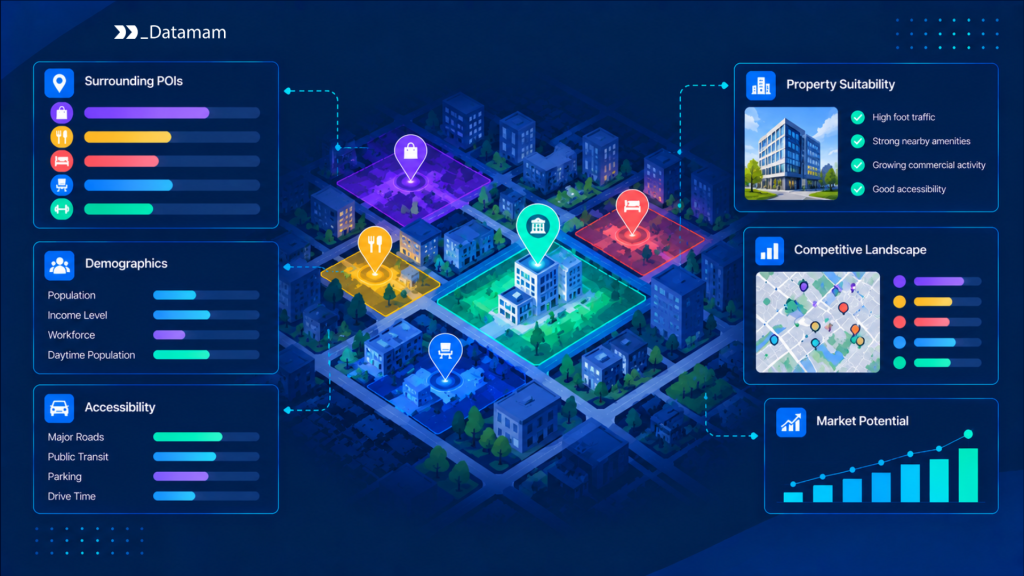
Commercial real estate teams evaluate locations by estimating how a property fits into the surrounding market. Real Estate Site Selection becomes difficult when decisions rely only on property specifications, rent levels, broker materials, demographics, or historical leasing assumptions. POI data gives acquisitions, leasing, asset management, development, research, and investment teams a structured view of nearby businesses, anchors, competitors, services, amenities, transport nodes, and commercial density. The commercial challenge is not simply knowing what sits near a property. It is understanding whether the surrounding environment supports tenant demand, customer access, footfall potential, leasing strategy, and long-term asset value. For CRE teams comparing many assets or markets, POI-based commercial property site selection helps turn local market context into a repeatable location evaluation process.
The Operational Problem in CRE Location Evaluation
A commercial property is not evaluated only by its square footage, rent, vacancy, cap rate, frontage, parking, or building condition. Its value is shaped by the surrounding location system. Nearby grocery stores, restaurants, offices, schools, hospitals, hotels, gyms, transit stations, entertainment venues, and competitor properties can influence tenant demand and customer behavior.
This makes CRE location analysis more complex than a static property review. A retail asset near strong anchors may support higher leasing confidence. An office building near transit, food, gyms, and business services may be easier to position for tenants. A mixed-use development may depend on whether the surrounding POI ecosystem can support daily routines.
Why Property Data Alone Is Not Enough
Property data can describe the asset. It cannot fully explain the market around the asset. Two properties with similar size, rent, and demographics may perform differently because one sits inside an active commercial corridor while the other is isolated from demand drivers.
POI data adds the local market layer. It shows where businesses, services, destinations, and competitors are located. This helps CRE teams evaluate whether a property is supported by the right environment for its intended use.
Where Manual Market Research Breaks
Manual market research may work for one asset. It breaks when teams need to evaluate portfolios, acquisition targets, development sites, or multiple markets. Analysts may review maps, broker reports, local directories, zoning documents, tenant lists, and spreadsheets. However, these inputs are hard to standardize.
One property may receive detailed amenity mapping. Another may rely on outdated local notes. A third may miss recent openings, closures, or competitive developments. Real Estate Site Selection needs structured location data so assets can be compared consistently.
POI Data as a CRE Location Intelligence Layer
POI data becomes valuable when it operates as a location intelligence layer between property records and investment or leasing decisions. The goal is not simply to map nearby businesses. The goal is to classify, validate, and analyze the surrounding market so teams can understand asset fit, tenant demand, and competitive positioning.
This layer should answer practical questions. What demand drivers sit near the property? Which tenant categories are already represented? Which amenities support leasing? Are direct competitors nearby? Is the area growing, saturated, underserved, or shifting?
Mapping Anchors, Amenities, and Competitors
Different property types require different POI lenses. A retail center may need visibility into grocery anchors, pharmacies, restaurants, banks, gyms, entertainment venues, and competing centers. An office asset may need nearby transit, parking, hotels, restaurants, coffee shops, childcare, fitness, and business services. A healthcare property may depend on hospitals, clinics, pharmacies, senior living, and referral ecosystems.
Competitor mapping also matters. A property may appear attractive until teams see nearby competing assets, tenant overlap, or saturation in the same category. POI data helps quantify this local context.
Evaluating Tenant Fit and Market Gaps
Commercial property site selection is often about tenant fit. A location may be strong for quick-service restaurants but weak for premium retail. Another may work for medical offices but not lifestyle retail. POI data helps teams compare existing business mix against target tenant categories.
Market gaps also matter. If an area has high residential density, strong traffic generators, and limited fitness options, that may support a gym tenant. If a corridor has many restaurants but few service businesses, leasing strategy may shift. POI data gives leasing and development teams a clearer view of category opportunity.
def route_cre_location(asset):

    if asset["quality_status"] == "validated":

        return {"action": "publish_to_cre_location_dashboard", "asset_id": asset["asset_id"]}

    if asset["quality_status"] == "failed":

        return {"action": "send_to_location_data_review", "asset_id": asset["asset_id"]}

    return {"action": "hold_for_review", "asset_id": asset["asset_id"]}


REQUIRED_CRE_FIELDS = [

    "asset_id",

    "address",

    "latitude",

    "longitude",

    "property_type",

    "trade_area_radius",

    "quality_status",

]


def validate_cre_location(asset):

    missing = [field for field in REQUIRED_CRE_FIELDS if not asset.get(field)]

    if missing:

        return {"valid": False, "reason": "missing_fields", "fields": missing}

    if asset.get("anchor_poi_count") is None:

        return {"valid": False, "reason": "anchor_poi_count_required"}

    if asset.get("poi_freshness_days", 999) > 90:

        return {"valid": False, "reason": "poi_data_stale"}

    return {"valid": True}


asset = {

    "asset_id": "CRE-48192",

    "address": "Candidate commercial property",

    "latitude": 32.7767,

    "longitude": -96.7970,

    "property_type": "retail_center",

    "trade_area_radius": 3,

    "anchor_poi_count": 14,

    "poi_freshness_days": 27,

    "quality_status": "validated",

}


print(route_cre_location(asset))

print(validate_cre_location(asset))
This logic reflects the operating principle. A commercial property should not move into location dashboards unless the address, coordinates, property type, trade area, anchor context, and POI freshness are validated.
Data Requirements for Commercial Real Estate Location Data
Commercial real estate location data should connect property records with surrounding place data. Useful fields include property ID, property type, address, latitude, longitude, trade area, nearby POIs, category mix, anchor proximity, competitor count, transit access, business density, source, last updated date, and confidence score.
Bad POI data can distort CRE decisions. A closed anchor may still appear active. A duplicate restaurant may inflate commercial density. A poorly geocoded business may appear inside the wrong trade area. A vague category may misclassify a medical office, retail service, or entertainment venue. These issues can affect acquisition underwriting, leasing strategy, and asset positioning.
Address Validation and Geocoding Precision
Address validation confirms that both properties and surrounding POIs are usable for analysis. Geocoding precision is especially important in dense commercial areas where a few blocks can change access, visibility, and tenant mix.
A property at a major intersection may have a different commercial profile than one nearby but separated by a highway, rail line, river, or parking structure. CRE location analysis should preserve coordinate precision and geocode confidence.
Category Taxonomy and Deduplication
POI category taxonomy must be detailed enough to support CRE decisions. “Retail” is not enough. Teams may need grocery, pharmacy, fitness, restaurant, bank, medical, entertainment, hotel, office, education, auto, home services, and specialty retail categories.
Deduplication prevents inflated market scores. The same business may appear under different names, source records, or local listings. Duplicate records can make a property look more commercially active than it is.
Infrastructure Application Model for CRE Location Analysis
At scale, CRE location workflows require repeatable infrastructure. Property records, POI data, competitor locations, tenant lists, geocodes, trade areas, foot traffic, and internal asset performance must be connected consistently. A one-time map export is not enough for portfolio-level analysis.
ETL and ELT pipelines can move property and POI records into structured staging tables. Airflow can orchestrate refresh schedules, validation checks, deduplication, geocoding updates, and trade area scoring. Spark can process large geospatial joins and market-level calculations. dbt can transform raw records into normalized property, POI, anchor, competitor, and trade area tables. Snowflake, BigQuery, or Databricks can support analytics, history, and delivery into GIS, BI, asset management, or investment workflows.
Validation, Observability, and Lineage
Validation controls should check missing addresses, invalid coordinates, duplicate POIs, stale records, closed businesses, weak categories, and low geocode confidence. Great Expectations or similar frameworks can test completeness, uniqueness, accepted values, and freshness. Data observability systems can monitor source failures, abnormal POI count changes, geocoding errors, and category drift.
Lineage matters because CRE teams need to explain why a location was scored positively or negatively. If a retail asset is marked as anchor-rich, leaders should know which POI records contributed to that conclusion and when they were refreshed.
Governance and Sourcing Controls
CRE location data workflows need governance. Teams should document approved sources, refresh cadence, address validation rules, geocoding standards, category taxonomy, deduplication logic, retention, and access controls.
Cross-market analysis adds complexity because address formats, business categories, POI coverage, tenant terminology, and property types vary by country. Governance keeps commercial real estate location data comparable across regions and portfolios.
Commercial Impact of POI-Driven CRE Location Analysis
The commercial value of POI data appears when CRE teams can compare locations using current, structured market context. Better location intelligence can improve acquisition screening, development planning, leasing strategy, tenant targeting, competitor assessment, and portfolio reporting.
For acquisitions and leasing teams, POI-based workflows reduce dependence on manual research and static broker summaries. Analyst time spent building market maps, tenant mix summaries, and competitor context can fall materially when POI data is validated and integrated into dashboards.
Better Acquisition and Development Screening
Real Estate Site Selection improves when teams can compare candidate assets by surrounding demand drivers. A retail property near strong anchors and complementary services may deserve closer review. An office asset with weak amenity access may require different tenant positioning. A healthcare site near referral networks may have stronger location logic than one with only favorable rent.
POI data does not replace underwriting. It improves the location evidence used before deeper financial review.
Stronger Leasing and Tenant Strategy
Leasing teams can use POI data to understand tenant gaps, competitor density, and local demand patterns. If a center lacks fitness, medical, restaurant, or service tenants relative to surrounding demand, leasing strategy can become more targeted.
This supports more disciplined tenant outreach and asset positioning because teams can explain why certain tenant categories fit the location.
Risk Avoidance and Strategic Advantage
Without reliable POI data, CRE teams risk evaluating properties with incomplete local context. A nearby anchor may have closed. A competitor property may be missing. A corridor may be declining despite attractive demographics. A category may appear underserved because business records are incomplete.
These errors can affect acquisition decisions, development planning, leasing strategy, and portfolio performance. Real Estate Site Selection therefore needs validated location intelligence, not only property-level assumptions.
Governance Gaps in CRE Location Decisions
Governance gaps appear when teams cannot explain which POI sources were used, how categories were assigned, how duplicates were resolved, or when records were refreshed. This weakens confidence in investment and leasing recommendations.
Audit logs, metadata, and lineage support accountability. Investment, asset management, and leasing leaders need to know whether location decisions are based on current and validated data.
AI and Automation Risk
As CRE teams use AI for property screening, market scoring, tenant targeting, and portfolio analysis, POI quality becomes more important. Models trained on stale, duplicated, or misclassified place data can recommend weak assets or miss stronger locations.
POI data must therefore be structured enough for human review and reliable enough for automated analytics. Otherwise, automation may scale poor location assumptions across the portfolio.
Evaluating Real Estate Site Selection Readiness
A CRE location readiness review should assess whether current workflows produce trusted, comparable, and timely market intelligence. The review should not only ask whether POI data exists. It should ask whether the data is accurate enough to support acquisition, development, leasing, and asset decisions.
Useful evaluation areas include property-to-POI matching, source coverage, address validation, geocoding precision, duplicate resolution, category taxonomy, anchor classification, competitor mapping, trade area logic, freshness, lineage, and integration into GIS, BI, asset, or investment systems.
What a CRE Location Data Audit Should Reveal
A structured location data audit should show where commercial property site selection risk accumulates. It may reveal stale anchors, duplicate POIs, weak category mapping, missing competitor properties, imprecise coordinates, inconsistent trade areas, or unclear source coverage.
The output should clarify which markets have reliable coverage, which property types need stronger location models, which POI categories require better classification, and which workflows can safely use automated location scoring.
When Infrastructure Review Becomes Necessary
A location intelligence infrastructure consultation becomes useful when CRE teams are comparing many assets, entering new markets, building tenant targeting workflows, or integrating POI data into investment dashboards. At that point, the key question is not only “what is near this property?” The stronger question is “can we trust this location intelligence enough to influence underwriting, leasing, and asset strategy?”
An architecture review should evaluate source strategy, data model design, geocoding workflows, validation coverage, observability, governance, and integration pathways.
Conclusion: CRE Location Analysis as Market Intelligence Infrastructure
Commercial real estate teams use POI data to understand how properties fit into surrounding markets. Accurate visibility into anchors, amenities, competitors, tenant categories, business density, transport access, and trade area context helps teams evaluate location strength more consistently.
Real Estate Site Selection becomes commercially valuable when POI data is treated as market intelligence infrastructure, not manual map research. CRE teams that maintain trusted commercial real estate location data will be better positioned to screen assets, shape leasing strategy, reduce location risk, and make property decisions with greater discipline.