Key Takeaways
- Business Location Data helps teams map companies, competitors, branches, service areas, and commercial density across markets
- A business location database should include validated addresses, coordinates, category, company identity, status, source, and update history
- Business mapping data supports territory design, white-space analysis, competitor coverage, and market prioritization
- Territory analysis fails when business records are duplicated, stale, misclassified, poorly geocoded, or disconnected from parent companies
- Reliable location intelligence requires validation, deduplication, lineage, governance, and integration into GIS, CRM, BI, or planning workflows
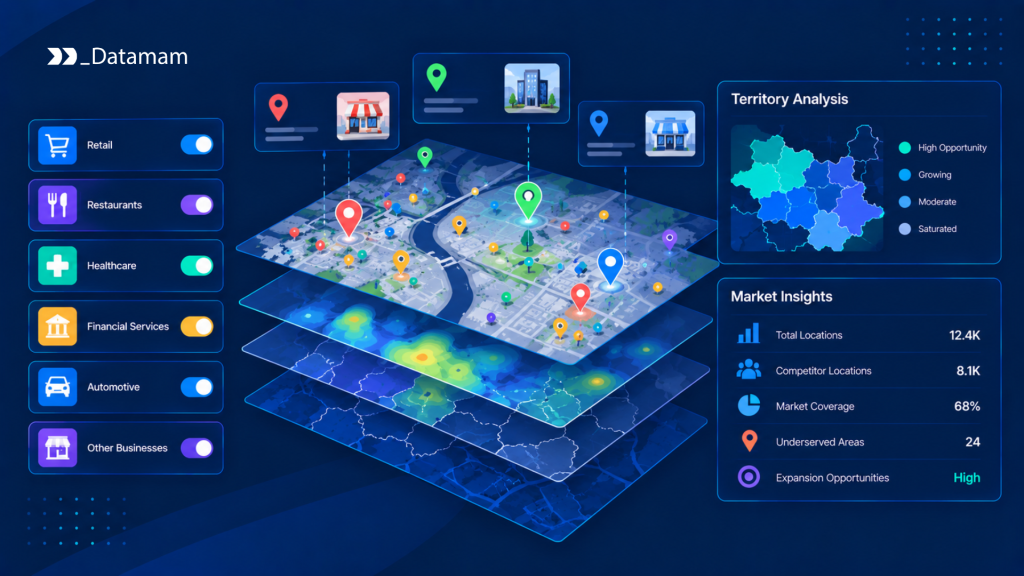
Market mapping and territory planning depend on knowing where businesses are located, how they are categorized, which companies operate multiple sites, and how local commercial density changes by region. Location intelligence solutions provide sales, strategy, operations, franchise, real estate, and market intelligence teams a structured way to map companies, branches, offices, stores, clinics, warehouses, dealers, service centers, and competitors. The commercial problem is not simply having addresses. It is understanding which locations matter, how they relate to parent companies, whether they are active, how they fit into a market, and how territories should be designed around them. Without reliable company location data, teams can misread market coverage, overassign territories, miss white-space opportunities, or plan from outdated business maps.
The Operational Problem in Market Mapping
Market mapping becomes difficult when teams rely on incomplete business lists, manual research, outdated directories, or inconsistent CRM records. A market may appear undercovered because business locations are missing. Another may appear saturated because duplicate records inflate counts. A sales territory may look balanced by geography but contain very different business density, account value, competitor presence, or service complexity.
Business Location Data creates a more reliable view of local market structure. It shows where companies operate, where competitors are concentrated, where customer segments cluster, and where expansion or sales coverage may be weak.
Why Business Location Data Is More Than Address Lists
An address alone does not explain commercial meaning. A business record should show what the location is, who operates it, which category it belongs to, whether it is active, and how it connects to a broader company or chain.
For example, a healthcare company may operate clinics, labs, offices, and urgent care sites. A logistics company may operate warehouses, depots, branches, and service centers. A retailer may operate stores, outlets, pickup points, and distribution sites. Territory analysis needs this context before locations can be compared properly.
Where Manual Territory Research Breaks
Manual business mapping may work for one market or one sales region. It breaks when teams need to compare many territories, industries, competitor networks, or regional opportunities. Analysts may collect company addresses from websites, directories, map platforms, filings, CRM exports, and spreadsheets, but these sources often conflict.
A company may appear under multiple names. A branch may have moved. A closed office may still appear active. A franchise may be disconnected from its parent brand. Without a maintained business location database, market mapping becomes inconsistent and difficult to defend.
Business Location Data as a Market Intelligence Layer
Business Location Data becomes valuable when it acts as a market intelligence layer between raw company records and commercial decisions. The goal is not only to map business points. The goal is to classify, validate, and analyze business locations so teams can design territories, compare markets, and prioritize opportunities.
This layer should answer practical questions. Which companies operate in this territory? Where are competitor locations concentrated? Which regions have high business density but low sales coverage? Which accounts have multiple physical locations? Also, which territories need redesign because market conditions changed?
Mapping Companies, Branches, and Competitors
Business mapping data should connect individual locations to company identity. A branch, store, office, clinic, dealer, warehouse, or franchise location should be traceable to the correct brand or parent organization where possible. This is important for account planning and competitor analysis.
Sales teams may need to know where target accounts operate. Strategy teams may need to see competitor coverage. Operations teams may need to map service areas. Franchise teams may need to evaluate territory density. Each workflow depends on accurate location-to-company relationships.
Identifying White Space and Territory Imbalance
Territory analysis should reveal where coverage and opportunity are misaligned. A territory may be geographically large but commercially sparse. Another may be small but dense with target accounts. A third may contain strong competitor presence and require more focused coverage.
Business Location Data helps teams quantify these differences. Markets can be scored by target business count, account density, competitor count, category mix, distance from existing offices, and territory overlap. These scores support planning, but they depend on reliable location data.
def route_business_location(location):

    if location["quality_status"] == "validated":

        return {"action": "publish_to_territory_map", "location_id": location["location_id"]}

    if location["quality_status"] == "failed":

        return {"action": "send_to_entity_resolution_review", "location_id": location["location_id"]}

    return {"action": "hold_for_review", "location_id": location["location_id"]}


REQUIRED_BUSINESS_LOCATION_FIELDS = [

    "location_id",

    "company_name",

    "address",

    "latitude",

    "longitude",

    "business_category",

    "status",

]


def validate_business_location(location):

    missing = [field for field in REQUIRED_BUSINESS_LOCATION_FIELDS if not location.get(field)]

    if missing:

        return {"valid": False, "reason": "missing_fields", "fields": missing}

    if location["status"] not in ["active", "closed", "relocated", "planned"]:

        return {"valid": False, "reason": "invalid_location_status"}

    if location.get("geocode_confidence", 0) < 0.80:

        return {"valid": False, "reason": "low_geocode_confidence"}

    return {"valid": True}


location = {

    "location_id": "BIZ-48192",

    "company_name": "regional_service_provider",

    "address": "Validated business address",

    "latitude": 39.9526,

    "longitude": -75.1652,

    "business_category": "field_service_office",

    "status": "active",

    "geocode_confidence": 0.91,

    "quality_status": "validated",

}


print(route_business_location(location))

print(validate_business_location(location))
This simple logic reflects the operating principle. A business location should not move into territory maps unless identity, address, coordinates, category, status, and geocode confidence are validated.
Data Requirements for a Business Location Database
A business location database should include business name, parent company, local branch name, address, latitude, longitude, category, industry, location type, operating status, phone, website, hours, source, last updated date, and confidence score. For enterprise workflows, it should also support company hierarchy, branch grouping, territory assignment, and historical change tracking.
Poor data quality can distort market mapping. Duplicate records can exaggerate market density. Missing branch locations can understate opportunity. Weak category mapping can mix unrelated businesses. Imprecise coordinates can assign locations to the wrong territory. These issues directly affect sales coverage, expansion planning, and competitor analysis.
Address Validation and Geocoding Precision
Address validation confirms that a location record is usable. Geocoding turns the address into coordinates, but precision matters. Rooftop-level or parcel-level coordinates are stronger than city or ZIP-code centroids for territory design.
A location assigned to the wrong side of a territory boundary can affect ownership, sales compensation, service routing, and coverage planning. Business Location Data should preserve geocode confidence and coordinate source so teams understand how precise each record is.
Entity Resolution and Company Hierarchy
Entity resolution connects duplicate and related records. The same company may appear under legal name, trade name, local branch name, abbreviation, or franchise name. Company hierarchy helps teams connect locations to brands, subsidiaries, parent companies, and account ownership structures.
This matters because territory analysis is rarely only location-based. A sales team may assign accounts by parent company. A market intelligence team may analyze competitors by brand. An operations team may plan service coverage by branch network.
Infrastructure Application Model for Business Mapping Data
At scale, business location workflows require repeatable infrastructure. Company websites, branch locators, directories, public registries, map sources, commercial listings, and local pages change frequently. New businesses open, relocate, close, merge, or rebrand. A one-time extract becomes outdated quickly.
ETL and ELT pipelines can move raw company location records into structured staging tables. Airflow can orchestrate refresh schedules, validation checks, entity resolution jobs, geocoding updates, and territory scoring. Spark can process large business location datasets, geospatial joins, and market-level calculations. dbt can transform raw records into normalized company, branch, competitor, and territory tables. Snowflake, BigQuery, or Databricks can support analytics, history, and delivery into GIS, CRM, BI, or planning systems.
Validation, Observability, and Lineage
Validation controls should check missing addresses, invalid coordinates, duplicate locations, stale records, closed businesses, weak categories, inconsistent company names, and low geocode confidence. Great Expectations or similar frameworks can test completeness, uniqueness, accepted values, and freshness. Data observability systems can monitor source failures, abnormal business count changes, geocoding errors, and category drift.
Lineage helps teams understand how a territory map was built. If a region appears undercovered, leaders should know which sources were used, when records were refreshed, and how business categories were assigned.
Governance and Cross-Market Controls
Business location workflows need governance. Teams should document approved sources, refresh cadence, address validation rules, geocoding standards, category taxonomy, entity resolution logic, retention rules, and access controls.
Cross-market analysis adds complexity because address formats, business categories, company structures, languages, and source coverage vary by country. Governance ensures that business mapping data remains comparable across regions.
Commercial Impact of Business Location Data
The commercial value of Business Location Data appears when teams can design territories, evaluate markets, and map competitors from a trusted location foundation. Better data can improve sales coverage, expansion prioritization, competitor visibility, account planning, and service area design.
For sales operations, strategy, franchise, real estate, and market intelligence teams, validated company location data reduces dependence on manual research and static spreadsheets. It also creates a reusable foundation for planning and performance analysis. Foot traffic analysis in retail sectors can provide invaluable insights into customer behavior and preferences. By understanding patterns in foot traffic, businesses can strategically place promotional displays and optimize store layouts. This level of analysis ultimately enhances the customer experience and drives sales growth.
Better Territory Design
Territory design improves when teams can compare market density, business counts, account clusters, competitor presence, and travel distance. Instead of assigning territories only by region or ZIP code, teams can design coverage around actual commercial opportunity.
This supports more balanced sales and service territories. It can also reveal where current coverage does not match market potential.
Stronger Market and Competitor Mapping
Business Location Data helps teams understand where competitors operate, where target accounts cluster, and where market gaps exist. A competitor may have fewer total locations but stronger presence in high-value markets. A target segment may be concentrated in corridors that are not obvious from demographics alone.
Company location data makes these patterns visible and easier to compare across markets.
Risk Avoidance and Strategic Advantage
Without reliable business mapping data, teams risk making territory and market decisions from incomplete or outdated evidence. A region may look unattractive because target businesses are missing. A territory may appear balanced but contain far fewer active accounts. A competitor may be underestimated because branch locations are not linked correctly.
These errors can affect sales planning, expansion strategy, account coverage, service delivery, and executive reporting. Business Location Data reduces risk by creating a validated view of business presence and market structure.
Governance Gaps in Territory Decisions
Governance gaps appear when teams cannot explain which sources were used, how companies were matched, how duplicates were resolved, or when records were refreshed. This weakens trust in territory and market recommendations.
Audit logs, metadata, and lineage support commercial accountability. Sales, strategy, and operations leaders need to know whether location decisions are based on current and validated data.
AI and Automation Risk
As organizations use AI for territory planning, market scoring, lead routing, and competitor mapping, location data quality becomes more important. Models trained on stale, duplicated, or poorly geocoded business records can recommend weak territories or miss stronger opportunities.
Business location data must therefore be structured enough for human review and reliable enough for automated analytics.
Evaluating Business Location Data Readiness
A business location data readiness review should assess whether current workflows produce trusted, current, and comparable market intelligence. The review should not only ask whether business data exists. It should ask whether the data is accurate enough to support territory and market decisions.
Useful evaluation areas include source coverage, address validation, geocoding precision, duplicate resolution, company hierarchy, category taxonomy, operating status, freshness, lineage, and integration into GIS, CRM, BI, or planning tools.
What a Business Location Data Audit Should Reveal
A structured business location data audit should show where market mapping risk accumulates. It may reveal duplicate company records, missing branches, weak category classification, stale operating status, imprecise coordinates, disconnected parent companies, or inconsistent territory assignments.
The output should clarify which markets have reliable coverage, which business categories need stronger classification, which sources require refresh, and which workflows can safely use automated territory scoring.
When Infrastructure Review Becomes Necessary
A location intelligence infrastructure consultation becomes useful when teams are redesigning territories, expanding into new markets, mapping competitors, consolidating company location lists, or integrating business location data into CRM and BI systems. At that point, the key question is not only “do we have business addresses?” The stronger question is “can we trust this business mapping data enough to guide commercial decisions?”
An architecture review should evaluate source strategy, data model design, entity resolution, geocoding workflows, validation coverage, observability, governance, and integration pathways.
Conclusion: Business Location Data as Territory Intelligence Infrastructure
Business location data, as a form of location intelligence for retail, supports market mapping and territory analysis by giving teams a validated view of where companies, branches, competitors, service locations, and target accounts operate. When business records are accurate, deduplicated, categorized, geocoded, and connected to company hierarchy, teams can evaluate market opportunity more consistently.
Business Location Data becomes commercially valuable when it is treated as territory intelligence infrastructure, not a static address list. Organizations that maintain trusted business location databases and business mapping data workflows will be better positioned to design territories, map competitors, prioritize markets, and make commercial decisions with greater discipline.