Key Takeaways
- Digital Shelf Monitoring should separate product/formula identity, shade or variant identity, retailer listing, and point-in-time observation.
- Parent-level availability can hide shade-level stock gaps, size differences, set configurations, or regional assortment changes.
- Beauty product content monitoring should compare observed retailer content with the appropriate approved product reference rather than assuming all retailer copy must be identical.
- Beauty shade availability tracking should preserve shade name, shade code, formula, size, finish, retailer, market, and stock status where relevant.
- Ingredient, claim, SPF, warning, and other regulated content should be evaluated in the context of the relevant product version and market.
- Promotions such as gift-with-purchase, loyalty offers, bundles, and promo codes require their own structured terms rather than a generic discount flag.
- Valid observations, content completeness, commercial priority, and workflow actions should remain separate concepts.
- Monitoring quality should be measured through coverage, match quality, reference-content comparison, variant availability, freshness, promotion execution, and exception rates rather than record volume alone.
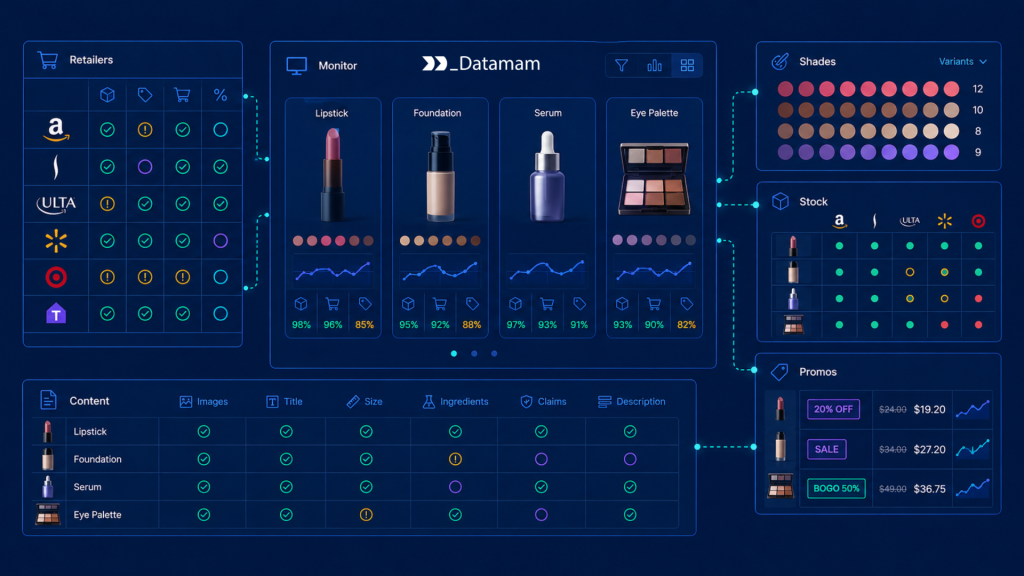
A beauty product can be live on a retailer’s website and still have serious digital shelf gaps.
A foundation may be listed while several priority shades are unavailable. A retailer may show an old packaging image after a product refresh. An ingredient list may belong to a previous formulation. A gift-with-purchase promotion may appear on a category page but not on the product detail page.
Digital Shelf Monitoring has to capture that level of detail.
The question is not simply whether a product exists online. Beauty, ecommerce, sales, and brand teams need to know which variants are available, which product version is represented, whether important content matches an approved reference, what promotion is being shown, and whether the observation applies to the correct market and retailer.
That makes beauty digital shelf monitoring a product-, variant-, content-, and availability-monitoring problem rather than a page-presence check.
Why Beauty Digital Shelves Are Difficult to Monitor
Beauty catalogs contain several layers of variation.
Foundation can have dozens of shades.
Fragrance can have multiple concentrations and bottle sizes.
Skincare products can be reformulated without changing their familiar product name.
Lipstick may reuse similar shade names across different finishes or product lines.
Seasonal gift sets may combine products already sold individually.
Retailers also structure their catalogs differently.
One retailer may place every foundation shade on a single page. Another may create separate variant URLs. A marketplace may expose partial content. A department store may shorten descriptions or retain older packaging imagery during a product transition.
This makes simple URL or parent-product monitoring insufficient.
McKinsey’s 2026 State of Beauty research estimates that ecommerce represents about 28% of global beauty sales and expects digital channels to drive a significant share of category growth through 2030. That reinforces the importance of accurate digital representation, although it does not establish the commercial effect of any individual content or availability problem.
Beauty Product Identity Needs More Than a Shade Name
Shade is not a globally unique product identifier.
“Warm Beige” could describe:
- a foundation shade;
- a concealer shade;
- a tinted moisturizer;
- an older formula;
- a reformulated version;
- a region-specific product.
A stronger identity model is:
brand → product line/formula/version → shade or variant → retailer listing → timestamped observation
Product Line, Formula, and Version
The product level may include:
- brand;
- product line;
- formula;
- product identifier;
- size;
- packaging version;
- formulation version;
- market.
This matters when a familiar product name remains unchanged during:
- reformulation;
- packaging redesign;
- shade-range expansion;
- ingredient updates.
Shade or Variant
Depending on the category, variant fields may include:
- shade name;
- shade code;
- color family;
- undertone;
- finish;
- size;
- concentration;
- set configuration;
- fragrance variation.
Not every beauty product requires a shade.
Category-specific requirements are more accurate.
For example:
| Category | Useful Variant Fields |
| Foundation / concealer | Shade, shade code, undertone, finish, size |
| Lip color | Shade, finish, size |
| Hair color | Shade, color code, formulation |
| Skincare | Size, formulation/version |
| Fragrance | Size, concentration |
| Gift set | Set configuration, component products |
| Nail color | Shade, shade code, finish |
This prevents a skincare serum from being treated as incomplete simply because it has no shade_name.
Match Shades Within the Correct Product Context
Beauty retailers may use:
- shade names;
- shade numbers;
- internal retailer IDs;
- product images;
- swatches;
- descriptive color labels.
Matching should combine those signals with the product line or formula.
A shade called “320W Warm Beige” in one foundation should not be matched to “320W” in a different formula merely because the code looks similar.
Useful relationship types may include:
- exact product and variant;
- exact product, different size;
- same product line, different shade;
- bundle or set containing the product;
- previous or alternate product version;
- non-comparable product.
The relationship itself should remain visible downstream.
Parent Product Availability Is Not Shade Availability
A parent product can show:
In stock
while several commercially important shades are unavailable.
For a complexion product, a structured view may look more like:
| Shade | Retailer Status | Stock Status |
| 110N | Listed | In stock |
| 210W | Listed | In stock |
| 320W | Listed | Out of stock |
| 410N | Listed | Limited |
| 520C | Not observed | Unknown |
That is considerably more useful than:
foundation = in_stock
Beauty shade availability tracking should therefore preserve:
- product ID;
- variant ID;
- shade name;
- shade code;
- retailer;
- market;
- size;
- stock status;
- observed timestamp.
Priority Shades Require Brand Reference Data
A monitoring system can observe that a shade is unavailable.
It cannot determine from the retailer page alone whether that shade is:
- a hero shade;
- top seller;
- launch priority;
- strategically important.
Those classifications should come from approved brand or commercial reference data.
The system can then combine:
observed stock status
with:
internal commercial priority
to determine whether an alert deserves escalation.
That is different from declaring an out-of-stock priority shade to be invalid data.
Separate Observation Validity From Commercial Severity
An out-of-stock shade can be a perfectly valid observation.
So can:
- a product page with missing content;
- an unexpected bundle;
- an old packaging image;
- a promotion with incomplete terms.
The monitoring system should keep several dimensions separate.
Observation Validity
Was the retailer listing captured and identified correctly?
Content or Reference Status
Does the observed listing match the applicable approved reference?
Commercial Priority
Is this product, shade, retailer, or promotion strategically important?
Workflow Action
Should the observation:
- enter a dashboard;
- trigger an alert;
- go to matching review;
- go to content review;
- remain in historical storage?
Separating these concepts prevents the system from discarding the very exceptions it was designed to find.
Beauty Product Content Monitoring Needs a Reference Source
A retailer description cannot be labeled “wrong” simply because it differs from another retailer.
Beauty product content monitoring needs an approved comparison reference.
Depending on the organization, that may be:
- a product information management record;
- an approved product master;
- market-specific approved copy;
- approved ingredient data;
- approved imagery;
- packaging/version reference;
- approved campaign content.
A useful model is:
approved reference → retailer observation → field-level comparison
Not Every Difference Is an Error
Retailers may legitimately shorten or restructure editorial copy.
It is useful to distinguish:
Required factual attributes Understanding competitor pricing strategies in retail can provide valuable insights for establishing a competitive edge. By analyzing these strategies, retailers can better determine product positioning and promotional tactics. Furthermore, adapting to market changes and consumer behavior requires constant monitoring of competitor pricing to stay relevant in the industry. Pricing strategies for marketplace sellers can significantly influence their success and profitability. By carefully evaluating these strategies, sellers can identify the most effective pricing models for their products. Additionally, leveraging data analytics to refine pricing approaches can lead to improved sales performance and customer satisfaction.
- product name;
- size;
- ingredient information where applicable;
- warnings;
- shade;
- formula/version;
- material product claims.
Retailer editorial presentation
- shortened description;
- merchandising copy;
- ordering of benefits;
- page layout.
Regulatory or claim-sensitive content
- claims;
- warnings;
- SPF statements;
- certifications;
- regulated labeling fields.
Visual presentation
- packaging;
- hero image;
- swatch;
- texture image;
- model imagery.
The acceptable comparison rule may differ for each group.
Product Versions Matter for Ingredients and Packaging
Suppose a brand reformulates a moisturizer but keeps the same public-facing name.
One retailer may still have inventory using the previous formulation while another has moved to the new version.
A simple comparison against only the newest ingredient list could incorrectly label the first retailer’s page as an error.
The monitoring model should preserve where available:
- product/formula version;
- packaging version;
- effective date;
- approved ingredient reference;
- observed ingredient content;
- observed imagery.
Possible classifications might include:
- approved current version;
- approved previous version;
- version unclear;
- content inconsistent with known approved versions.
This creates better transition handling than labeling every old-pack image as “outdated.”
Claims and Ingredient Checks Are Market-Specific
Beauty content can have regulatory significance, but the rules are not universal.
In the United States, FDA guidance on cosmetics labeling claims explains that cosmetic labeling and claims must be truthful and not misleading. Claims that a product treats or prevents disease, or affects the structure or function of the body, can also change its regulatory treatment.
The FDA also explains in its guidance on makeup products that makeup making sun-protection claims may be regulated as both a cosmetic and a drug in the United States.
In the European Union, Commission Regulation (EU) No 655/2013 establishes common criteria for the justification of claims used in relation to cosmetic products.
Digital Shelf Monitoring should therefore preserve:
- market or jurisdiction;
- approved reference version;
- observed claim;
- observed ingredient content;
- warning or labeling fields where relevant.
The monitoring layer should identify differences and route them for the appropriate internal review. It should not make unsupported regulatory conclusions on its own.
Images and Swatches Need Variant Context
Beauty is highly visual, but “correct imagery” also requires a reference.
Useful image-monitoring checks can include:
- expected hero image present;
- shade swatch present;
- variant image matches variant identity;
- packaging version recognized;
- image URL working;
- expected image type present.
For complexion products, a retailer might show the correct parent-product image while using an incorrect or missing shade swatch.
For a packaging transition, both the previous and current package may temporarily be acceptable.
The reference model should support that possibility.
Promotions Need More Than a Discount Flag
Beauty retailers frequently use promotions that do not change the visible item price.
Examples include: Markdown pricing strategies for retailers can effectively attract more customers by highlighting discounts. These strategies allow for a flexible approach to pricing without permanently altering the listed price. Ultimately, implementing markdown pricing can lead to increased sales and inventory turnover.
- gift with purchase;
- loyalty points;
- promo codes;
- brand-wide events;
- sample offers;
- bundles;
- exclusive sets;
- subscribe-and-save;
- threshold-based discounts.
A useful promotion model may include:
- promotion type;
- qualifying product or brand;
- minimum spend;
- visible discount;
- promo code;
- membership requirement;
- gift item;
- gift size;
- bundle configuration;
- start date where known;
- end date where known.
Model Gift-With-Purchase Explicitly
Suppose a retailer offers:
Free 10 ml serum with $75 brand purchase.
That should not be reduced to:
promotion = true
A more useful observation preserves:
promotion_type = gift_with_purchase
minimum_spend = 75
gift_product = serum
gift_size = 10 ml
eligible_brand = …
That allows teams to distinguish added-value promotions from direct price reductions.
Promotion Accuracy Requires an Expected Campaign Reference
External monitoring can establish what a retailer is showing.
It cannot establish what the retailer should be showing unless the system also has internal campaign data.
If the brand expects:
- retailer A;
- 15% off;
- products X, Y, Z;
- September 1–7;
- loyalty members only;
the monitoring system can compare that reference with the observed retailer execution.
This creates a clear distinction:
observed promotion
versus
expected campaign
and supports more defensible promotion-execution reporting.
Stock Status Should Stay at Variant Level
Beauty availability can vary by:
- shade;
- size;
- retailer;
- market;
- fulfillment type.
A mascara may be available in black but unavailable in brown.
A fragrance may be available in 50 ml but not 100 ml.
A seasonal gift set may disappear while each component remains individually available.
Useful states can include:
- in stock;
- out of stock;
- limited stock;
- waitlist;
- back in stock;
- temporarily unavailable;
- discontinued where explicitly indicated;
- unknown.
A change from in stock to out of stock is an observation.
It should not automatically be interpreted as lost revenue or demand without additional evidence.
Ratings and Reviews Are Observations Too
Ratings and review counts can be useful digital shelf fields.
Teams may monitor:
- average rating;
- review count;
- review-count change;
- retailer;
- product/variant association;
- timestamp.
But changes need context.
Review counts may shift because of:
- syndication;
- variant merging;
- variant splitting;
- moderation;
- platform changes.
A decline in review count should therefore be treated as an observed change requiring interpretation, not immediate evidence of a retailer problem.
This distinction also aligns with FTC guidance on endorsements, influencers, and reviews, which emphasizes accurate representation of customer feedback and review practices.
Regional Catalog Differences Should Remain Explicit
Beauty products can differ across markets through:
- shade assortment;
- ingredient formulation;
- packaging;
- claim language;
- size;
- currency;
- promotion;
- retailer assortment.
A listing that differs between the United States and France is not automatically inconsistent.
The data model should preserve:
- market;
- retailer;
- currency;
- product/formula version;
- shade/variant;
- approved market reference;
- observed content.
That prevents local catalog differences from being treated as universal errors.
A Beauty Digital Shelf Data Model
A practical beauty workflow can be organized as:
collection → product/formula/version resolution → shade/variant resolution → retailer-listing resolution → approved-reference comparison → content normalization → image/claim checks → availability and promotion mapping → validation → history → delivery
Raw Observation
Raw source data may include:
- source URL;
- retailer;
- market;
- raw product title;
- variant selector;
- shade text;
- image URLs;
- ingredient text;
- claims;
- description;
- promotion text;
- stock message;
- price;
- rating;
- review count;
- timestamp.
Normalized Observation
A structured observation may contain:
- observation ID;
- internal product ID;
- competitor or retailer product ID;
- product/formula/version ID;
- variant ID;
- shade name;
- shade code;
- size;
- finish;
- retailer;
- market;
- currency;
- stock status;
- current price;
- promotion type;
- content-reference status;
- image-reference status;
- source URL;
- observed timestamp;
- quality status.
If the retailer does not expose a stable product or variant ID, an internally assigned stable identifier can represent the resolved external entity.
Validate the Observation Without Hiding Shelf Problems
A simplified validation model could look like this:
BASE_REQUIRED_FIELDS = [

    "internal_product_id",

    "retailer_product_id",

    "category",

    "retailer",

    "market",

    "stock_status",

    "observed_at",

]


CATEGORY_VARIANT_FIELDS = {

    "foundation": ["shade_name"],

    "concealer": ["shade_name"],

    "lip_color": ["shade_name"],

    "hair_color": ["shade_name"],

    "skincare": ["size"],

    "fragrance": ["size", "concentration"],

}


def validate_beauty_observation(observation):

    required_fields = BASE_REQUIRED_FIELDS + CATEGORY_VARIANT_FIELDS.get(

        observation.get("category"),

        [],

    )


    missing = [

        field

        for field in required_fields

        if observation.get(field) is None

    ]


    if missing:

        return {

            "valid": False,

            "reason": "missing_required_fields",

            "fields": missing,

        }


    return {

        "valid": True,

        "quality_status": "validated",

        "stock_status": observation["stock_status"],

        "content_complete": observation.get("content_complete"),

        "commercial_priority": observation.get("commercial_priority"),

    }
This model deliberately allows a valid observation to report:
stock_status = out_of_stock
or:
content_complete = false
Those are findings, not reasons to discard the record.
A separate workflow can decide whether the observation should trigger:
- availability alert;
- content review;
- matching review;
- promotion review;
- historical storage.
Freshness Should Match the Business Use Case
Not every beauty-monitoring workflow needs the same refresh rate.
A product-launch week may require much fresher observations than a quarterly content-quality audit.
Freshness may depend on:
- launch status;
- retailer importance;
- priority product or shade;
- promotional calendar;
- category;
- business workflow.
Real-time monitoring is not automatically better.
The important question is:
How recent must the observation be for the decision it supports?
The feed should preserve observed_at so downstream teams can apply their own freshness rules.
How to Measure Beauty Digital Shelf Monitoring Quality
The number of pages monitored is not enough.
More useful measures include:
| Area | Example Measure |
| Retailer coverage | Share of required retailers or markets observed |
| Product coverage | Share of expected products observed |
| Variant coverage | Share of expected shades, sizes, or configurations observed |
| Product matching | Exact-match precision and unresolved-match rate |
| Availability | Share of variants with usable stock status |
| Priority availability | Availability rate for internally defined priority variants |
| Content coverage | Share of required factual fields successfully captured |
| Reference comparison | Share of monitored fields matching an approved reference |
| Images | Share of required image or swatch types present |
| Promotions | Share of observed or expected promotions with usable terms |
| Market context | Share of observations tied to the correct market/reference |
| Freshness | Share meeting the required observation window |
| Data quality | Validation and exception rates |
| Traceability | Share linked to source URL and timestamp |
Match accuracy should be measured against a reviewed reference set rather than inferred from match volume.
Commercial outcomes should be measured separately rather than assumed.
How to Evaluate Digital Shelf Monitoring Readiness
A beauty digital shelf review should determine whether the current process can answer the questions commercial teams actually need.
Useful questions include:
- Are parent products separated from shades, sizes, sets, and other variants?
- Are shade names and codes resolved within the correct product or formula?
- Can the system distinguish current and previous product or packaging versions?
- Are required variant fields category-specific?
- Is parent availability separated from shade-level availability?
- Are priority-shade classifications supplied by approved brand data rather than inferred externally?
- Is observed retailer content compared with an approved market-specific reference?
- Are factual fields separated from retailer-specific editorial copy?
- Are claims, ingredients, warnings, and SPF-related information handled in the appropriate market context?
- Can previous and current packaging both be recognized during legitimate transition periods?
- Are gift-with-purchase, bundles, loyalty offers, and other beauty promotions stored with their conditions?
- Can expected campaigns be compared with observed retailer execution?
- Are ratings and review counts treated as observations rather than automatic quality conclusions?
- Can analysts trace each normalized observation to the source page and timestamp?
- Are valid exceptions such as an out-of-stock priority shade retained and surfaced rather than rejected as bad data?
These questions reveal whether a process is checking beauty pages or producing decision-ready digital shelf intelligence.
Conclusion
Digital Shelf Monitoring for beauty works best when it recognizes that a retailer page contains several different kinds of information at once.
The product or formula establishes identity.
The shade, size, finish, or set establishes the variant.
The approved reference establishes what content is expected for that market and product version.
The retailer listing shows what shoppers can currently see.
The observation records the price, promotion, imagery, content, and availability at a specific time.
Keeping those layers separate allows beauty brands to identify meaningful shelf differences without turning every retailer variation into an error.
That gives ecommerce, sales, category, and brand teams a clearer basis for deciding which shade gaps, content differences, promotion issues, and retailer changes require action and which simply reflect legitimate differences in market, product version, or presentation.