Key Takeaways
- Marketplace Seller Monitoring separates product identity, seller identity, offer conditions, and timestamped observations.
- Seller price monitoring should distinguish item price, shipping, buyer-visible fees, promotions, availability, condition, fulfillment, and seller identity rather than reducing every offer to one price.
- Third-party seller tracking can surface newly observed sellers, recurring seller activity, unexpected distribution patterns, and changes that may warrant channel review.
- Marketplace seller analytics should preserve seller-level history so teams can distinguish one-time observations from persistent pricing, availability, or distribution patterns.
- Seller classifications such as approved, unknown, or requiring review should be based on maintained reference data and business evidence rather than inferred from marketplace presence alone.
- Reliable monitoring requires product matching, offer normalization, seller identity continuity, timestamped observations, evidence capture, alert logic, and governance controls.
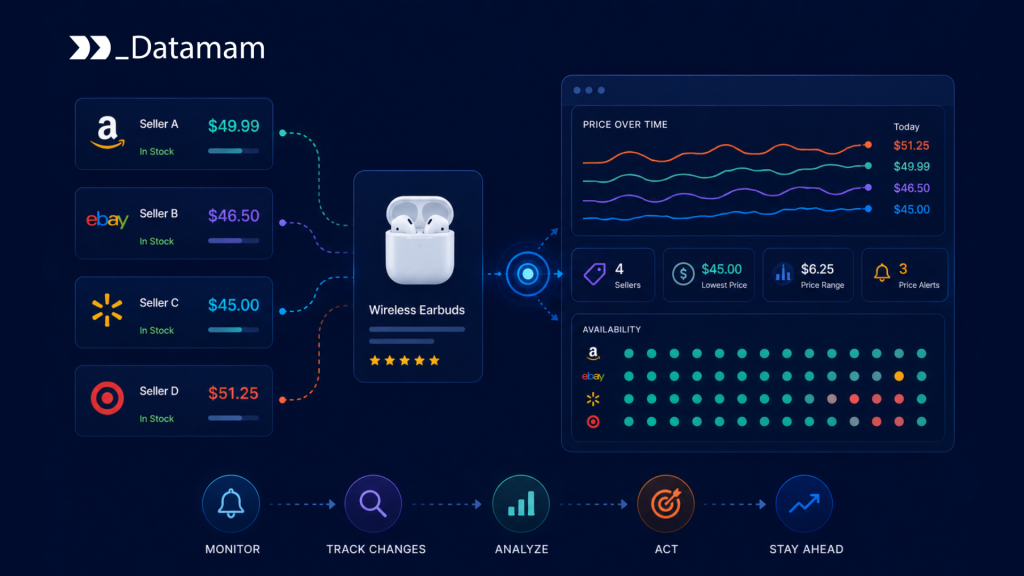
Marketplace pricing is rarely represented by one seller or one price.
The same branded product may appear through a marketplace operator, known retail partners, multiple third-party sellers, resellers, distributors, liquidation channels, cross-border sellers, and accounts using different fulfillment models. Each seller may present a different item price, shipping cost, delivery promise, promotion, condition, or stock status.
Marketplace Seller Monitoring gives brands visibility into that seller-level offer environment.
It does not only ask:
What is the marketplace price?
It asks:
Who is offering the product, under what commercial conditions, and how does that offer change over time?
That distinction matters because one product listing can contain several competing offers. A low observed price may come from a seller with limited inventory, a refurbished item, slower delivery, or additional shipping costs. Another seller may hold the featured offer despite having a higher item price because its overall conditions differ.
Reliable monitoring therefore has to preserve the structure behind the visible price.
Why Marketplace Seller Monitoring Matters
Marketplace listings combine several entities that traditional price monitoring often collapses into one record:
- the product;
- the seller;
- the offer;
- the point-in-time observation.
A brand may monitor a product page successfully while still missing the seller-level behavior that affects price perception, marketplace visibility, availability, and channel analysis.
Deloitte’s 2026 global retail industry outlook discusses an environment where retailers are using dynamic pricing, data-led promotions, targeted assortment changes, and other measures to protect profitability. For brands operating through marketplaces, reliable seller-level information provides additional context around how those market conditions are actually represented to customers. Retail competitor analysis methods are crucial for brands to understand their market position. By leveraging these techniques, companies can identify pricing strategies and promotional activities of their rivals. Additionally, thorough analysis can reveal trends that influence consumer preferences, ultimately guiding brands in making data-driven decisions.
Why Product-Level Monitoring Is Not Enough
Product-level monitoring may capture:
- a visible product price;
- availability;
- title;
- ratings;
- images;
- product content.
That is useful, but marketplace competition often happens at the offer level.
Several sellers may offer the same underlying product.
One may be featured.
Another may show a lower item price but higher shipping.
Another may offer a used or refurbished product.
Also, another may have limited stock or a slower delivery promise.
If monitoring stores only one visible product-level price, these differences disappear.
Teams can no longer tell: Competitor pricing analysis in retail reveals the nuances of how pricing strategies can influence customer choices. Understanding these variations enables teams to devise more effective pricing tactics. By continually monitoring competitor pricing, businesses can ensure they remain competitive in a rapidly changing marketplace.
- which seller generated the observed price;
- whether the seller was first-party or third-party;
- whether the item was new or refurbished;
- whether shipping changed the effective comparison;
- whether the offer was actually available;
- whether the same seller repeated the behavior over time.
Marketplace seller analytics should therefore preserve offer-level observations instead of collapsing them into a single product price.
Product, Seller, Offer, and Observation Are Different Entities
A useful marketplace data model separates four layers.
Product
The product represents the item being sold.
Relevant fields may include:
- internal product ID;
- GTIN, UPC, or another product identifier;
- brand;
- model;
- size;
- color;
- pack count;
- variant;
- product-match ID.
Seller
The seller represents the marketplace account or merchant offering the product.
Relevant fields may include:
- raw seller name;
- marketplace seller ID;
- normalized seller display name;
- storefront URL;
- marketplace;
- seller rating;
- seller classification;
- classification confidence or review status.
Stable marketplace seller IDs should be preferred where available.
A similar seller name should not automatically be treated as proof that two accounts belong to the same legal entity.
Offer
The offer represents the commercial terms under which that seller is presenting the product.
It may include:
- item price;
- shipping charge;
- buyer-visible fees;
- promotion;
- condition;
- fulfillment method;
- delivery promise;
- availability;
- featured-offer status.
Observation
The observation records what that offer looked like at a specific time.
It adds fields such as:
- observed timestamp;
- source URL;
- capture status;
- evidence reference.
This distinction is important because an offer is not static.
The same seller can change price, stock, delivery, condition, or promotion repeatedly.
A useful historical model therefore looks less like:
product → seller → price
and more like:
product → seller → offer → timestamped observation
That structure supports seller histories rather than isolated snapshots.
Seller Price Monitoring Requires Offer Normalization
Marketplace offers are not always directly comparable.
The lowest item price may not represent the lowest commercially relevant offer.
A seller may:
- charge shipping;
- offer a coupon;
- require membership;
- sell a refurbished item;
- offer slower delivery;
- bundle accessories;
- show limited stock.
Seller price monitoring should therefore preserve individual price components.
Separate Item Price From Other Charges
A useful observation can distinguish:
- item price;
- shipping;
- buyer-visible delivery or handling fees;
- displayed discount;
- coupon;
- membership price;
- total observed price where the page exposes one.
Taxes may depend on buyer location and jurisdiction and should not be assumed unless the marketplace exposes them consistently for the relevant comparison.
A simple validation pattern might look like this:
SELLER_OFFER_RULES = {

    "required_fields": [

        "seller_name",

        "item_price",

        "availability",

        "condition",

    ],

    "blocked_statuses": [

        "seller_unknown",

        "price_missing",

        "product_unmatched",

    ],

}


def validate_seller_offer(offer):

    missing = [

        field

        for field in SELLER_OFFER_RULES["required_fields"]

        if not offer.get(field)

    ]


    if missing:

        return {

            "valid": False,

            "reason": "missing_offer_fields",

            "fields": missing,

        }


    if offer.get("status") in SELLER_OFFER_RULES["blocked_statuses"]:

        return {

            "valid": False,

            "reason": "blocked_offer_status",

        }


    item_price = offer.get("item_price", 0)

    shipping_price = offer.get("shipping_price", 0)


    return {

        "valid": True,

        "item_plus_shipping_price": item_price + shipping_price,

        "seller_name": offer.get("seller_name"),

        "availability": offer.get("availability"),

        "condition": offer.get("condition"),

    }
This is illustrative rather than production software.
The important point is that item_price + shipping_price should not automatically be presented as the final buyer cost. Coupons, buyer-specific taxes, membership conditions, marketplace-specific charges, and other components may require separate treatment.
Condition Changes the Meaning of Price
A low marketplace price is not necessarily comparable with a standard new-product offer.
Condition categories may include:
- new;
- used;
- refurbished;
- renewed;
- open-box;
- damaged-box;
- incomplete;
- imported or market-specific configuration.
A new product and a refurbished product may share the same model identifier while representing materially different commercial offers.
Condition should therefore travel with the price observation.
This is particularly important in:
- electronics;
- appliances;
- tools;
- furniture;
- premium consumer goods.
Track Marketplace-Specific Featured Offers
Some marketplaces designate or visually prioritize one seller offer using concepts such as a featured offer, default purchasing option, or marketplace-specific equivalent.
Monitoring should preserve whether an offer held that position where the marketplace exposes it.
Useful fields may include:
- is_featured_offer;
- featured seller ID;
- position observed at;
- prior featured seller;
- duration or frequency of observed featured status.
A low-priced seller may matter differently if it appears deep in a secondary offer list rather than as the default purchasing option.
Seller position is therefore part of the commercial context.
Third-Party Seller Tracking Begins With Identity
Third-party seller tracking is useful only when the system can distinguish one seller from another over time.
Seller names alone are often insufficient.
Names may:
- change;
- differ by marketplace;
- use abbreviations;
- resemble other seller names;
- differ from the seller’s legal entity.
Where available, monitoring should preserve:
- marketplace seller ID;
- raw seller name;
- normalized display name;
- storefront URL;
- seller location where exposed;
- fulfillment method;
- first-seen date;
- most-recent-seen date;
- internal seller classification.
Use Observable Seller Classifications
Marketplace presence alone does not establish whether a seller is contractually authorized, unauthorized, part of a gray-market channel, or otherwise violating a commercial policy.
Those classifications require additional business evidence.
A monitoring system can instead classify sellers operationally as:
- known approved seller;
- known seller under review;
- newly observed seller;
- unknown seller;
- previously observed seller;
- seller requiring channel review.
A brand may later determine that a seller is authorized in one territory but not another, or that an unfamiliar marketplace account belongs to a known distributor.
The monitoring system should support that business review rather than treating every unfamiliar seller as a violation.
Track Seller Identity Confidence
Where seller identity resolution is not based on a stable platform ID, teams may also want to preserve confidence in the normalization.
For example:
| Raw Seller Name | Platform Seller ID | Normalized Seller | Identity Status |
| ABC-Electronics | 4839201 | ABC Electronics | Confirmed |
| ABC Outlet | 5820014 | Unknown | Review |
| A.B.C. Retail | None | Possible ABC Electronics | Low confidence |
This helps prevent similar names from being merged without evidence.
Seller Behavior Matters More Than a Single Snapshot
A single observation can reveal an offer.
Repeated observations reveal behavior.
Marketplace seller analytics can track:
- price history;
- availability history;
- fulfillment changes;
- featured-offer frequency;
- product coverage;
- seller entry and exit;
- condition changes;
- promotion history;
- shipping changes.
Over time, teams can distinguish persistent patterns from short-lived events.
For example, a seller may:
- briefly reduce price during a promotion;
- repeatedly appear below a defined monitoring threshold;
- go in and out of stock;
- expand from one product into an entire category;
- appear only during periods of excess marketplace inventory.
Those are different patterns and should not be interpreted from one observation alone.
Seller Price History
A structured observation can look like this:
def build_seller_offer_observation(product, offer):

    return {

        "product_match_id": product.get("match_id"),

        "brand": product.get("brand"),

        "seller_id": offer.get("seller_id"),

        "seller_name": offer.get("seller_name"),

        "marketplace": offer.get("marketplace"),

        "item_price": offer.get("item_price"),

        "shipping_price": offer.get("shipping_price", 0),

        "item_plus_shipping_price":

            offer.get("item_price", 0)

            + offer.get("shipping_price", 0),

        "availability": offer.get("availability"),

        "condition": offer.get("condition"),

        "fulfillment_method": offer.get("fulfillment_method"),

        "is_featured_offer": offer.get("is_featured_offer"),

        "observed_at": offer.get("observed_at"),

    }
Each record represents one point-in-time observation.
Repeated records can then support:
- seller-specific price history;
- offer volatility;
- featured-offer history;
- availability transitions;
- seller entry and exit;
- cross-product seller analysis.
Marketplace Seller Analytics for Brand Teams
The purpose of marketplace seller analytics is not simply to generate more seller records.
It should help commercial teams answer specific questions.
Examples include:
- Which sellers are currently active?
- Which sellers are newly observed?
- Which sellers appear across the largest number of products?
- Which offers fall below a defined monitoring threshold?
- Which sellers frequently change price?
- Which sellers repeatedly become unavailable?
- Which sellers gain featured-offer visibility?
- Where is seller competition expanding?
Different teams may use those answers differently.
Pricing teams may focus on offer dispersion.
Channel teams may investigate newly observed sellers.
Marketplace teams may track featured-offer position and stock.
Legal or policy-review teams may review seller evidence where a defined contractual or advertised-price policy is relevant.
The monitoring layer should provide evidence rather than automatically determine the legal or contractual meaning of an observation.
Seller Coverage and Product Coverage
Seller coverage shows how many active seller accounts offer a particular product or category.
Product coverage shows how many products are associated with a seller.
Together, those measures can reveal changes in marketplace distribution.
For example:
- a product may gain several newly observed sellers;
- one seller may rapidly expand across a brand’s catalog;
- seller activity may appear suddenly in a new market;
- seller coverage may contract as inventory disappears.
These signals can support channel investigation, but they do not by themselves establish how inventory reached a seller.
Unexpected distribution patterns should therefore be treated as evidence to investigate, not automatic proof of inventory leakage or another channel violation.
Price Variance and Offer Spread
Offer spread measures the difference between seller offers for the same matched product.
A wide spread can result from:
- seller pricing differences;
- shipping costs;
- different conditions;
- stock constraints;
- fulfillment differences;
- promotions;
- stale listings.
That means price variance should not be interpreted in isolation.
A $20 spread between a new first-party offer and a refurbished third-party offer has a different meaning from a $20 spread between two equivalent new offers with comparable delivery terms.
Seller classification and offer normalization should therefore be carried into marketplace price analytics.
Availability and Stock Signals
Availability is another essential part of seller-level analysis.
Useful states may include:
- in stock;
- out of stock;
- limited stock;
- preorder;
- backorder;
- temporarily unavailable;
- unknown.
A low price from an unavailable seller should not influence pricing analysis in the same way as a low price from an actively fulfillable offer.
Repeated availability observations can also reveal whether a seller is:
- consistently active;
- intermittently active;
- showing stale listings;
- returning inventory periodically.
Deloitte’s 2026 global retail outlook highlights the importance of pricing, assortment, value, and operating discipline in the current retail environment. Seller-level price and availability history can provide additional marketplace context around those commercial conditions.
Alerting Should Reflect Business Context
Not every seller observation deserves an alert.
A monitoring system that flags every price change or new seller quickly becomes noisy.
Alert logic should consider:
- seller classification;
- product importance;
- price deviation;
- offer condition;
- availability;
- featured-offer position;
- persistence over time;
- marketplace;
- region.
For example, one temporary price change from a secondary seller may not require action.
A recurring large deviation from a known seller on a strategic product may deserve review.
A newly observed seller gaining featured-offer position across several products may also warrant investigation.
Thresholds should be defined as monitoring rules, not automatic declarations of a policy or legal violation.
Preserve Evidence for Important Observations
Seller monitoring becomes more useful when observations are traceable.
A useful evidence record can preserve:
- marketplace;
- source URL;
- product identifier;
- matched product ID;
- seller name;
- seller ID;
- item price;
- shipping;
- buyer-visible fees;
- promotion;
- condition;
- availability;
- fulfillment;
- featured-offer status;
- timestamp;
- capture status.
For cases requiring further review, teams may also retain page or screenshot evidence where appropriate and permitted.
Evidence helps teams distinguish genuine seller behavior from:
- parsing errors;
- page changes;
- temporary interface states;
- stale listings;
- incorrect product matches.
Governance and Ownership
Marketplace Seller Monitoring can feed pricing, channel, marketplace, BI, legal, or policy-review workflows.
That makes ownership important.
Useful responsibilities may include:
| Responsibility | Example Owner |
| Product matching | Data or marketplace intelligence team |
| Seller reference data | Channel or marketplace team |
| Offer normalization | Data engineering / intelligence team |
| Seller classification review | Channel or commercial owner |
| Legal or policy interpretation | Appropriate internal legal/policy team |
| Alert thresholds | Business owner |
| Monitoring pipeline | Data operations team |
OECD’s broader work on data governance discusses trust, responsible data use, and clear responsibilities across the data lifecycle. While it does not address marketplace seller monitoring specifically, preserving provenance, ownership, and evidence applies those general governance principles to seller intelligence used in enterprise decision-making.
Connecting Seller Monitoring to Internal Systems
Seller observations create more value when they reach the systems where teams already work.
Possible outputs include:
- pricing dashboards;
- marketplace dashboards;
- seller-review queues;
- BI tables;
- channel-management workflows;
- evidence packages;
- alerts;
- internal APIs;
- analytical models.
Downstream records should preserve enough context to prevent misuse.
A pricing system should not receive only:
price = 72.99
It may also need:
- seller ID;
- seller classification;
- product-match confidence;
- condition;
- availability;
- shipping;
- fulfillment;
- observation timestamp.
That context determines whether the price is relevant to the decision.
How to Evaluate a Marketplace Seller Monitoring Workflow
Teams reviewing marketplace seller monitoring software or internal processes should ask:
- Are products matched before seller offers are compared?
- Are product, seller, offer, and observation stored separately?
- How are newly observed sellers classified?
- Are stable marketplace seller IDs captured where available?
- How are newly observed sellers classified?
- How is seller identity normalization reviewed?
- Are item price and shipping stored separately?
- Are condition and fulfillment preserved?
- Is featured-offer status captured where relevant?
- Are seller histories timestamped?
- Can monitoring distinguish temporary changes from persistent patterns?
- Are alert thresholds based on business context?
- Is source evidence retained for important observations?
- Can downstream teams see the context behind each seller alert?
- Are legal or contractual classifications kept separate from raw marketplace observations?
These questions reveal whether the monitoring system is simply collecting seller pages or maintaining decision-ready seller intelligence.
Conclusion
Marketplace pricing is not one price.
It is a changing set of seller offers attached to the same underlying product.
Reliable Marketplace Seller Monitoring therefore has to preserve four things separately:
the product, the seller, the offer, and the timestamped observation.
That structure allows teams to distinguish a genuinely relevant marketplace change from a misleading low price, unavailable offer, different condition, unfamiliar seller, or temporary promotion.
When seller identity, offer conditions, evidence, and history are modeled correctly, brands gain a clearer view of how their products are actually being offered across marketplaces.
For teams reviewing an existing seller-monitoring workflow, useful starting points include product matching, seller identity coverage, offer normalization, observation history, evidence capture, alert logic, and how seller context is carried into downstream commercial decisions. Beauty brand product monitoring techniques are essential for maintaining a competitive edge in the ever-evolving marketplace. Implementing these strategies enables brands to track their product performance and address any discrepancies swiftly. By focusing on these monitoring methods, teams can ensure that their brand integrity remains intact while maximizing sales opportunities.