Key Takeaways
• Data Quality Rules define the validation logic, business expectations, thresholds, and control checks used to determine whether enterprise data is fit for use.
• Data quality business rules should connect technical validation with domain meaning, ownership, severity, and downstream impact.
• Data validation rules must scale across pipelines, warehouses, CRM systems, analytics platforms, AI workflows, and operational reporting environments.
• A data quality rule engine helps standardize rule execution, classification, routing, and audit evidence across distributed data systems.
• Strong rule design requires governance, metadata, observability, exception handling, and remediation workflows, not only field-level checks.
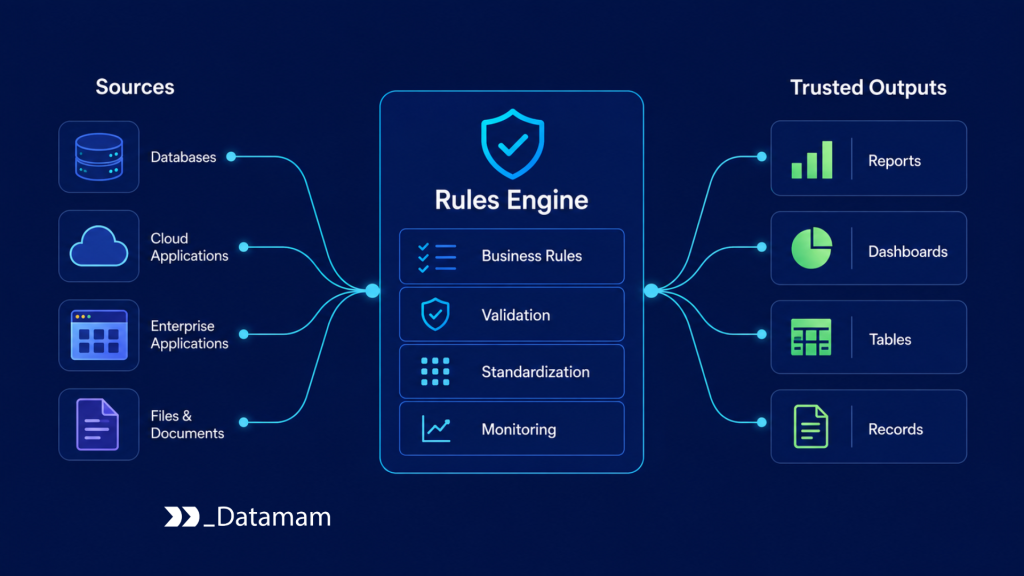
Enterprise data quality often breaks because teams create rules locally, inconsistently, and too late. One team validates customer records inside a CRM workflow. Another checks product data in a warehouse transformation. A finance team reconciles values manually after reporting. A machine learning team creates separate feature checks inside model pipelines. Each rule may be useful, but the enterprise still lacks a scalable control model.
Data Quality Rules create that model. They define how records, fields, relationships, reference values, freshness, duplication, and business logic should be evaluated before data is trusted by downstream systems.
In enterprise environments, quality rules are not just technical filters. They are operational controls that protect analytics, AI systems, finance reports, customer platforms, product workflows, and compliance processes from unreliable data.
Why Data Quality Rules Matter at Enterprise Scale
Data Quality Rules matter because data quality problems rarely stay inside one system. A missing customer identifier may affect CRM segmentation, billing reconciliation, customer support routing, and executive reporting. An invalid product category may affect ecommerce publication, inventory reporting, pricing analysis, and AI recommendations.
Deloitte’s data credibility and governance guidance emphasizes that C-suite leaders can improve data stewardship by establishing clear governance structures, roles, ownership, escalation paths, and accountability for data quality and risk. Data Quality Rules are the technical expression of that accountability inside production systems. Data accuracy measures for enterprises are essential for maintaining trusted datasets across various departments. Implementing these measures can help prevent costly errors and improve operational efficiency. By prioritizing data accuracy, organizations can enhance decision-making and drive better business outcomes.
Why Local Rules Do Not Scale
Local rules usually emerge inside individual workflows. A dashboard team checks for null values. A data engineer blocks duplicate IDs. A business analyst flags suspicious totals. These controls solve immediate problems, but they often use different definitions, thresholds, and severity levels.
At scale, this creates rule fragmentation. The same field may have different validation logic across systems. Another may accept a value rejected by one pipeline. A defect classified as critical in finance may be treated as low priority in analytics.
Enterprise data quality requires rules that can be reused, versioned, governed, and monitored across systems. Without that structure, rule logic becomes hidden inside scripts, dashboards, tickets, and tribal knowledge.
How Weak Rules Create Silent Failure
Weak data validation rules create silent failure when data passes technical checks but still violates business meaning. A customer record may contain an email address, but the address may be duplicated across accounts. A product record may include a SKU, but the SKU may not match the approved category hierarchy. A finance record may contain a cost center, but the cost center may be inactive for the reporting period.
Gartner’s 2025 data and analytics trends highlight that governance and AI-ready data are becoming central as data and analytics become more embedded in enterprise operations. In that environment, weak quality rules can affect automated decisions, analytics confidence, and compliance exposure.
Designing Data Quality Business Rules
Data quality business rules translate enterprise expectations into testable logic. They define what must be true for data to be considered fit for a specific business use.
A strong rule is not only “field cannot be null.” It includes domain context, owner, severity, exception handling, and downstream impact.
Connecting Rules to Business Meaning
Business meaning should come before technical implementation. A field may be required only for certain record types, regions, channels, or lifecycle states. A product attribute may be mandatory for marketplace publication but optional for internal catalog analysis. A customer consent field may be critical for marketing activation but not for internal billing.
Data quality business rules should therefore answer several questions: what business process depends on this rule, which records are in scope, what condition must pass, who owns the rule, and what happens if it fails.
This prevents rule design from becoming generic validation. It makes the rule operationally relevant.
Defining Severity and Tolerance
Not every data quality failure has the same impact. A missing optional description may create low risk. A missing customer ID may block multiple systems. An invalid ledger account may affect financial reporting. A stale AI feature input may affect automated model output.
Rules should include severity levels such as warning, degraded, blocked, or critical. They should also include tolerance where appropriate. Finance reconciliation may allow small rounding differences. Duplicate customer records may have zero tolerance in some systems. Event-volume anomalies may require thresholds based on historical patterns.
Severity allows teams to prioritize remediation instead of treating every issue as equal.
Making Rules Executable
A scalable rule should be clear enough to execute automatically. The logic should be understandable to both engineering and business stakeholders.
DATA_QUALITY_RULES = {

    "customer": {

        "required_fields": ["customer_id", "email", "country"],

        "blocked_statuses": ["duplicate", "unverified"],

    },

    "product": {

        "required_fields": ["sku", "category", "publication_status"],

        "blocked_statuses": ["missing_category", "inactive_sku"],

    },

}


def validate_data_quality_record(record):

    rules = DATA_QUALITY_RULES.get(record.get("entity_type"))


    if not rules:

        return {"valid": False, "reason": "unknown_entity_type"}


    missing = [field for field in rules["required_fields"] if not record.get(field)]


    if missing:

        return {"valid": False, "reason": "missing_required_fields", "fields": missing}


    if record.get("quality_status") in rules["blocked_statuses"]:

        return {"valid": False, "reason": "blocked_quality_status"}


    return {"valid": True}
This pattern keeps rule logic simple: define requirements by entity type, check required fields, block unsafe statuses, and return a clear result for downstream routing.
Data Validation Rules Across Enterprise Systems
Data validation rules must operate across many system types. CRM platforms, ERP systems, data warehouses, cloud lakes, BI tools, machine learning pipelines, and operational applications all need quality controls, but they do not all validate data in the same way.
The rule architecture should create consistency without ignoring local system requirements.
Validating Structure, Completeness, and Format
Structural validation checks whether expected fields, data types, schemas, and formats are present. Completeness validation checks whether required values exist. Format validation checks whether values match accepted patterns, such as country codes, currency codes, dates, phone formats, IDs, or classification codes.
These rules are foundational because downstream systems often assume that data structure is stable. A schema change in an upstream pipeline can break transformation jobs, dashboards, AI feature tables, or reporting models.
However, structure is only the first layer. A complete record can still be wrong if the values violate domain logic.
Validating Relationships and Reference Data
Relationship rules verify that records connect correctly. A contact should connect to a customer account. A transaction should connect to a ledger account. A product variant should connect to a parent SKU. A support ticket should connect to a customer, queue, or agent.
Reference data rules verify that codes, labels, categories, and allowed values are valid. These rules are critical because reference data often appears small but affects many systems. Invalid region codes, product categories, status values, or cost centers can create widespread reporting errors.
The OECD’s data governance work describes governance as a framework for enabling data availability and use while addressing trust, control, protection, and stakeholder interests. Reference and relationship rules help make that governance practical inside enterprise systems.
Validating Freshness and Timeliness
Freshness rules check whether data is current enough for its intended use. A daily executive dashboard may tolerate different timing than a fraud monitoring workflow or inventory feed. A machine learning feature pipeline may need freshness thresholds tied to scoring windows.
Timeliness should be rule-based rather than assumed from job completion. A pipeline may run successfully but process yesterday’s data because the source feed was late. A dashboard may refresh while using stale partitions.
Data validation rules should therefore include freshness expectations for each high-impact data product or pipeline.
Building a Data Quality Rule Engine
A data quality rule engine standardizes how rules are defined, executed, classified, monitored, and escalated. It helps enterprises avoid fragmented validation logic across scripts and teams.
The rule engine does not have to be one product. It can be an architecture pattern supported by tools such as Great Expectations, dbt tests, warehouse checks, orchestration systems, catalogs, metadata repositories, and observability platforms.
Standardizing Rule Definitions
A rule engine should define standard fields for each rule. These may include rule ID, data domain, asset name, owner, description, validation logic, severity, threshold, schedule, remediation owner, exception policy, and downstream impact.
Standard definitions make rules easier to compare and manage. They also support governance review because each rule has ownership and purpose.
Without standard rule definitions, quality checks become difficult to audit. Teams may know a test failed, but not why the test exists, who owns it, or whether it should block downstream use.
Executing Rules in the Pipeline Lifecycle
Rules should execute at the right point in the data lifecycle. Some checks should run during ingestion. Others should run after transformation. Some should run before publishing. Some should monitor production datasets continuously.
For example, schema checks should run early. Business-rule checks may run after transformation. Reconciliation checks may run before reporting. Freshness checks may run continuously. AI feature checks may run before model scoring or training.
This staged execution prevents invalid data from moving too far downstream before detection.
Routing Rule Failures
Rule failures should route to the correct owner. A schema failure may require data engineering. A source completeness failure may require the source system owners. A business-rule failure may require a domain owner. A reference data failure may require a governance or master data team.
QUALITY_FAILURE_ROUTING = {

    "schema_failed": {"owner": "data_engineering", "action": "review_schema_change"},

    "missing_required_field": {"owner": "data_steward", "action": "resolve_source_gap"},

    "reference_value_invalid": {"owner": "reference_data_owner", "action": "update_or_correct_code"},

    "business_rule_failed": {"owner": "domain_owner", "action": "review_business_logic"},

}


def route_quality_rule_failure(failure):

    route = QUALITY_FAILURE_ROUTING.get(failure.get("failure_type"))


    if not route:

        return {"owner": "data_operations", "action": "manual_review"}


    return {

        "rule_id": failure.get("rule_id"),

        "asset": failure.get("asset"),

        "owner": route["owner"],

        "action": route["action"],

    }
This turns rule failure into operational workflow. Detection is useful only when the organization knows who should respond.
Scaling Rules Across Pipelines and Platforms
Data Quality Rules scale when they are reusable, metadata-driven, and integrated into platform operations. They should not depend on individual engineers remembering to copy checks into each new pipeline.
Rule scaling requires architecture.
Using Metadata to Apply Rules
Metadata can determine which rules apply to which assets. For example, assets classified as customer data may require identity checks. Assets classified as financial data may require reconciliation checks. Production datasets may require owner, freshness, lineage, and validation evidence. Restricted datasets may require access and policy checks.
Metadata-driven rule execution reduces manual rule assignment. It also improves governance because the platform can enforce controls based on classification, domain, and lifecycle status.
This approach connects data quality with metadata engineering, cataloging, and platform governance.
Managing Rule Versions
Rules change over time. A required field may become optional. A threshold may tighten. A business definition may change. A new data consumer may require stronger validation. A regulatory or contractual requirement may introduce new checks.
Rule versions should be tracked. Teams should know which rule version ran against which dataset and when the change was approved. This matters for auditability and incident investigation.
Without versioning, teams may struggle to explain why a record passed last month but failed today.
Preventing Rule Sprawl
Too many ungoverned rules can create noise. Duplicate rules may check the same condition differently. Low-value rules may generate alerts that teams ignore. Old rules may continue running after business logic changes.
Rule governance should include review cycles. Teams should retire unused rules, consolidate duplicates, adjust thresholds, and confirm ownership.
At scale, quality improves when rules are curated as enterprise controls, not accumulated as unmanaged tests.
Governance and Auditability for Data Quality Rules
Governance defines who owns rules, who approves changes, how exceptions are handled, and how rule results affect downstream use. Auditability preserves evidence of rule execution, failures, remediation, and approvals.
NIST’s data governance glossary defines data governance as authority, control, and shared decision-making over data assets. Data Quality Rules operationalize that authority by defining what data must satisfy before it is trusted.
Assigning Rule Ownership
Every production rule should have an owner. Ownership may sit with a data steward, data product owner, platform owner, business domain owner, or governance team.
The owner should approve rule logic, severity, thresholds, exceptions, and remediation paths. Technical teams may implement the rule, but business ownership is often required to define whether the rule reflects real operating expectations.
Ownership prevents rules from becoming orphaned checks with unclear business value.
Managing Exceptions
Exceptions are expected. Some failures may be accepted temporarily because the source system is being remediated. Some records may be valid outliers. Also, some downstream processes may not require the same quality threshold.
Exception management should be controlled. Exceptions should include reason, owner, expiration date, affected asset, rule ID, and risk acceptance. Permanent exceptions should be rare and reviewed.
Without exception governance, teams may bypass rules informally and weaken the control model.
Preserving Rule Evidence
Rule evidence should include run history, pass/fail status, affected records, severity, owner, remediation status, approved exceptions, and downstream publication decisions.
This evidence matters when data supports finance, healthcare, regulatory reporting, AI workflows, executive dashboards, customer operations, or product publishing. Teams should be able to show which rules ran, what failed, who responded, and whether the data was approved for use.
Technology and Operating Considerations
Data Quality Rules depend on both technology and operating discipline. Tooling can automate checks, but governance determines whether those checks produce reliable outcomes.
A rule architecture should connect pipelines, warehouses, catalogs, observability, remediation workflows, and ownership models. Data quality strategies for enterprise systems must prioritize consistency and accuracy at every level. Establishing effective governance frameworks can help ensure that data is not only collected but also maintained to the highest standards. Regular audits and updates to these strategies can prevent data decay and enhance overall decision-making processes. Data integrity for executive reporting is essential in drawing accurate conclusions from analyzed information. Ensuring that the data is not only complete but also reliable empowers leadership to make informed strategic decisions. This focus on data integrity ultimately drives accountability and transparency within the organization.
Integrating With Pipelines and Warehouses
Rules should run inside or alongside pipelines built with systems such as Airflow, Dagster, Prefect, Spark, dbt, Kafka, Snowflake, BigQuery, Databricks, and warehouse-native scheduling.
The important design choice is that rule outcomes should influence pipeline behavior. A failed critical rule should block publication. A warning should notify the owner. A repeated defect should create remediation work.
Rules should not be passive reports that teams review after damage has already reached downstream systems.
Integrating With Observability
Data quality rule results should feed observability systems. Freshness failures, schema changes, duplicate rates, null thresholds, volume anomalies, and rule failures should appear in pipeline health monitoring.
This helps teams distinguish job success from data reliability. A pipeline can run successfully and still fail quality expectations.
When rule results are integrated with observability, quality becomes part of operational monitoring rather than a separate audit exercise.
Supporting AI and Analytics Readiness
AI and analytics systems need stable, explainable, and high-quality inputs. Gartner’s AI-ready data guidance emphasizes that organizations must scale and govern data with robust frameworks for quality, compliance, and ethical use as AI initiatives grow. Data Quality Rules are one mechanism for making that readiness measurable.
For AI workflows, rules may check feature completeness, freshness, distribution shifts, training-serving consistency, and source stability. For analytics, rules may check metric definitions, aggregation logic, and reporting completeness.
In both cases, rule design directly affects trust in downstream outputs.
Risk Containment Through Scalable Rule Design
Scalable Data Quality Rules reduce enterprise risk by detecting defects before they spread. They help teams block unsafe data, route issues, preserve evidence, and improve quality over time.
This is especially important in distributed platforms where many teams produce and consume data.
Preventing Defect Propagation
Defect propagation occurs when a source issue moves through pipelines into warehouses, dashboards, models, and operational systems. Once a defect spreads, remediation becomes harder because teams must identify every affected asset.
Quality rules reduce propagation by acting as control points. Critical failures can stop publishing. Warnings can notify consumers. Repeated failures can trigger remediation.
The earlier the rule runs, the easier the defect is to contain.
Improving Remediation Prioritization
Rules help prioritize remediation because they classify issue type, severity, affected records, and downstream impact. A critical finance rule failure should not sit in the same queue as a low-risk formatting issue.
This prioritization helps data teams allocate effort where business risk is highest.
Building Institutional Confidence
Reliable rule design creates confidence across engineering, governance, analytics, procurement, and executive stakeholders. It shows that data quality is not managed through informal cleanup, but through structured controls.
Ultimately, scalable rules make quality measurable. They turn abstract concerns about trust into visible pass/fail conditions, ownership, remediation, and audit evidence.
Conclusion: Turning Quality Rules Into Enterprise Controls
Data Quality Rules are one of the most important control layers in enterprise data platforms. They define what data must satisfy before it can be trusted by analytics, AI systems, reports, CRM workflows, warehouses, and operational processes.
Strong rule design connects data quality business rules, data validation rules, rule engines, metadata, observability, governance, ownership, exception handling, and remediation workflows. It prevents quality logic from becoming fragmented across scripts, dashboards, and manual reviews.
The capability matters because enterprise data quality cannot scale through one-off checks. As platforms grow, quality rules must become standardized, reusable, governed, and auditable.
A structured review can help evaluate whether current workflows have reliable Data Quality Rules, data quality business rules, data validation rules, and a data quality rule engine. You can run an external data infrastructure audit with our team to review your current setup and understand what is required to build reliable, enterprise-scale data quality infrastructure.