
Key Takeaways
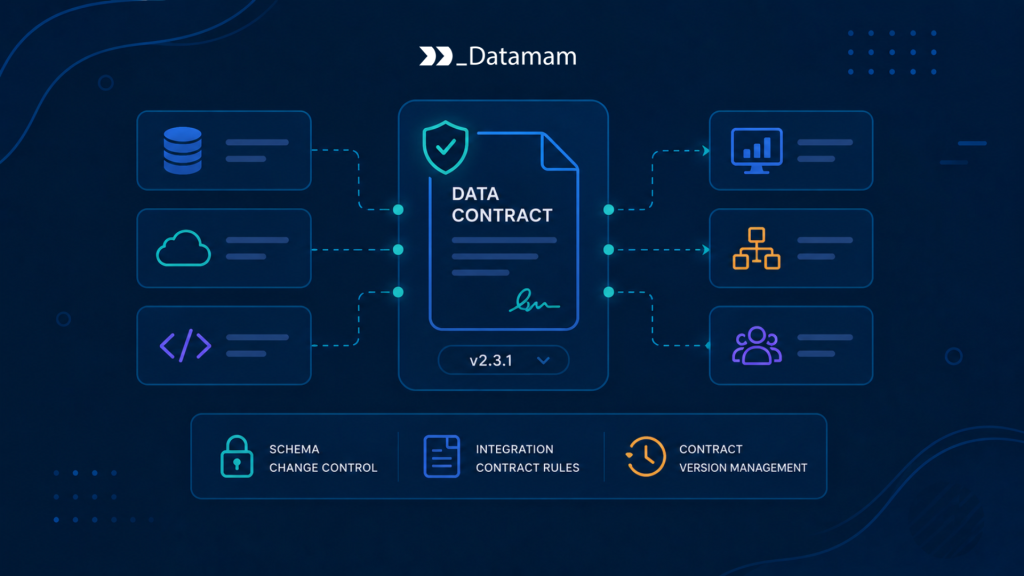
- Data Contract Management defines explicit expectations between data producers and data consumers before integrated systems depend on shared data.
- Schema change control prevents upstream field changes, data type changes, required-field changes, and deprecated fields from breaking downstream systems.
- Integration contract rules should cover required fields, data types, allowed values, nullability, freshness, ownership, quality thresholds, and delivery expectations.
- Contract version management allows APIs, event streams, files, tables, and data products to evolve without creating uncontrolled production failures.
- Reliable data contracts require validation, monitoring, ownership, approval workflows, audit trails, and consumer-impact review.
Enterprise integration programs often break when upstream systems change faster than downstream systems can adapt. A CRM team renames a field. An ERP system adds a required status. A product platform changes an event schema. A vendor feed introduces a new nested structure. The integration may continue running, but downstream dashboards, warehouse models, operational workflows, and AI pipelines may no longer receive data in the expected structure.
Data Contract Management creates a controlled agreement between data producers and consumers. It defines what data will be delivered, which schema is expected, which fields are required, how changes are handled, and what guarantees consumers can rely on.
In cross-system integration programs, data contracts are not only technical artifacts. They are operating controls that protect integration reliability, schema stability, downstream trust, and governance accountability.
Why Data Contract Management Matters in Integration Programs
Data Contract Management matters because enterprise systems are continuously changing. Product teams release new application features. ERP teams adjust operational processes. CRM teams modify lifecycle fields. Data teams refine warehouse models. AI teams add new feature requirements. Without explicit data contracts, every upstream change can become a downstream incident.
Gartner’s 2025 data and analytics predictions emphasize the growing role of AI-augmented and automated decisions in enterprise operations, which increases the importance of reliable data foundations before downstream systems act on data. Data integration strategies for customer insights are essential for ensuring that all teams have access to accurate and timely information. They facilitate a holistic view of customer behavior, enabling better decision-making across departments. As organizations continue to rely on data-driven approaches, implementing these strategies will be critical in maintaining a competitive edge.
Why Integrated Systems Need Explicit Data Expectations
Integrated systems need explicit expectations because producers and consumers often see data differently. A producing system may consider a field optional because its application can operate without it. A consuming system may consider that same field required because it drives reporting, fulfillment, risk scoring, or downstream routing.
A data contract makes these expectations explicit. It documents required fields, data types, allowed values, freshness, delivery frequency, ownership, quality thresholds, and change rules. This allows consumers to design against known expectations rather than reverse-engineering upstream behavior.
In practice, data contracts reduce informal dependency. Instead of relying on meetings, assumptions, or pipeline failures, teams rely on documented and enforceable integration rules.
How Weak Contracts Create Schema Breakage and Downstream Risk
Weak contracts create schema breakage because upstream teams can change data structures without understanding the downstream impact. A removed column can break a dbt model. A changed data type can fail a warehouse load. A new enum value can confuse reporting logic. A renamed API field can create nulls in operational workflows.
The risk is often silent. A pipeline may not fail immediately. It may load incomplete data, misclassify records, or produce inaccurate metrics. By the time the issue appears in BI, finance reporting, customer operations, or AI outputs, the root cause may be difficult to trace.
IBM’s 2025 data integration announcement highlights enterprise demand to simplify integration, reduce complexity, and deliver trusted data at scale. Data contracts support that objective by defining reliable expectations across producers, consumers, and integration layers.
Building Integration Contract Rules Across Systems
Integration contract rules define what producers must provide and what consumers can expect. These rules should be specific enough for automated validation and clear enough for business and technical owners to review.
A useful contract covers structure, meaning, delivery, quality, ownership, and change handling. It should not stop at the schema. A schema can tell systems what a field looks like, but a contract should also explain what the field means and how it should behave.
Defining Producers, Consumers, Required Fields, and Data Types
Every contract should identify the producer, consumer, data product or interface, owner, and purpose. A producer may be an application team, ERP module, CRM platform, Kafka topic owner, vendor feed manager, or data platform team. A consumer may be a warehouse model, BI dashboard, operational workflow, API, AI pipeline, or another application.
Required fields should be defined clearly. Each field should include name, data type, business meaning, required status, allowed null behavior, default logic, and validation expectation. If a field is required by a downstream process, the contract should state that explicitly.
Data types should also be governed. A numeric field should not become a string without review. A timestamp should not change timezone behavior silently. A boolean field should not become a multi-value status without migration planning.
Documenting Allowed Values, Nullability, Freshness, and Delivery Expectations
Contracts should define allowed values for categorical fields. Statuses, regions, order states, product types, customer segments, and risk levels should have accepted values and rules for new value introduction.
Nullability is equally important. A field that was historically populated may become null after an upstream change. If consumers expect the field to be complete, null behavior should be contractually defined and validated.
Freshness and delivery expectations should also be documented. A contract may require hourly delivery, daily refresh, event-level publishing, or near real-time availability. If data arrives late, consumers should know whether that is a contract violation, expected delay, or degraded operating mode.
Separating Technical Contract Rules from Business Data Definitions
Data contracts should include technical rules, but they should not replace business definitions. Technical rules define schema, type, delivery format, and compatibility. Business definitions explain what the data means.
For example, a contract can specify that “customer_status” is a required string with allowed values. However, the business definition must explain what “active,” “inactive,” “suspended,” or “prospect” means. Without that clarity, systems may comply technically while creating business inconsistency.
This separation matters because engineering teams can enforce structure, but business owners must approve meaning. A reliable contract management model keeps both layers connected.
Schema Change Control in Cross-System Integration
Schema change control governs how changes are proposed, reviewed, tested, approved, and deployed. It prevents producers from unintentionally breaking consumers and gives consumers time to adapt when changes are necessary.
At scale, schema changes are unavoidable. The goal is not to prevent change. The goal is to make change controlled, visible, and safe.
Identifying Breaking, Non-Breaking, and Deprecated Schema Changes
Schema changes should be classified by impact. Non-breaking changes may include adding an optional field or extending metadata without changing existing behavior. Breaking changes may include removing a field, changing a data type, renaming a field, changing nullability, altering event meaning, or changing allowed values without notice.
Deprecated changes sit between the two. A producer may plan to remove a field later, but consumers need time to migrate. Deprecation should include notice, replacement logic, migration guidance, and retirement dates.
Databricks’ 2026 guidance on schema evolution describes schema evolution as the ability to adapt to structural changes over time, including new columns, data type shifts, nested structure changes, and evolving third-party or streaming inputs. This reinforces why schema change classification is necessary before production systems absorb upstream changes.
Creating Approval Workflows Before Production Schema Updates
Schema changes should not move directly from producer development to production integration. They should pass through an approval workflow that checks consumer impact, validation rules, backward compatibility, governance requirements, and migration timing.
The approval workflow should include producer owners, consumer owners, data platform teams, governance stakeholders, and business owners where the change affects operational meaning. Critical contracts may also require security or compliance review if sensitive fields, access rules, or regulated data are affected.
Approval workflows reduce avoidable incidents. They also create accountability when a schema change affects downstream reporting, AI features, or operational systems.
Testing Schema Changes Against Downstream Consumers
Schema changes should be tested against downstream consumers before deployment. This means checking dbt models, warehouse loads, Kafka consumers, API clients, BI dashboards, AI feature pipelines, and operational workflows that depend on the contract.
Testing should confirm that consumers can parse the new schema, required fields remain available, allowed values remain valid, transformations still work, and downstream metrics remain consistent where expected.
Contract Version Management for Enterprise Data Flows
Contract version management allows integrations to evolve without breaking production operations. It defines how contracts are versioned, how consumers migrate, and how old versions are retired.
Version management is especially important in environments with APIs, Kafka topics, warehouse tables, files, vendor feeds, and data products that change at different speeds. Managing integration dependencies effectively is crucial for maintaining smooth operations. By prioritizing these dependencies, teams can ensure that updates and changes do not disrupt user experiences. This thoughtful approach to integration helps mitigate risks associated with rapid changes in technology and data management.
Maintaining Versioned Contracts Across APIs, Events, Tables, and Files
Data contracts should be versioned across all major integration interfaces. APIs may use endpoint or schema versions. Kafka topics may use schema registry versions. Files may include layout versions. Warehouse tables may maintain model versions or compatibility layers. Data products may publish contract versions for consumers.
Versioning helps teams understand which expectations were active at a specific time. It also supports historical debugging. If a downstream issue appears after a release, teams can compare contract versions and identify what changed.
Versioned contracts should include release date, owner, change summary, breaking-change status, consumer migration requirement, and retirement timeline.
Managing Backward Compatibility and Consumer Migration Windows
Backward compatibility allows producers to evolve contracts while protecting existing consumers. For example, adding optional fields may be backward compatible. Removing fields usually is not. Changing field meaning can be more dangerous than changing field structure because it may not trigger technical failures.
Consumer migration windows give teams time to adapt. A producer may publish version 2 while version 1 remains available for a defined period. Consumers can update their models, tests, and workflows before version 1 is retired.
Confluent’s current Schema Registry documentation explains that data contracts can include quality rules, metadata, and migration rules for schema evolution, helping teams validate constraints and migrate schemas safely. This is directly relevant to event-driven integration, where many consumers depend on stable schemas.
Retiring Old Contract Versions Without Breaking Operations
Old contract versions should not remain active indefinitely. Too many versions create complexity, cost, and governance overhead. However, retiring a version too early can break consumers.
Retirement should follow a controlled process. Teams should identify active consumers, confirm migration status, provide deprecation notices, monitor remaining usage, and schedule removal. Critical consumers should not be surprised by contract retirement.
A strong retirement process treats old versions as operational dependencies. They are removed only when downstream systems are ready or when a documented exception is approved.
Operational Controls for Data Contract Reliability
Data contracts become useful when they are enforced. A contract stored in documentation but not validated during execution cannot prevent schema drift or downstream failure.
Operational controls should validate contract compliance before data is published and monitor contract behavior after deployment.
Validating Contract Compliance Before Data Publication
Contract validation should occur as early as possible. Producers should validate schema, required fields, allowed values, nullability, and quality thresholds before publishing data. Integration layers should validate again before loading downstream systems.
Validation can be implemented in CI/CD pipelines, schema registries, orchestration workflows, ingestion jobs, dbt tests, Spark jobs, API gateways, and event-stream processing. The goal is to detect contract violations before they affect consumers.
Detecting Contract Violations, Schema Drift, and Consumer Impact
Contract monitoring should detect schema drift, missing fields, unexpected values, invalid nulls, freshness failures, and consumer errors. It should also connect violations to downstream impact.
A contract violation in a low-risk enrichment field may require review but not immediate shutdown. A violation in an order status event, customer identifier, financial field, or AI feature input may require immediate escalation.
Monitoring should include producer metrics, consumer failures, validation errors, contract version usage, and downstream incident signals. This gives teams a full view of contract health.
Handling Contract Exceptions Without Blocking Critical Operations
Not every contract exception should block operations. Some violations can be quarantined while valid records continue. Others require fallback rules, default values, delayed publication, or manual review. Critical violations may require stopping a flow until the issue is resolved.
Exception handling should be defined in the contract or supporting operating policy. Teams should know which violations are fatal, which are tolerable for a limited period, and which require business approval.
This prevents contract enforcement from becoming either too weak or too rigid. The objective is controlled reliability, not unnecessary operational blockage.
Technology and Integration Considerations
Data Contract Management depends on tooling that can store, enforce, test, monitor, and expose contract rules. Contracts should connect to the platforms where data moves, transforms, and gets consumed.
The technology layer should support both operational and analytical integration. Contracts may apply to event streams, APIs, file feeds, warehouse tables, dbt models, Spark pipelines, and data products. Data integration solutions for enterprises play a crucial role in harmonizing disparate data sources. They enable organizations to achieve a unified view of their operations, leading to enhanced decision-making capabilities. By leveraging these solutions, enterprises can streamline their processes and accelerate data-driven insights.
Using Schema Registries, dbt, Airflow, Kafka, and Data Catalogs for Contract Enforcement
Schema registries can manage schemas, compatibility rules, and versions for event-driven environments. Kafka can move contracted events between producers and consumers. dbt can document and test analytical contracts. Airflow can orchestrate validation gates, approvals, retries, and release sequencing. Spark can enforce contract checks in high-volume transformations. Data catalogs can expose contract metadata, ownership, and lineage.
Confluent’s Schema Registry documentation states that schema registry supports governance capabilities such as quality, standards adherence, lineage visibility, audit capabilities, collaboration, and application development protocols. These capabilities make schema registries relevant to contract enforcement in streaming and event-driven integration.
Connecting Data Contracts to Snowflake, BigQuery, Databricks, BI, APIs, and Lineage Systems
Contracts should remain visible where data is consumed. Snowflake, BigQuery, and Databricks should preserve contract metadata where possible. BI dashboards should expose approved definitions and freshness expectations. APIs should publish contract versions and compatibility rules. Lineage systems should show which assets depend on which contract versions.
This visibility matters during incidents. If a contract changes, teams need to know which dashboards, models, operational workflows, and AI systems are affected. If a violation occurs, lineage should help identify consumers before business users discover the problem.
Databricks’ 2026 documentation on Auto Loader schema inference and evolution describes automated schema detection and evolution for loaded data, which is useful in flexible ingestion environments but still requires contract controls when downstream consumers depend on predictable schemas.
Governance and Auditability in Data Contract Management
Governance defines who owns contracts, who approves changes, how consumers are notified, and how violations are handled. Without governance, contract rules can become outdated or unenforced.
Auditability matters because data contracts affect operational reliability. Teams need evidence of what changed, who approved it, when it changed, and which consumers were affected.
Creating Ownership, Review Cycles, and Escalation Paths
Every contract should have a producer owner and a consumer owner. The producer owner is responsible for data delivery and schema stability. The consumer owner is responsible for validating downstream dependency and migration readiness. Data platform teams may own contract infrastructure. Governance teams may own policy alignment.
Review cycles should occur when schemas change, consumers are added, systems migrate, data products change, or incidents occur. Critical contracts should be reviewed more frequently than low-risk contracts.
Escalation paths should define who responds to contract violations, breaking changes, failed migrations, and consumer-impact incidents. This prevents contract failures from becoming cross-team confusion.
Maintaining Audit Trails for Contract Changes, Approvals, and Violations
Audit trails should capture contract creation, version changes, approval records, schema diffs, compatibility checks, consumer notifications, validation failures, exceptions, and remediation actions.
Audit trails support incident response and regulatory review. If a dashboard or operational workflow produces incorrect results, teams should be able to identify whether a contract changed, whether validation passed, and who approved the release.
The OECD.AI 2025 Data Governance Working Group Report highlights the technical, legal, and institutional dimensions of data governance. Data Contract Management reflects the same pattern because contract rules require technical enforcement, business accountability, and institutional review.
Conclusion: Turning Data Contracts into Controlled Integration Infrastructure
Data Contract Management helps enterprises control how data producers and consumers interact across integrated systems. It defines expected schemas, required fields, allowed values, freshness rules, delivery expectations, ownership, change procedures, and version management.
Strong schema change control prevents upstream releases from breaking downstream systems. Integration contract rules clarify what consumers can rely on. Contract version management allows APIs, events, files, tables, and data products to evolve without creating uncontrolled production risk. Operational controls validate contract compliance, detect violations, monitor drift, and support controlled exceptions.
The capability matters because enterprise integration reliability depends on stable expectations between systems. ERP, CRM, warehouse, BI, product, supplier, order, and AI workflows can only operate reliably when producers and consumers share enforceable data contracts.
A structured review can help evaluate whether current integration workflows have reliable Data Contract Management, schema change control, integration contract rules, contract version management, and audit-ready contract governance. You can run an external data infrastructure audit with our team to review your current setup and understand what is required to build a reliable, enterprise-scale integration infrastructure.