
Key Takeaways
- Integration Dependency Management helps enterprises understand which systems, pipelines, APIs, tables, events, and workflows depend on each other.
- Dependency mapping systems make upstream and downstream relationships visible before failures cascade across the data environment.
- Integration dependency tracking helps teams monitor system changes, ownership, sync timing, schema expectations, and downstream impact.
- Dependency risk analysis identifies fragile flows, single points of failure, overloaded systems, hidden consumers, and critical business dependencies.
- Reliable dependency management requires lineage, observability, ownership records, review cycles, audit trails, and escalation paths.
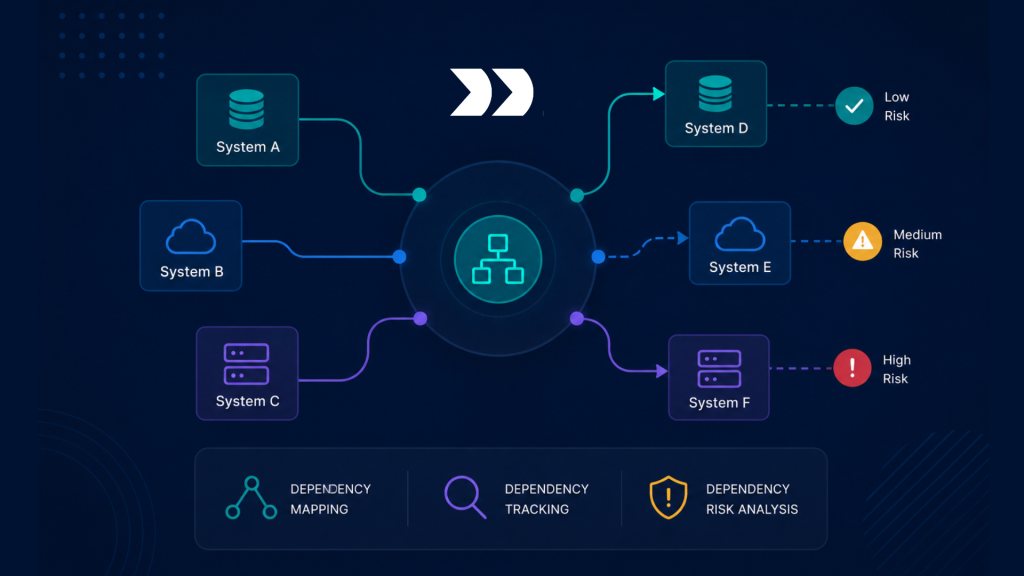
Enterprise data environments rarely fail in isolation. A delayed ERP export may affect a warehouse model. A CRM schema change may break a downstream customer view. A supplier feed outage may delay procurement reporting. A product master update may block order management synchronization. A single upstream table may support dashboards, AI features, regulatory reports, and operational workflows at the same time.
Integration Dependency Management is the discipline of identifying, tracking, governing, and controlling these relationships across connected systems. It defines how systems depend on one another, which workflows are affected by upstream changes, and where failures can cascade.
In complex integration programs, dependency management is not a documentation exercise. It is an operational resilience control. Without it, enterprises discover dependencies only after something breaks.
Why Integration Dependency Management Matters in Enterprise Data Operations
Integration Dependency Management matters because enterprise systems are increasingly connected across functions. ERP, CRM, warehouse, BI, supplier, product, order, finance, customer support, and AI systems all depend on shared data flows. When those dependencies are not visible, teams cannot evaluate operational risk accurately.
Gartner’s 2025 data and analytics predictions emphasize that AI-augmented and automated decisions are becoming more common across enterprise operations, which increases the need for reliable data foundations before systems act on integrated data. Reliable enterprise data delivery solutions ensure that organizations can maintain data integrity across all systems. This is crucial as businesses rely on accurate data to make informed decisions. By investing in effective data delivery mechanisms, companies can mitigate risks associated with operational dependencies.
Why Integrated Systems Create Hidden Dependency Chains
Integrated systems create hidden dependency chains because data moves through many layers before reaching the final user. A field may originate in CRM, transform in a warehouse, enrich through a reference table, publish into BI, and feed an AI feature store. Each step depends on upstream availability, schema stability, data quality, timing, and ownership.
These dependencies are often undocumented. Engineering teams may understand pipeline dependencies. Business teams may understand process dependencies. Governance teams may understand data ownership. However, the full dependency chain often sits across tools, teams, and systems.
In practice, hidden dependencies create operational fragility. A team may change a source table without knowing it supports financial reporting. A sync job may be delayed without knowing it blocks downstream order analytics. A vendor feed may fail without triggering alerts for all affected consumers.
How Weak Dependency Visibility Creates Cascading Risk
Weak dependency visibility turns local failures into enterprise incidents. A small upstream failure can affect multiple downstream systems if teams do not understand the dependency graph. The failure may appear as a dashboard issue, a sync delay, a missing AI feature, or an operational report mismatch, even though the root cause is upstream.
This creates two problems. First, response time increases because teams investigate symptoms rather than dependency paths. Second, prevention becomes difficult because teams cannot identify fragile flows before they fail.
KPMG’s 2025 guidance on renewed urgency in third-party risk management emphasizes risk-based prioritization based on data access, service criticality, operational resilience, and regulatory impact. Integration Dependency Management applies the same logic internally by identifying which dependencies are most critical to enterprise operations.
Dependency Mapping Systems for Enterprise Integration
Dependency mapping systems document how data flows across systems, pipelines, interfaces, tables, events, reports, and business processes. They show which assets produce data, which assets consume it, and which workflows depend on each relationship.
A dependency map should be operational, not static. It should help teams understand impact, ownership, sequence, and failure exposure before changes are made.
Mapping Upstream and Downstream System Relationships
Dependency mapping begins by identifying upstream and downstream relationships. Upstream assets may include source systems, APIs, vendor feeds, event topics, databases, files, applications, and reference tables. Downstream assets may include warehouses, BI dashboards, ML pipelines, operational applications, reporting layers, and data products.
The map should capture more than connection names. It should include dependency type, data domain, refresh cadence, service criticality, owner, validation rules, and downstream consumers. A table that supports exploratory analysis has a different risk profile from a table that supports order fulfillment or regulatory reporting.
At scale, dependency mapping should show both technical and business relationships. A pipeline dependency tells engineering what must run first. A business dependency tells leadership which process is affected if the pipeline fails.
Connecting Dependency Maps to Data Lineage and Business Processes
Data lineage shows how data moves and transforms. Dependency mapping adds operational context: which systems depend on that movement, how critical the dependency is, and what happens if it breaks.
For example, lineage may show that a CRM account table feeds a warehouse customer model. Dependency mapping should show that the customer model supports Customer 360 reporting, sales territory planning, support prioritization, and AI account scoring. That context changes how the dependency is governed.
Dependency maps should connect to business processes such as billing, order management, supplier onboarding, product launch, customer support, compliance review, and executive reporting. This makes integration risk visible in business terms, not only in technical diagrams.
Integration Dependency Tracking Across System Lifecycles
Integration dependency tracking keeps dependency information current as systems change. Initial mapping is not enough because data environments evolve. New consumers are added. Fields change. Systems migrate. Pipelines are refactored. Business teams create new dashboards. AI workflows begin consuming existing datasets.
Tracking ensures that dependency knowledge remains accurate after the integration is delivered. Effective enterprise data quality improvement strategies are essential in maintaining the integrity of these evolving systems. By implementing systematic checks and balances, organizations can proactively address data discrepancies as they arise. This continuous evaluation helps to enhance decision-making processes and supports overall business objectives.
Tracking System Changes, Pipeline Changes, and Consumer Growth
System changes should trigger dependency review. A schema update, API version change, new source field, retired table, altered sync cadence, or modified transformation can all affect downstream consumers. If dependencies are tracked, teams can assess impact before release.
Consumer growth is equally important. A dataset may start as a limited analytics table and later become a dependency for dashboards, AI workflows, finance reports, or operational alerts. The risk profile changes when more consumers depend on it.
Integration dependency tracking should therefore record active consumers, system owners, change history, criticality, and review status. This helps prevent unmanaged reuse from turning a low-risk asset into a hidden enterprise dependency.
Maintaining Ownership and Accountability Across Dependency Chains
Dependencies cross team boundaries. An ERP team may own the source. A data engineering team may own ingestion. An analytics engineering team may own transformations. A BI team may own dashboards. A business team may own the process outcome. Without clear ownership, dependency issues become difficult to resolve.
Each critical dependency should have defined ownership at the source, integration, target, and business-process level. Teams should know who approves changes, who responds to incidents, who validates recovery, and who communicates downstream impact.
Ownership is especially important when dependencies involve external providers or third parties. KPMG’s 2025 TPRM guidance notes that organizations need detailed information about service delivery and controls when risk depends on external parties. In integration environments, the same principle applies to vendor feeds, SaaS applications, managed APIs, and external platforms that support internal data flows.
Dependency Risk Analysis in Complex Data Environments
Dependency risk analysis evaluates which integrations are fragile, critical, concentrated, or poorly governed. It helps teams prioritize controls based on operational impact rather than treating every dependency equally.
Risk analysis should consider system criticality, dependency depth, consumer count, recovery difficulty, failure history, ownership clarity, and business process impact.
Identifying Single Points of Failure and Fragile Flow Paths
A single point of failure exists when one system, table, API, file, event stream, or job supports a critical downstream workflow without backup, fallback, or recovery path. These points are common in integration environments because systems grow incrementally.
Fragile flow paths may include one vendor feed supporting many analytics outputs, one reference table controlling multiple transformations, one scheduled job feeding several operational dashboards, or one API serving both internal applications and external reporting.
Dependency risk analysis should identify these weak points before incidents occur. The analysis should ask whether the dependency has monitoring, ownership, retry logic, recovery evidence, backup options, and downstream notification rules.
Evaluating Dependency Severity by Business Impact
Dependency severity should be based on business impact. A failure in a low-use enrichment table may be tolerable. A failure in order status synchronization may affect fulfillment. Also, a failure in a finance reporting flow may affect close processes. A failure in a compliance monitoring flow may require immediate escalation.
Severity evaluation should include operational impact, revenue impact, compliance exposure, customer experience, AI model impact, reporting impact, and recovery time. This creates a prioritized dependency risk model.
NIST’s 2025 SP 800-61 Rev. 3 incident response guidance emphasizes incorporating incident response into broader risk management so organizations can prepare for incidents, reduce their impact, and improve response efficiency. Dependency risk analysis supports the same operating principle by identifying where incidents are likely to cascade before they occur.
Operational Controls for Dependency Reliability
Dependency reliability requires controls that detect changes, prevent unexpected breakage, and support recovery when dependency chains fail. These controls should be embedded into integration operations.
The goal is not to eliminate dependency. Integrated environments depend on shared systems by design. The goal is to make dependency visible, governed, and recoverable.
Monitoring Dependency Health, Freshness, and Flow Completion
Dependency monitoring should track whether upstream systems are available, whether data arrived on time, whether jobs were completed, whether validations passed, and whether downstream consumers received the expected output.
Freshness monitoring is critical. A dependency may not fail, but delayed data can still create operational risk. Flow completion monitoring should show whether each step in a dependency chain has been completed successfully before downstream publication.
Monitoring should also identify the downstream impact. If a source system fails, teams should know which reports, models, applications, and workflows are affected. This requires connecting observability to lineage and dependency metadata.
Managing Change Windows, Release Coordination, and Impact Review
Dependency management should be part of release governance. When a source system changes, downstream consumers should be reviewed. When an integration job changes, dependent workflows should be tested. Also, when a schema changes, affected models and dashboards should be identified.
Change windows matter because dependent systems may operate on different schedules. A CRM release during business hours may affect sales operations. An ERP update during close may affect finance. A warehouse migration during reporting periods may affect leadership dashboards.
Impact review should happen before release, not after failure. Teams should understand which dependencies are affected, which consumers need notification, and which rollback or mitigation options are available.
Technology and Integration Considerations
Integration Dependency Management depends on tooling that can discover, store, visualize, and monitor dependencies. The technology layer should connect orchestration, lineage, observability, catalogs, warehouses, and operational systems.
Tools are useful only when they support real decisions. A dependency graph should help teams assess impact, prioritize risk, investigate incidents, and plan changes. Effective communication and clarity are essential in managing dependencies across projects. Implementing data contract management solutions can greatly enhance the transparency of these relationships, ensuring that all team members are aligned. By utilizing these solutions, organizations can streamline their processes and foster better collaboration among stakeholders.
Using Airflow, Kafka, Spark, dbt, and Observability Tools for Dependency Tracking
Airflow can represent job dependencies, schedules, retries, and upstream completion requirements. Kafka can expose event producer and consumer relationships. Spark can process large dependency scans, reconciliation jobs, and flow-level checks. dbt can show model dependencies and test relationships across analytical transformations. Observability tools can track freshness, failures, latency, and service health.
These systems should feed dependency metadata into a shared view. A pipeline dependency in Airflow, a model dependency in dbt, an event dependency in Kafka, and a dashboard dependency in BI should not remain separate operational islands.
In practice, dependency tracking becomes more valuable when it connects technical execution to business impact. Engineering teams need to debug. Business teams need to know which decisions are affected.
Connecting Dependency Metadata to Snowflake, BigQuery, BI, AI, and Lineage Systems
Dependency metadata should be visible where data is consumed. Snowflake, BigQuery, Databricks, BI platforms, AI workflows, and lineage systems should preserve source relationships, transformation paths, load status, freshness, and consumer dependencies where possible.
A warehouse table should not be treated as an isolated asset. Teams should know which upstream sources feed it and which downstream dashboards, exports, models, or applications consume it. AI workflows should know which upstream systems influence training or inference inputs.
This visibility supports incident response and change control. If a dependency fails, teams can identify affected outputs quickly. If a system changes, teams can review downstream consumers before release.
Governance and Auditability in Integration Dependency Management
Governance ensures dependency information is maintained, reviewed, and used in operational decision-making. Without governance, dependency maps become stale diagrams rather than control systems.
The OECD data governance framework describes governance as technical, policy, and regulatory frameworks for managing data across its value cycle. Integration Dependency Management fits this model because dependencies must be controlled from source creation through transformation, consumption, monitoring, and retirement.
Creating Ownership, Review Cycles, and Escalation Paths
Critical dependencies should have defined owners. Source owners manage upstream changes. Integration owners manage flow reliability. Data product owners manage downstream use. Business owners define operational impact.
Review cycles should be based on criticality. High-risk dependencies may require a quarterly review or review after every major system change. Lower-risk dependencies may be reviewed less frequently. Review should cover ownership, consumer list, failure history, recovery readiness, and business criticality.
Escalation paths should define who responds when a dependency breaks. A dependency incident may require source system owners, integration engineers, analytics teams, business stakeholders, and governance leaders. Predefined escalation reduces confusion during incidents.
Maintaining Audit Trails for Dependency Changes and Risk Decisions
Audit trails should record dependency additions, removals, ownership changes, downstream consumer changes, risk ratings, approved exceptions, impact reviews, and recovery actions. These records help teams understand how the environment changed over time.
Auditability matters when dependency failures affect executive reporting, AI workflows, finance processes, customer operations, supplier coordination, or compliance monitoring. Teams should be able to show which dependencies were known, which risks were accepted, and which controls were in place.
NIST’s 2025 incident response guidance emphasizes lessons learned as part of improving future response. Dependency audit trails provide the evidence needed to convert incidents into stronger integration controls rather than repeated troubleshooting.
Conclusion: Turning Dependency Management into Controlled Integration Infrastructure
Integration Dependency Management helps enterprises understand how systems, pipelines, tables, events, APIs, dashboards, AI workflows, and business processes depend on one another. In complex data environments, failures rarely remain local. They move through dependency chains unless those chains are visible, monitored, and governed.
Dependency mapping systems show upstream and downstream relationships. Integration dependency tracking keeps those relationships current as systems evolve. Dependency risk analysis identifies fragile paths, single points of failure, hidden consumers, and high-impact business dependencies. Operational controls monitor freshness, flow completion, change impact, and recovery readiness.
The capability matters because connected systems create a shared operational state. ERP, CRM, warehouse, BI, supplier, product, order, finance, customer, and AI workflows can only remain reliable if the enterprise understands which integrations depend on which assets.
A structured review can help evaluate whether current integration workflows have reliable Integration Dependency Management, dependency mapping systems, integration dependency tracking, dependency risk analysis, and audit-ready dependency governance. You can run an external data infrastructure audit with our team to review your current setup and understand what is required to build a reliable, enterprise-scale integration infrastructure.