Data Integration Services have become an enterprise data delivery infrastructure, not a downstream technical function. As organizations expand external data pipelines, AI workflows, business intelligence systems, pricing engines, customer platforms, and operational applications, the strategic constraint is no longer only whether data can be collected. The constraint is whether data can move into enterprise systems with consistency, governance, reliability, and business context. Without disciplined integration, external and internal data remain fragmented assets rather than operational intelligence.
Data Integration Services as Enterprise Delivery Infrastructure
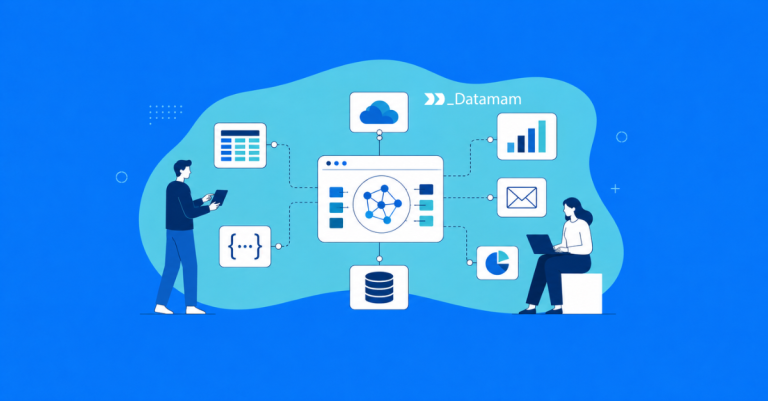
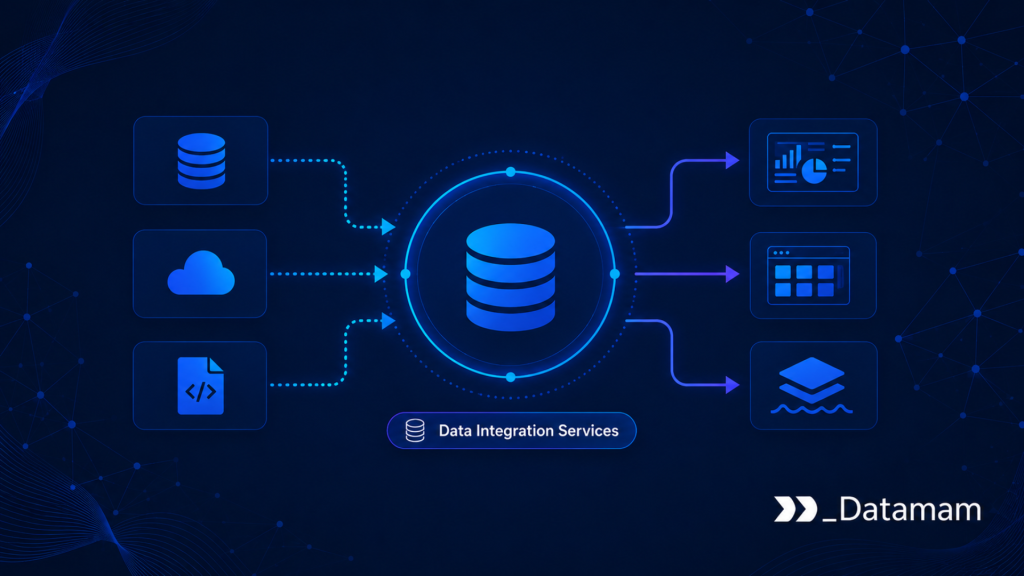
Enterprise data integration is the operating layer that converts collected, sourced, and prepared data into usable business infrastructure. Data may be available, validated, and structured, but it still has limited value if it does not reach the systems where decisions happen. Therefore, integration should be understood as the delivery architecture that connects external data, internal systems, analytics environments, AI pipelines, and operational workflows into a controlled and usable data supply chain.
From Data Movement to Operational Data Delivery
Traditional integration was often treated as data movement between systems. That framing is too narrow for enterprise environments that depend on external signals, cloud platforms, AI models, data warehouses, operational applications, and real-time workflows. In practice, modern integration must preserve data meaning, enforce schema expectations, support access control, manage refresh timing, and detect failures. The objective is not simply to move records. It is to deliver trusted data into the business systems that rely on it.
Why Integration Quality Determines Data Infrastructure Value
Integration quality determines whether upstream data investments produce enterprise value. A strong sourcing strategy can identify the right external signals, and a strong collection infrastructure can capture them reliably. However, if delivery into downstream systems is inconsistent, delayed, poorly mapped, or weakly governed, decision teams still operate with partial visibility. Data integration solutions, therefore, serve as the bridge between data availability and operational use. They determine whether data becomes a usable asset or remains trapped in disconnected environments.
The Enterprise Data Delivery Gap
The enterprise data delivery gap appears when organizations have many systems, data sources, and analytics tools but lack a reliable integration model between them. Data may exist across warehouses, lakes, SaaS platforms, CRM systems, ERP systems, marketplaces, external APIs, spreadsheets, internal databases, and AI environments. However, fragmented delivery prevents consistent use. As a result, teams spend time reconciling records, resolving mismatched fields, repairing broken flows, and questioning whether the data they see is current or complete.
Why Data Availability Does Not Equal Data Usability
Data availability is not the same as data usability. A dataset can exist in a cloud storage location, vendor feed, API endpoint, warehouse table, or internal system and still be unusable for business decisions. Usability depends on schema consistency, refresh cadence, lineage, permissions, quality checks, mapping logic, and business context. According to Gartner’s 2025 data and analytics predictions, by 2027, 50% of business decisions will be augmented or automated by AI agents, increasing the need for governed data, analytics, and decision flows.
How Fragmented Delivery Slows Enterprise Execution
Fragmented delivery slows execution because every downstream team must compensate for weak integration. Analysts rebuild transformations. Engineers troubleshoot mismatched schemas. AI teams reformat inputs. Operations teams compare conflicting dashboards. Procurement teams question vendor data completeness. Finance teams reconcile inconsistent identifiers. Consequently, enterprise data integration becomes a productivity and decision-speed issue, not only a technical architecture concern. When integrated data services are weak, the cost is borne across the organization through duplicated work, delayed decisions, and reduced trust in data outputs.
Why Data Integration Services Have Become Infrastructure
Data integration becomes infrastructure when multiple enterprise systems rely on repeatable, governed, and timely data delivery. This now applies across business intelligence, AI model development, customer 360 programs, pricing systems, risk monitoring, ERP and CRM alignment, product information synchronization, supplier coordination, and post-merger consolidation. Once these workflows depend on shared data, integration quality becomes a control point. A data integration company is therefore not evaluated only by connector availability or platform familiarity. It is evaluated by delivery reliability, governance maturity, mapping discipline, and long-term operational accountability.
External Data Integration Across Internal Systems
External data integration is increasingly important because market, pricing, product, regulatory, supplier, and customer signals often originate outside internal systems. These signals must be integrated into warehouses, dashboards, AI workflows, CRM records, product catalogs, pricing tools, and planning systems. However, external data rarely arrives in formats that match internal architecture. It may require mapping, validation, normalization, enrichment, deduplication, and controlled delivery. Without integration discipline, external data remains separate from the systems that need it most. Data extraction techniques for businesses can streamline the process of integrating external signals into existing systems. By employing advanced methodologies, organizations can ensure that important insights from various sources are effectively utilized. This transition not only enhances decision-making but also drives efficiency across departments.
Enterprise Data Integration Across Complex Technology Environments
Enterprise data integration must operate across complex technology environments, including legacy databases, cloud warehouses, SaaS platforms, internal applications, external APIs, data lakes, real-time streams, and AI platforms. Each system has different schemas, permissions, latency expectations, business rules, and operational dependencies. Therefore, integration design must account for system context, not only data format. The real challenge is not connecting two endpoints. It is maintaining reliable data flow across a changing enterprise architecture.
AI and Automation Increase Integration Dependency
AI and automation increase integration dependency because models and agents require current, governed, and context-rich data from multiple systems. McKinsey’s 2025 global AI survey found that nearly two-thirds of respondents had not yet begun scaling AI across the enterprise, even as AI adoption and agent experimentation increased. One implication is that enterprise AI scaling depends on data foundations, operating models, and integration maturity. AI systems cannot operate reliably when critical data remains siloed, stale, or semantically inconsistent.
| Enterprise Driver | What Changed | Why Integration Infrastructure Is Required |
| External data dependency | Strategy, pricing, risk, AI, and analytics teams rely on external signals | External data must be delivered into internal systems with context and governance |
| Multi-system complexity | Enterprises operate across SaaS, cloud, legacy, operational, and AI environments | Data must be mapped, synchronized, and governed across different architectures |
| AI and automation growth | Models and agents require current and integrated enterprise context | Siloed or stale data weakens automated decisions and model performance |
| Governance expectations | Data use requires lineage, access control, documentation, and auditability | Integration must preserve traceability across systems and workflows |
| Operational speed | Business teams need timely data in the systems where work occurs | Manual transfers and disconnected pipelines create decision latency |
The Operating Model Behind Data Integration Services
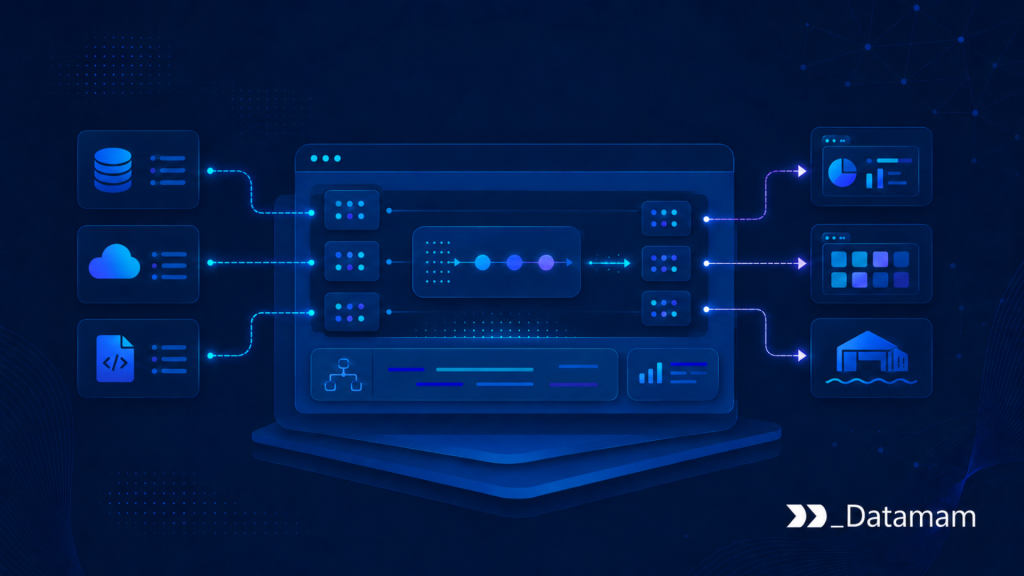
At enterprise scale, Data Integration Services are not defined by connectors alone. They are defined by an operating model that converts source data into reliable downstream delivery. This model includes intake design, mapping logic, transformation rules, synchronization planning, validation controls, delivery mechanisms, monitoring, and governance. Each layer has a distinct role. If one layer is weak, downstream systems inherit inconsistency, latency, or quality failures. Integration infrastructure must therefore be designed before data delivery becomes mission-critical.
| Operating Layer | Core Responsibility | Enterprise Output |
| Intake Layer | Receive data from external sources, internal systems, APIs, files, streams, and platforms | Controlled entry point for structured and semi-structured data |
| Mapping Layer | Align source fields with target schemas, business rules, and system requirements | Clear source-to-target logic for downstream delivery |
| Transformation Layer | Clean, enrich, format, deduplicate, and prepare data for destination systems | Integration-ready datasets with consistent structure |
| Delivery Layer | Move data into warehouses, BI tools, applications, AI workflows, or operational systems | Usable data inside enterprise decision environments |
| Monitoring Layer | Track flow health, latency, failures, freshness, and exceptions | Visibility into integration reliability and operational risk |
| Governance Layer | Manage lineage, access, auditability, documentation, and change controls | Controlled integration infrastructure with accountable data movement |
Intake Layer for External and Internal Data Flow
The intake layer defines how data enters the integration environment. Inputs may arrive from APIs, cloud storage, data warehouses, vendor feeds, public data pipelines, SaaS systems, operational databases, event streams, or flat files. The intake layer must identify source ownership, delivery format, update cadence, authentication requirements, field expectations, and failure behavior. In practice, this layer creates the controlled boundary between raw data availability and enterprise-ready data movement.
Mapping Layer for Source-to-Target Alignment
The mapping layer translates source structures into destination requirements. This includes field mapping, identifier alignment, business rule interpretation, relationship modeling, and target schema compatibility. Strong mapping prevents downstream teams from guessing what fields mean or how they should be interpreted. It also supports auditability because integration logic becomes documented rather than embedded in undocumented scripts. Source-to-target mapping is especially important when external data must align with internal customer, product, supplier, transaction, or market entities.
Transformation Layer for Delivery Readiness
The transformation layer prepares data for operational use. It may include cleaning, formatting, deduplication, enrichment, type conversion, taxonomy alignment, timestamp standardization, currency conversion, and exception handling. However, transformation should not be treated as an arbitrary manipulation. It must follow business rules, preserve lineage, and support downstream system requirements. According to Deloitte’s 2026 State of AI in the Enterprise report, enterprise AI adoption is moving from ambition toward activation, which increases the need for industrialized data and operating processes.
Delivery Layer for BI, Applications, and AI Workflows
The delivery layer moves integrated data into the systems where it creates value. These may include business intelligence tools, cloud warehouses, data lakes, data marts, CRM systems, ERP platforms, product information systems, pricing engines, feature stores, model training environments, dashboards, or operational applications. Delivery design must account for latency, schema stability, permissions, load patterns, and consumer expectations. In this context, a data integration platform is useful only when it supports reliable delivery into real business workflows.
Monitoring Layer for Flow Health and Reliability
The monitoring layer tracks whether integrations are operating as expected. It should measure freshness, completion status, latency, failure rates, schema changes, missing fields, volume anomalies, transformation errors, and downstream delivery issues. Without monitoring, integration failures often remain hidden until business teams discover inconsistent reports or missing data. Monitoring turns integration from a fragile technical process into managed infrastructure. It also creates the evidence needed for incident response and service-level management.
Governance Layer for Lineage, Access, and Control
The governance layer ensures that data movement remains traceable, secure, and reviewable. It includes lineage records, access controls, transformation documentation, ownership assignment, retention rules, audit logs, schema change controls, and policy alignment. The NIST AI Risk Management Framework emphasizes structured risk management practices for AI systems, and those practices increasingly depend on governed data movement. If integrated data feeds AI or automated decisions, integration governance becomes part of model risk control.
Enterprise Risks Created by Weak Integration Operations
Weak integration operations create risks that appear outside the data team. They affect executive reporting, AI model stability, customer experience, financial reconciliation, product availability, supplier coordination, compliance review, and operational planning. The risk is structural. If systems do not share consistent, timely, and governed data, the enterprise operates through fragmented versions of reality. Integration failures rarely remain technical. They become business failures through delayed decisions, inconsistent metrics, manual workarounds, and declining confidence in enterprise data.
Decision Latency from Delayed Data Delivery
Decision latency occurs when data reaches downstream teams too late to influence action. Pricing teams may wait for competitor or inventory data. Finance teams may wait for reconciled transactions. Customer teams may wait for updated account records. AI systems may train on outdated datasets. In each case, delayed delivery weakens responsiveness. External data integration must therefore be designed around the required decision cadence, not only technical batch schedules. Timeliness is a business requirement, not a secondary optimization.
Operational Risk from Conflicting System Records
Conflicting system records create operational risk when different teams see different versions of the same customer, supplier, product, order, or market signal. CRM may show one customer status while billing shows another. Product systems may contain outdated attributes while commerce platforms show current listings. Supplier platforms may update differently from procurement systems. These conflicts create friction, rework, and poor decision quality. Integrated data services reduce this risk by enforcing alignment across system boundaries.
AI Degradation from Siloed and Inconsistent Inputs
AI degradation occurs when models rely on incomplete, outdated, or inconsistent data from disconnected systems. A model may underperform because customer interactions, product attributes, pricing history, and external signals are not integrated correctly. This creates unreliable recommendations, weak predictions, and unstable automation. Gartner’s 2026 data and analytics predictions point toward increased importance of governance automation and machine-verifiable data contracts, reinforcing the need for structured integration controls.
Compliance Exposure from Weak Lineage and Access Control
Compliance exposure increases when data moves between systems without clear lineage, access controls, transformation records, or policy enforcement. Teams may not know where sensitive fields traveled, how data was modified, which systems consumed it, or whether permissions remained appropriate. This becomes more serious when integrated data supports regulated workflows, customer records, financial reporting, or AI systems. Governance must be embedded in integration architecture because uncontrolled movement can create risk even when the original source is legitimate.
Infrastructure Fragility from Undocumented Dependencies
Infrastructure fragility appears when integrations depend on undocumented scripts, unclear ownership, hidden schedules, informal transformations, or fragile system dependencies. When one upstream schema changes, downstream systems may fail unexpectedly. When a key employee leaves, integration logic may become difficult to maintain. Also, when a new system is added, teams may not know what dependencies already exist. Enterprise data integration reduces this fragility by documenting flows, dependencies, ownership, and change control expectations.
Build vs Buy Decisions for Data Integration Services
The build versus buy decision for integration should be evaluated as an infrastructure strategy. Internal teams may build integration capabilities when the scope is narrow, systems are stable, and data flows are limited. However, enterprise-scale integration requires sustained capability across mapping, transformation, monitoring, governance, security, and operational support. A data integration company may be appropriate when organizations need faster delivery, specialized integration design, or external capacity without expanding internal platform burden.
| Evaluation Area | Build Internally | Managed Integration Capability |
| Best Fit | Narrow system scope, stable architecture, strong internal data engineering capacity | Multi-system, external data, governed delivery, and scalable operational workflows |
| Cost Profile | Lower visible start cost, higher hidden maintenance and dependency burden | Structured cost with delivery accountability and implementation discipline |
| Control | Maximum internal ownership of logic and systems | Shared operating model with documented handoff and governance |
| Scalability | Limited by internal team capacity and platform maturity | Designed for expansion across systems, sources, and use cases |
| Risk Ownership | Technical, governance, monitoring, and continuity risk remain internal | Risk is distributed through operating controls, documentation, and service expectations |
When Internal Integration Operations Are Rational
Internal integration operations are rational when the organization has mature data engineering capacity, stable source and target systems, clear ownership, and limited external dependency. A narrow CRM-to-warehouse integration, a controlled ERP reporting feed, or a small set of internal application syncs may be appropriate for internal teams. Internal ownership can also make sense when business logic is highly proprietary or tightly tied to core operational systems. However, even internal builds require documentation, monitoring, and governance discipline.
Where Internal Integration Breaks at Scale
Internal integration breaks at scale when every new system, source, or use case creates a custom engineering project. Data teams become responsible for mapping, transformation, exception handling, quality checks, schema changes, access reviews, and incident response across too many workflows. As system complexity grows, maintenance begins to compete with innovation. Deloitte’s 2025 Global Business Services Survey highlights how organizations are expanding agile, digital, and multifunctional delivery models to improve efficiency, cost performance, and capability access.
Total Cost Beyond Connectors and Initial Deployment
The total cost of integration extends beyond connectors, implementation, or platform licensing. It includes mapping design, transformation logic, QA, exception handling, monitoring, security review, documentation, change management, incident response, and downstream support. Initial deployment costs are visible. Ongoing maintenance costs are often underestimated. Data integration solutions should therefore be evaluated by lifecycle economics, not only setup speed. A quick integration that becomes fragile later is not a low-cost solution.
Risk Allocation Across Delivery, Governance, and Continuity
Risk allocation determines who is responsible when integrated data fails, arrives late, violates schema expectations, or creates downstream conflicts. Internal builds concentrate responsibility inside the organization. Managed models can distribute risk through documented processes, service-level expectations, monitoring, and integration governance. The decision should not be framed as control versus outsourcing. It should be framed as which operating model provides reliable data delivery with acceptable cost, accountability, and resilience.
Integration Tools vs Managed Data Delivery Infrastructure
Integration tools are useful components, but they are not the same as managed delivery infrastructure. A tool can provide connectors, orchestration, workflow automation, or transformation interfaces. However, enterprise delivery depends on architecture, mapping quality, monitoring, governance, documentation, and operational accountability. This distinction matters because many organizations acquire tools before defining integration operating models. The result is often a larger tool stack with the same underlying delivery fragmentation.
Why Connector Availability Is Not the Same as Integration Readiness
Connector availability means a system can technically connect to another system. Integration readiness means the data can be mapped, transformed, validated, governed, monitored, and delivered in a way that supports business use. A connector does not automatically resolve entity matching, schema conflict, business rules, latency requirements, or access control. Therefore, integration readiness depends on design, not connector count. A data integration platform is valuable when it supports the full delivery lifecycle.
The Operational Ownership Gap in Integration Programs
The operational ownership gap appears when different teams own fragments of the integration lifecycle. Application teams own source systems. Data engineering owns pipelines. Analytics owns reporting. Security owns access. Compliance owns policy review. Business teams own requirements. Without a clear operating model, failures move between teams without accountability. Managed integration infrastructure reduces this gap by defining ownership across mapping, transformation, delivery, monitoring, incident response, and governance.
Industry Applications of Data Integration Services
Industry applications vary because each sector has different system complexity, data sensitivity, latency requirements, and operational dependencies. Retail teams need product, pricing, inventory, marketplace, and customer data integrated across commerce and planning systems. Financial services teams require governed delivery across risk, compliance, customer, and analytics systems. Technology companies need integration across product, support, usage, and AI workflows. Manufacturing and supply chain teams need supplier, order, warehouse, and logistics data connected across operational platforms.
Retail and E-Commerce Data Integration
Retail and e-commerce environments rely on integration across product catalogs, inventory systems, pricing engines, marketplace feeds, customer platforms, fulfillment systems, reviews, and external competitor data. Weak integration creates inconsistent product availability, delayed pricing updates, inaccurate assortment analysis, and fragmented customer visibility. Effective integration can reduce manual reconciliation, improve pricing responsiveness, support digital shelf analytics, and strengthen demand planning. In practical environments, integration improvements often reduce data preparation effort by 30-60% for recurring reporting and operational workflows.
Financial Services and Risk Data Delivery
Financial services integration must support risk modeling, customer records, regulatory monitoring, fraud detection, reporting, and compliance workflows. Data must move across internal systems and external sources with strong lineage, permissions, and auditability. In this environment, delivery reliability is as important as data quality. A delayed or poorly mapped feed can affect risk scoring, customer reviews, compliance monitoring, or reporting accuracy. Integrated data services provide value when they preserve traceability while reducing manual reconciliation across systems.
Technology and AI Workflow Integration
Technology companies depend on integration across product usage data, support tickets, customer feedback, CRM records, documentation, operational logs, external market signals, and model development environments. AI workflows are especially sensitive to incomplete integration because models often require context from multiple systems. OECD’s 2025 work on trustworthy AI identifies data, digital infrastructure, governance, and oversight as important enablers and guardrails. For AI-enabled technology environments, integration connects those principles to operational execution.
Manufacturing and Supply Chain System Coordination
Manufacturing and supply chain operations depend on integration across supplier systems, ERP platforms, warehouse management systems, order management tools, logistics providers, quality systems, and demand planning environments. Weak integration creates inventory mismatch, delayed supplier visibility, inaccurate order status, and inefficient planning. Strong delivery infrastructure improves coordination by aligning operational data across systems. The business value appears through better fulfillment visibility, fewer manual updates, faster exception handling, and improved planning confidence.
Business Outcomes From Enterprise Integration Infrastructure
The value of enterprise data integration should be measured through delivery reliability, decision speed, operational efficiency, governance readiness, AI enablement, and system scalability. These outcomes depend on architecture maturity, source complexity, system landscape, data quality, and adoption by business teams. However, when integration infrastructure is designed well, the organization reduces rework and improves data confidence across functions. Integration turns data from a distributed asset into a shared operating layer.
Faster Data Delivery into Decision Systems
Data delivery accelerates when integration workflows are designed with clear mapping, transformation, validation, and destination requirements. Business teams do not wait for manual exports, spreadsheet uploads, or custom data pulls. Data reaches dashboards, applications, warehouses, and AI systems on defined schedules or event triggers. For recurring workflows, well-structured integration can reduce delivery delays by 20-40%, especially where teams previously relied on manual reconciliation or fragmented file-based processes.
Better Cross-System Data Consistency
Cross-system consistency improves when integration logic aligns identifiers, schemas, fields, and business rules. This matters for customers, products, suppliers, orders, assets, pricing, and market signals. If systems disagree, teams waste time reconciling differences and lose confidence in reporting. Enterprise data integration creates a more consistent data layer by enforcing mapping logic and monitoring exceptions. The result is stronger alignment across analytics, operations, finance, sales, procurement, and executive reporting.
Lower Manual Reconciliation Burden
Manual reconciliation is one of the clearest symptoms of weak integration. Analysts compare exports. Operations teams correct records. Engineers build temporary scripts. Finance teams resolve mismatches. Procurement teams validate supplier data manually. Strong integration reduces this burden by automating repeatable delivery and exception handling. The practical outcome is not only time saved. It is a better use of skilled teams, who can focus on analysis, process improvement, and strategic decisions rather than routine data repair.
Stronger Governance Across Data Movement
Governance improves when data movement is documented, monitored, and controlled. Integration infrastructure creates records of where data came from, how it changed, where it went, and who can access it. OECD’s 2025 policy brief on data access and sharing in the age of AI emphasizes balancing data access with legal, technical, and organizational safeguards. That same balance applies to enterprise integration, where data must be useful without becoming uncontrolled.
More Reliable Scaling Across Systems and Use Cases
Scaling becomes more reliable when integration patterns are reusable. A mature integration model can support new sources, systems, geographies, business units, and use cases without rebuilding architecture from scratch. This matters during growth, mergers, platform modernization, AI expansion, and new external data initiatives. Without reusable patterns, every new integration becomes custom work. With disciplined infrastructure, new workflows benefit from existing mapping standards, delivery controls, monitoring practices, and governance expectations.
Integration as an Upstream Control Point for AI and Analytics
Integration is an upstream control point because AI and analytics depend on delivered context, not isolated data assets. A model cannot use customer behavior if it remains in a disconnected application. A dashboard cannot compare markets if external data is not mapped into the warehouse. A pricing engine cannot react if competitor signals are delayed. Therefore, integration determines whether data investments become usable inside decision systems. This is why integration architecture increasingly shapes enterprise AI and analytics performance.
Why AI Readiness Depends on Integrated Context
AI readiness depends on an integrated context because models need relationships across data domains. Customer behavior, product attributes, transactions, support history, external market signals, and operational events often reside in different systems. If those domains are not integrated, models train on partial context. This weakens prediction quality and limits automation. Enterprise AI systems require integrated data pipelines that preserve meaning, lineage, and freshness across sources. Without that, AI programs remain constrained by data silos.
Why Analytics Depend on Consistent Delivery Semantics
Analytics depend on consistent delivery semantics because business teams must interpret data the same way across systems and reports. Revenue, customers, products, suppliers, inventory, orders, and market categories must follow shared logic. If integration pipelines apply inconsistent transformations, analytics outputs diverge. According to Gartner’s 2025 analytics outlook, 75% of new analytics content will be contextualized for intelligent applications through generative AI by 2027, increasing the importance of consistent data semantics.
Commercial Evaluation Criteria for a Data Integration Company
Enterprise buyers should evaluate a data integration company by delivery discipline, not by claims of technical flexibility alone. The provider should demonstrate how it handles source-to-target mapping, transformation logic, exception workflows, monitoring, access control, documentation, and operational handoff. It should also show how integration design aligns with business outcomes, system architecture, and governance requirements. A strong partner reduces delivery ambiguity before implementation begins.
Evidence of Source-to-Target Mapping Discipline
A serious integration capability should show structured source-to-target mapping discipline. This includes field definitions, business rules, identifier alignment, transformation logic, target schema expectations, exception handling, and ownership. Mapping should be documented in a way that business, data, engineering, and governance teams can review. Without this discipline, integration logic becomes hidden in code, tools, or individual knowledge. That creates long-term maintenance risk.
Monitoring and Exception Management Standards
Monitoring and exception management standards should be part of the integration model from the beginning. Buyers should evaluate how flow failures are detected, how data freshness is measured, how schema changes are flagged, how anomalies are reviewed, and how incidents are escalated. Strong monitoring prevents silent degradation. It also gives operational teams confidence that integrations are being actively managed rather than assumed to be working.
Governance, Security, and Handoff Quality
Governance, security, and handoff quality determine whether integration work can scale safely. Buyers should expect lineage records, access controls, transformation documentation, delivery ownership, testing standards, and operational runbooks. Handoff should include enough information for internal teams to maintain visibility into flows even when external specialists support implementation. Integration infrastructure becomes durable when accountability, documentation, and controls are clear from the start.
Conclusion: Data Integration Services as Enterprise Data Delivery Infrastructure
Data Integration Services have become an enterprise data delivery infrastructure because modern organizations rely on data moving reliably across external sources, internal systems, analytics environments, operational platforms, and AI workflows. Data collection, sourcing, and preparation create value only when data reaches the systems where decisions, automation, and reporting occur.
The enterprise advantage is not simply connecting more systems. It is creating governed, reliable, monitored, and business-aligned data delivery across the organization. Strong integration infrastructure reduces decision latency, improves cross-system consistency, lowers manual reconciliation, strengthens governance, and supports AI-ready operations.
Ultimately, enterprise data value depends on delivery. Organizations that treat integration as infrastructure build stronger foundations for analytics, automation, customer visibility, operational coordination, and long-term data scalability.
Strategic Consultation for Enterprise Data Integration Readiness
A strategic consultation should clarify whether the organization’s current integration model can support its data delivery requirements. Many enterprises already have integration tools, data platforms, dashboards, and internal engineering teams, but still lack reliable flow design, governance, monitoring, and cross-system alignment. The assessment should identify where delivery gaps, mapping issues, manual reconciliation, system dependencies, or governance weaknesses limit data performance. The objective is to create clarity before expanding integration complexity.
Assessing Data Flow, Delivery, and Governance Gaps
An integration readiness assessment should begin by mapping critical data flows across source systems, destination systems, business processes, analytics workflows, and AI pipelines. This includes reviewing source-to-target mappings, refresh cadence, transformation logic, failure visibility, ownership, access controls, and lineage. The assessment should identify where data breaks, slows, conflicts, or becomes difficult to trust. From there, leadership can distinguish a platform problem from a delivery infrastructure problem.
Evaluating Internal, External, and Managed Integration Models
The final step is evaluating whether integration should be managed internally, supported by external specialists, or operated through a managed delivery model. The decision should consider system complexity, internal capacity, governance exposure, downstream dependency, total cost of ownership, and required speed of implementation. Submit an inquiry when the objective is to clarify the right integration operating model before allocating engineering resources, procurement budget, or enterprise data infrastructure investment.