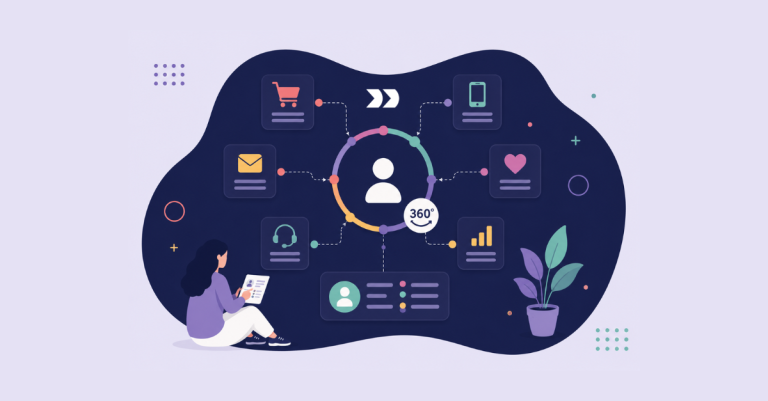
Key Takeaways
- How Customer 360 Data Integration creates a trusted single customer view across commercial, operational, and service systems
- Why customer data unification requires identity resolution, data quality controls, governance, and clear source ownership
- How unified customer records improve sales visibility, personalization, support operations, retention analysis, and executive reporting
- Why the customer 360 strategy depends on data lineage, auditability, access controls, and privacy-aware integration workflows
- How structured integration pipelines reduce duplicate profiles, manual reconciliation, and inconsistent customer reporting
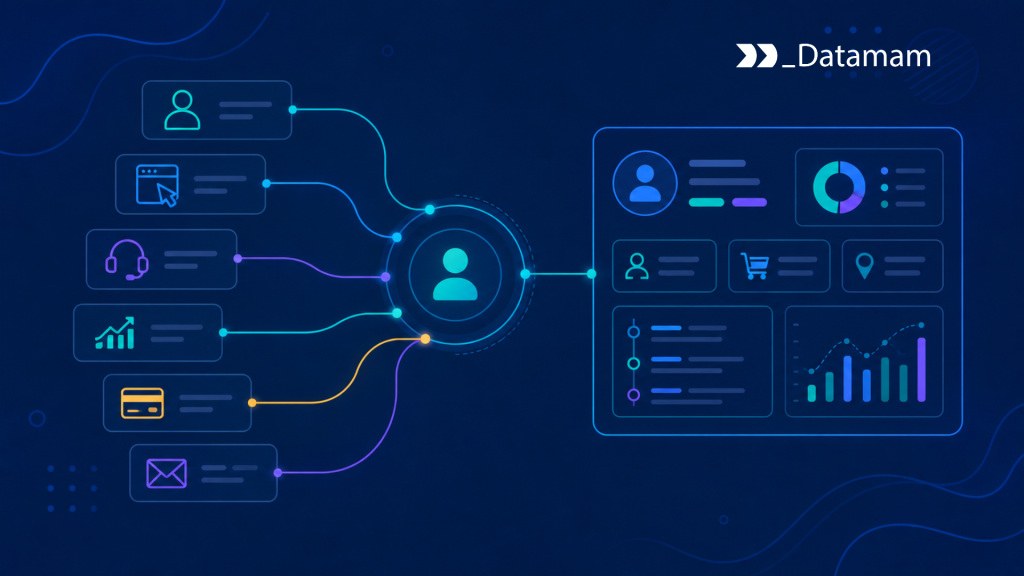
Customer 360 programs are designed to give organizations a reliable, unified view of customers across sales, marketing, service, billing, product usage, digital engagement, and support operations. However, most enterprises do not begin with one clean customer record. They begin with fragmented customer data spread across CRM, ERP, CDP, support platforms, ecommerce systems, billing tools, product analytics, data warehouses, and marketing automation platforms. Customer 360 Data Integration gives business and data teams a structured way to unify these records, reduce duplicate profiles, improve customer intelligence, and support more consistent decisions across the customer lifecycle.
The Customer Visibility Gap Across Enterprise Systems
Customer data is created in many places. Sales teams create accounts in CRM. Marketing platforms track campaign engagement. Support teams log tickets and service history. Billing platforms store invoices, subscriptions, and payment status. Product systems track usage, onboarding, feature adoption, and behavioral events. E-commerce systems capture transactions and browsing behavior. Each system may describe the same customer differently.
This creates a visibility gap. A customer may appear as one account in CRM, three billing entities in ERP, two email profiles in marketing automation, and multiple users in a product analytics platform. Without Customer 360 Data Integration, teams cannot reliably answer basic questions: who the customer is, what they bought, what they use, what issues they have, and what relationship the organization has with them.
NIST’s Privacy Framework is relevant because customer data unification often involves personal, contractual, behavioral, and transactional information that must be governed carefully.
Why Customer Records Fragment Over Time
Customer records are fragmented because each system is optimized for a different business process. CRM may structure customers around sales ownership and account hierarchy. Billing systems may structure customers around legal entities and payment responsibility. Support platforms may structure customers around users, tickets, or service contracts. Product systems may structure customers around workspaces, devices, subscriptions, or user IDs.
Over time, these different models create duplicates, conflicting identifiers, missing fields, outdated contacts, inconsistent addresses, and incomplete customer histories. The issue is not only technical. It reflects how different departments define “customer” for their own work. Customer 360 Data Integration must preserve operational context while creating a trusted shared view.
How Fragmentation Affects Sales, Marketing, Support, and Finance
Fragmented customer data affects nearly every commercial function. Sales teams may miss expansion opportunities because product usage and support signals are not visible in CRM. Marketing teams may send irrelevant campaigns because customer status, segment, or consent data is incomplete. Support teams may lack billing or contract context. Finance may struggle to reconcile customer revenue when accounts are duplicated across systems.
As a result, the customer 360 strategy becomes a business alignment issue, not only a data engineering project. The organization needs a unified customer record that can serve multiple teams without forcing every system to use the same operational model.
Customer 360 Data Integration as an Operating Layer
Customer 360 Data Integration becomes valuable when it operates as a governed layer between source systems and business workflows. The purpose is not simply to copy customer data into one database. It is to create a trusted customer profile that connects identifiers, account hierarchies, transactions, interactions, product usage, consent status, support history, and lifecycle events.
A mature customer 360 strategy defines which systems own which fields, how records are matched, how conflicts are resolved, how sensitive data is protected, and how downstream systems consume unified customer records. This operating layer supports both analytics and action. It allows teams to understand the customer and then apply that understanding in sales, marketing, service, retention, and reporting workflows.
Defining Source Ownership Across Customer Data Domains
Source ownership is one of the first decisions in a Customer 360 program. CRM may own sales stage, account owner, opportunity history, and relationship notes. ERP or billing may own legal customer name, invoice status, payment terms, and revenue history. Support platforms may own ticket history and satisfaction signals. Product systems may own usage activity, feature adoption, and workspace membership.
A simple customer profile event might look like this:
def send_for_validation(event):
    print(f"Queuing {event['event_type']} from {event['source_system']} for validation")


event = {
    "event_type": "customer.profile_updated",
    "source_system": "crm",
    "crm_account_id": "CRM-90214",
    "billing_customer_id": "BILL-77102",
    "customer_domain": "example-enterprise.com",
    "updated_fields": ["industry", "account_owner", "customer_segment"],
    "timestamp": "2026-06-17T10:40:00Z",
    "sync_policy": "publish_after_validation",
}

if event["sync_policy"] == "publish_after_validation":
    send_for_validation(event)
This kind of event structure helps teams control how customer changes move across systems. Not every field should update every system automatically.
Creating Unified Customer Records Without Losing Context
Unified customer records should not flatten every customer relationship into one oversimplified profile. Enterprises often need hierarchy. A parent company may have subsidiaries, business units, billing entities, regional offices, user groups, and product workspaces. A useful single customer view connects these relationships rather than hiding them.
Customer data unification should map individuals, accounts, households, legal entities, product users, billing entities, and support contacts where relevant. The unified profile becomes a relationship graph, not just a merged row. This allows sales, finance, support, and marketing teams to view the same customer from different perspectives while relying on shared identifiers.
Connecting Customer 360 Strategy to Business Workflows
The Customer 360 strategy should be tied to specific business workflows. If the goal is retention, the unified profile should connect product usage, support issues, renewal dates, customer health, and account ownership. If the goal is personalization, the profile should integrate consent, segmentation, engagement, purchase history, and channel preferences. Also, If the goal is sales expansion, it should connect account hierarchy, product adoption, contract status, and opportunity history.
This business-first sequencing prevents customer 360 programs from becoming abstract data warehouse projects. Integration should prioritize the customer signals that improve real decisions.
Infrastructure Requirements for Customer Data Unification
Customer 360 Data Integration depends on an infrastructure that can ingest, match, transform, validate, govern, and publish customer data across systems. The objective is not to create a large raw customer repository that analysts must clean manually. The objective is to produce trusted customer records that business teams can use repeatedly.
Customer data pipelines must support changing schemas, duplicate detection, identity resolution, consent controls, validation rules, and downstream synchronization. NIST’s Cybersecurity Framework 2.0 is useful because Customer 360 systems expand access to sensitive customer data and require clear governance, identity, protection, monitoring, and response practices.
Continuous Data Intake Across Customer Systems
Customer data must be ingested from CRM, ERP, billing platforms, support tools, marketing automation systems, product analytics platforms, ecommerce systems, data warehouses, and event streams. Apache Airflow can orchestrate scheduled extraction, validation, and transformation workflows. Kafka can support event-driven updates when customer changes need to move quickly across systems.
Continuous intake matters because customer records change constantly. Contacts leave companies, billing details change, support issues occur, products are adopted, subscriptions renew, and consent preferences update. If Customer 360 depends on occasional exports, the unified view becomes stale quickly.
Identity Resolution and Customer Matching Logic
Identity resolution connects records that belong to the same customer. Matching may use email, domain, phone number, billing ID, account name, tax identifier, device ID, user ID, address, or product workspace. The rules must balance accuracy and caution. Overmatching can merge different customers incorrectly. Undermatching can leave duplicates unresolved.
A lightweight SQL-style matching model might look like this:
def resolve_customer_identity(crm, billing, support):
    crm_domain = (crm.get("account_domain") or "").lower()
    support_domain = (support.get("domain") or "").lower()

    if crm_domain and crm_domain == support_domain:
        match_rule = "domain_match"
    elif crm.get("tax_id") and crm.get("tax_id") == billing.get("tax_id"):
        match_rule = "tax_id_match"
    else:
        match_rule = "manual_review"

    return {
        "crm_account_id": crm.get("account_id"),
        "billing_customer_id": billing.get("customer_id"),
        "support_organization_id": support.get("organization_id"),
        "normalized_domain": crm_domain,
        "match_rule": match_rule,
    }
This type of logic is usually only one layer of the process. Enterprise customer matching often requires deterministic rules, probabilistic scoring, stewardship review, and exception queues.
Validating Customer Data Before Publication
Validation controls prevent poor data from entering the unified customer profile. These controls should check duplicate records, missing identifiers, invalid emails, incomplete billing fields, inconsistent account hierarchy, consent conflicts, inactive customers, and mismatched regions. Great Expectations or similar data quality frameworks can enforce validation before customer records are published.
A simple validation configuration might look like this:
customer_360_validation:
  required_fields:
    - unified_customer_id
    - source_system
    - customer_status
    - record_last_updated
  uniqueness_checks:
    - unified_customer_id
  review_required_when:
    - match_confidence_below: 0.85
    - conflicting_legal_names: true
    - consent_status_changed: true
  blocked_conditions:
    - customer_status: "deleted"
      publish_to_marketing: false
These controls reduce the risk of spreading inaccurate or non-compliant customer records into activation systems.
Technology Stack Behind Customer 360 Programs
A mature Customer 360 program operates across orchestration, processing, storage, identity resolution, data quality, governance, and activation. The stack must support both analytical use cases and operational synchronization. Business teams need dashboards, but they also need customer data to flow back into CRM, marketing tools, support platforms, and customer success workflows.
The technology stack should be designed for repeatability. Customer 360 Data Integration is not a one-time cleanup exercise. It is an ongoing operating capability that must handle new customers, system changes, data source additions, and evolving governance requirements. Effective enterprise data delivery solutions are essential for maintaining the integrity and accessibility of customer information. They ensure that all relevant data is available in real time for decision-making processes across the organization. Additionally, implementing robust data delivery solutions can significantly enhance operational efficiency and improve customer engagement strategies.
Orchestration and Data Movement Using Airflow, Kafka, and APIs
Airflow can coordinate batch customer ingestion from CRM, ERP, billing, support, and marketing platforms. Kafka can support near-real-time customer events such as signup, purchase, support escalation, renewal update, consent change, or product activation. APIs provide controlled communication with source and downstream systems when direct database access is not appropriate.
This architecture allows organizations to apply different sync cadences by business need. A consent change may need rapid propagation. A customer hierarchy update may require review before publication. A product usage summary may update daily. The integration design should match business risk and operational value.
Processing and Transformation Through Spark, dbt, and ETL Pipelines
Processing layers convert raw customer records into structured, unified datasets. Spark can process high-volume behavioral events, product usage records, transaction history, support logs, and marketing engagement data. dbt can manage transformation logic, documentation, dependency graphs, tests, and semantic models for customer reporting.
ETL and ELT pipelines can standardize names, normalize addresses, map account hierarchies, resolve identities, classify customer segments, reconcile revenue, and connect users to accounts. This makes customer data unification repeatable rather than dependent on manual spreadsheet reconciliation.
Storage, Analytics, and Governance in Snowflake, BigQuery, or Databricks
Snowflake, BigQuery, and Databricks can support centralized customer intelligence layers where teams store unified customer records, event history, consent status, transaction summaries, product usage, support history, and customer health metrics. These platforms can also support BI dashboards, machine learning features, segmentation workflows, and downstream activation.
Governance controls should include role-based access, audit logs, metadata catalogs, data lineage, retention rules, consent fields, and source documentation. These controls matter because Customer 360 programs often expose sensitive customer information to more teams than the source systems did.
Commercial Impact of Customer 360 Data Integration
The commercial value of Customer 360 Data Integration appears when unified customer records improve decision speed, customer experience, retention, personalization, and reporting confidence. Strong integration does not guarantee revenue growth, but weak integration often creates friction across every customer-facing function. Teams lose time reconciling records, correcting campaign audiences, investigating account ownership, and explaining why reports do not match.
For CROs, CMOs, CIOs, CFOs, and customer success leaders, the value is operational alignment. A trusted single customer view helps teams work from the same understanding of the customer. Scalable enterprise integration strategies enable organizations to streamline processes and enhance collaboration among departments. By adopting these strategies, companies can significantly reduce data silos and increase transparency throughout the organization. Ultimately, this leads to better-informed decisions and a more agile response to customer needs.
Improving Sales and Account Management Visibility
Sales teams need visibility into customer history beyond CRM activity. A unified profile can show product usage, billing status, open support issues, renewal timing, purchase history, customer health, and related accounts. This helps account teams prepare better conversations and avoid asking customers for information the organization already has.
Customer 360 Data Integration also supports expansion planning. Sales can identify underused products, cross-sell potential, regional account relationships, and unresolved service issues that may affect renewal or upsell timing.
Supporting Personalization and Customer Experience
Personalization depends on accurate customer context. Marketing teams need to know customer segment, lifecycle stage, consent status, purchase history, engagement behavior, and product usage. If customer records are duplicated or outdated, personalization can become irrelevant or harmful.
A reliable single customer view helps teams avoid messaging existing customers as prospects, sending campaigns to users who opted out, or promoting products that customers already own. Customer data unification improves the quality of customer experience by reducing avoidable mistakes.
Reducing Manual Reconciliation Across Departments
Manual reconciliation is one of the most visible costs of fragmented customer data. Revenue operations may compare CRM exports against billing records. Marketing may deduplicate lists before campaigns. Support may ask finance for the account status. Finance may reconcile customer revenue across multiple systems.
Unified customer records reduce this burden by creating common identifiers and trusted integration logic. Teams can spend less time validating basic customer facts and more time improving retention, service quality, campaign performance, and account strategy.
Risk Exposure When Customer 360 Data Is Incomplete
Incomplete Customer 360 data creates operational, commercial, and governance risk. A sales team may approach the wrong account contact. Marketing may target customers without valid consent. Support may miss important billing or product context. Finance may report revenue under duplicate accounts. Leadership may make customer strategy decisions from inconsistent records.
The risk increases as organizations add more systems, channels, products, and regions. Data fragmentation that is manageable at a small scale becomes expensive and risky at an enterprise scale.
Duplicate Customer Profiles and Inconsistent Reporting
Duplicate customer profiles distort reporting. One customer may appear as multiple records across CRM, billing, support, and product systems. Revenue, usage, support volume, churn, lifetime value, and marketing engagement may be split across records. This weakens segmentation, account planning, and executive reporting.
Identity resolution, hierarchy mapping, and stewardship workflows reduce this risk. Customer 360 Data Integration should define how duplicates are detected, reviewed, merged, or preserved as separate entities when needed.
Poor Customer Experience from Missing Context
Missing context leads to poor customer experience. A support agent may not know that a customer has an open renewal issue. A sales rep may not see a recent service escalation. A marketing campaign may ignore current product usage. A customer success manager may miss early signs of churn because product and support signals are disconnected.
A unified customer record helps prevent these failures by connecting customer history across systems. The value is practical: fewer repeated questions, fewer irrelevant messages, and better internal coordination.
Privacy and Consent Risks in Unified Customer Records
Customer 360 programs can create privacy risk if consent, purpose, access, and retention rules are not built into the integration layer. Combining data from many systems can make customer profiles more powerful but also more sensitive. Teams must know which data can be used for marketing, service, analytics, personalization, or reporting.
Governance controls should document consent status, processing purpose, data source, retention rule, and access permission. Without these controls, customer data unification can increase compliance exposure.
Governance Requirements for Customer 360 Strategy
Customer 360 strategy must include governance from the beginning because unified customer records affect privacy, security, analytics, marketing activation, service operations, and executive reporting. Data may come from CRM, ERP, billing, support, product analytics, ecommerce, data warehouses, and third-party enrichment sources. Each source carries different ownership, quality, and permitted-use constraints.
Governance should make Customer 360 usable, not slow it down. The goal is to give business teams trusted data while ensuring that sensitive customer information is protected and traceable.
Source Documentation, Access Controls, and Audit Logs
Customer 360 datasets should document source system, field ownership, refresh cadence, transformation logic, sensitivity level, consent relevance, and known limitations. Access controls should restrict personal data, billing information, contract details, product usage, support history, and sensitive segmentation outputs. Audit logs should record who accessed, transformed, exported, or activated customer data.
These controls help organizations demonstrate that customer intelligence is based on approved sources and governed workflows. They also reduce the risk that customer data spreads into uncontrolled spreadsheets or downstream tools.
Data Lineage Across Source, Identity, and Activation Layers
Data lineage allows teams to understand how each customer field moved from the source system to the unified profile. Traceability should cover source record, matching rule, transformation logic, validation result, consent status, profile version, and downstream activation. This matters because customer data may be challenged by sales, marketing, support, finance, or compliance teams.
Lineage also supports debugging. If a customer receives the wrong campaign, teams can determine whether the issue came from identity matching, consent logic, segmentation, data freshness, or downstream activation.
Cross-Regional and Multi-Brand Customer Data Considerations
Customer 360 becomes more complex across regions, brands, business units, legal entities, and data privacy regimes. A customer may interact with multiple brands under the same parent company. Consent rules may vary by country. Customer identifiers may differ across local systems. Data residency and retention expectations may also affect integration design.
Cross-regional controls should document legal entity ownership, storage location, permitted use, transfer rules, language handling, consent model, and access rights. This reduces the risk that a single customer view works technically but fails operationally or legally across markets.
Evaluating Customer 360 Data Integration Readiness
Customer 360 Data Integration becomes valuable when it supports repeatable customer decisions, not simply when data is centralized. Readiness depends on source inventory, identity resolution, field ownership, data quality, consent handling, governance, and workflow integration. Teams should evaluate whether unified customer records can support the decisions they are expected to improve.
A readiness review helps identify where customer data risk accumulates before the program becomes too large to correct easily.
How Teams Assess Customer Data Quality
A structured assessment should evaluate duplicate rates, missing identifiers, invalid contact fields, account hierarchy accuracy, billing linkage, product usage linkage, consent completeness, support history matching, and source freshness. It should also review identity match confidence, conflicting values, schema changes, transformation logic, and downstream activation errors.
For Customer 360 programs, data quality must be evaluated commercially. A dataset may look complete while still failing to support personalization, renewal forecasting, account planning, or customer service workflows.
When Organizations Need a Customer 360 Integration Architecture Review
An integration architecture review becomes useful when teams rely on manual customer exports, disconnected dashboards, duplicate profiles, inconsistent account hierarchies, or unclear source ownership. The review should assess intake workflows, source coverage, identity resolution logic, validation controls, storage architecture, lineage tracking, governance posture, and activation readiness.
The output should clarify where customer data unification is incomplete, where unified customer records may be unreliable, and which infrastructure improvements would make the single customer view more useful for sales, marketing, support, finance, and leadership teams. Implementing data contract management best practices can significantly enhance data reliability across systems. These practices serve to establish clear agreements between data providers and consumers, ensuring that data quality and accessibility are maintained. By focusing on these best practices, organizations can expect more consistent data utilization, fostering better decision-making and strategic alignment.
Conclusion: Customer 360 Data Integration as Customer Intelligence Infrastructure
Customer 360 programs are not only analytics initiatives. They are a customer intelligence infrastructure. CRM, ERP, billing, support, marketing, product, and e-commerce systems all create important customer signals, but those signals rarely align by default. Customer 360 Data Integration creates the governed foundation needed to connect those signals into a reliable single customer view.
Ultimately, organizations that treat customer 360 as an integration and governance discipline will be better positioned to improve customer data unification, maintain unified customer records, reduce manual reconciliation, and make more consistent customer decisions across the enterprise.