Key Takeaways
- Integration Error Handling defines how enterprise data systems detect, classify, route, recover, and audit failures across connected workflows.
- Error handling workflows should distinguish transient failures, structural failures, data quality exceptions, system outages, and business-rule violations.
- Integration failure recovery requires retry logic, backoff, checkpoints, replay paths, idempotency, and partial-load recovery controls.
- Exception handling logic protects downstream systems by routing invalid, incomplete, duplicate, or conflicting records before they propagate.
- Reliable error handling requires observability, ownership, escalation paths, root-cause review, audit trails, and recovery evidence.
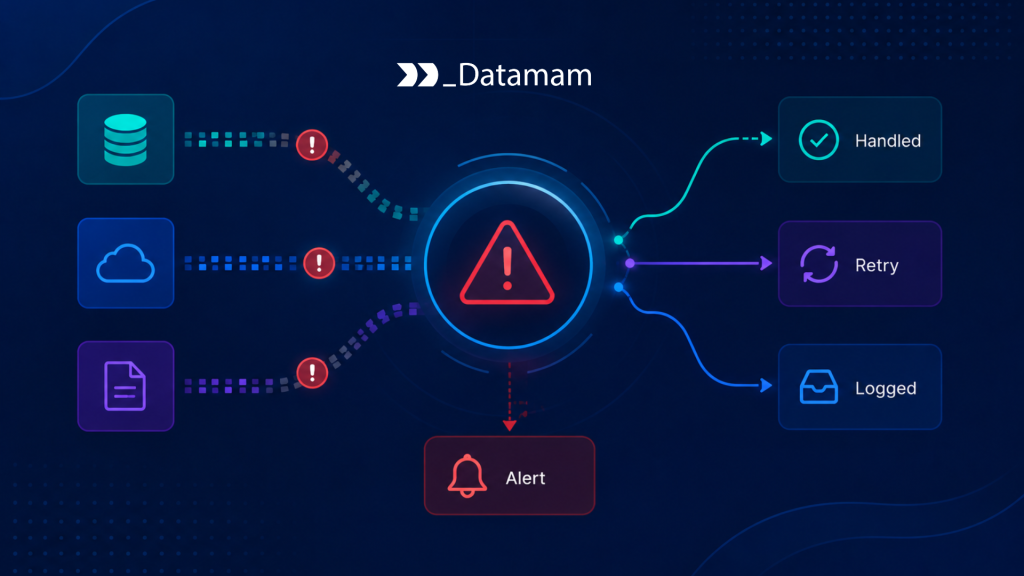
Enterprise data operations rarely fail in one clean way. A source system may delay delivery. An API may return intermittent errors. A warehouse load may be partially complete. A schema change may break a transformation. A downstream BI model may reject a new status value. A queue may duplicate messages after a retry. A CRM record may conflict with the ERP state. The integration may continue running, but the data flowing through it may no longer be reliable.
Integration Error Handling is the discipline of designing how integrated systems respond when something goes wrong. It defines how errors are detected, classified, retried, quarantined, escalated, recovered, and audited.
In enterprise integration programs, error handling is not defensive code around a pipeline. It is an operational resilience layer. Without it, connected systems can silently propagate broken data into dashboards, AI workflows, customer operations, supplier processes, finance reporting, and executive decision environments.
Why Integration Error Handling Matters in Enterprise Data Operations
Integration Error Handling matters because enterprise decisions increasingly depend on connected operational data. ERP, CRM, warehouse, product, supplier, order, billing, support, and analytics systems are often linked through recurring workflows. When one flow fails, the impact can move quickly across the organization.
Gartner’s 2025 data and analytics predictions highlight the growing role of AI-augmented and automated decisions in enterprise operations, which raises the importance of reliable data foundations before downstream actions are automated. Enterprise data delivery solutions overview emphasizes the need for seamless access to high-quality data. By implementing these solutions, organizations can mitigate risks associated with data silos and enhance their decision-making capabilities. As a result, effective integration and management of data become critical components of successful enterprise operations.
Why Integration Failures Become Business Failures
Integration failures become business failures when systems depend on shared state. A delayed order sync can affect fulfillment. A failed supplier update can affect procurement decisions. A rejected customer record can affect support workflows. A broken warehouse load can affect reporting. An AI model may consume incomplete records if the pipeline status is not visible.
The issue is not only whether the pipeline failed. The issue is whether the failure affected the business’s state. A retryable API timeout is operationally different from a schema change that corrupts downstream values. A failed enrichment job is different from an incomplete ERP load that affects finance reporting.
Error handling workflows should therefore classify failures by business impact, not only by technical error message. This allows teams to prioritize response where the operational risk is highest.
How Silent Errors Create Downstream Data Risk
Silent errors are more dangerous than visible failures. A pipeline that stops completely may trigger an alert. A pipeline that continues while dropping records, defaulting values, duplicating events, or misrouting exceptions can create false confidence.
Silent errors appear later as reconciliation gaps, incorrect dashboards, incomplete customer views, unstable AI inputs, or operational disputes between teams. By then, root cause analysis becomes harder because the original failure may have occurred in several systems upstream.
IBM’s 2025 data integration announcement emphasizes the enterprise’s need to simplify integration, reduce complexity, and deliver trusted data at scale. The error handling is one of the controls that keeps integration complexity from becoming downstream unreliability.
Error Handling Workflows Across Integrated Systems
Error handling workflows define how failures move through detection, classification, remediation, escalation, and closure. They should be designed before production integration, not improvised after incidents.
A practical workflow should answer: What failed? Is the failure transient or structural? Can it be retried safely? Should the record be quarantined? Who owns the fix? Which downstream systems are affected? What evidence proves recovery?
Classifying Errors by Source, Severity, and Business Impact
The first control is classification. Errors should be grouped by source system, target system, pipeline stage, severity, and business impact. This prevents all failures from being treated equally.
A low-risk enrichment failure may only require delayed processing. A failed customer identity sync may require immediate escalation. A rejected order update may need operational intervention. A schema mismatch in a critical table may require publication to stop until the issue is resolved.
Useful classifications include transient infrastructure failures, source availability failures, schema failures, validation failures, duplicate records, reference-data mismatches, authorization failures, partial-load failures, and business-rule violations. Each class should have a defined response path.
Separating Transient Errors from Structural Failures
Transient errors are temporary conditions. These include API timeouts, network interruptions, temporary rate limits, queue lag, warehouse contention, and short-lived service unavailability. These failures often support controlled retry.
Structural failures are different. They include schema changes, missing required fields, invalid reference values, incompatible data types, authentication changes, source contract violations, and business-rule conflicts. Retrying a structural failure without remediation usually repeats the same error and may increase operational noise.
A good error handling workflow separates these cases early. Transient failures move toward retry and recovery. Structural failures move toward quarantine, owner review, schema review, or business escalation.
Designing Error Queues, Retry Paths, and Escalation Rules
Error queues preserve failed records or events for review and recovery. Retry paths define when a system should attempt processing again. Escalation rules define when a human owner must intervene.
Retry should not be unlimited. Repeated retries can overload systems, create duplicates, or hide unresolved defects. Error queues should include reason codes, timestamps, source identifiers, target identifiers, attempt count, validation status, and downstream impact.
Escalation rules should be based on severity. A single invalid optional field may be queued for periodic review. A repeated failure in a critical integration flow may require immediate incident response.
Integration Failure Recovery for Operational Data Flows
Integration failure recovery defines how systems return to a trustworthy state after failure. Recovery is not only restarting the job. It requires knowing which records were processed, which failed, which downstream systems were affected, and whether replay is safe.
NIST’s 2025 revision of SP 800-61r3 on incident response emphasizes preparation, response, recovery, and lessons learned across organizational operations. While the guidance is written for cybersecurity incident response, the same operating logic applies to integration failure recovery: recovery should be planned, evidence-based, and connected to risk management.
Building Retry Logic Without Creating Duplicate Records
Retry logic is necessary, but unsafe retry logic can create duplicates or overwrite good data. A retry should know whether the original operation completed, partially completed, or failed before committing any target-side change.
This is where idempotency matters. An idempotent operation can run more than once without creating duplicate effects. For example, a customer update should use a stable event ID or record key so that repeated processing updates the same target state rather than inserting duplicate records.
A small retry pattern may look like this:
import time

from random import uniform


def retry_with_backoff(operation, max_attempts=4, base_delay=2):

    for attempt in range(1, max_attempts + 1):

        try:

            return operation()

        except TransientIntegrationError as error:

            if attempt == max_attempts:

                raise

            delay = base_delay ** attempt + uniform(0, 0.5)

            log_retry_attempt(error=error, attempt=attempt, delay=delay)

            time.sleep(delay)
This pattern is intentionally limited. It retries only transient failures, caps attempts, adds backoff, and logs recovery evidence. Structural failures should not be pushed through this path.
Using Backoff, Replay, and Checkpointing for Controlled Recovery
Backoff prevents systems from retrying too aggressively during outages or rate limits. Replay allows teams to reprocess failed events or records from a known point. Checkpointing records the last successfully processed unit of work.
Together, these controls allow recovery without guessing. If a batch fails halfway through, checkpointing shows which records were completed. If a stream consumer falls behind, replay can resume from a specific offset or event time. Also, if a target system is unavailable, backoff prevents retry storms.
Controlled recovery should also preserve evidence. Teams should know when recovery started, which records were replayed, which errors remained, and which downstream systems were cleared for use.
Recovering from Partial Loads, Failed Syncs, and Broken Dependencies
Partial loads are common in enterprise integration. Some records may load successfully while others fail. A dependent job may run before the required upstream data is complete. A sync may update customer records but fail related order records. These failures can leave systems inconsistent.
Recovery requires isolation. Valid records may continue if they do not depend on failed records. Invalid records should move to quarantine. Downstream publication may need to pause until required dependencies are complete.
Broken dependencies should be visible in orchestration systems. Airflow, for example, can enforce upstream completion before downstream jobs run. Data warehouses can preserve batch identifiers and load status. Observability systems can alert when dependency chains are incomplete.
Exception Handling Logic for Cross-System Integration
Exception handling logic defines what happens to records that cannot be processed safely. It protects downstream systems from bad data propagation.
Exceptions may include missing required fields, invalid values, conflicting identifiers, duplicate events, failed reference lookups, unauthorized access, or business-rule violations. These should not be treated as generic failures because each requires a different response.
Routing Invalid, Incomplete, and Conflicting Records
Invalid records should be routed based on cause and severity. Missing optional enrichment may allow delayed processing. Missing required identifiers may require quarantine. Conflicting entity matches may require manual review. Unauthorized records may require access review. Schema violations may require producer escalation.
A simple exception routing pattern may look like this:
def route_exception(record, validation_result):
    if validation_result.error_type == "missing_required_field":
        send_to_quarantine(record, reason=validation_result.message)
    elif validation_result.error_type == "duplicate_event":
        mark_as_duplicate(record, event_id=record["event_id"])
    elif validation_result.error_type == "reference_mismatch":
        send_to_manual_review(record, owner="data_operations")
    elif validation_result.error_type == "unauthorized":
        send_to_access_review(record, reason=validation_result.message)
    elif validation_result.error_type == "schema_violation":
        escalate_to_producer(record, reason=validation_result.message)
    else:
        send_to_error_queue(record, reason="unclassified_exception")
This is not meant to represent a full platform implementation. It shows the operating idea: exceptions should be classified and routed, not buried in logs or forced into the target system.
Managing Quarantine Tables, Dead-Letter Queues, and Manual Review Paths
Quarantine tables store records that failed validation but may be recoverable. Dead-letter queues capture events that could not be processed after a defined number of attempts. Manual review paths route ambiguous cases to data owners or operations teams.
Each path should include metadata. The record should carry source system, target system, error type, failed rule, timestamp, processing attempt, owner, and recovery status. Without this metadata, exception queues become data graveyards.
Manual review should be reserved for cases where human judgment is required. Most technical exceptions should be classified and processed through predefined rules. Overusing manual review slows operations and creates inconsistent handling.
Protecting Downstream Systems from Bad Data Propagation
Downstream protection requires gates. A record should not reach ERP, CRM, warehouse, BI, or AI workflows if it violates required rules. A dashboard should not refresh from incomplete critical loads without a freshness status. An AI feature table should not consume quarantined records unless explicitly approved.
This protection does not always mean blocking everything. It may mean publishing valid records while isolating invalid ones, flagging incomplete data, or applying controlled fallback behavior. The key is that downstream users and systems should not unknowingly consume failed data.
Operational Controls for Integration Reliability
Operational controls make error handling measurable. They show whether failures are increasing, whether recovery is working, and whether downstream systems remain protected.
Without operational controls, error handling becomes reactive. Teams investigate only after business users report symptoms.
Monitoring Error Rates, Latency, Rejections, and Recovery Status
Monitoring should track error rates by flow, system, domain, and severity. It should also track latency, rejected records, retry counts, queue depth, dead-letter volume, quarantine volume, replay activity, and recovery completion.
Latency matters because a delayed integration may be operationally equivalent to a failed one. Rejection patterns matter because repeated record failures may indicate schema drift, mapping errors, source changes, or business-rule misalignment.
Prometheus, application logs, data observability systems, orchestration metadata, and warehouse audit tables can all contribute to this view. The monitoring model should show technical health and business impact together.
Defining Failure Thresholds and Alert Priorities
Failure thresholds define when an issue becomes an alert, incident, or escalation. A small number of low-severity exceptions may not require immediate response. A rising error rate in a critical flow should trigger escalation. A complete failure in an operational sync may require incident response.
Alert priority should reflect business impact, not only system volume. A low-volume finance integration may be more critical than a high-volume enrichment feed. A single failed compliance update may require a faster response than thousands of low-impact enrichment failures.
Thresholds should be reviewed after incidents. If teams receive too many low-value alerts, they ignore them. If thresholds are too loose, failures remain hidden.
Tracking Root Cause Patterns Across Systems and Pipelines
Root-cause tracking helps teams improve architecture rather than repeatedly treating symptoms. Patterns may reveal unstable source systems, weak schema contracts, brittle mappings, insufficient retry logic, poor reference-data governance, or overloaded targets.
Root causes should be categorized and reviewed periodically. Repeated transient errors may justify infrastructure changes. Repeated validation failures may require producer-side correction. Also, repeated manual review of cases may indicate missing business rules.
Deloitte’s current guidance on technology resilience emphasizes resilience at scale through modern engineering practices, automated managed services, and recovery-oriented design. In integration operations, root-cause review is what converts incidents into stronger architecture.
Technology and Integration Considerations
Integration Error Handling depends on orchestration, transformation, monitoring, storage, lineage, and governance tools. The architecture should make errors visible, recoverable, and auditable across systems.
Technology should not only catch exceptions. It should support controlled recovery, downstream protection, and evidence of remediation. Integration strategies for complex data systems are essential for ensuring seamless communication between diverse platforms. By implementing robust frameworks, organizations can mitigate risks associated with data discrepancies. Furthermore, these strategies enable scalability and adaptability in rapidly evolving technological landscapes. Data integration solutions for business alignment are crucial for fostering collaboration across departments. They not only enhance data accuracy but also streamline workflows, enabling teams to make informed decisions quickly. By adopting these solutions, businesses can ensure that all stakeholders are working from the same data set, thus promoting efficiency and transparency.
Using Airflow, Kafka, Spark, dbt, and Observability Tools for Error Handling
Airflow can orchestrate workflows, retries, dependencies, backfills, and failure notifications. Kafka can route events and support replay when configured with appropriate retention and identifiers. Spark can process high-volume validation, deduplication, and recovery jobs. dbt can test analytical transformations and prevent invalid warehouse models from publishing. Observability tools can track failure rates, latency, service health, and data quality signals.
The important design point is coordination. Airflow retries should respect idempotency. Kafka replay should preserve ordering and event identity. Spark recovery jobs should avoid double-writing target records. dbt tests should block or warn based on severity. Observability alerts should connect technical failure to affected business flows.
Connecting Error Metadata to Snowflake, BigQuery, Databricks, BI, and Lineage Systems
Error metadata should be stored where downstream teams can use it. Snowflake, BigQuery, Databricks, and other analytical environments should preserve batch IDs, load status, error reason, quarantine status, source system, target system, and recovery outcome where relevant.
BI systems should expose data freshness and error state for critical datasets. Lineage systems should show which dashboards, models, workflows, and reports depend on failed integration flows. AI pipelines should know whether input data came from complete, partial, recovered, or exception-filtered loads.
This connection turns error handling into operational transparency. Teams can see not only that something failed, but which business outputs are affected.
Governance and Auditability in Integration Error Handling
Governance defines who owns errors, who approves recovery, how exceptions are reviewed, and how recurring failures are escalated. Without governance, error handling becomes a technical backlog rather than an enterprise control.
The OECD data governance framework describes data governance as technical, policy, and regulatory frameworks for managing data across its value cycle. Integration Error Handling fits that model because errors must be managed from detection through recovery, retention, review, and deletion.
Creating Ownership, Incident Review, and Escalation Paths
Each critical integration flow should have defined ownership. Source owners handle upstream issues. Target owners handle downstream acceptance. Data engineering owns pipeline logic. Data governance owns rule alignment. Business owners decide operational impact.
Incident review should occur after significant failures. The review should identify what failed, when it failed, why detection occurred or did not occur, which systems were affected, what recovery actions were taken, and what controls need improvement.
Escalation paths should be predefined. A data engineer should not have to decide alone whether a finance load can proceed after partial failure. A business owner should not have to interpret raw pipeline logs. The workflow should define who decides and what evidence is required.
Maintaining Audit Trails for Errors, Recovery Actions, and Exceptions
Audit trails should capture error events, failed records, retry attempts, quarantine decisions, manual overrides, recovery jobs, replay windows, downstream notifications, and closure status.
Auditability matters when data supports financial reporting, compliance monitoring, customer operations, AI workflows, or executive dashboards. Teams should be able to show what failed, what was done, who approved recovery, and when the system returned to a trustworthy state.
NIST’s 2025 incident response guidance also emphasizes lessons learned and integrating incident response into broader risk management. In integration operations, audit trails create the evidence needed for those lessons learned to improve system design, not only close tickets.
Conclusion: Turning Error Handling into Controlled Integration Infrastructure
Integration Error Handling determines whether enterprise data operations can recover from failure without losing trust. Connected systems will experience timeouts, rejected records, schema issues, duplicate events, partial loads, broken dependencies, and business-rule exceptions. The difference between a fragile integration and a reliable one is whether those failures are detected, classified, routed, recovered, and audited.
Strong error-handling workflows separate transient failures from structural failures. Integration failure recovery uses retry logic, backoff, checkpointing, replay, and idempotency to restore trustworthy state. Exception handling logic protects downstream systems from invalid, incomplete, conflicting, or unauthorized records. Operational controls make error rates, recovery status, and root causes visible.
The capability matters because integration failures rarely stay technical. They affect ERP, CRM, warehouse, BI, supplier, product, order, finance, customer, and AI workflows. When error handling is designed as infrastructure, failures become manageable events rather than hidden business risk.
A structured review can help evaluate whether current integration workflows have reliable integration, error handling workflows, integration failure recovery, exception handling logic, and audit-ready recovery controls. You can run an external data infrastructure audit with our team to review your current setup and understand what is required to build a reliable, enterprise-scale integration infrastructure.