Key Takeaways
- Canonical Data Models create standardized data structures that help enterprise systems exchange information without rebuilding point-to-point logic for every integration.
- An enterprise data model defines shared entities, attributes, identifiers, relationships, and business meanings across ERP, CRM, warehouse, BI, product, supplier, and order systems.
- A common data model reduces duplicated transformation logic, inconsistent definitions, brittle mappings, and downstream reporting conflicts.
- Canonical models should be governed through ownership, version control, lineage, validation rules, and change approval workflows.
- Scalable integration depends on balancing standardization with domain flexibility so the model supports enterprise consistency without becoming too rigid.
Enterprise integration becomes difficult when every system defines business objects differently. A customer in CRM may not match a billing customer in ERP. A product in a warehouse system may not match the product record used by e-commerce. A supplier in procurement may not match the legal entity used by finance. Each system may be technically correct inside its own workflow, but inconsistent when data must move across the enterprise.
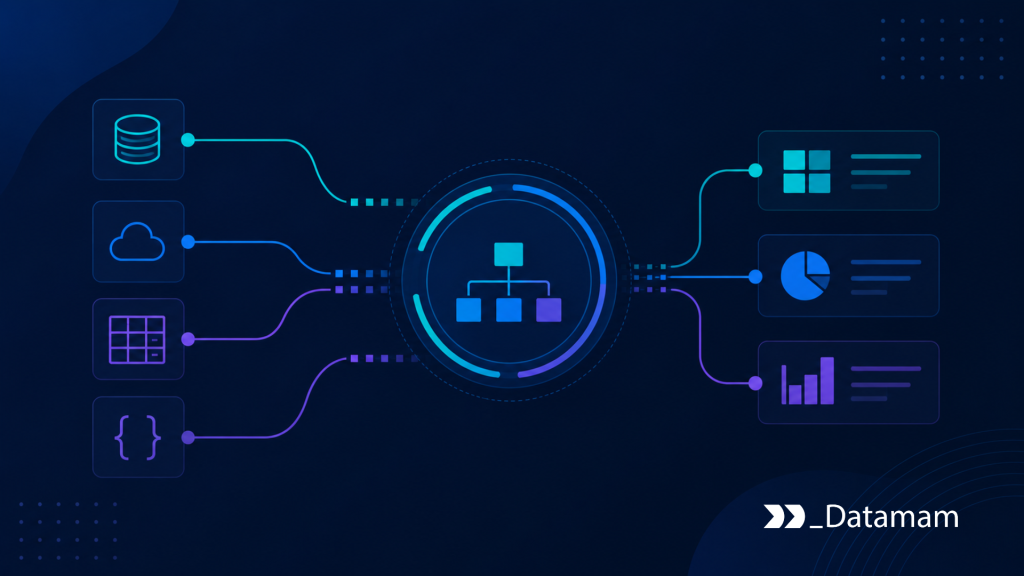
Canonical Data Models solve this integration problem by creating standardized data structures for shared business entities. They define a common representation for customers, products, suppliers, orders, invoices, locations, accounts, contracts, and other core data objects.
In enterprise integration programs, canonical models are not abstract architecture diagrams. They are operational control structures that reduce integration complexity, improve data consistency, and give downstream systems a stable foundation for analytics, automation, AI workflows, and governed data delivery.
Why Canonical Data Models Matter in Enterprise Integration
Canonical Data Models matter because enterprise systems are usually designed around local process needs, not cross-system consistency. ERP, CRM, product information, order management, finance, supplier, support, warehouse, BI, and AI systems each use different structures, identifiers, and definitions.
Deloitte’s guidance on enterprise data strategy and data architecture notes that data sprawl increases the need for robust enterprise data strategy and governance, especially when organizations need integrated platforms that can scale. Canonical modeling is one way to reduce that sprawl at the integration layer.
Why Point-to-Point Integration Does Not Scale
Point-to-point integration works when only two systems need to exchange data. It becomes fragile when many systems must communicate. Each new system requires new mappings, transformations, validation rules, and exception logic. Over time, the integration environment becomes difficult to maintain.
For example, if CRM sends customer data to ERP, BI, support, and a warehouse, each target may require separate transformation logic. If the CRM customer structure changes, every downstream integration must be reviewed. If each target also sends data elsewhere, the complexity multiplies.
A canonical model reduces this by creating a shared representation. Systems map into the canonical structure and consume from it. This does not eliminate all system-specific logic, but it reduces repeated transformation work and makes change impact easier to control.
How Canonical Models Improve Operational Consistency
Canonical models improve consistency by defining shared business objects and standard structures. Instead of allowing every integration to interpret customer, product, supplier, or order data independently, the enterprise defines a common representation.
This matters for operational workflows. A customer status should not mean one thing in CRM and another in the warehouse. A product category should not collapse differently in ecommerce, inventory, and reporting. An order lifecycle should not have conflicting stages across fulfillment and finance.
According to KPMG’s 2025 article on managing complexity in modern data ecosystems, data must be migrated, integrated, standardized, mastered, and cataloged at scale and with precision for enterprise execution to work. Canonical models directly support that standardization requirement.
Designing an Enterprise Data Model for Integration
An enterprise data model defines the shared data concepts that systems use across the organization. It should describe entities, relationships, identifiers, attributes, hierarchies, reference values, and ownership.
For integration purposes, the model should be practical. It should support system exchange, validation, transformation, and governance. It should not become an academic model that is too broad to implement. Data integration services for enterprises play a crucial role in ensuring that all systems communicate effectively. By leveraging these services, organizations can streamline their operations and enhance overall data accuracy. This enables better decision-making and fosters a more agile business environment.
Defining Core Entities, Attributes, and Relationships
Canonical modeling begins with core entities. These usually include customer, account, product, supplier, order, invoice, location, employee, contract, shipment, payment, and inventory. Each entity should have a defined meaning, owner, identifier strategy, and required attributes.
Relationships are equally important. A customer may have many accounts. An account may have many orders. A supplier may be linked to multiple legal entities and operating locations. A product may belong to multiple category hierarchies. These relationships must be modeled clearly because integrations depend on them.
A simple canonical structure for a customer entity might look like this:
def validate_customer(record):
    if not record.get("canonical_customer_id"):
        raise ValueError("missing required field: canonical_customer_id")
    if not record.get("legal_name"):
        raise ValueError("missing required field: legal_name")
    if record.get("status") not in ("active", "inactive", "suspended"):
        raise ValueError(f"invalid status: {record.get('status')}")


customer = {
    "canonical_customer_id": "CUST-100284",
    "source_system_ids": {
        "crm": "CRM-88721",
        "erp": "ERP-44190",
    },
    "customer_type": "business_account",
    "legal_name": "Example Manufacturing LLC",
    "status": "active",
    "primary_country": "US",
    "last_updated_at": "2026-06-16T10:30:00Z",
}

validate_customer(customer)
This snippet is not meant to define a complete model. It shows the operating principle: the canonical structure preserves a stable enterprise identifier while retaining source-specific identifiers for traceability.
Separating Enterprise Meaning from System-Specific Fields
Canonical models should separate enterprise meaning from system-specific implementation. A CRM may use sales-oriented account fields. ERP may use billing and finance fields. A support system may use service-status fields. Not every local field belongs in the canonical model.
The canonical model should capture the attributes required for cross-system use. System-specific details can remain in domain systems or be attached through extensions. This prevents the model from becoming overloaded.
The key question is whether the attribute is needed across systems. If it supports enterprise identity, reporting, synchronization, compliance, or shared operations, it may belong in the canonical model. If it only supports one local workflow, it may not.
Managing Identifiers Across Enterprise Systems
Identifier management is central to canonical modeling. Systems often assign different IDs to the same entity. CRM may identify an account one way, ERP another, and warehouse another. Without a canonical identifier strategy, joins become inconsistent and downstream systems rely on fragile matching logic.
A canonical model should define enterprise IDs and preserve source IDs. It should also define survivorship rules: which system is authoritative for each attribute, how conflicts are resolved, and how merged or split records are handled.
Identifier governance is especially important in Customer 360, supplier coordination, product data integration, order management, and post-merger consolidation. These programs often fail when identity alignment is treated as a technical join rather than an enterprise modeling decision.
Building a Common Data Model Across Systems
A common data model standardizes the structure used to exchange data between systems. It gives integration teams a repeatable model for common entities and reduces the need for custom translation in every flow.
The model should be stable enough to support reuse, but flexible enough to support domain-specific variation.
Standardizing Data Structures Across Domains
Standardized data structures define how entities should be represented across integrations. A canonical order model may include customer, order header, order line, payment status, fulfillment status, shipment, and invoice relationships. A canonical product model may include product ID, category, brand, attributes, lifecycle state, and market availability.
Standard structures help teams reuse integration patterns. If a new downstream system needs product data, it consumes the canonical product structure instead of requiring a new interpretation of each source system. If a source system changes, the integration layer absorbs the change and preserves the canonical output where possible.
Deloitte’s 2025 perspective on architecting the always-on data platform describes modern data platforms as integrated architectures where ingestion, transformation, monitoring, replication, and governance operate continuously. Canonical structures support this kind of operating model because they provide stable data shapes across moving parts.
Balancing Standardization with Domain Flexibility
Too little standardization creates inconsistency. Too much standardization creates rigidity. A canonical model must balance enterprise alignment with domain-specific needs.
For example, customer identity may require a shared enterprise structure. However, marketing, finance, support, and compliance may each need domain-specific extensions. Product data may require a shared product identity and classification model, while category-specific attributes remain flexible.
A practical common data model supports core shared fields and controlled extensions. This allows enterprise consistency without forcing every domain into the same operational shape.
Avoiding Overloaded Canonical Models
Canonical models fail when teams try to include every field from every system. The model becomes too large, difficult to govern, and slow to change. It may also become unclear which fields are trusted, required, or actively used.
The canonical model should focus on shared integration needs. It should define required fields, optional fields, extension areas, ownership, and versioning. Unused or local-only fields should not enter the model by default.
This keeps the model manageable and makes it easier for teams to understand what is truly enterprise-standard.
Standardized Data Structures for Integration Reliability
Standardized data structures improve integration reliability by reducing ambiguity. When teams know what a customer, product, supplier, or order object should look like, they can validate inputs, detect drift, and enforce downstream expectations.
This does not remove mapping work. It makes mapping more controlled because each system maps to a known structure. Data integration solutions for warehouse management enable systems to operate more efficiently by ensuring accurate data flow. By implementing these solutions, organizations can streamline their inventory processes and enhance order fulfillment. Ultimately, this leads to improved customer satisfaction and operational effectiveness. Customer 360 program strategies allow organizations to gain a holistic view of their customers, enabling personalized marketing and service approaches. By leveraging comprehensive customer insights, businesses can identify trends and preferences that drive engagement. This strategic focus ultimately leads to increased loyalty and higher revenue generation.
Applying Validation Rules to Canonical Structures
Canonical structures should include validation rules. These rules may define required fields, allowed values, data types, format expectations, reference values, relationship requirements, and timestamp behavior.
For example, a canonical order object may require a valid customer ID, at least one order line, a supported currency, a known fulfillment status, and a valid order timestamp. If an incoming system cannot produce those fields, the record should be routed for remediation or treated as incomplete.
A simple validation rule set might look like this:
REQUIRED_ORDER_FIELDS = [
    "canonical_order_id",
    "canonical_customer_id",
    "order_status",
    "order_created_at",
    "currency"
]

VALID_ORDER_STATUSES = {"created", "confirmed", "fulfilled", "cancelled"}

def validate_canonical_order(order):
    missing = [field for field in REQUIRED_ORDER_FIELDS if not order.get(field)]

    if missing:
        return {"valid": False, "reason": "missing_required_fields", "fields": missing}

    if order["order_status"] not in VALID_ORDER_STATUSES:
        return {"valid": False, "reason": "invalid_order_status"}

    return {"valid": True}
This snippet shows how standardized structures become enforceable. The model is not only a diagram. It becomes a validation layer that protects downstream systems.
Reducing Duplicate Transformation Logic
Without canonical structures, transformation logic is repeated across many integrations. CRM-to-warehouse, CRM-to-BI, CRM-to-support, and CRM-to-AI may each transform customer data differently. This creates duplicated logic and inconsistent outputs.
Canonical models reduce this duplication. Source systems map into a common structure once, and downstream systems consume from that structure. Updates to transformation logic can be reviewed centrally rather than scattered across point-to-point flows.
This improves maintainability and reduces the chance that two teams interpret the same field differently.
Supporting Downstream BI, AI, and Operational Workflows
BI, AI, and operational workflows depend on consistent structures. BI teams need stable dimensions and metrics. AI teams need reliable features and labels. Operational systems need predictable identifiers and state transitions.
KPMG’s 2025 article on data governance in the age of AI argues that modern governance needs transparency, enforceable policies, standards, and reduced duplicate data sets as data and AI use expands. Canonical Data Models support those needs by defining consistent structures and reducing uncontrolled variations across systems.
Operational Controls for Canonical Model Reliability
Canonical models require operational controls. A model that is not versioned, monitored, or governed will drift as systems change. The control layer ensures the model remains trusted over time.
Controls should cover ownership, validation, change management, compatibility, lineage, and consumer impact.
Managing Model Versions and Compatibility
Canonical models must evolve. New fields are added. Definitions change. Systems migrate. Business processes change. If versioning is unmanaged, downstream consumers may break or misinterpret data.
Model versions should identify what changed, whether the change is breaking, which consumers are affected, and what migration window exists. Backward-compatible changes may include optional fields. Breaking changes may include renamed fields, changed meanings, changed required fields, or removed structures.
Version management should be tied to release governance. Critical canonical entities should not change without impact review and consumer notification.
Monitoring Model Drift and Source Misalignment
Model drift occurs when source systems change, but canonical structures do not reflect those changes, or when integrations begin producing values outside the expected canonical rules. Drift may appear as new status values, rising nulls, unexpected identifiers, schema changes, or invalid relationships.
Monitoring should detect these issues early. Data observability systems, dbt tests, Spark validation jobs, warehouse audit tables, and lineage tools can all support canonical model monitoring.
The goal is to identify whether the source changed, the mapping changed, the canonical model is outdated, or the business definition needs review. Without this control, canonical models become stale and lose authority.
Technology and Integration Considerations
Canonical Data Models must be implemented through data platforms, orchestration, transformation, validation, and metadata systems. The model should be visible where data is produced, transformed, and consumed.
A canonical model should not live only in architecture slides. It should connect to schemas, contracts, transformations, validation checks, lineage, catalogs, and operational workflows.
Using Airflow, Spark, dbt, and Data Catalogs for Canonical Modeling
Airflow can orchestrate canonical model workflows, dependencies, validation gates, and publication schedules. Spark can transform high-volume source data into canonical structures. dbt can model canonical entities in analytical environments and document transformation logic. Data catalogs can expose canonical definitions, ownership, versions, and lineage.
These systems help operationalize the enterprise data model. A canonical customer entity can be built from CRM, ERP, support, and billing systems. A canonical product entity can integrate product information, e-commerce, warehouse, and supplier systems.
The architecture should preserve source traceability. Canonical structures should not erase source context. They should standardize it while retaining enough lineage for audit, troubleshooting, and governance review.
Connecting Canonical Models to Warehouses, BI, APIs, and AI Pipelines
Canonical models should connect to Snowflake, BigQuery, Databricks, BI systems, APIs, and AI workflows. Warehouses may store canonical tables. APIs may expose canonical objects. BI dashboards may consume standardized dimensions. AI pipelines may use canonical features.
This creates consistency across consumption layers. A customer used in BI should align with the customer used in AI features and operational workflows. A product hierarchy used in reporting should match the hierarchy used in product synchronization.
McKinsey’s data-driven enterprise of 2025 describes an environment where employees increasingly use data across many aspects of work. Canonical models help support that broad consumption by making shared data objects consistent and reusable across systems.
Governance and Auditability in Canonical Data Models
Governance defines how canonical models are created, approved, changed, and retired. It also defines who owns the enterprise meaning of shared entities.
Without governance, canonical models become technical convenience layers. With governance, they become enterprise integration controls.
Creating Ownership, Review Cycles, and Approval Paths
Each canonical entity should have defined ownership. Business owners define meaning. Data owners define standards. Engineering teams implement the model. Governance teams review controls and usage. Platform teams manage deployment and observability.
Review cycles should occur when systems change, new domains are added, downstream consumers expand, or data quality incidents reveal definition gaps. Critical entities such as customer, order, product, supplier, and invoice should receive stronger review than low-risk reference structures.
Approval paths should be clear. A change to a canonical customer identifier, order status, product hierarchy, or supplier entity relationship can affect many systems. These changes should not occur informally.
Maintaining Audit Trails for Model Changes and Consumer Impact
Audit trails should capture model versions, field changes, definition changes, approval records, migration windows, validation results, and affected consumers. If a downstream report or workflow changes unexpectedly, teams should be able to trace whether a canonical model update contributed.
Audit trails also help with compliance and operational review. They show that shared data structures were governed rather than changed ad hoc.
The OECD data flows and governance work emphasize that effective data use depends on the ability to move, share, analyze, protect, and govern data. Canonical Data Models support that operating requirement by defining how shared data should be structured and controlled across enterprise flows.
Conclusion: Turning Canonical Models into Controlled Integration Infrastructure
Canonical Data Models help enterprises scale integration without rebuilding custom structures for every system connection. They define shared representations for core entities such as customers, products, suppliers, orders, invoices, accounts, and locations. This reduces duplicated transformation logic, inconsistent definitions, fragile mappings, and downstream confusion.
A strong enterprise data model defines shared entities, identifiers, attributes, relationships, and ownership. A common data model standardizes the structures that systems exchange. Standardized data structures make validation, monitoring, lineage, and downstream reuse more reliable. Operational controls ensure that canonical models evolve safely as systems and business processes change.
The capability matters because enterprise integration depends on shared meaning. ERP, CRM, warehouse, BI, supplier, product, order, finance, customer, and AI workflows can only remain consistent when the organization agrees on how core business objects are represented.
A structured review can help evaluate whether current integration workflows have reliable Canonical Data Models, enterprise data model governance, common data model design, standardized data structures, and audit-ready model version controls. You can run an external data infrastructure audit with our team to review your current setup and understand what is required to build a reliable, enterprise-scale integration infrastructure.