Key Takeaways
- How Post-Merger Data Integration supports system consolidation after acquisitions, mergers, and carve-ins
- Why post-merger systems often fail to align without structured data mapping, migration, and governance controls
- How merger data consolidation improves reporting consistency, customer visibility, and operational decision-making
- Why acquisition data migration requires validation, lineage, auditability, access controls, and reconciliation workflows
- How a system consolidation strategy reduces duplicate platforms, integration delays, and post-close operational risk
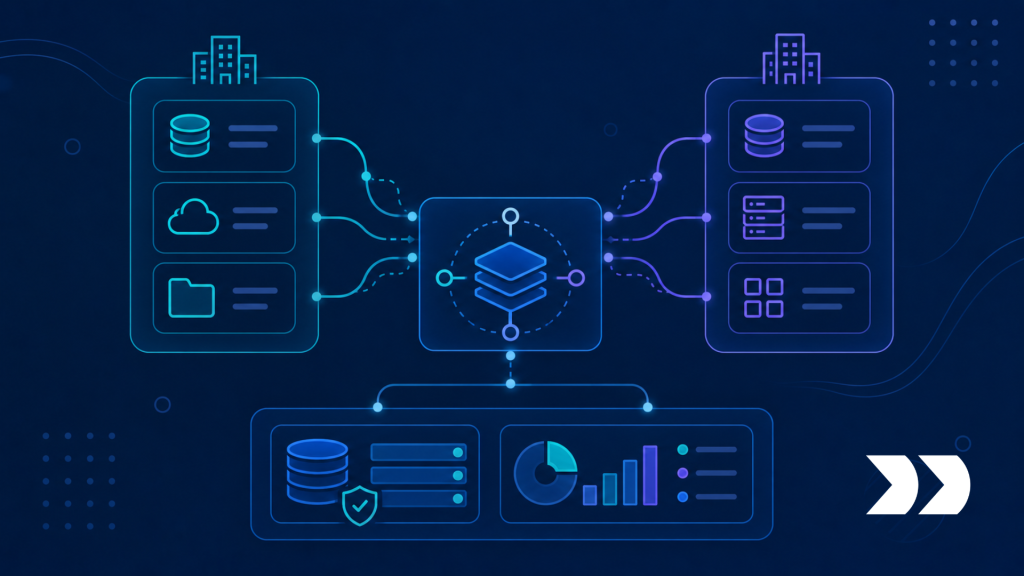
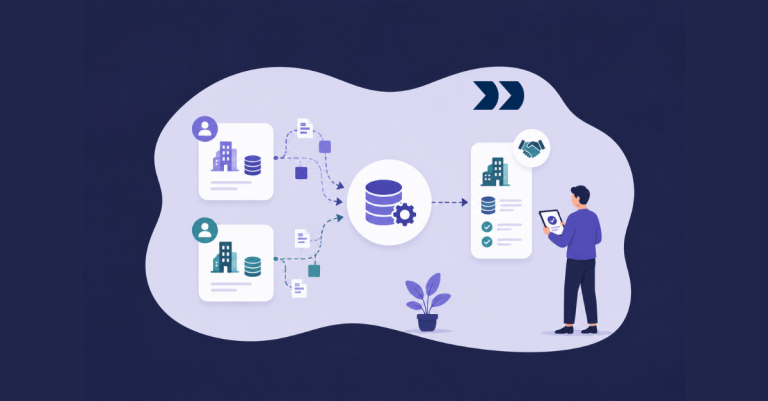
Post-merger system consolidation is where deal strategy becomes operational reality. After close, leadership may expect rapid synergy realization, unified reporting, shared customer visibility, and reduced technology duplication. However, acquired organizations rarely arrive with cleanly compatible systems. ERP platforms, CRMs, data warehouses, billing tools, procurement systems, product databases, analytics models, identity systems, and reporting definitions often differ across the two companies. Post-Merger Data Integration gives integration leaders a structured way to consolidate business-critical data while reducing disruption, protecting governance, and supporting operational continuity.
The System Consolidation Gap After M&A
M&A transactions are often justified by growth, market expansion, cost synergy, product expansion, or capability acquisition. However, the operating value of a deal depends heavily on whether the combined organization can function as one business. Bain’s Global M&A Report 2025 emphasizes that successful dealmaking depends on value creation discipline, not only transaction execution. In practice, that discipline often becomes visible in the post-close integration of systems, data, and operating processes.
The consolidation gap appears when deal teams assume that combining organizations is mostly a legal, financial, or organizational exercise. In reality, post-merger systems often carry incompatible customer records, product taxonomies, supplier files, revenue definitions, contract structures, and reporting logic. Without structured Post-Merger Data Integration, leadership may see consolidated ownership before the business can operate with consolidated intelligence.
Why Post-Merger Systems Rarely Align by Default
Post-merger systems reflect the history of each company. One organization may run Salesforce while another uses Microsoft Dynamics. One may store customer hierarchy at the account level, while another stores it by legal entity. One may use Snowflake for analytics, while another depends on legacy SQL Server environments. Product identifiers, invoice fields, supplier records, and financial dimensions may follow entirely different conventions.
As a result, system consolidation cannot begin with platform migration alone. It requires a clear understanding of how data definitions, workflows, ownership boundaries, and reporting requirements differ between organizations. Otherwise, migration teams may move data into a target platform without resolving the business meaning behind that data. This creates a larger problem: a technically consolidated system that still produces inconsistent operational outputs.
How Data Fragmentation Delays Synergy Realization
Synergy plans often assume that teams can quickly consolidate spend, cross-sell customers, unify reporting, reduce duplicate software, or integrate supply chains. Data fragmentation slows each of these outcomes. Sales teams cannot cross-sell effectively if customer hierarchies are inconsistent. Finance cannot report performance confidently if revenue categories do not align. Procurement cannot consolidate supplier spend if vendor records are duplicated or incomplete.
Consequently, Post-Merger Data Integration becomes a commercial dependency. It allows leadership to see where overlap exists, where systems should remain separate temporarily, and where migration risk is highest. Without this visibility, integration programs may spend months reconciling spreadsheets, debating definitions, or correcting data quality issues after downstream reporting has already lost credibility.
Post-Merger Data Integration as an Operating Layer
Post-Merger Data Integration becomes valuable when it is treated as an operating layer between acquired systems, target platforms, governance controls, and business users. It is not simply a migration exercise. It is the process of making combined data usable for finance, sales, operations, procurement, product, compliance, and executive reporting. PwC’s Global M&A Industry Trends highlights how dealmakers increasingly focus on strategic fit, transformation, and value creation, which raises the importance of integration readiness after close.
The operating layer must support both short-term continuity and long-term consolidation. In the first phase, systems may need to coexist. In the second phase, data may need to be synchronized. Also, In the third phase, selected platforms may be retired. Each phase requires a different system consolidation strategy.
Mapping Critical Data Across Merged Organizations
The first integration challenge is mapping critical data domains. These often include customers, products, suppliers, employees, contracts, invoices, assets, inventory, pricing, orders, opportunities, and financial dimensions. Each domain requires business-level mapping, not only field-level mapping. A customer ID in one system may represent a parent account, while another system may treat each branch as a separate customer.
Effective mapping connects source fields, target fields, transformation rules, ownership, quality thresholds, and reconciliation logic. Tools such as dbt can document transformation models, while metadata systems can preserve data definitions and lineage. This mapping phase helps integration teams understand where data can be consolidated directly and where business rules must be resolved first.
Establishing a Merger Data Consolidation Model
Merger data consolidation requires a model that defines how the combined data will be structured. Some organizations choose a single target system quickly. Others create an interim consolidated data layer while operational systems remain separate. In practice, a common pattern is to build a trusted integration layer in Snowflake, BigQuery, or Databricks before retiring source platforms.
This model allows finance, sales, and operations teams to access consolidated reporting while migration proceeds in controlled phases. It also reduces pressure to force immediate platform replacement before data definitions are stable. The objective is not only faster consolidation. It is a safer consolidation, where business users can trust the outputs before legacy systems are decommissioned.
Connecting System Consolidation Strategy to Business Outcomes
A system consolidation strategy should be driven by business outcomes rather than platform preference. If the priority is unified customer reporting, CRM, and account hierarchy integration may come first. If procurement synergy is the priority, supplier and spend data may lead. Also, If the deal depends on product bundling, product master and pricing data become critical.
This sequencing matters because integration capacity is limited. Trying to consolidate every system at once increases risk. A business-driven strategy prioritizes the data domains that unlock synergy, reduce risk, or improve operating control fastest. It also gives CFOs, CIOs, and integration management offices a clearer way to measure progress beyond technical migration milestones.
Infrastructure Requirements for Post-Merger Data Integration
Post-Merger Data Integration depends on infrastructure that can ingest, transform, validate, reconcile, and govern data across acquired and acquiring company systems. The goal is not to create another temporary data lake filled with raw exports. Integration teams need decision-ready data that supports controlled migration, operational continuity, reporting consistency, and audit readiness. NIST’s Cybersecurity Framework 2.0 is relevant because post-merger integration often expands the enterprise technology surface and requires disciplined governance, identity, access, and risk management.
Post-merger systems frequently include unknown dependencies, unmanaged user access, duplicate integrations, undocumented reporting jobs, and inconsistent data controls. Infrastructure must therefore support both consolidation and risk containment.
Continuous Data Intake Across Acquired and Legacy Systems
Integration teams need controlled intake from ERP, CRM, HRIS, billing, procurement, data warehouse, file storage, application databases, and analytics systems. Apache Airflow can orchestrate extraction jobs, dependency handling, retries, and validation workflows across source systems. Kafka may support event-based synchronization when operational systems must remain active during phased integration.
Continuous intake is especially useful during transition periods. Orders, invoices, customer updates, and support cases continue after close. If integration pipelines depend only on one-time exports, merged datasets become stale quickly. Controlled intake allows teams to maintain current visibility while longer-term acquisition data migration proceeds.
Normalizing Customers, Products, Suppliers, and Financial Data
Normalization is the core of merger data consolidation. Customer names, product SKUs, supplier entities, chart of accounts, cost centers, contract types, sales stages, and invoice categories often differ across companies. Without normalization, combined reporting produces duplication, misclassification, and inconsistent metrics.
Entity resolution, taxonomy mapping, currency conversion, unit standardization, and master data alignment are required before teams can compare performance. Spark can process large data volumes across systems, while dbt can apply documented transformation rules. Normalization converts fragmented post-merger systems into comparable operating data. Without it, system consolidation may reduce software count while increasing reporting confusion.
Validating Integrated Data Before Migration and Reporting
Validation controls prevent poor data from entering target systems or executive reports. These controls should check record completeness, duplicate rates, referential integrity, invalid dates, orphaned records, field type mismatches, currency errors, and reconciliation against source totals. For example, revenue data should reconcile to finance-approved source reports before it is used in consolidated performance dashboards.
Validation should occur before data acquisition and data migration, not only after migration issues appear. Data quality frameworks such as Great Expectations can enforce rules at pipeline gates. Prometheus or data observability systems can monitor pipeline freshness, failure rates, and anomaly patterns. This reduces silent degradation during integration.
Technology Stack Behind Post-Merger System Consolidation
Post-merger consolidation requires a coordinated technology stack that supports extraction, transformation, migration, quality control, governance, and operational reporting. The stack must handle both legacy system diversity and executive urgency. Integration teams often need to deliver consolidated visibility before every operational platform is fully merged. This makes the data integration layer critical.
A mature stack connects orchestration, processing, storage, metadata, data quality, and monitoring. The technologies matter less than the operating discipline around them. However, enterprise integration programs need tools that can operate reliably across high-volume, high-dependency systems.
Orchestration and Data Movement Using Airflow, Kafka, and ETL Pipelines
Apache Airflow can coordinate batch movement across source systems, staging environments, transformation workflows, and target platforms. Kafka can support streaming or near-real-time synchronization for use cases where customer, order, or transaction updates must move quickly between post-merger systems. Traditional ETL and modern ELT pipelines can support both immediate reporting and phased migration.
The important design principle is separation between extraction, transformation, validation, and publication. When these stages are separated, teams can isolate failures, rerun jobs, reconcile outputs, and maintain historical continuity. This is essential during system consolidation, where source systems may change ownership, access patterns, or schema structures during the integration period.
Processing and Transformation Through Spark, dbt, and Data Quality Controls
Processing layers convert raw acquired and legacy data into structured consolidated datasets. Spark can handle high-volume migration workloads, log data, transaction history, and operational records. dbt can manage transformation logic, dependency graphs, testing, documentation, and reusable models for finance, customer, supplier, and product reporting.
Data quality controls should be embedded in transformation workflows. Great Expectations or similar validation frameworks can enforce completeness, uniqueness, accepted values, and cross-table consistency. This ensures that merger data consolidation is not treated as a one-time cleanup exercise. It becomes a repeatable control process that supports migration and reporting.
Storage, Analytics, and Governance in Snowflake, BigQuery, or Databricks
Snowflake, BigQuery, and Databricks can provide consolidated environments where integration teams build common reporting layers before target operational systems are fully merged. These platforms can store source extracts, transformed datasets, reconciliation tables, lineage records, and executive integration dashboards.
Governance controls should include role-based access, audit logs, data lineage, metadata catalogs, retention policies, and source-system documentation. These controls matter because post-merger data often includes sensitive customer, employee, contract, pricing, and financial records. A consolidated platform without governance can create more risk than the fragmented systems it replaces.
Commercial Impact of Post-Merger Data Integration
The commercial value of Post-Merger Data Integration appears when consolidated data accelerates synergy execution, improves reporting confidence, and reduces operational duplication. Strong integration does not guarantee deal success, but weak integration often delays value realization. The combined business needs to know who its customers are, which suppliers overlap, where revenue is concentrated, which products are duplicated, and which systems can be retired safely.
For CFOs, CIOs, and integration management offices, the practical value is decision confidence. Data integration turns deal assumptions into measurable operating visibility. Data integration services for inventory management play a crucial role in optimizing supply chain efficiency. These services enable organizations to maintain accurate stock levels and improve forecasting accuracy. Consequently, businesses can respond more swiftly to market demands and enhance customer satisfaction.
Accelerating Synergy Tracking and Executive Reporting
Synergy tracking requires consistent financial, operational, and customer data. If one company defines revenue by booked orders and another by invoiced sales, consolidated reporting becomes unreliable. If cost categories differ, savings estimates become difficult to validate. Also, If supplier records are duplicated, procurement synergy may be understated or overstated.
Post-Merger Data Integration creates the common reporting foundation needed to track synergy progress. Finance and integration teams can compare planned savings against actual results, monitor integration milestones, and identify where operational barriers are slowing value capture. The result is not just better dashboards. It is stronger executive control over deal execution.
Reducing Duplicate Systems and Operational Overhead
System consolidation can reduce licensing costs, support burden, reporting duplication, and process fragmentation. However, retiring systems too early creates operational risk. Teams need to know which data must be migrated, which integrations depend on the system, which users rely on its reports, and whether target platforms can support the required workflows.
A structured system consolidation strategy helps organizations retire platforms in a controlled sequence. It identifies dependencies, validates migration completeness, and preserves historical access where needed. This reduces the risk of cost-cutting decisions that disrupt operations or weaken audit readiness.
Improving Customer, Supplier, and Product Visibility
Merged organizations often discover that customer, supplier, and product overlap is harder to measure than expected. Different naming conventions, regional structures, legal entities, and product hierarchies obscure the combined view. This limits cross-sell planning, supplier consolidation, account management, and product rationalization.
Post-Merger Data Integration improves visibility by resolving identities and aligning taxonomies across systems. Sales teams can identify shared accounts. Procurement can evaluate supplier concentration. Product teams can compare overlapping SKUs or service lines. Finance can measure revenue and margin across the combined portfolio with greater confidence. Data integration in supply chain management is crucial for achieving operational efficiency. By synchronizing data from various departments, organizations can optimize inventory levels and streamline logistics. This holistic approach not only minimizes costs but also enhances the ability to respond to market changes promptly.
Risk Exposure When Post-Merger Integration Is Weak
Weak integration creates risk long after the deal closes. The organization may operate with duplicated systems, inconsistent reporting, ungoverned data exports, unclear access rights, and unresolved migration defects. These issues reduce synergy realization and increase operational friction. They also create governance exposure because combined data may be used in financial reporting, customer communication, compliance processes, or executive decisions.
The risk is not only technical. It is commercial and institutional. When leadership cannot trust consolidated data, integration decision-making slows.
Delayed Acquisition Data Migration and Business Disruption
Acquisition data migration can disrupt operations if it is poorly sequenced. Migrating customer, supplier, product, or financial records without validation can create duplicate accounts, broken invoices, incorrect pricing, missing history, or reporting gaps. If teams delay migration indefinitely, the organization continues to carry duplicate systems and manual reconciliation efforts.
A controlled migration approach reduces disruption by prioritizing critical domains, validating source-to-target movement, preserving historical records, and reconciling migrated data against source totals. Migration should be treated as a governed workflow, not a bulk data transfer.
Reporting Inconsistency Across Merged Business Units
Reporting inconsistency is one of the most visible signs of weak merger data consolidation. Executives may receive different revenue, customer, margin, or cost figures depending on which source system produced the report. Business units may define pipeline, churn, bookings, or supplier savings differently. This weakens confidence and slows integration decisions.
A common semantic layer, documented definitions, and governed transformation logic reduce this risk. Consolidated reporting should be built from validated data models rather than manually reconciled spreadsheets. Otherwise, integration teams spend more time debating numbers than managing the business.
Governance and Access Risks Across Combined Systems
Mergers expand the access control surface. Employees from both organizations may retain permissions in legacy systems, shared drives, BI tools, SaaS platforms, and databases. Sensitive customer, employee, pricing, and contract data may move through temporary exports during integration. Without governance, these temporary processes can become a permanent risk.
Access reviews, audit logs, metadata catalogs, and data lineage tools should be embedded into the integration program. This helps security, compliance, and IT teams understand who can access which data, how data is moved, and where sensitive records are stored.
Governance Requirements for Merger Data Consolidation
Post-merger systems require governance because integrated data affects financial reporting, customer operations, compliance, cybersecurity, and executive decision-making. Data may come from acquired systems, legacy platforms, third-party applications, flat files, APIs, data warehouses, and manual migration workbooks. Each source carries different ownership, quality, and access constraints. NIST’s Privacy Framework provides a strong reference for managing privacy risk and improving governance around personal data.
In post-merger environments, governance should not wait until systems are fully consolidated. It must guide source discovery, data classification, migration planning, access control, and retention decisions from the beginning.
Source Documentation, Access Controls, and Audit Logs
Integration datasets should include clear documentation of the source system, data owner, refresh cadence, transformation logic, sensitivity level, and known limitations. Access controls should restrict sensitive customer, employee, pricing, contract, payroll, and financial data. Audit logs should record who accessed, transformed, exported, or approved integration datasets.
These controls help integration teams demonstrate that migration and reporting activities are based on approved sources and controlled workflows. They also reduce the risk that temporary integration workarounds create unmanaged copies of sensitive data.
Data Lineage Across Source, Staging, and Target Systems
Data lineage allows teams to understand how each record moved from the source system to the consolidated dataset or target platform. Traceability should cover the extraction source, transformation rule, validation outcome, reconciliation status, migration batch, approval step, and publication destination. This matters because migrated data may be challenged by finance, audit, operations, or customers.
Lineage also supports debugging. If customer revenue appears wrong after consolidation, teams can determine whether the issue came from source data, transformation logic, duplicate matching, currency conversion, or migration rules. This makes integration issues easier to resolve.
Cross-Border and Regulatory Considerations in Acquisition Data Migration
Acquisition data migration may involve customer, employee, supplier, and transaction data across multiple jurisdictions. Privacy laws, data residency expectations, sector regulations, contractual commitments, and cross-border transfer rules may affect how data can be moved or consolidated. This is especially important in regulated industries such as finance, healthcare, insurance, telecom, and public sector contracting.
Cross-border controls should document source rights, processing purpose, storage location, access roles, retention requirements, and transfer basis. Without these controls, integration teams may create compliance exposure while trying to accelerate consolidation.
Evaluating Post-Merger Data Integration Readiness
Post-Merger Data Integration becomes valuable when it supports repeatable consolidation decisions, not simply when data has been exported. Readiness depends on source inventory, data quality, domain mapping, migration sequencing, governance, validation controls, and integration with target systems. Teams should evaluate whether the combined organization has enough data clarity to support reporting, migration, platform retirement, and operational continuity.
A readiness review helps identify where consolidation risk accumulates before integration failures become visible to executives, customers, or regulators.
How Integration Teams Assess Data and System Readiness
A structured assessment should evaluate source systems, data owners, critical domains, field completeness, duplicate rates, master data conflicts, reporting dependencies, integration interfaces, access permissions, and regulatory constraints. It should also review transformation logic, reconciliation methods, data quality thresholds, and migration acceptance criteria.
For post-merger systems, readiness must be evaluated commercially and technically. A dataset may be technically exportable while still being too inconsistent for executive reporting or too poorly governed for migration into a regulated environment.
When Organizations Need a Data Integration Architecture Review
A data integration architecture review becomes useful when teams rely on manual exports, disconnected migration workbooks, unclear system ownership, inconsistent definitions, or fragmented reporting. The review should assess intake workflows, source coverage, mapping logic, validation controls, storage architecture, lineage tracking, governance posture, and target-system readiness.
The output should clarify where data risk accumulates, where merger data consolidation may be incomplete, and which infrastructure improvements would make system consolidation safer, faster, and more defensible. Implementing effective enterprise data delivery solutions can significantly enhance data accessibility across the organization. These solutions streamline the flow of information, ensuring that all stakeholders have timely access to accurate data. Furthermore, adopting such approaches helps in establishing a unified framework for data governance and compliance.
Conclusion: Post-Merger Data Integration as Consolidation Infrastructure
Post-merger system consolidation is not only a technology project. It is the operational foundation for realizing deal value. Internal systems from both organizations remain essential, but they are rarely aligned enough to support unified reporting, customer visibility, supplier consolidation, product rationalization, or platform retirement without structured integration. Post-Merger Data Integration gives organizations a disciplined way to convert fragmented post-merger systems into governed operating data.
Ultimately, organizations that treat integration as data infrastructure, not just application migration, will be better positioned to execute acquisition data migration, reduce duplicate systems, track synergies, and build a more reliable combined enterprise.