
Key Takeaways
- How Order Management Integration improves coordination between OMS, WMS, ERP, ecommerce, marketplace, shipping, and customer service systems
- Why does order system integration require reliable data flows across order capture, inventory allocation, fulfillment, shipping, and returns
- How fulfillment data integration improves warehouse execution, delivery visibility, exception handling, and customer communication
- Why inventory order visibility depends on validation, synchronization, governance, auditability, and consistent item-level data
- How structured integration pipelines reduce overselling, shipment delays, manual reconciliation, and fulfillment reporting gaps
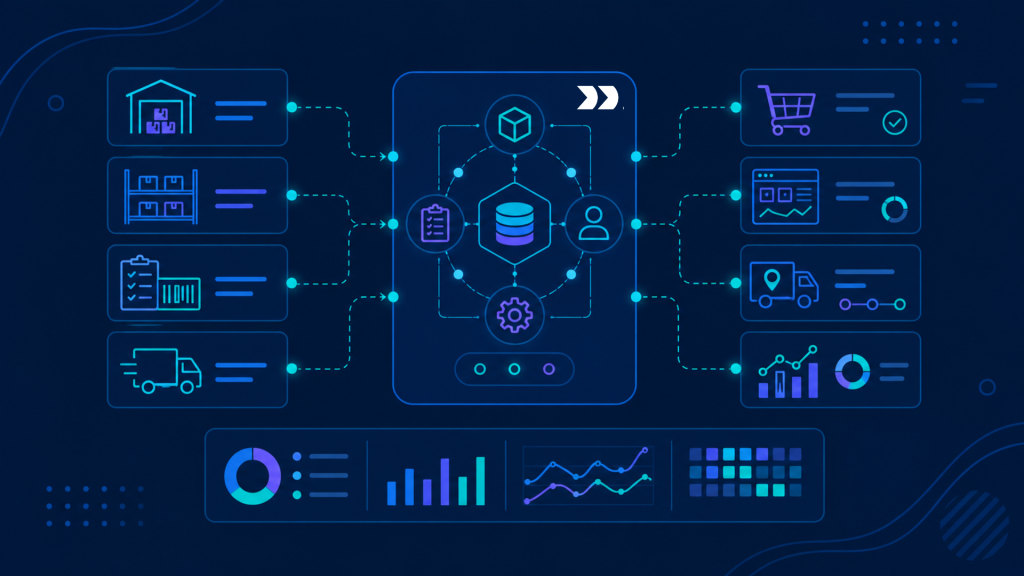
Warehouse and order management systems sit at the center of fulfillment execution. Orders arrive from ecommerce platforms, marketplaces, retail systems, sales channels, EDI feeds, customer service teams, and ERP platforms. Warehouses must then translate those orders into inventory allocation, picking, packing, shipping, returns, substitutions, replenishment, and customer updates. When these systems are disconnected, fulfillment teams work from partial visibility, inventory records become unreliable, and customer-facing teams cannot explain order status accurately. Order Management Integration gives operations, supply chain, finance, ecommerce, and customer service teams a structured way to connect order data, warehouse activity, and inventory signals into one operational workflow.
The Visibility Gap Between Orders, Inventory, and Fulfillment
Warehouse and order management teams often operate across systems that were implemented for different purposes. An order management system may control order orchestration and customer status. A warehouse management system may control picking, packing, receiving, and inventory movement. ERP may control financial posting, inventory valuation, purchasing, and invoicing. E-commerce and marketplace platforms may control customer-facing order creation. Shipping systems may control carrier labels, tracking numbers, and delivery updates.
This creates a visibility gap. A customer-facing team may see that an order was placed, but not whether it was allocated. A warehouse team may see a pick task, but not why the order was prioritized. Finance may see shipped revenue, but not the fulfillment exception that delayed invoicing. ASCM’s SCOR Digital Standard is a useful context because it frames modern supply chain activity around connected planning, ordering, fulfillment, returns, and orchestration processes.
Why Order and Warehouse Systems Drift Apart
Order and warehouse systems drift apart because they manage different moments in the fulfillment lifecycle. The OMS may accept orders, split shipments, apply business rules, route orders to facilities, manage cancellations, and send updates to customers. The WMS executes physical work: receiving, inventory movement, location management, wave planning, picking, packing, staging, and shipping confirmation.
These systems often use different identifiers, statuses, timestamps, and item definitions. The OMS may classify an order as “ready to fulfill,” while the WMS sees missing inventory or a blocked pick path. The WMS may mark a shipment complete, while the OMS waits for tracking confirmation from the carrier. Order Management Integration must reconcile these state changes so every team understands the same fulfillment reality.
How Disconnected Fulfillment Data Affects Operations
Disconnected fulfillment data creates delays, manual work, and customer-facing uncertainty. A retailer may oversell because the marketplace inventory was not updated quickly enough. A distributor may promise delivery based on ERP inventory, while warehouse inventory is reserved for another order. A customer service team may tell a customer the order is processing when the warehouse has already flagged an exception.
Consequently, order system integration becomes an operational control mechanism. It helps prevent promises from being made on outdated data. It also gives operations leaders a clearer view of where orders are blocked, which facilities are constrained, and where inventory allocation rules need review.
Order Management Integration as an Operating Layer
Order Management Integration becomes valuable when it operates as a governed layer between order capture, inventory control, warehouse execution, shipping, returns, and financial systems. The goal is not simply to move order records between applications. The goal is to create a trusted operational flow that allows teams to understand order status, inventory availability, fulfillment progress, shipment movement, and exception risk.
This operating layer should define which system owns each status, which changes trigger downstream updates, which exceptions require human review, and which data is published to customers. Without these rules, integration can spread incomplete or incorrect order information faster across the enterprise.
Defining Source Ownership Across the Order Lifecycle
Source ownership is the foundation of reliable Order Management Integration. E-commerce platforms may own customer checkout details and payment authorization. OMS platforms may own order orchestration, split shipment rules, cancellations, and customer-visible status. WMS platforms may own pick status, pack status, warehouse exceptions, and shipment readiness. ERP may own invoicing, inventory valuation, procurement, and financial posting.
Clear ownership prevents conflicting updates. For example, a warehouse should not independently change customer payment status, and an e-commerce platform should not override warehouse-confirmed shipment completion without validation. The integration layer should preserve each system’s role while creating shared visibility across the full order lifecycle.
Creating a Common Order, Item, and Inventory Model
A common order model connects order IDs, line items, SKUs, quantities, locations, inventory status, fulfillment method, shipment groups, carrier data, and customer commitments. This model does not require every system to store data identically. However, it does require consistent relationships between orders, items, inventory pools, and fulfillment events.
Item-level consistency is especially important. A SKU may appear differently across e-commerce, ERP, WMS, and marketplace systems. Product bundles, kits, substitutions, units of measure, and regional item codes can complicate fulfillment. A shared model helps teams understand which item was sold, which item was allocated, which item was picked, and which item was shipped.
Connecting Fulfillment Data Integration to Customer Experience
Fulfillment data integration affects customer experience directly. Customers expect accurate order status, delivery estimates, tracking updates, backorder notifications, return status, and refund timing. If internal systems disagree, customers receive inconsistent messages or delayed updates.
A connected fulfillment data layer allows customer service teams to see warehouse status, carrier status, inventory exceptions, and return progress without switching across multiple systems. It also supports proactive communication. If an order is delayed because an item failed quality inspection or inventory was reallocated, the organization can detect and communicate the issue earlier.
Infrastructure Requirements for Order System Integration
Order system integration depends on infrastructure that can collect, validate, synchronize, and monitor data across OMS, WMS, ERP, ecommerce, marketplace, shipping, and customer service systems. The objective is not to create a brittle point-to-point connection. Operations teams need a controlled pipeline that handles schema changes, retries, exception queues, source ownership, validation logic, and audit records.
Order and warehouse data is time-sensitive. Inventory availability can change within minutes. Carrier labels can fail. Orders can be modified, canceled, split, or returned. Integration infrastructure must therefore support both speed and control. GS1 standards are relevant because standardized identifiers and data exchange practices help supply chain partners improve consistency across products, locations, shipments, and trading relationships.
Continuous Data Intake Across OMS, WMS, ERP, and Channels
Order data may enter through ecommerce platforms, marketplaces, retail POS systems, EDI feeds, customer service tools, subscription platforms, ERP systems, and B2B portals. Warehouse data may come from WMS, labor management systems, robotics platforms, scanners, carrier systems, yard management tools, and returns systems. Continuous intake captures these signals with source, timestamp, status, and validation context.
Apache Airflow can orchestrate scheduled ingestion and reconciliation workflows, while Kafka can support event-driven updates for high-value events such as order creation, inventory reservation, pick completion, shipment confirmation, and return receipt. Controlled intake helps teams avoid stale order status and delayed inventory updates.
Normalizing Orders, SKUs, Locations, and Fulfillment Status
Raw order and warehouse data is rarely consistent across systems. One system may use “allocated,” another “reserved,” and another “committed.” A warehouse may define shipped status when a package leaves the dock, while an OMS may define shipped status when a carrier tracking number is confirmed. Locations may be defined by facility, zone, bin, store, supplier, or third-party logistics partner.
Normalization aligns order IDs, SKUs, quantities, units of measure, inventory states, warehouse locations, fulfillment statuses, carrier events, return statuses, and customer-facing milestones. Spark can process high-volume order and inventory data, while dbt can manage repeatable transformation logic and documentation. This allows teams to analyze fulfillment performance from consistent definitions.
Validating Order and Inventory Data Before Operational Use
Validation controls prevent incorrect order and inventory data from entering downstream workflows. These controls should check duplicate orders, missing line items, invalid SKUs, unavailable inventory, mismatched quantities, blocked customer accounts, incomplete shipping addresses, missing carrier services, and inconsistent status changes.
Validation should occur before orders are released to warehouses, inventory is published to sales channels, or customer-facing status updates are sent. Data quality frameworks such as Great Expectations can support rule-based checks for completeness, accepted values, referential integrity, and cross-system consistency. Without validation, order integration can accelerate fulfillment errors.
Technology Stack Behind Warehouse and Order Management Integration
Warehouse and order management integration requires a technology stack that can move operational data quickly while preserving accuracy and governance. The stack must support transactional events, batch reconciliation, warehouse execution data, product master data, carrier updates, inventory adjustments, and returns processing.
A mature integration environment connects OMS, WMS, ERP, ecommerce, marketplaces, 3PL systems, shipping platforms, BI tools, and customer service systems into repeatable workflows. It should reduce manual coordination without weakening operational controls around inventory, fulfillment, and revenue recognition. Enterprise data delivery services overview can enhance the connectivity between various systems, ensuring that information flows seamlessly across the organization. By leveraging advanced data pipelines, businesses can achieve real-time visibility into their operations, enabling quicker decision-making and improved efficiency. These services are essential for maintaining data integrity while scaling operations in a rapidly changing market.
Orchestration and Connectivity Using Airflow, Kafka, APIs, and EDI
Order system workflows may use APIs, EDI, webhooks, secure file transfer, event streams, and middleware connectors. Airflow can coordinate recurring workflows for order reconciliation, inventory refreshes, shipment reporting, and return updates. Kafka can support event-based movement when order status, inventory allocation, or shipment confirmation needs rapid downstream visibility.
EDI remains important in B2B order environments for purchase orders, order acknowledgments, advance shipment notices, and invoices. APIs are common in e-commerce, marketplaces, carrier systems, and modern warehouse platforms. The integration architecture should support both because warehouse and order ecosystems usually include partners with different technical maturity.
Processing and Transformation Through Spark, dbt, and Fulfillment ETL Pipelines
Processing layers convert raw operational events into structured fulfillment datasets. Spark can process high-volume orders, inventory snapshots, shipment events, warehouse scans, returns, and exception logs. dbt can manage standardized transformation models for order lifecycle reporting, fulfillment performance, inventory availability, and customer status visibility.
Fulfillment ETL and ELT pipelines can resolve product identifiers, classify order types, map warehouse locations, standardize status codes, align shipment events, calculate fulfillment cycle time, and connect orders to invoices. This makes inventory order visibility repeatable rather than dependent on manual exports from the warehouse and e-commerce systems.
Storage, Analytics, and Governance in Snowflake, BigQuery, or Databricks
Snowflake, BigQuery, and Databricks can support integrated fulfillment intelligence layers where operations, finance, ecommerce, and customer service teams analyze order flow, inventory availability, shipment performance, returns, and exceptions. These platforms can store order history, inventory snapshots, fulfillment events, validation logs, carrier updates, and reconciliation outputs.
Governance controls should include role-based access, audit logs, metadata catalogs, data lineage, retention rules, source documentation, and exception history. These controls matter because order and warehouse data influence customer commitments, inventory valuation, revenue timing, carrier performance, and operational planning.
Commercial Impact of Order Management Integration
The commercial value of Order Management Integration appears when order, inventory, and fulfillment visibility become more reliable. Better integration can reduce overselling, improve shipment accuracy, shorten exception resolution, support customer communication, and reduce manual reconciliation across operations and finance. The result is not simply faster system communication. It is better to have operating control across the fulfillment lifecycle.
For COOs, supply chain leaders, ecommerce teams, CFOs, and customer service leaders, the practical value is confidence. Integrated order data helps teams understand which orders are open, which are allocated, which are delayed, which are shipped, and which require intervention.
Improving Inventory Order Visibility
Inventory order visibility improves when teams can connect available inventory, reserved inventory, allocated inventory, picked inventory, shipped inventory, and returned inventory in one data model. Without this connection, teams may rely on ERP inventory that does not reflect warehouse reservations or marketplace inventory that does not reflect recent sales.
Integrated visibility helps prevent overselling and underpromising. It also supports better allocation decisions across warehouses, stores, 3PLs, and suppliers. When inventory status is synchronized with order demand, teams can make more reliable fulfillment promises.
Reducing Fulfillment Exceptions and Manual Escalations
Fulfillment exceptions often occur when data is incomplete or inconsistent. A warehouse may receive an order with an invalid SKU. A shipment may fail because the address is incomplete. A carrier label may not generate because service rules are missing. A return may not match the original order record. Each exception creates manual work.
Fulfillment data integration helps identify these issues earlier through validation and exception queues. Teams can route problems to the right owner before they affect customer delivery. This reduces avoidable escalations across the warehouse, customer service, ecommerce, and finance teams.
Supporting Better Customer and Revenue Operations
Order Management Integration supports customer and revenue operations by connecting fulfillment status to customer communication and financial workflows. Customer service can see where an order stands. Finance can connect shipped orders to invoicing. E-commerce teams can understand cancellation and backorder patterns. Sales teams can see whether B2B orders are delayed or partially fulfilled.
This creates a more reliable connection between customer promise, warehouse execution, and financial outcome. It also reduces the number of internal teams needed to answer basic order status questions.
Risk Exposure When Order Systems Are Disconnected
Disconnected order and warehouse systems create operational, financial, and customer experience risk. Orders may be accepted without inventory. Inventory may be reserved but not reflected in sales channels. Shipments may occur without customer notification. Returns may be received without the workflow activation. Finance may recognize revenue based on incomplete fulfillment status.
The risk grows as order volume, channel complexity, warehouse network size, and product variety increase. Manual coordination may work with limited volume, but it becomes fragile when organizations operate across marketplaces, ecommerce stores, retail locations, 3PLs, and B2B fulfillment flows.
Overselling, Stockouts, and Allocation Errors
Overselling occurs when sales channels display inventory that is no longer available. Stockouts occur when demand exceeds available or properly allocated inventory. Allocation errors occur when inventory is reserved for the wrong customer, channel, warehouse, or priority tier. These problems often originate from delayed or inconsistent data synchronization.
Order Management Integration reduces this risk by connecting order capture, inventory reservation, warehouse execution, and channel updates. It also helps teams define allocation rules that reflect commercial priorities, customer commitments, and operational constraints.
Shipment Delays and Customer Communication Gaps
Shipment delays become more damaging when customer-facing systems do not reflect warehouse reality. If a pick exception, carrier issue, address error, or inventory shortage occurs, customer service and ecommerce systems need timely updates. Otherwise, customers receive outdated order status or no explanation at all.
Fulfillment data integration gives customer-facing teams earlier visibility into warehouse exceptions and shipping events. This supports more accurate communication and reduces avoidable support volume. Canonical data model concepts explained can help in structuring data efficiently across various systems. By leveraging these concepts, organizations can ensure that all departments are aligned and communicate effectively, minimizing discrepancies. Ultimately, a well-defined data model enhances decision-making and optimizes overall operational performance.
Governance Gaps in Order and Fulfillment Data
Order and fulfillment data can create governance issues if sources, transformations, and ownership are unclear. Teams may use order data for customer communication, revenue reporting, inventory planning, carrier performance analysis, and operational forecasting. If the data cannot be reproduced or explained, confidence declines.
NIST’s Cybersecurity Framework 2.0 provides a strong governance reference because it emphasizes risk management, asset visibility, access control, monitoring, and governance across enterprise systems. These principles apply when order, warehouse, and customer data move across operational platforms and external partners.
Governance Requirements for Warehouse and Order Data
Warehouse and order data must be governed because it affects customer commitments, inventory control, revenue timing, shipment execution, returns, and financial reporting. Data may come from ecommerce platforms, OMS, WMS, ERP, carrier systems, 3PL portals, EDI networks, customer service platforms, and marketplace feeds. Each source has different ownership, reliability, and update cadence.
Governance should make operational data more usable, not slower. The goal is to give teams trusted fulfillment visibility while ensuring that sensitive customer, inventory, pricing, and shipment data is protected and traceable. Data integration strategies for suppliers are essential for ensuring seamless communication across various platforms. By implementing effective integration methods, organizations can improve data accuracy and reduce discrepancies in order processing. This also fosters better relationships with suppliers, ultimately enhancing overall supply chain efficiency.
Source Documentation, Access Controls, and Audit Logs
Order datasets should document source system, field ownership, refresh cadence, transformation logic, status definitions, and known limitations. Access controls should restrict sensitive customer data, pricing information, payment references, shipment details, and operational performance data. Audit logs should record who accessed, changed, exported, or approved order and inventory records.
These controls help operations, finance, and customer service teams demonstrate that fulfillment decisions are based on approved data. They also reduce the risk that sensitive order data moves into uncontrolled spreadsheets or unauthorized tools.
Data Lineage Across Orders, Inventory, and Shipments
Data lineage allows teams to understand how an order moved from capture to fulfillment to financial reporting. Traceability should cover order creation, inventory reservation, warehouse release, pick status, pack status, shipment confirmation, carrier tracking, invoice posting, and return processing. This matters because order status may be challenged by customers, finance, operations, or external partners.
Lineage also supports debugging. If an order appears shipped in one system but open in another, teams can determine whether the issue came from source data, synchronization timing, status mapping, carrier confirmation, or transformation logic.
Multi-Warehouse and Multi-Channel Considerations
Order Management Integration becomes more complex across multiple warehouses, stores, marketplaces, brands, sales channels, currencies, and fulfillment partners. A product may be available in one warehouse but restricted from another channel. A marketplace order may require a different shipment confirmation process than a direct e-commerce order. A B2B order may require partial shipment rules that do not apply to consumer orders.
Multi-channel controls should document source ownership, inventory allocation logic, channel rules, warehouse priorities, shipping method constraints, and customer notification requirements. This reduces the risk that integration works technically but fails operationally across channels.
Evaluating Order Management Integration Readiness
Order Management Integration becomes valuable when it supports repeatable fulfillment workflows, not simply when systems can exchange files. Readiness depends on source inventory, data ownership, SKU mapping, order status definitions, inventory synchronization, validation controls, governance, and workflow integration. Teams should evaluate whether order data can move reliably from capture to allocation, fulfillment, shipping, invoicing, and returns.
A readiness review helps identify where fulfillment risk accumulates before it becomes delayed shipments, overselling, customer complaints, or revenue reconciliation problems.
How Teams Assess Order and Fulfillment Data Quality
A structured assessment should evaluate duplicate orders, missing line items, invalid SKUs, inventory mismatch rates, shipment status accuracy, return matching, carrier event completeness, address quality, and status freshness. It should also review field ownership, update cadence, failed sync jobs, exception volume, and reconciliation differences between OMS, WMS, ERP, and sales channels.
For fulfillment data integration, data quality must be evaluated operationally. An order record may look complete in one system while still failing to support warehouse release, carrier label generation, customer updates, or invoice posting.
When Organizations Need an Order Integration Architecture Review
An order integration architecture review becomes useful when teams rely on manual order exports, disconnected warehouse systems, inconsistent inventory records, delayed shipment updates, or reports that do not reconcile. The review should assess source coverage, integration flows, transformation logic, validation controls, sync cadence, storage architecture, lineage tracking, governance posture, and exception handling.
The output should clarify where order data risk accumulates, where inventory order visibility may be incomplete, and which infrastructure improvements would make order system integration more reliable for operations, finance, ecommerce, and customer service teams.
Conclusion: Order Management Integration as Fulfillment Infrastructure
Warehouse and order management depend on reliable data movement across OMS, WMS, ERP, ecommerce, marketplaces, carrier systems, customer service platforms, and finance tools. When these systems remain disconnected, teams spend excessive time reconciling orders, resolving inventory mismatches, correcting shipment updates, and investigating fulfillment exceptions. Order Management Integration creates the governed data foundation needed to coordinate order system integration across the fulfillment lifecycle.
Ultimately, organizations that treat order integration as fulfillment infrastructure, not just application connectivity, will be better positioned to improve fulfillment data integration, strengthen inventory order visibility, reduce manual handoffs, and make warehouse and order management operations more reliable across the enterprise.