
Key Takeaways
- An enterprise web scraping SLA should measure accepted data delivery, not merely collector or API uptime. The contract needs a business-job definition, effective source scope, original deadline, acceptance policy, and consumer boundary.
- Define the denominator before negotiating a percentage. A provider that omits difficult sources from its schedule can appear compliant unless expected work is reconciled against the approved source registry.
- Completed empty, completed late, and unresolved are different outcomes. A verified no-result search is valid work; a failed collection is not proof that a flight, room, or product is unavailable.
- Keep quality, timeliness, and source completeness separately enforceable. A high global completion rate can conceal missing strategic markets or incorrect prices.
- A workable agreement needs evidence and a response mechanism. Reporting periods, customer-verifiable manifests, incident notices, corrective maintenance, recovery limits, and negotiated remedies matter as much as the headline target.
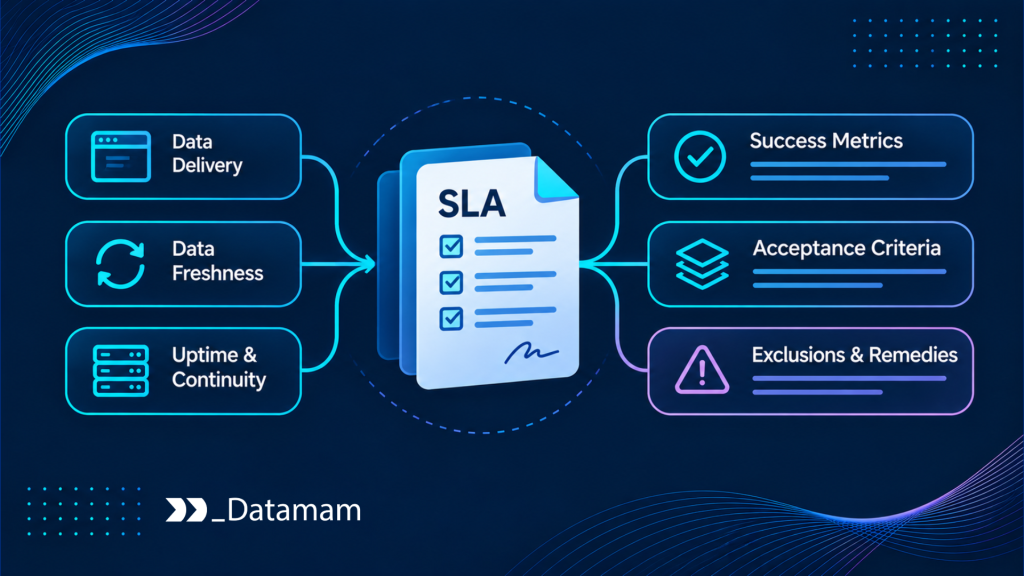
A buyer can sign a 99.9% web scraping uptime promise and still receive an incomplete competitor-price feed. The collection endpoint might remain reachable while a source redesign changes the meaning of a price, a country-specific search fails, or the accepted data never loads into the customer’s warehouse. Uptime tells the buyer little about those outcomes.
A web scraping service level agreement should instead specify the data obligation the customer intends to use. That means which source and business-record population is covered, what constitutes an accepted result, how quickly it must be available, how defects are measured, and what happens after a failure. Those terms must be realistic for the sources, legally appropriate, and capable of independent verification. This article is a procurement and engineering drafting guide, not legal advice or a statement of Datamam’s standard contract.
An SLA Should Protect the Business Data Obligation
Service availability is different from accepted output
A collector can be online without doing useful work. A network request can succeed with a challenge page or partial source response. A parser can output rows with the wrong currency or product variant. A file can arrive at cloud storage without loading into the target warehouse. A useful SLA must reach beyond each of those intermediate signals.
For a recurring feed, the primary obligation should be framed around eligible scheduled business jobs with accepted outcomes available by a defined deadline. Infrastructure uptime, request error rates, worker capacity, and retry counts remain essential operational diagnostics, but they do not replace the business-level measure. This follows the general logic in Google SRE’s guide to service-level objectives: measure the service behavior the user depends on, then choose a target and consequences that fit the need.
For some services the deliverable is a raw HTML archive; for others it is normalized offers, current inventory, or historical changes. The agreement must identify which. A contract for page retrieval should not be assumed to promise entity matching, and a contract for a managed analytics-ready feed should not quietly stop at HTTP response delivery.
Clear scraping data delivery specifications should define the expected output schema, delivery format, update frequency, validation requirements, acceptance criteria, and procedures for handling missing or rejected records. These specifications help ensure that service-level commitments reflect the quality and reliability of delivered data, not just successful collection attempts.
Separate service-level indicators, objectives, and agreement terms
A service-level indicator (SLI) is a precisely defined measurement. A service-level objective (SLO) is the agreed target for that indicator. A service level agreement (SLA) turns selected objectives into commercial obligations, including how performance is reviewed and what follows a miss. The terms are related, but a dashboard metric is not automatically a contractual warranty.
| Contract element | Enterprise scraping illustration | Decision required |
| SLI | Accepted on-time business jobs divided by eligible jobs due | Grain, denominator, destination boundary, counting rules |
| SLO | A negotiated minimum over an agreed reporting period | Target, period, per-source conditions |
| SLA | A written commitment with reporting, exclusions, and remedies | Notice, cure, escalation, evidence, financial or operational consequences |
Do not copy a generic 99% or 99.9% number into a web data contract simply because it appears in infrastructure agreements. Derive a feasible objective from representative sources, business deadlines, permitted access, and the cost of missed work. Preserve the technical measurement definition in an exhibit so a legal or commercial edit does not change what engineers measure.
Specify which source populations and delivery streams are covered
An enforceable scope names the authorized sources, geographies, relevant URLs or discovery rules, required page families, business-record grain, frequency tiers, mandatory fields, and destination streams. It should specify whether new sources, countries, or page variants enter automatically or require a change request.
A tour-monitoring engagement in Datamam’s project records separated departure pricing, metadata, and search-position captures. They had respective 12-hour, 24-hour, and 30-minute deadlines. Combining those streams into one SLA would allow good metadata delivery to mask failed visibility captures. An enterprise agreement should maintain separate obligations when use cases, clocks, or acceptance rules materially differ.
Define One Measurable Unit of Work
A scheduled source-job identity with required context
Start with a durable business-job key, not a URL or request identifier. An airline job might include source, origin, destination, departure date, passenger mix, cabin, point-of-sale country, currency, and scheduled window. A hotel job might include canonical property, source, check-in and check-out dates, guests, room or rate context, and required observation window.
Each due job should retain the original key through retries and reprocessing. Multiple HTTP requests remain technical attempts under one business obligation. A single job returning five fares counts once for search completion and five times, if valid, in the separate accepted-fare observation population. This avoids a provider improving its completion percentage by increasing retry traffic or multiplying output rows.
Eligibility, effective configuration, and fixed reporting period
The denominator must be generated independently from the accepted monitoring configuration. Record when each source or item enters or leaves the eligible population, which time zone governs the windows, and which approved refresh tier applies. The reporting period should be fixed (for example, a calendar month), with a clearly defined recovery cutoff that does not alter past deadlines.
A useful measurement exhibit specifies:
- Eligible jobs due: all approved business obligations in force for the period, including those a scheduler failed to admit.
- Accepted on time: eligible jobs with a validated terminal outcome available to the agreed consumer by the original deadline.
- Accepted late: eligible jobs validated and published after the deadline but before the stated recovery cutoff.
- Unresolved: remaining jobs without an accepted terminal outcome at the cutoff.
- Approved exclusions: narrowly defined and documented cases under the contract, applied consistently to the denominator and disclosed by reason.
Those categories should reconcile exactly. If 10,000 jobs were due, 9,700 completed on time, 200 completed late, and 100 remained unresolved, on-time completion is 97% and recovery-cutoff completion is 99%. The 200 recovered jobs cannot make the on-time rate 99%; they answered a different question. These figures are an illustration, not Datamam’s actual SLA or performance claim.
Required fields, valid empty results, and unresolved outcomes
Every job needs a terminal-state schema: accepted with records, accepted completed-empty, explicitly unsupported under the agreed conditions, unresolved retrieval, unresolved parsing, unresolved business-context validation, and, if applicable, approved source exclusion. The precise categories depend on the feed. Missing fields should be typed as unknown, unavailable, not applicable, or extraction failure where those meanings differ. Datamam’s documented airline workload illustrates the scale of the distinction: within 19,564,667 scheduled searches, 4,769,809 finished correctly with no qualifying itinerary, while 32,439 remained unresolved after recovery. Counting the first group as failures would understate service completion; counting the second group as no flights available would give clients false market intelligence. A good SLA defines the acceptance evidence for empty outcomes before operations begin.
Write Timeliness Terms the Consumer Can Verify
Observation window versus publication deadline
An observation window defines when a business fact should be checked; a publication deadline defines when the accepted outcome must reach the consumer. The agreement should say whether the deadline begins at a scheduled-window start, the observed event time, a source publication timestamp, or another explicit point. It also needs the applicable time zone and treatment of calendar boundaries and daylight saving changes.
A daily price feed can be collected at 04:00 and made available by 08:00, but the two times express different duties. A four-hour update promise can mean “attempt each item every four hours,” “capture each item in a four-hour window,” or “make an accepted observation available every four hours.” These are not equivalent. State the accepted observation age and the downstream deadline separately where the business requires both.
Consumer availability rather than file upload success
A supplier may mark a batch complete when it reaches object storage. The customer may not receive usable data until validation, warehouse loading, schema acceptance, and publication are finished. Decide which system owns the final measured boundary and how both parties can verify it.
For example, a receiving BigQuery table might be considered delivered only when a named release has loaded, passed row and schema reconciliation, and is queryable under the accepted data view. Google Cloud’s batch-loading documentation explains the semantics of loading batch data and the atomicity of load jobs; it does not itself guarantee a customer’s entire downstream transformation or merge. Contractually, responsibility can end at storage, loading, or the accepted consumer view, but the endpoint must be explicit.
Late recovery, cutoff, and historical timestamps
Recovery should have its own bounded interval and outcome measure. A late accepted result remains late against its original obligation. The contract may allow late delivery to improve historical completeness, mitigate remedies, or fulfill a separate target, but it should not rewrite an earlier on-time performance result.
Preserve the original scheduled time, actual source capture time, business acceptance time, and consumer publication time. Replaying stored evidence from the original time can recover a historical observation. A new collection performed after the deadline measures a different point in time and should not be inserted as an earlier market price. The agreement should state when re-collection is an acceptable substitute and when a missed historical value remains permanently unknown.
Make Quality Acceptance Explicit
Required-field coverage and approved value interpretation
Data quality is more than non-null columns. Define mandatory and conditional fields, types, normalization rules, identity keys, allowed value ranges, currency and unit context, source provenance, duplicate criteria, and accepted handling for absent values. Write the rules at the record grain the customer uses.
A retail price can be present yet wrong because it describes a different seller, pack quantity, or delivery country. A hotel rate can be a valid numeric value while confusing total-stay charges with nightly charges. ISO/IEC 25012 supplies a general data quality model for structured information and for establishing evaluation criteria, but the contract must still translate the framework into the specific customer’s fields and decisions.
Separate schema validity, completeness, semantic accuracy, and identity or comparison correctness. A feed can pass one and fail another. Where fields are inherently ambiguous, agree how the provider flags ambiguity and when a human decision or rule revision is required.
Sampling design, exclusions, and correction handling
A contractual accuracy metric needs a defined review population and method. Specify the sampling frame, whether selection is random or stratified, how critical sources and difficult edge cases are represented, what counts as a discrepancy, who adjudicates disagreements, and how corrected records are re-delivered. A rule allowing the provider to exclude all ambiguous offers from the quality denominator may create a clean percentage while destroying useful coverage.
Datamam’s documented airline project separately sampled 12,500 accepted fare observations and found 26 discrepancies, producing 99.79% observed sample agreement. That was a first-party quality-review result for that sample, not a guaranteed accuracy percentage for every record. It cannot be substituted for search completion, and it does not remove the need to negotiate the sampling plan for a new feed.
If a quality breach is found, decide whether correction changes historical interpretation, supersedes an accepted record, or requires a fresh observation. Keep audit trails and release versions so the customer can reverse an incorrect value without mistaking a parser repair for a real-world price change.
Source-level thresholds for strategically important populations
A global on-time completion target can be met even when one essential source is absent. For pricing, the missing source may be the only competitor in a region. For compliance or research data, one jurisdiction can be mandatory regardless of its record volume. A source-level minimum or mandatory-source condition may therefore be more useful than raising the aggregate target by a fraction of a percentage point.
Define which sources or categories are critical, which thresholds apply to them, and how approved maintenance or lawful source unavailability is treated. Avoid declaring every source “critical,” which can make the schedule impossible to operate. The key is to translate genuine business impact into a limited set of separately reported constraints rather than rely on volume-weighted averages alone.
Specify What Happens When Sources Change
Template changes, access interruptions, and data-semantic changes
Source changes are not one event class. A selector or template change can break parsing while leaving data accessible. An access interruption can prevent authorized retrieval even when the parser remains valid. A source may also change what a field means, such as moving from tax-inclusive to tax-exclusive price presentation. The last category is especially risky because the output may look healthy while becoming commercially incorrect.
An SLA should require a distinct incident class and handling path for these conditions. Corrective maintenance for existing agreed fields and templates can be in scope, while adding a new region, legally unavailable source, or different business field may require formal change control. The dividing line must be written, not inferred whenever a source changes.
Incident classification and notice to the buyer
An incident notice should state which scope was affected, what has been observed, whether accepted output is missing or only delayed, whether stale values remain in use, when the issue began, and what the provider is doing next. It should avoid asserting that prices or availability disappeared when the underlying source simply could not be verified.
Severity should follow business impact. An outage of a single optional source might warrant a routine ticket; missing an entire mission-critical geographic feed may warrant rapid escalation. The contract can specify acknowledgement and update intervals, but they should be feasible and tied to the customer’s operating hours and decision windows. Notice of an incident is not a substitute for the underlying delivery obligation unless expressly agreed.
Change requests versus corrective maintenance within scope
One practical boundary is to treat repairs required to keep the agreed output working under unchanged business requirements as corrective maintenance, while treating a new data requirement, additional source, or expanded geographic population as a change request. The agreement should also acknowledge genuine impossibility or restrictions where lawful collection cannot continue as planned.
A documented Datamam industrial-catalog takeover shows why the distinction matters. The service operated 56 sources and 6.8 million source items, with controlled source-by-source migration into the client’s existing schema. When one vendor template changed a field, publication for the affected source and field contract was paused while other source deliveries continued. That outcome supports a contract design with source-specific incident reporting and partial-service handling; it does not establish a universal Datamam remedy or warranty.
Protect Against Misleading Missing and Stale Data
A completed empty search versus unknown availability
A completed-empty result is an accepted statement about the specific search or business question. An unresolved result means the service lacks sufficient evidence to answer it. The SLA should require separate machine-readable states and prevent one from being silently substituted for the other.
For example, a complete room search under specified guest, date, room, and policy filters may correctly return no qualifying rate. A blocked or partially loaded search cannot prove the hotel is sold out. Similarly, a product-page timeout cannot justify an out-of-stock flag. Define the required acceptance evidence and whether unsupported source states count as valid terminal outcomes or documented exceptions.
Current records with visible observation age
The current-data view must expose when the underlying source was actually observed. Useful fields include observed_at, published_at, scheduled_window, last_refresh_status, source_id, and record_revision. When Tuesday’s check fails, Monday’s accepted record can remain historical, but it should not be presented as a new Tuesday observation.
One possible data freshness SLA measures whether the latest accepted consumer-visible observation for each required item is younger than an agreed threshold at the relevant evaluation time. This is not identical to completion rate: one delayed source may leave several stale records, while a completed-empty search can legitimately change the current availability state. A freshness report should show missing source groups and unknown states, not just a favorable median age.
Withholding or labeling defective partitions
A provider may choose to withhold an invalid partition, publish a clearly labeled partial release, or keep a previous accepted version in the consumer view. Which option is appropriate depends on whether stale-but-correct data is safer for the client than absent data. The agreement should define this behavior for critical fields and sources.
Withholding must not become a way to remove failures from the SLA denominator. Every expected partition remains due even if it was blocked by quality gates. If a partial release is permitted, the manifest must show affected sources, counts, missing windows, validation status, and the revision that will supersede it. The consumer should never have to infer source completeness from the mere existence of a file.
Define Escalation and Remediation Without Making False Guarantees
Named incident severity and response ownership
Give each incident class a clear owner, decision authority, acknowledgement window, communication route, and escalation path. The collection provider might own source-adapter diagnostics and reparsing; the customer might own downstream business-rule approval or its independently operated warehouse permissions. If responsibilities are split, the SLA should explain how a disputed failure is measured without allowing either side to leave the record unclassified.
Severity can be based on affected critical sources, expected-job loss, observed data defects, and time remaining before deadlines. Avoid vague promises that every incident will be “resolved immediately.” An agreement can reasonably promise a response process and defined restoration activities while recognizing that a third-party source may be outside either party’s direct control.
Recovery plan, RCA, and re-delivery evidence
An actionable recovery plan identifies the affected business-job population, retained evidence, recoverable versus irrecoverable windows, parser or access corrections, and the expected re-delivery method. When the root cause is known, the provider should document it and explain how recurrence will be detected or limited. Not every incident requires a long report, but material misses should yield enough traceability for the customer to reconcile its data.
A root-cause analysis (RCA) is more useful when it connects symptoms to missed business obligations. “429 responses increased” is a diagnostic fact; it does not establish how many approved jobs became late, whether data quality was affected, or which consumer partitions need correction. The closure evidence should include accepted outcome counts, release identity, destination availability, and any remaining unresolved records.
Service credits, remedies, and exclusions as negotiable terms
Service credits, fee adjustments, corrective work, termination rights, audit rights, and other remedies are commercial and legal terms, not automatic consequences of an engineering metric. Define the trigger, measurement period, notification requirements, remedy cap, cure process, and whether credits are exclusive. Seek qualified legal review for the applicable governing law and contract context.
Exclusions should be specific and evidenced. A source being difficult, changing layout, or returning an access notice should not automatically erase all missed obligations. The parties can negotiate treatment for changes in law, documented loss of lawful access, customer-side destination outages, formally approved scope suspensions, and other exceptional events. Require timely notice, attribution, and the exact population affected. Otherwise, a headline guarantee can become unenforceable in practice because every hard case is excluded.
What Should an SLA Report Contain Every Period?
Expected, completed-on-time, late, and unresolved jobs
Every report should start from the independently derived eligible-job denominator and reconcile terminal outcomes without double counting. Include the original deadline, reporting cutoffs, late recovery, explicitly accepted empty states, documented exclusions, and corrections. Display absolute counts beside percentages because a 0.1 percentage-point movement can represent thousands of missed observations in a high-volume program.
A compact report might include the following fields; the figures below are illustrative only and are not Datamam’s guaranteed performance:
| Reporting field | Illustrative value | Why the buyer needs it |
| Eligible jobs due | 10,000 | Fixed denominator from approved scope |
| Accepted on time | 9,700 | Original-deadline success |
| Accepted late before cutoff | 200 | Recovery, not timely success |
| Unresolved at cutoff | 100 | Missing business answers |
| On-time completion | 97.00% | 9,700 / 10,000 |
| Recovery-cutoff completion | 99.00% | (9,700 + 200) / 10,000 |
If any formal exclusions apply, show both the gross commissioned population and the contractual denominator after approved exclusions, with reasons and effective dates. Do not present only the latter. This makes the economics and operational impact of exclusion decisions visible.
Quality-review evidence and source-level completeness
Add accepted field-coverage measures, quality-review counts, discrepancy classes, corrective actions, and unresolved review decisions. Separate identity, semantic interpretation, and schema acceptance where those are independent failure modes. Include critical-source and market breakdowns rather than aggregate percentages alone.
A supplier might report 99% fleet completion while delivering no data for a strategic market. A useful source-level appendix reveals which specific source contracts met their obligations and where a missing population accumulated. The sampling methodology for quality claims should be fixed and disclosed; a sample that silently excludes troublesome sources is weak evidence of enterprise suitability.
A consumer-verifiable release and exception manifest
Attach or make accessible a release manifest describing source scope revision, scheduled-window ID, accepted-object names, schema version, file checksums, record counts, accepted terminal-state counts, destination release ID, and exception reasons. Buyers should be able to reconcile that manifest to the table or file they actually consume.
Datamam’s documented 200-website weekly portfolio used immutable source releases and a portfolio manifest to allow successful sources to publish while a redesigned source entered recovery. The client could replay a missing release without forcing duplicate ingestion of healthy sources. For the SLA, the takeaway is not that all customers need the same storage technology, but that an independent consumer should be able to verify exactly what arrived and which obligations remain open.
Review the SLA Against a Real Data Delivery
Reconstruct one missed obligation end to end
Before signature, take one representative failed job through the proposed agreement. For example: a retailer changes a product page at 03:00, a required 04:00 price job returns an access notice, the source adapter records a retrieval exception, an analyst identifies the problem, a repair is deployed, and the first accepted new observation is published at 14:00. Which deadline was missed? What is the observation time? Did the provider owe a 10:00 publication? What did the consumer see between those events?
The contract should answer every question without relying on verbal assurances: job eligibility, failed stage, incident classification, buyer notice, recovery window, current-data labeling, final record identity, and whether a remedy is triggered. This scenario is illustrative; it does not describe a documented Datamam incident.
Check conflict between quality, freshness, and completion targets
An agreement can become internally contradictory. For instance, a strict deadline may encourage the provider to publish a row before it passes commercial validation; a strict accuracy threshold may encourage the provider to withhold difficult sources; a freshness metric may encourage replacing historical observations with later collections. Resolve such incentives in the contract’s acceptance and priority rules.
One sensible hierarchy is to preserve business correctness first, expose missing or stale status explicitly, and record the missed deadline without rewriting it when recovery succeeds. The exact balance depends on the use case. A regulatory research archive may prefer complete, reviewable historical data after a delay; a dynamic marketplace alert may lose most of its value after the decision window has closed.
Confirm contract language with commercial and legal stakeholders
The data engineering team should own the definition of jobs, fields, deadlines, acceptance tests, and evidence. Business stakeholders should confirm which sources and windows are mission-critical. Procurement should compare provider scope and pricing against those obligations. Legal counsel should assess restrictions, permitted access, confidentiality, remedies, liability, dispute handling, and the governing jurisdiction.
A workable final agreement usually includes a short service description, a source-and-field schedule, an SLI/SLO measurement exhibit, reporting and incident terms, change control, and the remedies negotiated by the parties. Before committing, test an actual delivered partition under the customer’s warehouse schema and rehearse a source outage. The best SLA is not the one with the highest unaudited percentage; it is the one whose obligations and failures the buyer can establish from evidence.
If your team needs recurring web data with defined source coverage, quality acceptance, and consumer-visible delivery deadlines, contact Datamam to discuss the operating requirements.
Frequently Asked Questions
Is a 99% uptime SLA sufficient for web scraping?
Usually not for a business-critical managed data feed. It measures availability of a system or endpoint, not whether the commissioned data were collected, validated, and delivered correctly. Buyers should negotiate data-specific completion, deadline, quality, and source-coverage terms in addition to any useful infrastructure availability measure.
What is the denominator for scraping completion guarantees?
The denominator should be the eligible business jobs due under the approved, effective-dated source and scheduling configuration, with any contractually permitted exclusions separately documented. Counting only admitted or attempted jobs lets omitted work disappear before it can affect performance.
Should retries make a missed deadline count as on time?
No. Successful recovery can improve final completeness but cannot change the original deadline. Keep separate on-time and late-recovery metrics. A later capture should retain its real observation time rather than being backdated to the missed scheduled window.
How should an SLA treat blocked or redesigned source pages?
Distinguish parser regressions, temporary access interruptions, altered business semantics, legal restrictions, and scope expansions. The agreement should specify corrective work, incident notice, source-specific status, recovery options, and narrowly defined exclusions. A blocked source should not automatically become an undocumented exclusion from the success denominator.
Can scraping accuracy be covered by an SLA?
Yes, if accuracy is tied to an auditable definition of the required fields and the review method. Specify the reviewed record grain, sample design, discrepancy rules, adjudication, and correction process. Do not confuse sample agreement with a guaranteed error rate for the entire feed, or data completeness with semantic correctness.
What should a customer receive after a missed delivery?
At minimum, the affected scope and business-job IDs, a notice of the issue, original and actual timestamps, accepted and unresolved counts, an exception classification, recovery or re-delivery evidence, and a revised release manifest if applicable. Additional RCA, service credits, fees, or termination remedies depend on the negotiated contract.