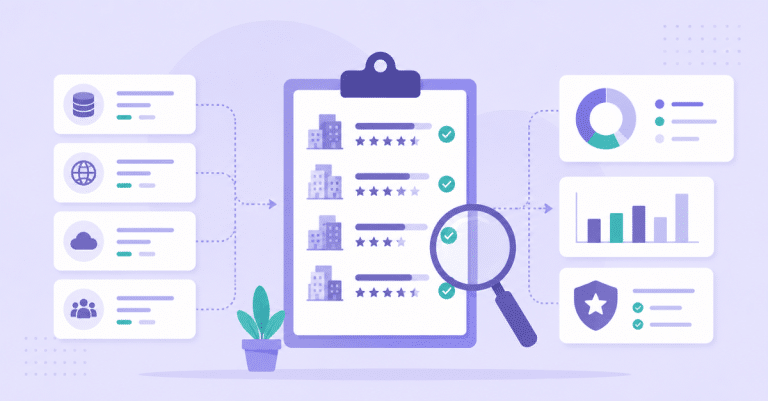
Key Takeaways
- Vendor Assessment Models help enterprises evaluate external data vendors before source dependency becomes operational risk.
- Data vendor evaluation should measure source coverage, freshness, quality controls, delivery consistency, governance posture, and support maturity.
- A vendor selection framework helps teams compare providers against business use cases rather than generic procurement criteria.
- External vendor review should include legal, security, cross-border, auditability, and usage-rights considerations.
- Supplier assessment criteria must be reviewed continuously because source reliability, coverage, and vendor performance change over time.

External data sourcing programs often fail before collection, integration, or analytics begin. The failure starts earlier, when an enterprise selects data vendors without a clear assessment model. A provider may appear suitable during procurement but later expose gaps in source coverage, refresh cadence, data quality, legal documentation, delivery reliability, or support responsiveness.
Vendor Assessment Models provide the evaluation structure needed to compare external data providers before they become embedded in decision systems. In enterprise sourcing environments, vendor review is not only a procurement exercise. It is an infrastructure risk control. Once vendor data feeds support pricing, market intelligence, AI models, compliance monitoring, or forecasting workflows, weak vendor selection becomes a downstream reliability issue.
The objective is not to find the cheapest source. It is to identify which external data vendors can support governed, scalable, and operationally reliable sourcing programs.
Why Vendor Assessment Models Matter in Data Sourcing
External data vendors create dependencies that extend beyond commercial contracts. Their data may shape dashboards, executive reporting, AI workflows, market monitoring, supplier analysis, risk scoring, and competitive intelligence. If the vendor’s source coverage weakens or delivery quality declines, downstream systems inherit the failure.
Accordingly, Vendor Assessment Models help enterprises evaluate whether a provider can support the required business use case, operating cadence, compliance posture, and integration model. Deloitte’s current guidance on third-party risk management emphasizes that strong third-party risk programs can reduce risk, improve resiliency, and support performance. External data vendors should be evaluated through that same risk-aware lens.
Why External Data Vendors Create Strategic Dependency
A vendor becomes strategically important when its data supports repeatable decisions. If a pricing team uses a vendor feed to adjust competitive strategy, that feed is no longer a passive input. If AI models depend on externally sourced datasets, vendor quality affects model stability. Also, if compliance teams monitor regulatory sources through a provider, source gaps can become governance exposure.
The dependency grows as the data becomes embedded in workflows. Teams build reports around it. Engineers design integrations around it. Analysts define benchmarks around it. Executives rely on outputs derived from it.
Vendor Assessment Models make this dependency visible before it hardens into infrastructure. They force teams to ask whether the vendor can sustain required coverage, freshness, documentation, quality controls, and escalation processes as use cases expand.
How Weak Vendor Evaluation Introduces Source Risk
Weak vendor evaluation often focuses on availability rather than reliability. A vendor may demonstrate that data exists but not prove that it is complete, current, legally usable, consistently delivered, or auditable. This creates source risk.
Source risk may appear as delayed feeds, missing markets, undocumented transformations, inconsistent schemas, unclear collection rights, weak support response, or limited transparency into source origin. These issues may remain hidden during pilot evaluation, but become expensive once the data is connected to production workflows.
A structured vendor model reduces this risk by comparing vendors against defined supplier assessment criteria. This includes coverage, refresh cadence, source authority, quality controls, security posture, contractual limitations, and operational continuity.
Core Criteria in Data Vendor Evaluation
Data vendor evaluation should begin with the enterprise use case. A vendor suitable for occasional research may not be suitable for daily pricing feeds. A provider useful for broad market coverage may not be reliable enough for AI training or compliance workflows. Assessment must reflect operational dependency, not generic vendor preference.
Therefore, the evaluation model should measure both data characteristics and vendor operating maturity. Data quality matters, but so do support processes, documentation, escalation paths, and long-term adaptability.
Assessing Source Coverage, Freshness, and Reliability
Source coverage defines whether the vendor can provide the sources, markets, categories, regions, entities, or signals the enterprise needs. Coverage should be tested against the business requirement, not against vendor claims. A vendor may claim global coverage but have weak depth in specific countries, marketplaces, or categories.
Freshness determines whether the data arrives at the right cadence. For pricing, inventory, demand, or compliance monitoring, stale data can undermine decisions. Reliability measures whether the feed remains consistent over time. A vendor that delivers complete data during onboarding but degrades under operational load creates hidden risk.
A strong data vendor evaluation process tests coverage samples, compares update timing, measures missing records, and examines historical continuity. The goal is to understand whether the vendor can support production use, not only provide a sample file.
Evaluating Data Quality, Documentation, and Delivery Consistency
Data quality evaluation should include completeness, accuracy, consistency, duplication, schema stability, source traceability, and transformation transparency. Enterprises should know whether the vendor delivers raw records, normalized outputs, enriched attributes, or interpreted signals.
Documentation is equally important. A vendor should explain field definitions, source methods, update cadence, known limitations, coverage gaps, and transformation logic. Without documentation, internal teams must reverse-engineer meaning and risk misinterpretation.
IBM’s current work on AI-ready data and data governance highlights that modern AI systems increasingly require high-quality, well-managed data foundations. External vendors that cannot document data origin, quality controls, and transformation logic may weaken that foundation.
Delivery consistency should be tested through repeated runs. A one-time sample is not enough. The assessment should measure whether the vendor can deliver the same structure, format, cadence, and completeness over time.
Designing a Vendor Selection Framework for External Data Programs
A vendor selection framework translates sourcing requirements into comparable evaluation criteria. It prevents procurement from relying on brand recognition, sales promises, or sample datasets alone. It also helps technical, legal, data, and business teams evaluate vendors using the same operating model.
The framework should include scoring categories, review ownership, evidence requirements, risk thresholds, pilot tests, and periodic reassessment. Vendor selection should not end when the contract is signed.
Matching Vendor Capabilities to Business Use Cases
Vendor capabilities should be evaluated against specific use cases. A market intelligence program may require broad coverage, fast refresh cycles, and entity-level consistency. An AI training program may require large-scale datasets, labeling support, provenance, and licensing clarity. A compliance monitoring program may require source authority, audit logs, and jurisdiction coverage.
The same vendor may score differently across use cases. A provider may be strong for historical datasets but weak for real-time monitoring. Another may be strong for structured APIs but weak for complex web sources. A third may provide strong coverage but limited transparency into the source origin.
Vendor Assessment Models should therefore map vendor strengths to business needs. This avoids selecting a provider that looks strong generally but fails under the actual sourcing requirement.
Comparing Access Methods, Refresh Cadence, and Scalability
Access method design affects operational fit. Some vendors provide APIs, others deliver files, dashboards, data warehouses, managed feeds, or custom exports. The right method depends on latency requirements, internal architecture, governance controls, and downstream consumption patterns.
Refresh cadence must also match business timing. A weekly refresh may be adequate for strategic benchmarking but insufficient for pricing intelligence or risk monitoring. Scalability matters when sourcing expands across markets, categories, or data types. A vendor that supports a small pilot may not handle enterprise volume, parallel feeds, or regional expansion.
IDC’s 2025 MarketScape for data integration software platforms notes that organizations are prioritizing AI readiness across data environments. External data vendors must therefore be assessed not only on data availability, but on whether their delivery and integration model can support AI-ready enterprise systems.
Separating Short-Term Fit from Long-Term Sourcing Risk
Short-term fit asks whether the vendor can solve the immediate sourcing problem. Long-term sourcing risk asks whether the vendor can remain reliable as the program scales. Both matter.
A vendor may be fast to onboard but weak in governance documentation. Another may provide strong initial coverage but lack continuity planning. A third may offer attractive pricing but limited support, weak SLAs, or unclear usage rights.
The vendor selection framework should include long-term criteria: source stability, roadmap alignment, contractual flexibility, data rights, escalation process, change notification, and resilience planning. Enterprises should avoid optimizing only for the pilot. Data sourcing programs become infrastructure once multiple teams depend on the feed.
External Vendor Review for Governance and Compliance
External vendor review must include governance and compliance controls. Data sourcing is not only a technical function. It can involve legal rights, data protection, contractual limitations, cross-border flows, security controls, usage restrictions, and audit requirements.
The review process should bring procurement, legal, security, data governance, engineering, and business owners into one evaluation model. Otherwise, a vendor may pass commercial review while failing operational or compliance requirements. Data sourcing strategies for businesses can significantly impact overall performance and risk management. Effective data sourcing not only enhances decision-making but also ensures compliance with regulatory standards. By aligning data sourcing strategies with organizational goals, companies can optimize their resources and achieve better outcomes.
Reviewing Legal, Security, and Cross-Border Data Controls
Legal review should examine data rights, permitted use, source restrictions, resale limitations, retention terms, privacy considerations, and contractual obligations. Security review should assess access controls, authentication, encryption, vendor infrastructure, incident response, and data handling practices.
Cross-border sourcing adds additional complexity. A vendor may collect, process, or deliver data across jurisdictions with different regulatory expectations. Enterprises need to understand where data originates, where it is processed, and whether usage creates legal or compliance constraints.
External vendor review should apply the same principle: access is valuable only when risk, rights, and governance are understood.
Validating Auditability, Source Transparency, and Usage Restrictions
Auditability determines whether the vendor can provide evidence. Enterprises should ask whether the source origin, update timing, transformation logic, and delivery history can be reviewed. If a downstream report is questioned, the vendor should support traceability.
Source transparency matters because not all sources carry equal authority. A vendor should identify whether data comes from public records, marketplaces, APIs, partner feeds, internal enrichment, or third-party aggregation. Usage restrictions should be clearly documented so internal teams do not apply the data beyond its permitted scope.
An external vendor review should not accept vague assurances. It should require documentation, sample audit trails, field-level explanations, and escalation contacts. Vendor transparency becomes essential once data supports regulated, executive, or AI-enabled decisions.
Supplier Assessment Criteria for Enterprise Data Operations
Supplier assessment criteria should evaluate the vendor as an operating partner, not only a data provider. External data sourcing programs require ongoing support, change management, incident response, roadmap communication, and performance review.
The supplier model should measure how the vendor behaves after onboarding. Many sourcing risks appear only during production operations, especially when sources change, coverage expands, or delivery failures occur. The impact of source credibility on decisions can significantly affect the overall vendor selection process. Assessing the trustworthiness of data sources helps to mitigate risks and ensure that the information used is reliable. Therefore, organizations should prioritize evaluating source credibility as part of their comprehensive supplier assessment strategy.
Measuring Operational Maturity and Support Responsiveness
Operational maturity includes documented processes, defined ownership, support SLAs, incident response, monitoring, escalation paths, and change communication. A vendor that cannot explain how failures are detected and handled may become a liability in production.
Support responsiveness should be tested during pilots. How quickly does the vendor answer technical questions? Can they explain anomalies? Do they provide knowledgeable support or only account management? Can they support engineering teams during integration?
Supplier assessment criteria should include supporting evidence, not only service promises. Enterprises should evaluate ticket response times, issue resolution, escalation procedures, and willingness to investigate data quality problems.
Evaluating Continuity Planning, Failure Handling, and Escalation Processes
External data sourcing programs need continuity planning. Vendors should explain how they handle source outages, structural changes, delivery failures, schema changes, data gaps, and infrastructure incidents. They should also explain how customers are notified and what remediation processes exist.
Failure handling is especially important when feeds support operational systems. If a vendor misses a refresh, delivers incomplete records, or changes schema unexpectedly, downstream systems may fail silently. Escalation processes should be defined before these situations occur.
A mature supplier assessment model asks what happens when things break. This is where procurement evaluation becomes infrastructure risk management.
Technology and Integration Considerations
Vendor assessment must include technical integration. A vendor may offer valuable data, but if delivery formats are unstable, metadata is weak, APIs are unreliable, or schemas are undocumented, internal teams will absorb the operational burden.
The technology review should assess how vendor outputs connect to internal warehouses, BI systems, AI workflows, governance tools, and monitoring environments.
Assessing API Readiness, Metadata Quality, and Delivery Formats
API readiness includes endpoint stability, authentication, rate limits, pagination, filtering, error handling, documentation, and versioning. File-based delivery should be assessed for format consistency, naming conventions, compression, schema documentation, and retry logic.
Metadata quality is critical. Vendor outputs should include source identifiers, timestamps, field definitions, update status, coverage indicators, and quality flags where possible. Without metadata, internal teams cannot easily validate freshness, trace source origin, or detect anomalies.
Delivery formats should match internal architecture. JSON, CSV, Parquet, database shares, APIs, and streaming feeds each create different operational implications. The vendor selection framework should score delivery fit against internal engineering requirements.
Connecting Vendor Outputs to Data Warehouses, BI, and AI Workflows
Vendor outputs often feed Snowflake, BigQuery, Databricks, BI dashboards, forecasting models, AI pipelines, and operational applications. The assessment should evaluate whether vendor data can be integrated without excessive manual transformation.
This includes schema consistency, entity identifiers, historical state, incremental updates, lineage metadata, and compatibility with transformation tools such as dbt or processing environments such as Spark. Monitoring systems such as Prometheus may also be needed to track delivery latency, failures, and feed completeness.
The vendor should reduce sourcing complexity, not transfer hidden engineering burden to internal teams. Integration readiness is therefore part of vendor quality.
Governance Model for Vendor Assessment
Vendor assessment should not be a one-time procurement event. External data vendors should be reviewed periodically because coverage, reliability, source access, business needs, and compliance requirements change.
A governance model defines who owns vendor review, how performance is scored, when reassessment occurs, and which issues trigger escalation or replacement planning.
Creating Scorecards, Review Cycles, and Ownership Controls
Vendor scorecards should include business fit, source coverage, freshness, quality, documentation, integration readiness, security, legal review, support responsiveness, and continuity planning. Each category should have evidence requirements and scoring thresholds.
Review cycles should occur at defined intervals, such as quarterly or semiannually, depending on operational dependency. High-impact vendors may require more frequent review. Ownership should be assigned across business, data, procurement, legal, and engineering stakeholders.
A governance model prevents vendor knowledge from living only in procurement files or an engineer’s memory. It creates institutional visibility into vendor risk and performance.
Tracking Vendor Performance Across Quality, Coverage, and Reliability
Vendor performance should be measured over time. Metrics may include delivery timeliness, missing record rates, schema stability, source coverage changes, support response, incident frequency, refresh success, and data quality exceptions.
These metrics should influence renewal decisions, expansion decisions, and mitigation planning. If a vendor’s coverage weakens or reliability declines, teams should know before downstream systems are affected.
Ongoing performance tracking also supports multi-vendor sourcing strategies. Enterprises can compare vendors by source authority, market coverage, delivery reliability, and operational maturity rather than relying on initial procurement assumptions. The impact of unreliable sources can undermine the effectiveness of multi-vendor strategies. It is crucial for enterprises to continuously evaluate the reliability and authority of their data sources. By doing so, organizations can prevent potential disruptions and ensure informed decision-making.
Conclusion: Building Vendor Assessment Discipline into External Data Sourcing
External data vendors can strengthen enterprise sourcing programs, but they also introduce dependency. Once vendor feeds support market intelligence, AI workflows, compliance monitoring, pricing decisions, or executive reporting, weak vendor selection becomes operational risk.
Vendor Assessment Models help enterprises evaluate providers through structured criteria. Strong data vendor evaluation examines source coverage, freshness, quality controls, delivery consistency, legal rights, security posture, documentation, integration readiness, and continuity planning. A vendor selection framework ensures that providers are assessed against real business use cases rather than generic procurement preferences.
The strongest external data sourcing programs treat vendor review as an ongoing governance function. They use supplier assessment criteria, external vendor review, performance tracking, and periodic reassessment to ensure vendors remain fit for purpose as data dependency grows.
A structured review can help evaluate whether current sourcing workflows have reliable vendor assessment models, documented supplier criteria, integration controls, governance review cycles, and source-risk visibility. You can run an external data infrastructure audit with our team to review your current setup and understand what is required to build a reliable, enterprise-scale external data infrastructure.