
Key Takeaways
- Source Reliability determines whether enterprise data can be trusted before downstream systems process it.
- Reliable data sources reduce rework, pipeline breakage, validation burden, and decision friction.
- Source reliability assessment helps teams identify source-level risk before business systems depend on unstable inputs.
- Source stability monitoring is becoming essential for AI, analytics, and market intelligence infrastructure.
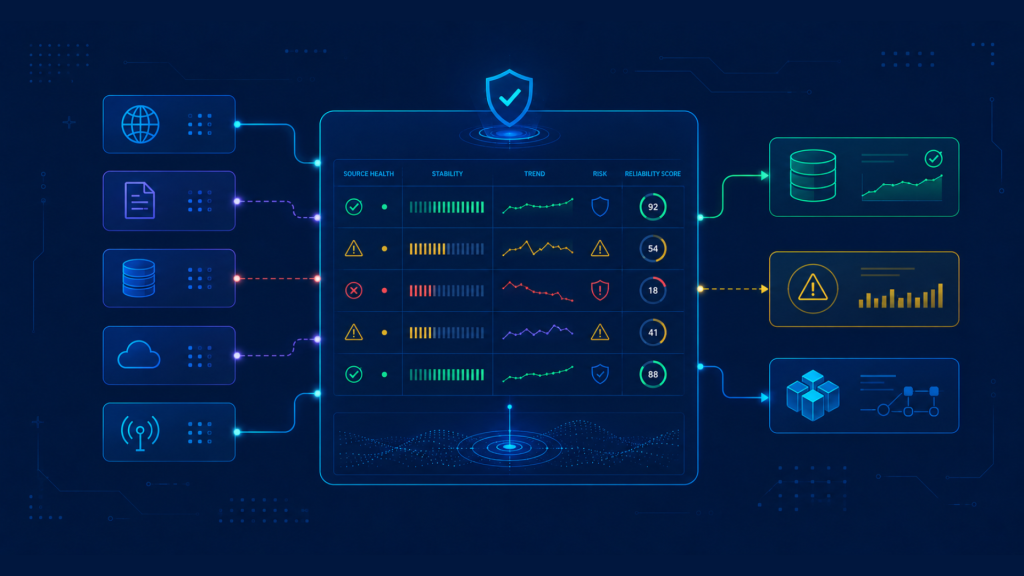
Source reliability is one of the least visible but most consequential foundations of enterprise data performance. A source may appear usable because it produces data, updates periodically, or integrates into a pipeline. However, reliability is not defined by access alone. It is defined by whether the source remains stable, current, complete, traceable, and fit for the systems that depend on it.
Weak Source Reliability creates cost before data reaches analytics, AI, market intelligence, or executive reporting systems. It increases validation burden, pipeline maintenance, engineering overhead, governance friction, and decision uncertainty. Over time, fragile sources become hidden liabilities inside data infrastructure because downstream teams may continue using outputs without realizing that the source layer has already degraded.
Source Reliability Determines Whether Enterprise Data Can Be Trusted Before It Enters the Pipeline
Enterprise data systems are often evaluated downstream. Leaders inspect dashboards, model outputs, reports, and data products. However, trust is shaped much earlier, at the source layer. If a source changes structure, updates inconsistently, loses coverage, introduces duplication, or becomes inaccessible, every downstream system inherits that weakness.
Source Reliability is therefore a prerequisite for data trust. It defines whether a source can support repeatable ingestion, consistent interpretation, and defensible decision-making. McKinsey’s Data-Driven Enterprise of 2025 describes a future where data is embedded into decisions, interactions, and processes. That vision depends on sources that can sustain continuous decision workflows, not merely one-time data access.
Reliable Data Sources Reduce Downstream Rework, Validation Burden, and Decision Friction
Reliable data sources reduce downstream friction because teams do not have to constantly question whether incoming data is complete, current, or structurally consistent. Data engineering teams spend less time repairing broken ingestion logic. Analytics teams spend less time explaining inconsistent metrics. AI teams spend less time investigating whether performance changes originated in the model or the source.
This does not mean reliable sources eliminate validation. Validation remains necessary. However, reliable sources reduce the number of preventable failures that validation systems must catch. Source stability creates a cleaner operating environment where data quality controls can focus on real anomalies rather than recurring source defects.
In practice, reliable data sources improve both speed and confidence. Teams can move faster because source behavior is more predictable. Decision-makers can trust outputs more because upstream instability is lower.
Weak Source Quality Creates Hidden Risk Before Analytics or AI Systems Process the Data
Weak source quality creates risk before transformation, modeling, or reporting begins. A source may contain inconsistent formats, missing fields, delayed updates, partial coverage, duplicated records, unstable identifiers, or unclear sourcing constraints. Once these weaknesses enter the pipeline, downstream systems may normalize them into apparently clean outputs.
That is dangerous because weak sources can become invisible after processing. A dashboard may look organized. A model may produce predictions. A report may appear complete. Yet the source may be quietly excluding important segments, updating irregularly, or changing definitions.
Accordingly, source reliability must be evaluated before data enters critical workflows. Downstream sophistication cannot fully compensate for unstable inputs.
Why Source Reliability Failures Are Often Discovered Too Late
Source reliability failures are often discovered late because pipelines can continue running even when source quality has degraded. Data may still arrive, but it may be incomplete. A field may still exist, but its definition may have changed. A source may still update, but less frequently than expected. Dashboards and models may continue operating while the evidence behind them becomes weaker.
Gartner’s 2025 Data and Analytics Predictions state that by 2027, half of business decisions will be augmented or automated by AI agents for decision intelligence. As more decisions become automated or AI-supported, source degradation becomes more serious because weak inputs can influence decisions at scale before humans detect the problem.
Unstable Sources Can Degrade Quietly While Dashboards and Models Continue Running
Unstable sources rarely announce failure in a clear way. A marketplace page may remove a field. A public source may delay publication. A vendor feed may change schema. An API may modify rate limits. A website may introduce dynamic rendering changes. An internal system may redefine a field without notifying downstream teams.
In many cases, data still flows. That makes the issue harder to detect. Dashboards refresh, models run, and reports populate. The problem is not a complete outage. It is a silent degradation.
Silent degradation is costly because teams may continue making decisions with partial or distorted inputs. By the time the problem is visible, leaders may have already acted on weakened intelligence.
Source Reliability Assessment Helps Teams Identify Risk Before Business Systems Depend on It
A source reliability assessment evaluates whether a source is stable enough for its intended use. It should examine update frequency, structural consistency, field completeness, historical availability, access stability, source ownership, documentation quality, and compliance constraints.
Different use cases require different reliability standards. A source used for exploratory research may tolerate occasional gaps. A source feeding pricing engines, AI models, risk dashboards, or executive reporting needs much stronger reliability. Assessment should therefore be tied to business criticality.
The goal is not to reject every imperfect source. It is to understand source risk before the source becomes embedded in systems that require continuity, auditability, and trust.
The Operational Cost of Fragile Data Sources
Fragile sources create operational costs because every instability becomes a maintenance event. Engineering teams must adjust pipelines, repair transformations, investigate missing values, resolve schema drift, and rebuild broken collection logic. Data teams must explain inconsistencies. Business teams must wait for clarification before acting. These costs are often distributed across teams, which makes them easy to underestimate.
IBM’s 2025 CDO Study reports that many Chief Data Officers say their data is still not ready to unlock AI’s full potential, even as organizations race to scale AI. Source reliability is part of that readiness gap. Enterprise data cannot become AI-ready if critical sources remain unstable, undocumented, or difficult to monitor.
Source Failures Increase Engineering Maintenance, Pipeline Breakage, and Monitoring Overhead
Every unreliable source creates maintenance debt. A changing page structure may require extraction updates. A modified API response may break transformation logic. A delayed file delivery may disrupt scheduled jobs. A field-level inconsistency may trigger validation failures. Repeated small failures accumulate into a permanent operational burden.
In source-heavy environments, this burden can consume significant engineering capacity. Teams that should be building new data products instead maintain fragile ingestion paths. Market intelligence, analytics, and AI initiatives then slow because foundational source work becomes reactive.
At scale, source reliability is a cost-control issue. Stable sources reduce maintenance overhead, while fragile sources convert data infrastructure into a continuous repair function.
Inconsistent Update Patterns Reduce Confidence in Time-Sensitive Data Products
Some data products depend heavily on timing. Pricing intelligence, risk monitoring, market signal tracking, demand sensing, fraud detection, and operational dashboards all require predictable update patterns. When source updates become inconsistent, the data product loses reliability even if the pipeline remains technically functional.
A pricing feed that updates irregularly can distort competitive analysis. A regulatory source that publishes late can weaken compliance monitoring. A marketplace source with inconsistent availability signals can affect inventory or demand interpretation. AI systems trained or refreshed on delayed inputs may respond to outdated conditions.
In time-sensitive systems, freshness is part of reliability. Source stability monitoring must therefore track not only whether data arrived, but whether it arrived on time and with expected coverage.
How Weak Source Stability Affects AI, Analytics, and Market Intelligence
Weak source stability affects multiple enterprise systems because the same source may feed several downstream workflows. A competitor source may support market intelligence, pricing analysis, and demand forecasting. A customer feedback source may support product analytics, sentiment models, and support automation. An external public source may support risk monitoring and AI training.
The World Economic Forum’s 2025 analysis on scaling AI with strategy, data, and workforce readiness argues that poor governance and low data maturity are major barriers to scaling AI. Source stability is one of the practical expressions of data maturity because unstable sources weaken the reliability of every system built on them.
Models and Dashboards Become Less Reliable When Source Inputs Shift Without Warning
Models and dashboards depend on source consistency. If a source changes without warning, downstream systems may produce misleading results. A model may interpret missing values as real signals. A dashboard may show a decline that reflects source coverage loss rather than market change. An analytics workflow may compare current data against historical data without realizing that definitions have changed.
This is especially important for AI systems. Model performance may degrade because the input distribution changed, not because the model itself failed. Without source-level monitoring, teams may misdiagnose the issue and retrain models unnecessarily.
Reliable source management helps teams distinguish source failure from business change. That distinction is essential for maintaining trust in AI and analytics.
Commercial and Operational Teams Lose Trust When Source Coverage Becomes Incomplete
Source coverage issues directly affect business trust. Commercial teams may question pricing dashboards if competitor coverage becomes inconsistent. Product teams may lose confidence in review analytics if marketplace coverage is incomplete. Risk teams may hesitate to rely on monitoring systems if public sources update unpredictably. Executives may doubt reports when numbers change without a clear explanation.
Once trust declines, adoption suffers. Teams create manual checks, duplicate reports, or separate spreadsheets to verify the data. These workarounds increase fragmentation and reduce the value of centralized data systems.
Source reliability, therefore, affects organizational behavior. Weak sources not only create technical problems. They change how teams trust and use data.
The Infrastructure Layer Behind Stronger Source Reliability
Source reliability must be supported by infrastructure. Manual review cannot scale across hundreds or thousands of internal, external, vendor, and public sources. Enterprises need systems that monitor source availability, detect structural changes, validate incoming data, preserve metadata, and connect source behavior to downstream impact.
NIST’s AI Risk Management Framework emphasizes lifecycle governance, measurement, and risk management for AI systems. Although the framework is AI-focused, the principle applies broadly: systems that depend on data need controls throughout the lifecycle. Also, source monitoring is part of that lifecycle because source-level failures can become model, analytics, and governance failures later.
Source Stability Monitoring Detects Structural Changes, Access Issues, and Data Freshness Gaps
Source stability monitoring tracks whether sources remain usable over time. It should detect structural changes, access failures, schema shifts, missing fields, freshness gaps, unusual volume changes, and coverage degradation. For external digital environments, this may include monitoring changes in page structure, dynamic rendering behavior, authentication requirements, rate limits, and availability of key fields.
Browser automation frameworks such as Playwright may be required when data sources exist in dynamic web environments rather than stable APIs. Airflow can orchestrate recurring source checks and ingestion workflows. Kafka can support continuous data movement. Spark can process high-volume source feeds. dbt can structure downstream transformations. Great Expectations can validate schema and quality rules before source defects spread further.
Source reliability improves when monitoring begins at the point of entry, not after data has already shaped reports or models.
Lineage, Metadata, and Observability Help Teams Trace Source-Level Failures
Lineage, metadata, and observability allow teams to understand how source problems affect downstream systems. Metadata documents source ownership, update cadence, schema expectations, quality scores, access constraints, and usage restrictions. Lineage shows which datasets, dashboards, models, or applications depend on a source. Observability systems such as Prometheus can monitor pipeline health, latency, freshness, and failures.
This matters because source-level failures often have a distributed impact. One source issue may affect an executive dashboard, a forecasting model, a pricing report, and a market intelligence workflow at the same time. Without lineage, teams may investigate each downstream symptom separately.
A stronger source infrastructure makes root-cause analysis faster. It allows teams to identify the source issue, understand downstream dependencies, and prioritize remediation based on business impact.
Why Source Reliability Is Becoming an Enterprise Governance Priority
Source reliability is becoming a governance priority because source failures now affect critical decision systems. As organizations embed data into AI, analytics, automation, and market intelligence workflows, leaders need visibility into which sources support high-impact decisions and how those sources are controlled.
The World Bank’s Digital Progress and Trends Report 2025 emphasizes the importance of foundational systems for responsible AI adoption and scale. Within enterprises, reliable data sources are part of that foundation. Without source accountability, organizations cannot fully govern the systems built on top of their data. Data sourcing strategies for growth can enhance the reliability of insights derived from analytics. Implementing robust data sourcing methods allows organizations to optimize decision-making processes effectively. By prioritizing quality sources, companies can ensure that their foundational systems support scalable and responsible AI initiatives.
Leaders Need Visibility into Which Sources Support Critical Decision Systems
Executives do not need to manage every data source directly, but they do need visibility into sources that support critical systems. A pricing model may depend on competitor pricing sources. A risk dashboard may depend on regulatory or public records. An AI system may depend on customer behavior, external market signals, or labeled training data. A commercial intelligence workflow may depend on marketplace and review data.
If leaders do not know which sources support these systems, they cannot evaluate operational risk. A source outage, coverage gap, or compliance concern may affect decisions before leadership understands the dependency.
Source-level visibility helps organizations prioritize monitoring and governance where the business impact is highest. Critical sources should have clearer ownership, stronger controls, and more frequent reliability review.
Scalable Data Programs Require Reliable Sources With Clear Ownership and Risk Controls
Scalable data programs require source ownership. Each important source should have defined accountability for access, quality, monitoring, documentation, and escalation. Risk controls should reflect the source’s importance. Low-risk exploratory sources do not need the same controls as sources feeding production AI or executive reporting.
Governance should also account for compliance. External sources may involve platform policies, cross-border considerations, data protection rules, sourcing documentation, legal review, and audit trails. Internal sources may involve access controls, retention rules, and stewardship obligations.
Ultimately, Source Reliability has become a strategic infrastructure issue because unreliable sources create costs that compound downstream. Source reliability assessment identifies risk before dependency becomes too deep. Reliable data sources reduce rework, decision friction, and model instability. Source stability monitoring keeps data systems aligned with the sources they depend on.
Organizations that govern source reliability early will build more resilient AI, analytics, and intelligence systems. Those that ignore it may continue producing data outputs, but they will struggle to prove that those outputs rest on stable, current, and defensible inputs.