Key Takeaways
- Access Method Design determines how enterprises connect to external data sources before sourcing programs become operational dependencies.
- Source access models should be selected based on source reliability, refresh needs, latency, volume, permissions, and downstream use cases.
- Data access planning helps teams define authentication, usage constraints, rate limits, source availability, and production readiness before integration.
- Acquisition access methods introduce different tradeoffs across stability, scalability, cost, maintenance burden, and governance control.
- Source connection strategy should include redundancy, monitoring, metadata capture, audit logs, and ownership controls for critical sources.
External data sourcing depends on access before it depends on collection, transformation, or analytics. If the enterprise cannot connect to a source reliably, every downstream workflow inherits that weakness. A data warehouse may be well designed, a dashboard may be well modeled, and an AI workflow may be carefully governed, but the system still fails if upstream source access is unstable, undocumented, or misaligned with business timing.
Access Method Design is the discipline of deciding how external sources will be reached, refreshed, authenticated, governed, monitored, and connected into enterprise systems. It includes source access models, data access planning, acquisition access methods, and source connection strategy.
In enterprise sourcing operations, access method decisions are infrastructure decisions. They determine how reliably external data can support market intelligence, AI training data, compliance monitoring, pricing workflows, procurement analysis, and executive reporting.
Why Access Method Design Matters in Data Sourcing
External data access is rarely uniform. Some sources provide APIs. Others deliver files. Some require partner agreements. Some are public but structurally unstable. Also, some support high-frequency access, while others only update periodically. Some carry explicit usage constraints, authentication requirements, or cross-border considerations.
Access Method Design creates the operating model for navigating these differences. Gartner’s 2025 data and analytics trends emphasize that data and analytics are becoming more widespread across organizations, while operational and governance challenges are increasing. In external data sourcing, those challenges begin at the source access layer. Data sourcing strategies for enterprises are essential for successful data management. They help organizations efficiently identify, evaluate, and secure the right data sources to meet their specific needs. As businesses increasingly rely on data-driven insights, optimizing these strategies becomes crucial for maintaining a competitive edge.
Why Source Access Determines Operational Reliability
Source access determines whether external data can be collected consistently, refreshed at the right cadence, and delivered into decision systems without interruption. A source that is easy to access once may still be unsuitable for production if it cannot support stable authentication, predictable update timing, or reliable transfer.
For example, a public web source may be useful for exploratory research but unstable for high-frequency market monitoring. A vendor API may be structured but limited by rate limits or contract terms. A file-based feed may be dependable but too slow for time-sensitive pricing workflows. A partner-provided dataset may carry strong authority but require strict access controls.
Access design forces teams to evaluate whether the connection model matches the operational role of the source. Critical sources require stronger access controls, monitoring, and continuity planning than occasional research sources.
How Poor Access Planning Creates Downstream Data Risk
Poor access planning creates downstream risk because teams often discover limitations after integration. A source may not support the required refresh cadence. Rate limits may prevent full coverage. Authentication may fail unpredictably. Schema changes may appear without notice. Legal or usage restrictions may limit how data can be stored or reused.
These issues can distort downstream analytics. Data may be stale, incomplete, inconsistently refreshed, or unavailable during critical decision windows. AI workflows may train on partial datasets. Compliance monitoring may miss source updates. Market intelligence teams may interpret access gaps as market stability.
IBM describes data governance as the discipline that helps ensure data quality, security, availability, integrity, and privacy through policies, standards, and procedures. Access method planning is one of the upstream decisions that determines whether those governance goals can be met in practice.
Core Source Access Models in Enterprise Sourcing
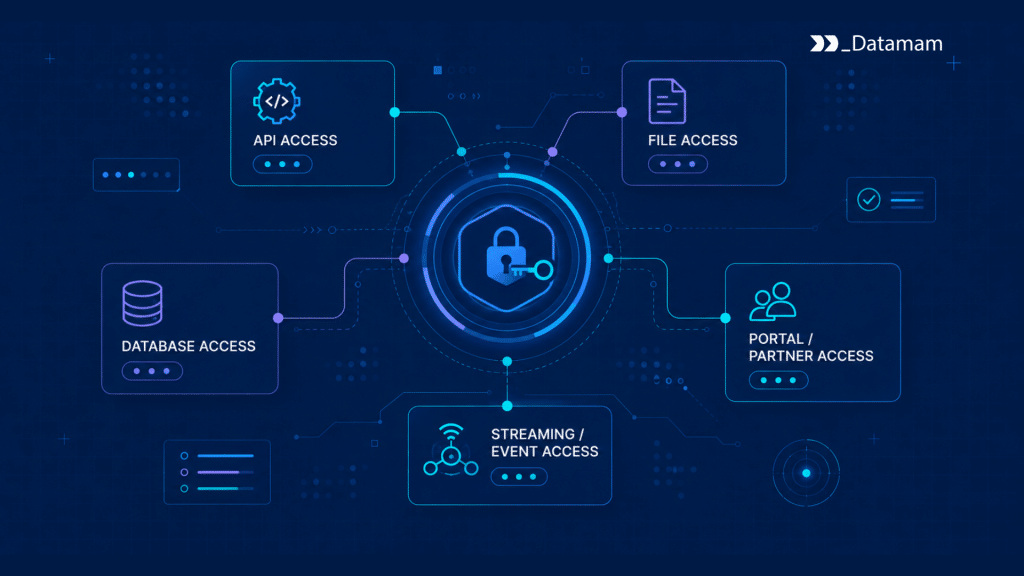
Enterprise sourcing programs typically use multiple source access models. No single model is universally best. API access, file delivery, web-based access, database sharing, partner feeds, and manual review workflows each have different strengths and limitations.
The correct design depends on business use case, source stability, data volume, latency requirements, legal constraints, technical infrastructure, and governance needs.
API-Based, File-Based, Web-Based, and Partner-Provided Access
API-based access is often preferred when sources provide structured endpoints, documentation, authentication, rate limits, and predictable response formats. APIs can support automated workflows, incremental updates, and integration with internal systems. However, APIs may limit fields, restrict volume, or change versions.
File-based access is common for vendors, partners, and batch-oriented sources. Files may arrive through SFTP, cloud storage, warehouse shares, or scheduled exports. This model can be stable and auditable, but it may be less suitable for low-latency use cases.
Web-based access may be necessary when structured feeds are unavailable. It can support broad source coverage but requires more monitoring and adaptation. Partner-provided access can offer high-authority data, but often introduces contractual, permission, and governance requirements.
Each model should be evaluated as an operational design choice, not a convenience.
Matching Source Access Models to Business and Technical Requirements
The access model should match the use case. Pricing intelligence may require frequent access, low latency, and high completeness. Regulatory monitoring may require authoritative source origin, auditability, and document retention. AI training data may require broad coverage, source transparency, and rights clarity. Market research may tolerate slower refresh cycles but require diversity across sources.
Technical requirements also matter. The enterprise must assess whether the access model fits existing orchestration systems, validation layers, warehouses, BI tools, AI pipelines, and security controls. A source may be valuable but costly to integrate if it requires unusual formats, manual steps, or inconsistent authentication.
Access Method Design, therefore, connects business value to technical feasibility. It ensures that a source is not only useful, but operationally supportable.
Data Access Planning for External Source Programs
Data access planning defines how each source will be connected, refreshed, secured, monitored, and governed. It should happen before production integration, not after a pilot succeeds.
The planning process should include source requirements, access permissions, expected volume, update cadence, latency tolerance, authentication model, failure behavior, escalation ownership, and compliance constraints. Implementing dynamic data sourcing strategies can significantly enhance the efficiency of data access planning. Such strategies allow organizations to adapt to changing data environments and user needs rapidly. Additionally, they ensure that the data remains accurate and relevant, leading to better decision-making outcomes.
Defining Refresh Cadence, Latency, Volume, and Availability Requirements
Refresh cadence defines how often the source must be accessed. Latency defines how quickly data must move from source update to internal availability. Volume defines how much data must be retrieved. Availability defines when the source can be accessed reliably.
These requirements vary by use case. A daily feed may be adequate for category benchmarking but insufficient for competitor price movement. A monthly source may be acceptable for strategic planning but not for compliance alerts. A high-volume source may require partitioning, incremental retrieval, or distributed processing.
Access planning should define these needs explicitly. If refresh expectations are vague, teams may build systems that technically work but fail to support decision timing.
Planning Authentication, Permissions, Rate Limits, and Usage Constraints
Authentication and permissions determine who or what can access the source. This may involve API keys, OAuth, SSO, vendor credentials, partner accounts, token rotation, IP allowlisting, or role-based access. Each method creates operational and security implications.
Rate limits and usage constraints determine how much data can be accessed and how frequently. These limits should be tested before production. A source may allow exploratory access but fail under enterprise volume. Usage constraints may also affect storage, redistribution, derived products, retention, or AI model training.
Enterprise access planning follows the same logic: access must be designed with both utility and constraints in view.
Separating Pilot Access from Production-Grade Access
Pilot access often hides production risk. A small test may use limited fields, low volume, manual credentials, or one-off file delivery. Production access must support repeatability, monitoring, scale, security, recovery, and governance.
Before a source moves into production, teams should confirm that access methods support expected volume, refresh cadence, authentication renewal, error handling, monitoring, and escalation. They should also verify whether the source owner allows production use at the intended scale.
The distinction matters because many sourcing programs fail during scale-up, not initial testing. Access Method Design prevents pilot assumptions from becoming production liabilities.
Acquisition Access Methods and Operational Tradeoffs
Acquisition access methods introduce different operational tradeoffs. Some are stable but slow. Others are flexible but maintenance-heavy. Some provide high source authority but limited scalability. Others provide broad coverage but weaker transparency.
Enterprise sourcing teams must evaluate access methods across reliability, scalability, cost, maintenance, governance, and downstream compatibility.
Evaluating Stability, Scalability, Cost, and Maintenance Burden
Stability measures whether the access method remains consistent over time. APIs with versioned contracts may be stable, but only if changes are communicated. Web access may be flexible but more vulnerable to structural change. File feeds may be stable but dependent on vendor delivery processes.
Scalability measures whether the method supports growth in source count, record volume, refresh frequency, regions, or use cases. Cost includes vendor fees, infrastructure, engineering effort, monitoring, and support burden. Maintenance includes authentication renewal, schema change handling, source monitoring, and incident response.
A low-cost access method can become expensive if it requires constant operational attention. A higher-cost access model may be justified when it reduces downtime, improves governance, or supports critical workflows.
Managing Source Changes, Access Failures, and Connection Degradation
External sources change. APIs deprecate fields, web pages redesign layouts, vendors change schemas, authentication methods expire, partners alter delivery timing, and file structures shift. Access design must assume change.
Connection degradation can be gradual. A source may still respond, but return fewer records. A feed may arrive, but with missing fields. A permission change may silently reduce coverage. These failures are dangerous because downstream systems may continue operating while data quality declines.
Access Method Design should include monitoring, freshness checks, record-count baselines, schema checks, retry logic, and escalation procedures. Access failures should be treated as operational incidents, not routine data gaps.
Source Connection Strategy for Enterprise Data Infrastructure
Source connection strategy defines how access methods fit into the broader data infrastructure. It connects upstream access to validation, orchestration, monitoring, governance, storage, and consumption systems.
A strong source connection strategy does not simply connect to the source. It defines how the enterprise will know whether the connection remains healthy, whether the data remains complete, and whether downstream systems can trust the feed.
Designing Redundant Connections for Critical Sources
Critical sources may require redundancy. If one source supports revenue-impacting pricing decisions, compliance monitoring, risk models, or AI workflows, the enterprise should evaluate backup access paths or alternative sources.
Redundancy may include multiple vendors, secondary APIs, fallback file feeds, cached historical records, mirror sources, or manual escalation workflows. The right design depends on criticality. Not every source needs redundancy, but critical sources should not rely on a single fragile connection without mitigation.
Redundant connection planning reduces operational exposure. It allows teams to maintain continuity when a source changes, a vendor fails, or an access method is temporarily unavailable.
Connecting Access Methods to Validation, Monitoring, and Governance Layers
Access methods should feed directly into validation, monitoring, and governance layers. Validation checks whether incoming data meets expected structure, completeness, and value rules. Monitoring tracks freshness, latency, failures, and volume. Governance records source origin, permissions, usage restrictions, access history, and ownership.
This connection is what turns access from a technical integration into a controlled infrastructure. Without validation and monitoring, teams may not detect failed access until downstream outputs look wrong. Without governance, teams may not know whether the data can be used for specific analytics, AI, or reporting workflows.
Deloitte’s third-party risk management guidance emphasizes reducing risk, improving resiliency, and managing third-party dependencies. External source access should be governed with the same discipline when vendors, partners, or external platforms become operational dependencies.
Technology and Integration Considerations
Access Method Design must account for the systems that will consume the data. A source connection is not successful because data can be retrieved only once. It is successful when the access method can be operated, monitored, governed, and integrated into enterprise data environments.
The technology review should include API contracts, file formats, authentication, metadata, delivery reliability, schema stability, and compatibility with downstream platforms. Data supply chain vulnerabilities examined reveal potential weaknesses that can disrupt data flow. Companies must prioritize identifying these vulnerabilities to ensure robust security measures are in place. Furthermore, continuous monitoring and assessment of these vulnerabilities will be critical to maintaining data integrity and reliability within the supply chain.
Assessing API Contracts, Metadata, Delivery Formats, and Security Controls
API contracts should include endpoint documentation, versioning, authentication, rate limits, pagination, filtering, error handling, and change notification. File delivery should include stable naming conventions, schema definitions, transfer security, checksums, and delivery status. Web-based access should include monitoring for structural changes and source availability.
Metadata quality is critical. Access methods should preserve source identifiers, timestamps, retrieval status, field definitions, access context, and usage constraints. This metadata helps teams validate, trace, and govern sourced data.
Security controls should include credential management, encryption, access logging, role-based permissions, and key rotation. A weak access security model can create risk even when the source data itself is non-sensitive.
Integrating Source Access with Warehouses, Pipelines, BI, and AI Systems
Access methods should integrate cleanly with enterprise systems such as Airflow, Kafka, Spark, dbt, Snowflake, BigQuery, Databricks, Prometheus, and data catalogs. Airflow can orchestrate access workflows. Kafka can route event-driven updates. Spark can process high-volume retrievals. dbt can model structured outputs. Warehouses and lakehouses can store raw, staged, and curated data. Prometheus can monitor access health and latency.
BI and AI systems should not consume source data until access-layer checks confirm freshness, completeness, and allowed usage. This is especially important when sourced data supports automated decisions, market intelligence, or training data workflows.
Integration readiness should be assessed before production. Otherwise, internal teams may spend more time compensating for access limitations than using the data.
Governance and Compliance in Access Method Design
Access Method Design has governance and compliance implications. Teams must understand who can access the source, under what conditions, how data can be used, where it can be stored, whether cross-border issues apply, and how access activity is logged.
Governance should be embedded into the access model rather than documented separately after integration. This reduces ambiguity and improves audit readiness.
Reviewing Legal Rights, Cross-Border Constraints, and Source Usage Rules
Legal and compliance review should examine source terms, vendor contracts, usage rights, privacy implications, retention rules, redistribution limits, and AI training restrictions. Cross-border constraints may apply when data is sourced, processed, or stored across jurisdictions.
Source usage rules should be recorded as metadata where possible. Internal teams need to know whether data can be used for reporting, resale, training, enrichment, or automated decision systems. If usage constraints are stored only in contracts, downstream users may violate them unintentionally.
Access design should therefore connect legal review to technical controls. Permissions, retention, dataset roles, and access logs should reflect the approved use case.
Creating Audit Logs, Access Records, and Ownership Controls
Audit logs should record access events, credential use, retrieval timing, failures, permission changes, source changes, and data delivery status. Access records help teams investigate issues and demonstrate control during audits or vendor reviews.
Ownership controls define who is responsible for each source connection. This includes technical owners, business owners, data governance owners, and vendor contacts where applicable. Without ownership, access failures can remain unresolved because no team is clearly accountable.
Access records also support performance review. Teams can analyze whether a source remains reliable, whether access failures are recurring, and whether usage remains aligned with approved sourcing objectives.
Conclusion: Building Reliable Source Access into Enterprise Data Sourcing Operations
Enterprise data sourcing depends on reliable access. Source value is limited if access is unstable, poorly documented, misaligned with refresh requirements, or unsupported by governance controls. Access Method Design gives enterprises a structured way to choose, operate, and govern source connections before downstream systems depend on them.
Strong source access models account for APIs, files, web sources, partner feeds, authentication, rate limits, usage constraints, refresh cadence, redundancy, monitoring, and integration readiness. Data access planning helps teams move beyond pilot success and test whether a source can support production-grade operations.
The capability matters because access failures become data failures. If source connections degrade, market intelligence, AI workflows, compliance monitoring, pricing systems, and executive reports may all inherit the weakness.
A structured review can help evaluate whether current sourcing workflows have reliable source access models, data access planning, acquisition access methods, source connection strategy, monitoring, and audit-ready access controls. You can run an external data infrastructure audit with our team to review your current setup and understand what is required to build a reliable, enterprise-scale external data infrastructure.