Key Takeaways
- External Source Quality shapes downstream data quality before transformation, validation, or modeling begins.
- Source quality assessment helps teams determine whether inputs are fit for business-critical use.
- Source quality control reduces rework across pipelines, models, reports, and decision systems.
- Scalable data programs require monitoring, metadata, lineage, versioning, observability, and governance at the source layer.

External source quality determines the reliability of everything built on top of the data. Before a dataset reaches a warehouse, dashboard, model, or decision workflow, its usefulness is already shaped by the condition of the source. If a source is incomplete, unstable, biased, poorly documented, duplicated, delayed, or difficult to validate, downstream systems inherit those weaknesses.
External Source Quality is therefore not only a data acquisition concern. It is a strategic control point for AI, analytics, market intelligence, risk monitoring, and executive reporting. Strong source quality improves trust before processing begins. Weak source quality creates defects that may remain hidden until they appear as unstable models, inconsistent metrics, poor forecasts, or delayed decisions.
External Source Quality Defines the Reliability of Every Decision Built on the Data
Enterprise data systems often focus attention downstream. Teams review dashboards, model outputs, reports, alerts, and analytics products. However, the reliability of those outputs begins at the source layer. A downstream system can only be as reliable as the source conditions it depends on. If the source is incomplete or unstable, even well-engineered pipelines can produce misleading confidence.
McKinsey’s Data-Driven Enterprise of 2025 emphasizes that data must become embedded into decisions, interactions, and processes, supported by trust in both the data and how it is managed. That level of trust depends on upstream quality because poor sources weaken the entire data chain before analytics or AI systems begin operating.
Source Quality Assessment Shows Whether Inputs Are Fit for Business-Critical Use
Source quality assessment determines whether a source is appropriate for the decision system it supports. A source used for exploratory research may tolerate occasional gaps, inconsistent fields, or limited coverage. A source feeding pricing decisions, risk monitoring, AI training, or executive reporting needs a much higher standard.
Assessment should evaluate completeness, freshness, accuracy, stability, representativeness, duplication risk, documentation quality, access constraints, and compliance exposure. External sources also require review of platform policies, sourcing rules, cross-border considerations, update cadence, and structural volatility.
The goal is not to declare a source perfect. It is to understand whether its limitations are acceptable for the use case. Without assessment, teams may treat all sources as equal, even though their downstream risk profiles differ significantly.
Weak Source Conditions Create Downstream Risk Before Data Enters Analytics or AI Systems
Weak source conditions create downstream risk before the first transformation job runs. A source may overrepresent certain markets, omit important segments, change fields without notice, publish delayed updates, or contain duplicate entities. These weaknesses then move into pipelines where they may be cleaned, normalized, and visualized in ways that make them appear more authoritative than they are.
This is especially risky for AI systems. Models may learn from source limitations without exposing them clearly in aggregate performance metrics. Analytics systems may show trends that reflect source coverage changes rather than business movement. Market intelligence workflows may interpret source defects as competitive signals.
Accordingly, source quality must be controlled before downstream systems convert weak inputs into trusted outputs.
Why Source Quality Problems Become More Expensive After Ingestion
Source quality issues become harder to fix after ingestion because they spread through transformations, models, dashboards, and reports. A defect at the source layer may be copied into multiple datasets, used in several analytical models, or embedded into executive reporting. By the time the issue is detected, teams must trace it backward through the data lifecycle.
Gartner’s 2025 Data and Analytics Predictions state that by 2027, half of business decisions will be augmented or automated by AI agents for decision intelligence. As decisions become more automated, source quality problems become more expensive because defects can influence decision flows before they are noticed by human reviewers.
Poor Source Documentation Makes Data Defects Harder to Diagnose Later
Poor source documentation slows diagnosis. If teams do not know where a source came from, how it was collected, what fields mean, when updates occur, or what restrictions apply, downstream defects become difficult to explain. A missing value may reflect source failure, extraction error, transformation logic, or a real-world condition. Without documentation, teams must investigate from scratch.
Documentation should include source ownership, collection method, update frequency, expected schema, field definitions, quality constraints, access rules, usage permissions, and known limitations. This context helps teams interpret defects accurately.
Without source documentation, organizations lose time during incident response, audit review, model debugging, and metric reconciliation. The source problem becomes an enterprise workflow problem.
Source Quality Control Reduces Rework Across Pipelines, Models, and Reports
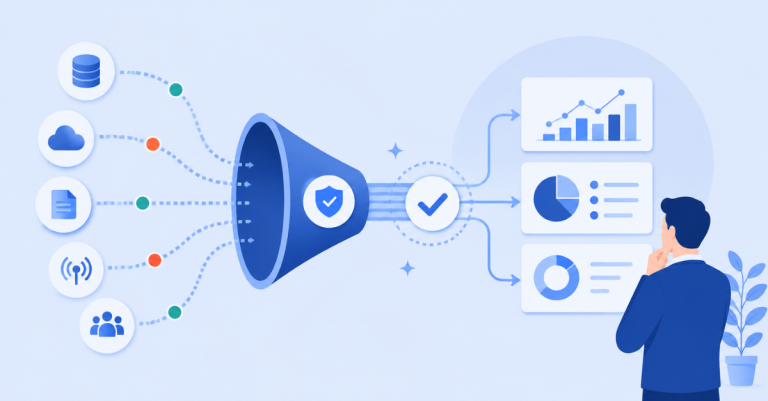
Source quality control reduces rework by preventing defects from spreading downstream. Controls may include source qualification, schema validation, completeness checks, freshness monitoring, duplication detection, anomaly detection, source change alerts, and quality scoring.
When these controls are applied early, teams catch problems before they become model failures, dashboard inconsistencies, or executive reporting issues. Engineering teams spend less time repairing downstream jobs. Analysts spend less time explaining metric changes. AI teams spend less time retraining models to solve problems caused by weak inputs.
In practice, source quality control improves both reliability and operating efficiency. It shifts the organization from reactive correction to preventative data management.
How Downstream Data Quality Depends on Source-Level Discipline
Downstream data quality is often discussed as a pipeline or transformation issue. That framing is incomplete. Transformation can standardize formats, remove duplicates, normalize entities, and validate schemas. However, downstream quality remains constrained by the condition of the source. If the source lacks coverage, contains biased observations, or changes unpredictably, downstream controls can only reduce part of the risk.
IBM’s 2025 CDO Study emphasizes that organizations need high-quality data and strong governance frameworks to unlock value from proprietary and ecosystem data. That point applies directly to external source quality. Ecosystem data becomes valuable only when sources are reliable enough to support trusted downstream use.
Validation cannot Fully Correct Incomplete, Biased, or Unstable Source Inputs
Validation is necessary, but it cannot fully correct poor source selection or weak source conditions. It can detect missing fields, invalid values, schema changes, duplicate records, or unusual patterns. It cannot create missing market coverage, remove all source bias, restore lost history, or prove that a source represents the decision environment.
A dataset may pass validation and still be strategically weak. For example, competitor pricing data may have complete fields but exclude important regional competitors. Customer review data may be clean, but overrepresent one platform. Public records may be structured but delayed. External product data may be valid, but missing critical sellers or variants.
Therefore, source quality and downstream validation must operate together. Validation checks whether incoming data meets expected rules. Source quality assessment checks whether the source deserves to be used in the first place.
Data Teams Need Source Context to Interpret Quality Issues Accurately
Data teams need source context to distinguish technical defects from real-world signals. A sudden drop in records may indicate source failure, market contraction, access restrictions, or a legitimate change in activity. A field value shift may reflect a source schema change, extraction failure, or actual business movement. A missing category may be a source coverage issue rather than a market trend.
Source context helps teams interpret these changes accurately. Metadata, historical source behavior, update cadence, field definitions, access patterns, and known limitations all matter.
Without source context, organizations risk misdiagnosis. They may treat source defects as business insights or dismiss real market changes as data issues. Both outcomes weaken decision quality.
The Strategic Impact of Weak External Source Quality
Weak external source quality affects strategy because it changes how teams interpret reality. Decision systems do not simply process data. They shape pricing decisions, competitive responses, AI outputs, risk assessments, forecasts, and executive judgments. If the source layer is weak, strategic interpretation becomes less reliable.
NIST’s AI Risk Management Framework provides a lifecycle approach to AI governance, measurement, and management. The framework reinforces a broader enterprise principle: risk must be addressed across the lifecycle, including the data inputs that shape system behavior. External source quality is one of the earliest risk points in that lifecycle. Data sourcing solutions for businesses play a crucial role in ensuring the reliability of decision-making processes. By enhancing the quality of data inputs, organizations can better align their strategic goals with accurate forecasts and assessments. Investing in robust data sourcing solutions ultimately contributes to more informed and effective leadership decisions.
Decision Systems Lose Trust When Source Defects Appear as Business Signals
Source defects become dangerous when they appear as business signals. A source coverage drop may look like declining demand. A delayed update may look like stable market conditions. A duplicated feed may inflate activity. A missing field may distort pricing analysis. A changed source structure may create false anomalies.
When teams discover that outputs were shaped by source defects, trust declines. Business users begin questioning dashboards, reports, and model outputs. Analysts add manual checks. Executives request more validation. Teams may build parallel workflows to confirm results.
The cost is not only technical correction. It is an organizational loss of confidence. Once users believe data products are unreliable, adoption becomes harder to rebuild.
AI, Market Intelligence, and Analytics Workflows Become Fragile When Sources Are Unreliable
AI, market intelligence, and analytics workflows depend on source reliability in different ways. Also, AI systems need stable and representative inputs for training, inference, monitoring, and retraining. Market intelligence programs need external sources that reflect competitors, channels, customers, and regions accurately. Analytics teams need consistent definitions and update patterns to support reporting and forecasting.
Unreliable sources weaken all three. Models drift for unclear reasons. Competitive intelligence misses movement. Dashboards show unstable metrics. Forecasts become less dependable. Governance teams face more review questions because source quality is difficult to defend.
External source quality, therefore, affects the resilience of the entire data environment. It determines whether downstream systems can remain trusted as sources change.
The Infrastructure Layer Behind Stronger Source Quality Control
Source quality control requires infrastructure because manual review cannot scale across large source portfolios. Enterprises need systems that monitor source health, validate incoming data, preserve context, trace downstream impact, and make source changes visible over time. Without this infrastructure, source quality becomes dependent on institutional memory and manual exception handling.
The World Economic Forum’s 2025 analysis on scaling AI with strategy, data, and workforce readiness argues that strong data foundations are necessary for enterprise AI scale. Source quality control is part of that foundation because AI and analytics cannot scale responsibly when the input layer is unstable or poorly governed.
Monitoring, Metadata, and Lineage Help Teams Trace Defects Back to Source Conditions
Monitoring tracks whether sources remain available, fresh, complete, and structurally consistent. Metadata records source ownership, expected update cadence, field definitions, quality scores, collection method, access constraints, and known limitations. Lineage shows where source data flows downstream and which models, dashboards, reports, or workflows depend on it.
Together, these controls help teams trace defects back to source conditions. If a dashboard changes unexpectedly, lineage can show which source contributed the underlying data. If a model begins underperforming, metadata can reveal whether a source changed coverage or freshness. When a pipeline fails, monitoring can show whether the issue began at the source or downstream.
This reduces diagnosis time and prevents teams from treating each downstream symptom as an isolated incident.
Versioning and Observability Make Source Quality Changes Visible Over Time
Versioning preserves the history of source schemas, datasets, transformations, and quality profiles. Observability systems make operational changes visible by tracking freshness, latency, failure rates, volume changes, coverage gaps, and anomaly patterns.
Prometheus and other observability systems can monitor pipeline health. Great Expectations can support schema validation, completeness checks, and anomaly detection. Airflow can orchestrate source workflows. Kafka can support the continuous movement of external data. Spark can process high-volume feeds. DBT can structure transformations into governed models. Snowflake, BigQuery, and Databricks can support scalable storage and analysis.
Dynamic external sources may require Playwright or other browser automation frameworks to capture data from changing web environments. Extraction resilience, proxy orchestration, source change detection, and legal sourcing controls may also be required when external sources are business-critical.
Why External Source Quality Is Becoming an Enterprise Governance Priority
External source quality is becoming a governance priority because source defects now influence systems that leaders rely on for strategic decisions. As AI, analytics, automation, and market intelligence become more embedded in enterprise operations, source quality becomes part of enterprise risk management. Leaders need visibility into which sources influence critical decisions and whether those sources are controlled.
The World Bank’s Digital Progress and Trends Report 2025 emphasizes the importance of foundational systems for responsible and scalable AI adoption. Inside enterprises, source quality is one of those foundations. Decision systems cannot scale responsibly when critical inputs are unstable, undocumented, or difficult to audit.
Leaders Need Visibility into Which Sources Influence Critical Decisions
Executives do not need to inspect every source. However, they need visibility into sources that influence critical decisions. Which sources feed production AI models? Which support pricing intelligence? Also, which inform risk monitoring? Which shape executive dashboards? Which external sources are single points of failure?
This visibility helps leaders prioritize governance. Business-critical sources should receive stronger controls, clearer ownership, more frequent quality review, and better continuity planning. Lower-risk exploratory sources may require lighter controls.
Without this visibility, source quality risk remains hidden until it affects decisions. By then, the organization may have already acted on weakened data.
Scalable Data Programs Require Source Quality Standards, Ownership, and Continuous Review
Scalable data programs require formal source quality standards. These standards should define acceptable freshness, completeness, stability, documentation, representativeness, access control, compliance review, and monitoring expectations. They should also clarify escalation thresholds when source quality declines.
Ownership is equally important. Each critical source should have a defined owner responsible for quality review, documentation, monitoring, issue resolution, and lifecycle management. Continuous review ensures that source quality remains aligned with business use as markets, platforms, regulations, and systems change.
Ultimately, External Source Quality shapes downstream decisions because source conditions define what data systems can reliably know. Source quality assessment determines whether inputs are fit for purpose. Source quality control prevents defects from spreading through pipelines, models, and reports. Downstream data quality depends on upstream discipline.
Organizations that manage external source quality as governance infrastructure will build more reliable AI, analytics, and intelligence systems. Those that treat sources as interchangeable inputs may collect more data, but they will struggle to prove that downstream decisions are based on stable, complete, and defensible evidence.