Key Takeaways
- How Supply Chain API Integration improves coordination between ERP, TMS, WMS, carrier, supplier, and customer-facing systems
- Why logistics data exchange must support shipment events, inventory movement, delivery milestones, and exception handling
- How supply chain visibility data reduces manual tracking, delayed escalation, and operational uncertainty
- Why tracking API connectivity depends on validation, lineage, governance, access controls, and source ownership
- How structured API pipelines improve event visibility, customer updates, logistics planning, and risk response
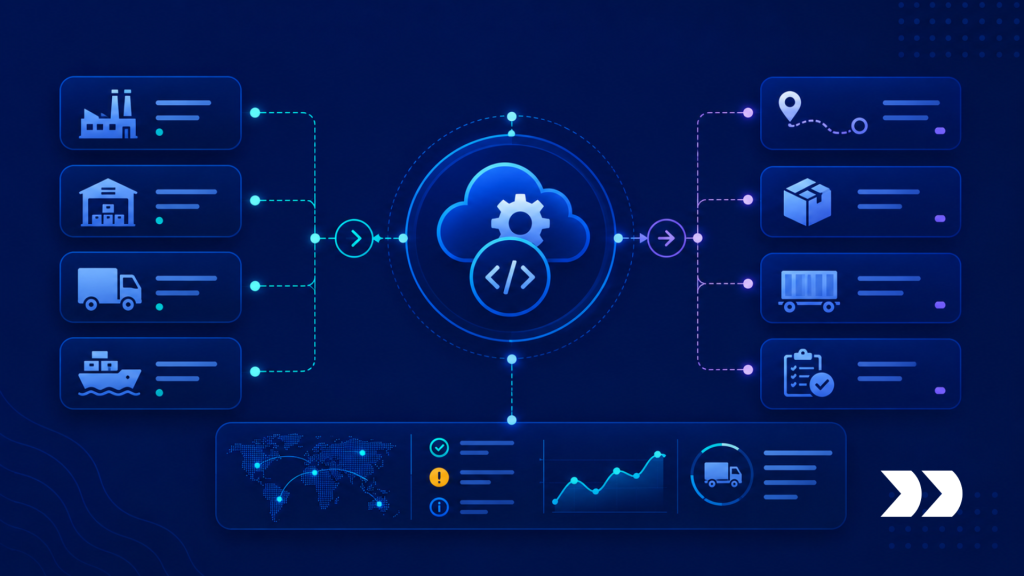
Supply chain visibility depends on accurate event data moving across suppliers, carriers, warehouses, freight forwarders, ports, customs systems, ERP platforms, transportation management systems, customer portals, and analytics environments. When these systems are disconnected, teams rely on delayed updates, manual shipment checks, carrier portals, spreadsheet trackers, and reactive escalation. Supply Chain API Integration gives logistics, procurement, operations, finance, and customer service teams a structured way to coordinate shipment events, inventory movement, delivery milestones, exception alerts, and performance data across the supply chain network.
The Visibility Gap Across Supply Chain Events
Supply chains generate constant movement: purchase orders, inventory receipts, warehouse picks, shipment creation, carrier pickup, customs clearance, port arrival, in-transit updates, delivery confirmation, returns, damage reports, and invoice events. However, these events often live across disconnected systems. A carrier may know a shipment is delayed before the ERP does. A warehouse may confirm dispatch before the customer portal updates. A supplier may change a delivery date before procurement receives notice.
This creates a visibility gap. Teams may know that a shipment exists, but not where it is, whether it is delayed, which milestone failed, or who owns the next action. GS1 EPCIS is relevant because it provides a standard for creating and sharing visibility event data across supply chain processes.
Why Supply Chain Event Data Fragments Across Systems
Supply chain event data fragments because each participant manages a different part of the physical flow. Suppliers manage production and dispatch. Warehouses manage receiving, storage, picking, and loading. Carriers manage pickup, transit, and delivery milestones. Customs brokers manage clearance events. ERP systems manage purchase orders, inventory valuation, and financial posting. Customer platforms manage communication and service status.
Each system may use different identifiers, timestamps, event names, and status definitions. One carrier may report “departed facility,” another “in transit,” and another “linehaul departed.” Supply Chain API Integration reduces this fragmentation by defining how events are normalized, validated, and published across systems.
How Disconnected Logistics Systems Affect Operations
Disconnected logistics systems create delays and unnecessary escalation. Procurement may not know that inbound materials are late. Customer service may not see delivery exceptions. Finance may receive freight invoices before shipment status is reconciled. Operations may plan labor around expected arrivals that have already shifted.
Consequently, logistics data exchange becomes an operating control. It helps teams identify delays earlier, synchronize shipment status, and route exceptions to the right owner. This is especially important when supply chains span multiple carriers, warehouses, geographies, suppliers, and customer channels.
Supply Chain API Integration as an Operating Layer
Supply Chain API Integration becomes valuable when it operates as a governed layer between logistics partners, internal systems, and customer-facing workflows. The goal is not simply to connect carrier APIs. The goal is to create a trusted flow of supply chain visibility data that supports planning, execution, escalation, reporting, and customer communication.
This operating layer should define which system owns each event, which updates trigger downstream workflows, which exceptions require review, and which records are visible to customers. Without these rules, integration can spread incomplete or inconsistent logistics data across the enterprise. Api integration strategies for crosssystem efficiency often focus on establishing clear protocols and standards for data exchange. By leveraging robust APIs, organizations can streamline operations and enhance collaboration across different software platforms. This ensures that all stakeholders have access to real-time information, ultimately driving better decision-making and improving overall service delivery.
Defining Source Ownership Across Supply Chain Events
Source ownership is the foundation of reliable tracking API connectivity. A WMS may own pick, pack, and dispatch events. A TMS may own shipment tendering, carrier selection, and route planning. A carrier may own pickup, transit, exception, and delivery events. ERP may own purchase orders, inventory, and financial status. Customer service systems may own communication history and escalation notes.
Clear ownership prevents conflicting updates. For example, a carrier may confirm delivery, but ERP may still need a receiving confirmation before inventory is updated. A warehouse may dispatch goods, but the TMS may own carrier tracking details. Integration logic should preserve these boundaries.
Creating a Common Shipment and Event Model
A common event model connects shipment ID, purchase order, sales order, carrier reference, tracking number, container ID, SKU, quantity, location, timestamp, event type, exception code, and responsible party. This does not require every partner to use the same internal data model, but it does require consistent mapping across systems.
For example, “shipped,” “picked up,” “departed terminal,” “arrived hub,” “out for delivery,” and “delivered” are different operational states. A shipment may be dispatched from the warehouse but not yet accepted by the carrier. It may be delivered to a dock but not yet received into inventory. Supply Chain API Integration should preserve these distinctions.
Connecting Event Visibility to Operational Workflows
Supply chain visibility data becomes useful when it triggers action. A late inbound shipment may require production rescheduling. A customs hold may require documentation review. A missed delivery appointment may require customer communication. A temperature excursion may require quality review. A damaged shipment may require claims processing.
Integrated event data allows these workflows to start earlier. Instead of waiting for manual status checks, teams can receive alerts, open exceptions, update customers, and adjust plans based on verified events.
Infrastructure Requirements for Logistics Data Exchange
Logistics data exchange depends on infrastructure that can collect, validate, synchronize, monitor, and govern event data across internal and external systems. The objective is not to build fragile one-off connectors for every carrier or supplier. Teams need controlled API workflows that can handle rate limits, retries, duplicate events, delayed updates, schema changes, and exception queues.
Supply chain event data is operationally sensitive because delayed or inaccurate updates can affect production, fulfillment, customer commitments, and working capital. UN/CEFACT is relevant because it supports standards and recommendations for electronic business, trade facilitation, and structured data exchange across international supply chains.
Continuous Intake Across Suppliers, Carriers, Warehouses, and ERP
Supply chain events may enter through carrier APIs, supplier portals, EDI feeds, IoT platforms, WMS, TMS, ERP, customs systems, freight forwarders, customer portals, and third-party logistics providers. Continuous intake captures milestone updates, shipment status, location changes, exception alerts, delivery confirmation, inventory movement, and return activity.
Apache Airflow can orchestrate scheduled reconciliation jobs and partner data refreshes. Kafka can support event-driven movement when shipment status, inventory events, or exception alerts need rapid downstream visibility. Controlled intake helps teams avoid stale tracking data and delayed escalation.
SUPPLY_CHAIN_EVENT_RULES = {
"required_fields": [
"shipment_id",
"source_system",
"event_type",
"event_timestamp",
"location",
],
"customer_visible_events": [
"picked_up",
"in_transit",
"out_for_delivery",
"delivered",
],
}

def route_supply_chain_event(event):
missing = [
field for field in SUPPLY_CHAIN_EVENT_RULES["required_fields"]
if not event.get(field)
]

if missing:
return {
"action": "quarantine",
"reason": "missing_required_fields",
"fields": missing,
}

if event.get("exception_code"):
return {
"action": "send_to_operations_review",
"shipment_id": event["shipment_id"],
"reason": "shipment_exception_detected",
}

if event["event_type"] in SUPPLY_CHAIN_EVENT_RULES["customer_visible_events"]:
return {
"action": "publish_to_customer_portal",
"shipment_id": event["shipment_id"],
}

return {
"action": "store_internal_event",
"shipment_id": event["shipment_id"],
}


event = {
"shipment_id": "SHP-904812",
"source_system": "carrier_api",
"event_type": "in_transit",
"event_timestamp": "2026-06-17T14:25:00Z",
"location": "DFW-HUB-02",
"tracking_number": "1Z999AA10123456784",
"purchase_order_id": "PO-77192",
"exception_code": None,
}

result = route_supply_chain_event(event)
print(result)
Normalizing Events, Locations, Shipments, and Status Codes
Raw logistics data is rarely consistent. One partner may report events by tracking number, another by container ID, another by purchase order, and another by shipment reference. Locations may appear as addresses, facility codes, port codes, GPS coordinates, or partner-specific names. Status codes may differ across carriers and regions.
Normalization aligns event names, shipment identifiers, timestamps, time zones, locations, carrier references, order IDs, SKU references, exception codes, and delivery milestones. Spark can process high-volume event and tracking datasets, while dbt can manage repeatable transformation logic and documentation. This makes supply chain visibility data more reliable for operations and reporting.
Validating Event Data Before Operational Use
Validation controls prevent unreliable event data from triggering incorrect actions. These controls should check duplicate events, missing shipment IDs, invalid timestamps, impossible location sequences, mismatched quantities, stale carrier updates, unknown exception codes, and inconsistent delivery statuses.
Validation should occur before shipment updates are published to customer portals, ERP, inventory systems, or executive dashboards. Data quality frameworks such as Great Expectations can support checks for completeness, accepted values, sequence logic, and cross-system consistency. Without validation, tracking data can create false confidence.
EVENT_VALIDATION_RULES = {
"required_fields": [
"shipment_id",
"event_type",
"event_timestamp",
"source_system",
"location",
],
"blocked_event_types": [
"unknown_status",
"test_event",
],
"review_required_when": [
"delivery_status_changed",
"carrier_reference_missing",
"exception_code_present",
],
}

def validate_supply_chain_event(event, flags=None):
missing = [
field for field in EVENT_VALIDATION_RULES["required_fields"]
if not event.get(field)
]

if missing:
return {
"valid": False,
"reason": "missing_required_fields",
"fields": missing,
}

if event.get("event_type") in EVENT_VALIDATION_RULES["blocked_event_types"]:
return {
"valid": False,
"reason": "blocked_event_type",
"event_type": event.get("event_type"),
}

if flags:
review_flags = [
flag for flag in flags
if flag in EVENT_VALIDATION_RULES["review_required_when"]
]

if review_flags:
return {
"valid": False,
"reason": "manual_review_required",
"flags": review_flags,
}

return {"valid": True}


event = {
"shipment_id": "SHP-904812",
"event_type": "delivered",
"event_timestamp": "2026-06-18T09:40:00Z",
"source_system": "carrier_api",
"location": "ATL-DC-01",
}

result = validate_supply_chain_event(
event,
flags=["delivery_status_changed"]
)

print(result)
Technology Stack Behind Supply Chain Event Visibility
Supply chain event visibility requires a technology stack that supports APIs, EDI, event streams, batch reconciliation, geospatial data, partner data feeds, and operational monitoring. The stack must handle both fast-moving tracking events and slower back-office reconciliation workflows.
A mature environment connects suppliers, carriers, WMS, TMS, ERP, customer service, BI, and risk systems through governed workflows. It should reduce manual tracking without weakening controls around shipment status, inventory movement, and customer commitments.
Orchestration and Connectivity Using APIs, EDI, Kafka, and Airflow
Supply chain workflows commonly use APIs for carrier tracking, shipment creation, rate retrieval, appointment scheduling, and event updates. EDI remains important for purchase orders, advance shipment notices, invoices, and transportation messages. Kafka can distribute logistics events across downstream systems. Airflow can coordinate reconciliation jobs, exception reports, and partner data refreshes.
The integration design should include retry logic, idempotency, event deduplication, failure monitoring, and partner-specific error handling. These controls matter because supply chain events often arrive late, repeat, or conflict across systems.
Processing and Transformation Through Spark, dbt, and Logistics ETL Pipelines
Processing layers convert raw partner and system events into structured logistics datasets. Spark can process high-volume shipment events, inventory movements, tracking updates, carrier files, and exception logs. dbt can manage standardized models for shipment status, carrier performance, inventory movement, delivery reliability, and exception analysis.
Logistics ETL and ELT pipelines can map status codes, normalize facility names, align time zones, connect shipments to orders, classify exceptions, and calculate milestone performance. This makes logistics data exchange repeatable rather than dependent on manual tracker updates.
Storage, Analytics, and Governance in Snowflake, BigQuery, or Databricks
Snowflake, BigQuery, and Databricks can support integrated supply chain visibility layers where operations, logistics, procurement, finance, and customer service teams analyze shipment status, inventory movement, carrier performance, exceptions, and delivery reliability.
Governance controls should include role-based access, audit logs, metadata catalogs, data lineage, retention rules, partner source documentation, and exception history. These controls matter because supply chain data affects customer commitments, inventory planning, supplier performance, freight cost management, and operational risk.
Commercial Impact of Supply Chain API Integration
The commercial value of Supply Chain API Integration appears when event visibility becomes more reliable, timely, and actionable. Better integration can reduce manual tracking, improve delay detection, support customer updates, reduce operational surprises, and strengthen logistics performance analysis. The result is not only cleaner connectivity. It is stronger control over movement and exceptions.
For supply chain leaders, operations teams, procurement, finance, and customer service, the practical value is confidence. Integrated event data helps teams understand what moved, what is delayed, what is delivered, and what requires intervention. Eventdriven architecture for APIs enhances the ability to respond to real-time changes in supply chain dynamics. By utilizing this architecture, organizations can achieve seamless data flow and automated responses, allowing for quicker decision-making. This adaptability ultimately leads to improved service levels and customer satisfaction.
Improving Shipment Visibility and Exception Response
Shipment visibility improves when carrier updates, warehouse events, supplier notices, and order records are connected. Teams can see whether a shipment is pending pickup, in transit, delayed, held, damaged, delivered, or awaiting receipt. This reduces reliance on manual portal checks and email updates.
Exception response improves because teams can act earlier. A delay can trigger customer communication, alternative sourcing, production rescheduling, or logistics escalation before the impact becomes larger.
Reducing Manual Tracking Across Logistics Teams
Logistics teams often spend time checking carrier portals, downloading tracking reports, emailing suppliers, and updating spreadsheets. Structured tracking API connectivity reduces this work by standardizing event intake and exception routing.
The operational value is consistency. When every team tracks shipments differently, visibility becomes fragmented. Integrated event data creates a shared foundation for transportation, warehouse, procurement, and customer service teams.
Supporting Supplier, Carrier, and Customer Performance Analysis
Supply chain visibility data supports performance analysis across suppliers, carriers, lanes, facilities, and customer segments. Teams can measure on-time pickup, transit reliability, appointment adherence, exception frequency, delivery accuracy, and receiving delays.
This supports better partner management. Procurement and logistics teams can evaluate whether performance issues are isolated events or recurring patterns. Finance can connect logistics performance to freight cost, penalties, and service-level commitments.
Risk Exposure When Supply Chain Systems Are Disconnected
Disconnected supply chain systems create operational, financial, and customer experience risk. Shipments may be delayed without escalation. Inventory may appear available before receiving is complete. Customers may receive outdated delivery information. Carrier invoices may not match shipment records. Supplier performance may be measured from incomplete data.
The risk increases as networks expand across suppliers, carriers, warehouses, borders, and customer channels. Manual tracking may work at low volume, but it becomes fragile when event volume and partner complexity increase.
Delayed Detection of Shipment Exceptions
Shipment exceptions can appear in carrier systems before internal teams see them. A shipment may be delayed, misrouted, held at customs, damaged, or missing delivery documentation. If these events are not synchronized, teams lose time.
Supply Chain API Integration helps detect exceptions earlier by collecting events from multiple partners and routing them into operational workflows. Earlier visibility gives teams more time to correct, communicate, or replan.
Inventory and Fulfillment Visibility Errors
Inventory visibility depends on accurate movement events. A shipment may be physically delivered but not received into the warehouse. Inventory may be in transit but is counted as available. Returns may be received but not reconciled. These gaps can affect fulfillment promises and planning decisions.
Logistics data exchange should connect shipment events with inventory and order systems. This reduces the risk of planning based on inaccurate availability data.
Governance Gaps in Supply Chain Event Data
Supply chain event data can create governance issues if source ownership, transformation logic, and access rights are unclear. Teams may use event data for customer communication, supplier scorecards, freight claims, inventory planning, and executive reporting. If the data cannot be reproduced or explained, confidence declines.
NIST Cybersecurity Framework 2.0 is useful because supply chain integrations connect internal systems, external partners, and operational data flows that require governance, access control, monitoring, and risk management.
Governance Requirements for Supply Chain Visibility Data
Supply chain visibility data must be governed because it affects customer commitments, inventory planning, supplier performance, carrier management, financial reporting, and operational response. Data may come from suppliers, carriers, brokers, warehouses, ERP, WMS, TMS, IoT devices, and customer platforms. Each source has different reliability, ownership, and update cadence.
Governance should make event data easier to trust. The goal is to give teams operational visibility while protecting sensitive supplier, customer, shipment, and commercial information.
Source Documentation, Access Controls, and Audit Logs
Supply chain datasets should document source system, field ownership, refresh cadence, transformation logic, status definitions, and known limitations. Access controls should restrict sensitive customer orders, supplier details, shipment values, commercial terms, and operational performance data. Audit logs should record who accessed, changed, exported, or approved event records.
These controls help logistics, procurement, and finance teams demonstrate that supply chain decisions are based on approved and traceable data.
Data Lineage Across Orders, Shipments, and Inventory Events
Data lineage allows teams to understand how an event moved from source to operational use. Traceability should cover purchase order, shipment creation, carrier pickup, in-transit milestone, delivery confirmation, receiving event, inventory update, and reporting publication.
Lineage also supports debugging. If a shipment appears delivered in one system but open in another, teams can determine whether the issue came from carrier status, WMS receiving, ERP posting, API timing, or transformation logic.
Multi-Partner and Cross-Border Supply Chain Considerations
Supply Chain API Integration becomes more complex across countries, carriers, suppliers, ports, languages, currencies, customs rules, and regulatory environments. A shipment event that is standard in one market may require different documentation or milestone definitions elsewhere.
Cross-border controls should document partner rules, location mapping, data rights, storage location, access permissions, customs references, and permitted use. This reduces the risk that tracking API connectivity works technically but fails operationally across regions. API benefits for product synchronization can significantly enhance the efficiency of cross-border logistics. By enabling seamless data exchange between systems, businesses can ensure that inventory levels and order statuses are consistently up to date. This optimization not only streamlines operations but also improves the overall customer experience by reducing delays and discrepancies.
Evaluating Supply Chain API Integration Readiness
Supply Chain API Integration becomes valuable when it supports repeatable visibility workflows, not simply when systems can exchange events. Readiness depends on source ownership, API coverage, event definitions, partner coverage, validation controls, governance, exception handling, and workflow integration.
A readiness review helps identify where visibility risk accumulates before it becomes a delivery delay, inventory mismatch, customer complaint, supplier dispute, or freight cost issue.
How Teams Assess Supply Chain Data Quality
A structured assessment should evaluate missing shipment IDs, duplicate tracking events, invalid timestamps, stale carrier updates, location accuracy, exception code consistency, delivery confirmation quality, order linkage, inventory event matching, and partner coverage. It should also review source ownership, update cadence, failed API calls, exception volume, and reconciliation differences between TMS, WMS, ERP, and carrier records.
For supply chain visibility data, quality must be evaluated operationally. A tracking record may look complete in one system while still failing to support customer communication, inventory planning, or carrier performance analysis.
When Organizations Need a Supply Chain Integration Architecture Review
A supply chain integration architecture review becomes useful when teams rely on manual tracking, disconnected carrier portals, inconsistent shipment records, delayed inventory updates, or reports that do not reconcile. The review should assess source coverage, API workflows, EDI dependencies, validation controls, sync cadence, storage architecture, lineage tracking, governance posture, and exception handling.
The output should clarify where event data risk accumulates, where logistics data exchange may be incomplete, and which infrastructure improvements would make supply chain visibility more reliable for operations, procurement, finance, and customer service teams.
Conclusion: Supply Chain API Integration as Event Visibility Infrastructure
Supply chain visibility depends on reliable data movement across suppliers, carriers, warehouses, ERP, WMS, TMS, customer systems, and analytics environments. When these systems remain disconnected, teams spend excessive time tracking shipments manually, reconciling inventory movement, investigating delays, and explaining delivery uncertainty. Supply Chain API Integration creates the governed data foundation needed to coordinate event visibility across the supply chain lifecycle.
Ultimately, organizations that treat supply chain integration as event visibility infrastructure, not just partner connectivity, will be better positioned to improve logistics data exchange, strengthen supply chain visibility data, reduce manual tracking, and build more reliable tracking API connectivity across complex operational networks.