Key Takeaways
- How Booking API Integration improves coordination between reservation engines, customer channels, payment systems, CRM, and operations platforms
- Why reservation system integration requires reliable data flows across availability, booking creation, modification, cancellation, and confirmation workflows
- How booking data sync reduces double bookings, stale inventory, customer service delays, and manual reconciliation
- Why the availability of the API connection depends on validation, access controls, lineage, monitoring, and source ownership
- How structured API pipelines improve booking workflow automation, operational visibility, and customer experience consistency
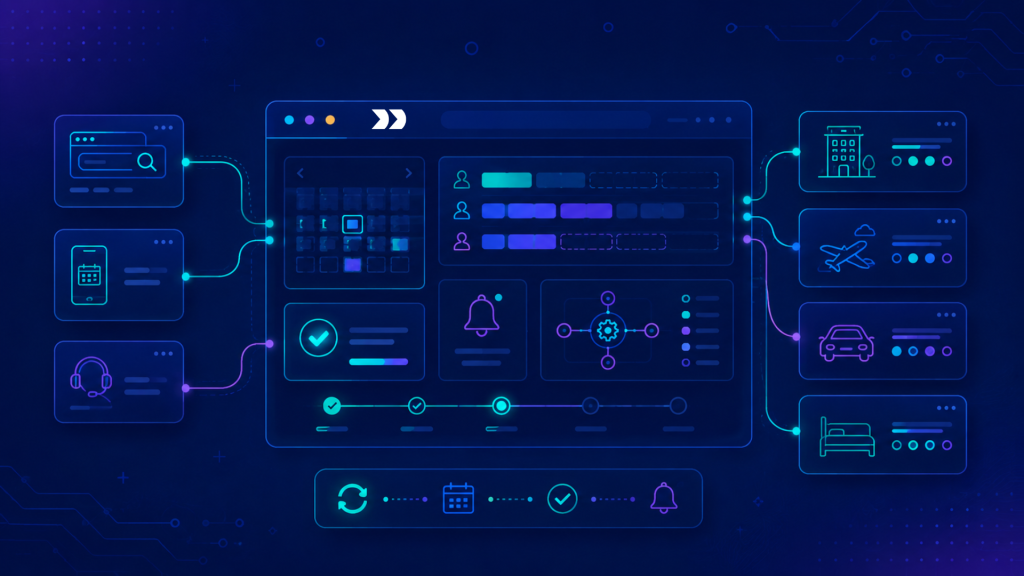
Booking and reservation workflows depend on accurate data movement between customer-facing booking platforms, reservation engines, inventory systems, payment gateways, CRM tools, partner channels, mobile apps, customer service systems, and operational scheduling platforms. When these systems are disconnected, teams deal with double bookings, stale availability, delayed confirmations, refund confusion, and manual reconciliation. Booking API Integration gives travel, hospitality, healthcare, events, mobility, and service-based organizations a structured way to coordinate availability, reservations, payments, cancellations, modifications, and customer communication across connected systems.
The Coordination Gap in Reservation Workflows
Booking workflows often look simple from the customer side: select a date, choose availability, submit details, confirm payment, and receive confirmation. Behind that flow, multiple systems need to agree on capacity, price, eligibility, customer identity, payment status, booking rules, cancellation windows, and operational readiness. If any system is out of sync, the customer-facing promise can become inaccurate.
This coordination gap appears across many industries. Hotels must sync rooms and rates across direct channels and OTAs. Airlines and travel sellers must coordinate fares, seats, ancillaries, and ticketing status. Clinics must align provider schedules with patient portals. Event operators must prevent seat overselling. OpenTravel Alliance is relevant because it focuses on travel data standards and interoperability across booking, travel distribution, and reservation systems.
Why Booking Data Fragments Across Systems
Booking data fragments because each system manages a different stage of the reservation lifecycle. A booking engine may own customer-facing search and reservation creation. A scheduling platform may own staff, room, vehicle, or asset availability. A payment gateway may own authorization and capture status. CRM may own the customer profile and communication history. Operating systems may have fulfillment readiness.
Over time, these systems develop different identifiers, statuses, and timing rules. One system may classify a booking as confirmed after customer submission, while another waits for payment capture. One may release inventory immediately after cancellation, while another waits for operational review. Booking API Integration reduces this fragmentation by defining how booking states move across systems.
How Disconnected Reservation Systems Affect Operations
Disconnected reservation systems create direct operational problems. A customer may reserve a slot that is no longer available. A partner channel may sell inventory after the direct channel has already consumed it. Customer service may see a booking but not the latest modification. Finance may see payment without a clear booking linkage. Operations may prepare for a reservation that was canceled elsewhere.
Consequently, reservation system integration becomes an operating control. It helps teams prevent double bookings, reduce manual updates, and maintain consistent booking status across customer-facing and internal systems. This becomes more important as organizations add channels, regions, partners, payment methods, and real-time availability requirements.
Booking API Integration as an Operating Layer
Booking API Integration becomes valuable when it operates as a governed layer between customer channels, reservation systems, inventory sources, payment systems, and operational platforms. The goal is not simply to connect APIs. The goal is to create a reliable flow of booking events that supports search, availability, reservation creation, payment, confirmation, modification, cancellation, and customer updates.
This operating layer should define which system owns availability, which system confirms the booking, which events trigger inventory updates, which changes require approval, and which status is visible to the customer. Without these rules, automation can spread inaccurate booking information quickly.
Defining Source Ownership Across Booking Data Domains
Source ownership is the foundation of a reliable booking data sync. The reservation engine may own the booking ID, reservation state, cancellation policy, and customer-facing confirmation. The inventory or scheduling system may include capacity, time slots, room availability, staff availability, vehicle availability, or seat inventory. The payment platform may own authorization, capture, refund, and settlement status. CRM may own the customer profile and communication preferences.
Clear ownership prevents conflicting updates. For example, customer service may request a cancellation, but the reservation system should confirm whether the booking was actually canceled. A payment gateway may confirm a refund, but it should not independently release availability unless the reservation state supports it. Integration logic should preserve these boundaries.
Creating a Common Booking, Availability, and Customer Model
A common booking model connects booking ID, customer ID, availability unit, date, time, location, price, payment status, confirmation status, cancellation terms, modification history, and communication events. This does not require every system to store data identically, but it does require consistent mapping across systems.
For example, “reserved,” “confirmed,” “paid,” “ticketed,” “checked in,” and “fulfilled” may represent different operational states. A booking may be confirmed but not paid. It may be paid but not fulfilled. It may be modified but not re-confirmed across all channels. Booking API Integration should preserve these distinctions so teams can avoid false visibility.
Connecting Booking Workflow Automation to Customer Experience
Booking workflow automation affects customer experience directly. Customers expect accurate availability, immediate confirmation, clean modification flows, reliable cancellation handling, and clear refund status. If internal systems disagree, customers receive conflicting messages or delayed support.
A connected booking layer gives customer service teams visibility into reservation status, payment status, operational readiness, and communication history. It also allows organizations to automate confirmation emails, reminders, waitlist updates, cancellation notices, and rebooking options with fewer manual steps.
Infrastructure Requirements for Reservation System Integration
Reservation system integration depends on infrastructure that can collect, validate, synchronize, monitor, and govern booking events across platforms. The objective is not to create brittle point-to-point connections between every channel and reservation engine. Teams need controlled API workflows that handle rate limits, retries, idempotency, duplicate booking attempts, schema changes, webhook failures, and exception queues.
Booking data is time-sensitive because availability can change quickly. A delay of minutes may cause overselling, customer confusion, or operational conflict. OpenAPI is relevant because documented API specifications help teams design, test, and maintain integration contracts across software systems.
Continuous Data Intake Across Booking, Inventory, and Channel Systems
Booking data may be entered through websites, mobile apps, partner portals, OTAs, marketplace channels, call centers, CRM tools, payment gateways, scheduling platforms, and operational systems. Continuous intake captures search requests, availability checks, reservation holds, confirmed bookings, modifications, cancellations, payments, refunds, and fulfillment events.
Apache Airflow can orchestrate scheduled reconciliation jobs, reporting workflows, and exception checks. Kafka can support event-driven updates when availability, booking status, payment events, or cancellation changes need rapid downstream visibility. Controlled intake helps prevent stale booking status and delayed availability updates.
def route_booking_event(event):
if event["status"] == "confirmed":
return {"action": "sync_availability", "booking_id": event["booking_id"]}

if event["status"] == "cancelled":
return {"action": "release_inventory", "booking_id": event["booking_id"]}

return {"action": "store_for_review", "booking_id": event["booking_id"]}


event = {
"booking_id": "BK-904812",
"source_system": "booking_engine",
"status": "confirmed",
"availability_unit": "ROOM-220",
"timestamp": "2026-06-17T14:25:00Z",
}

print(route_booking_event(event))
Normalizing Availability, Booking Status, and Channel Data
Raw reservation data is rarely consistent across systems. One channel may use “held,” another “pending,” another “reserved,” and another “confirmed.” Availability may be represented as seats, rooms, appointments, vehicles, tables, tickets, inventory units, or service slots. Pricing may include taxes, fees, deposits, promotions, or cancellation penalties.
Normalization aligns booking IDs, customer identifiers, channel names, availability units, timestamps, locations, status codes, prices, policies, and payment references. Spark can process large booking and event datasets, while dbt can manage repeatable transformation logic and documentation. This makes booking data sync more consistent across operational and analytical workflows.
Validating Booking Data Before Operational Use
Validation controls prevent incorrect booking records from entering downstream systems. These controls should check duplicate booking IDs, invalid availability units, missing customer details, incomplete payment references, conflicting time slots, unavailable inventory, invalid cancellation windows, and inconsistent modification records.
Validation should occur before booking status is published to customers, availability is released to channels, or operational schedules are updated. Data quality frameworks such as Great Expectations can support checks for completeness, accepted values, uniqueness, and cross-system consistency. Without validation, booking automation can accelerate customer-facing errors.
BOOKING_REQUIRED_FIELDS = [
"booking_id",
"customer_id",
"availability_unit",
"status",
"payment_status",
]

def validate_booking(record):
missing = [field for field in BOOKING_REQUIRED_FIELDS if not record.get(field)]

if missing:
return {"valid": False, "reason": "missing_fields", "fields": missing}

if record["status"] == "confirmed" and record["payment_status"] != "paid":
return {"valid": False, "reason": "payment_not_confirmed"}

return {"valid": True}


record = {
"booking_id": "BK-904812",
"customer_id": "CUST-77102",
"availability_unit": "ROOM-220",
"status": "confirmed",
"payment_status": "paid",
}

print(validate_booking(record))
Technology Stack Behind Booking Workflow Automation
Booking workflow automation requires a technology stack that supports APIs, webhooks, event streams, batch reconciliation, operational scheduling, payment events, and customer notifications. It must handle fast-changing availability and slower back-office workflows at the same time.
A mature environment connects booking engines, inventory systems, payment gateways, CRM, customer support platforms, partner channels, BI tools, and operational scheduling systems through governed workflows. It should reduce manual coordination without weakening controls around availability, payment, cancellation, and fulfillment. Effective collaboration between systems is essential for seamless payment system integration solutions. These solutions enable businesses to manage financial transactions efficiently and enhance customer satisfaction. By leveraging advanced technologies, organizations can streamline their operations and reduce the risks associated with payment processing.
Orchestration and Connectivity Using APIs, Webhooks, Kafka, and Airflow
Booking workflows often use APIs for availability search, reservation creation, modification, cancellation, and customer lookup. Webhooks can notify downstream systems when booking state changes. Kafka can distribute booking events to operations, support, reporting, and customer communication systems. Airflow can coordinate reconciliation jobs and reporting workflows.
The integration design should include retry logic, idempotency keys, event deduplication, and failure monitoring. These controls matter because customers may refresh checkout pages, retry payments, or submit duplicate booking attempts. Strong Booking API Integration handles these conditions without creating duplicate reservations.
Processing and Transformation Through Spark, dbt, and Booking ETL Pipelines
Processing layers convert raw booking, availability, payment, and channel data into structured reservation datasets. Spark can process high-volume availability searches, booking events, partner updates, cancellation records, and customer interactions. dbt can manage standardized models for booking status, availability utilization, cancellation analysis, channel performance, and operational reporting.
Booking ETL and ELT pipelines can map channel identifiers, normalize statuses, align time zones, classify booking types, convert currencies, connect payments to reservations, and calculate fulfillment metrics. This makes reservation system integration repeatable rather than dependent on manual exports.
Storage, Analytics, and Governance in Snowflake, BigQuery, or Databricks
Snowflake, BigQuery, and Databricks can support integrated booking intelligence layers where operations, finance, product, marketing, and customer service teams analyze bookings, availability, cancellations, channel performance, and revenue impact.
Governance controls should include role-based access, audit logs, metadata catalogs, data lineage, retention rules, source documentation, and exception history. These controls matter because booking data affects customer commitments, payment status, operational capacity, partner reporting, and revenue recognition.
Commercial Impact of Booking API Integration
The commercial value of Booking API Integration appears when availability, reservations, payments, and customer communication become more reliable. Better integration can reduce double bookings, improve booking conversion, shorten support resolution, reduce manual reconciliation, and improve operational planning. The result is not only cleaner connectivity. It is stronger coordination across the reservation lifecycle.
For revenue leaders, operations teams, finance, product, and customer experience teams, the practical value is confidence. Integrated booking data helps teams understand what is available, what is held, what is confirmed, what is canceled, and what requires intervention. Marketplace seller integration solutions play a crucial role in enhancing the efficiency of the e-commerce ecosystem. These solutions enable sellers to synchronize their inventory, streamline order processing, and improve customer engagement. As a result, businesses can achieve greater agility and responsiveness to market demands.
Improving Availability, Accuracy, and Booking Conversion
Availability accuracy improves when booking channels are connected to current inventory or scheduling systems. Customers are less likely to select unavailable time slots, rooms, seats, services, or assets. Partner channels can receive more reliable availability updates, reducing failed bookings and customer frustration.
This supports conversion because customers trust the booking flow when availability is accurate and confirmations are immediate. It also helps operations plan capacity based on real demand rather than delayed channel updates.
Reducing Double Bookings and Manual Corrections
Double bookings often occur when availability updates are delayed or reservation holds are not synchronized properly. Manual correction then falls to operations and customer service teams, who must contact customers, rebook slots, issue refunds, or provide compensation.
Booking data sync reduces this risk by connecting holds, confirmations, cancellations, and availability release rules across systems. It also gives teams exceptional visibility when systems disagree, allowing faster correction before the customer experience deteriorates.
Supporting Better Customer Service and Financial Operations
Customer service improves when agents can see booking history, payment status, modification records, cancellation policy, and refund progress in one place. Finance benefits when bookings, payments, refunds, and revenue records are connected through shared identifiers.
This reduces the time spent investigating customer issues and reconciling booking records. It also supports better reporting on channel performance, cancellation rates, refund volume, and operational utilization.
Risk Exposure When Booking Systems Are Disconnected
Disconnected booking systems create operational, financial, and customer experience risk. Customers may reserve unavailable inventory. Cancellations may not release capacity. Payments may not map to reservations. Refunds may be delayed. Customer support may provide an inaccurate status. Partner channels may continue selling inventory that should be closed.
The risk increases as organizations expand across channels, regions, payment methods, inventory types, and partner networks. Manual coordination may work at low booking volume, but it becomes fragile when availability changes quickly.
Double Booking, Overbooking, and Availability Errors
Double booking and overbooking usually originate from delayed synchronization or unclear ownership of availability. A reservation may be created in one channel while another channel still sees capacity as open. A cancellation may release availability too early or too late. A modification may create conflicts if the original slot is not handled correctly.
Availability API connection should include reservation holds, expiration rules, confirmation logic, and reconciliation checks. These controls reduce customer-facing conflicts and operational disruption.
Payment, Refund, and Cancellation Mismatches
Payment and cancellation mismatches occur when booking and payment systems do not share a consistent state. A customer may cancel a booking, but the refund may not be triggered. A payment may fail, but the booking may remain active. A partial refund may not connect to a modified reservation.
Payment and booking integration should preserve references between reservation ID, transaction ID, refund ID, and customer record. This improves financial accuracy and customer support.
Governance Gaps in Booking Data Use
Booking data can create governance issues if source ownership, transformation logic, and access rights are unclear. Teams may use booking data for customer communication, financial reporting, partner settlement, demand forecasting, and operational planning. If data cannot be reproduced or explained, confidence declines.
NIST Cybersecurity Framework 2.0 is useful because booking environments often connect internal platforms, customer-facing systems, payment tools, and external partners, requiring governance, access control, monitoring, and risk management.
Governance Requirements for Reservation Workflows
Reservation workflows must be governed because booking data affects customer commitments, payments, capacity planning, partner reporting, refunds, and revenue operations. Data may come from booking engines, payment gateways, partner channels, CRM, customer support tools, and operational systems. Each source has different ownership and reliability.
Governance should make booking data more usable while protecting customer information and operational integrity. The goal is to give teams trusted reservation visibility without spreading sensitive customer, payment, or partner data unnecessarily.
Source Documentation, Access Controls, and Audit Logs
Booking datasets should document source system, field ownership, refresh cadence, transformation logic, status definitions, and known limitations. Access controls should restrict sensitive customer data, payment references, booking notes, partner rates, and operational capacity data. Audit logs should record who accessed, changed, exported, or approved booking records.
These controls help operations, finance, and customer support teams demonstrate that booking decisions are based on approved data and traceable workflows.
Data Lineage Across Availability, Booking, and Payment Systems
Data lineage allows teams to understand how a booking moved from availability search to confirmation, payment, modification, cancellation, or fulfillment. Traceability should cover availability check, reservation hold, confirmation, payment reference, modification history, cancellation event, refund status, and customer notification.
Lineage also supports debugging. If a customer sees a confirmed booking but operations does not, teams can determine whether the issue came from channel sync, booking status mapping, payment timing, webhook failure, or transformation logic.
Multi-Channel and Cross-Regional Booking Considerations
Booking API Integration becomes more complex across channels, regions, languages, currencies, time zones, partner rules, cancellation policies, and inventory types. A reservation flow that works in one region may need different pricing, tax, deposit, confirmation, or refund logic elsewhere.
Cross-regional controls should document time-zone rules, currency handling, partner policies, storage location, permitted use, access permissions, and customer communication requirements. This reduces the risk that reservation system integration works technically but fails operationally across markets. Api integration for scalable operations is essential for adapting to varying demands across different markets. By ensuring that the integration can handle diverse scenarios, companies can maintain efficiency and responsiveness. Additionally, robust api integration allows for better data flow and communication between disparate systems, ultimately enhancing customer experience.
Evaluating Booking API Integration Readiness
Booking API Integration becomes valuable when it supports repeatable reservation workflows, not simply when systems can exchange events. Readiness depends on source ownership, API coverage, availability logic, booking status mapping, validation controls, governance, payment linkage, and workflow integration.
A readiness review helps identify where booking risk accumulates before it becomes double booking, refund delay, partner conflict, customer complaint, or operational disruption.
How Teams Assess Booking Data Quality
A structured assessment should evaluate duplicate booking rates, missing customer identifiers, invalid availability references, failed webhook events, payment mapping accuracy, cancellation status, refund linkage, time-zone handling, and status freshness. It should also review source ownership, update cadence, failed API calls, exception volume, and reconciliation differences between booking, payment, and operational systems.
For booking data sync, data quality must be evaluated operationally. A reservation may look complete in one system while still failing to support customer communication, payment reconciliation, or fulfillment planning.
When Organizations Need a Booking Integration Architecture Review
A booking integration architecture review becomes useful when teams rely on manual exports, disconnected reservation platforms, inconsistent availability records, delayed confirmation updates, or reports that do not reconcile. The review should assess source coverage, API workflows, webhook design, validation controls, sync cadence, storage architecture, lineage tracking, governance posture, and exception handling.
The output should clarify where booking data risk accumulates, where the availability API connection may be incomplete, and which infrastructure improvements would make booking workflow automation more reliable for operations, finance, product, and customer service teams.
Conclusion: Booking API Integration as Reservation Coordination Infrastructure
Booking and reservation workflows depend on reliable data movement across customer channels, reservation engines, inventory systems, payment gateways, CRM, partner platforms, operational systems, and reporting environments. When these systems remain disconnected, teams spend excessive time correcting reservations, reconciling payments, investigating availability conflicts, and responding to customer confusion. Booking API Integration creates the governed data foundation needed to coordinate reservation workflows across the full booking lifecycle.
Ultimately, organizations that treat booking integration as reservation infrastructure, not just application connectivity, will be better positioned to improve reservation system integration, strengthen booking data sync, reduce manual coordination, and build more reliable booking workflow automation across every channel.