
Key Takeaways
- How Product API Integration improves coordination between PIM, ERP, ecommerce, marketplace, warehouse, and analytics systems
- Why product data exchange requires reliable flows across SKUs, attributes, media assets, categories, inventory relationships, and channel records
- How catalog API integration reduces listing errors, duplicate SKUs, delayed product updates, and manual catalog maintenance
- Why product information sync depends on validation, audit logs, lineage, access controls, and source ownership
- How structured API pipelines improve launch readiness, channel consistency, product governance, and operational visibility
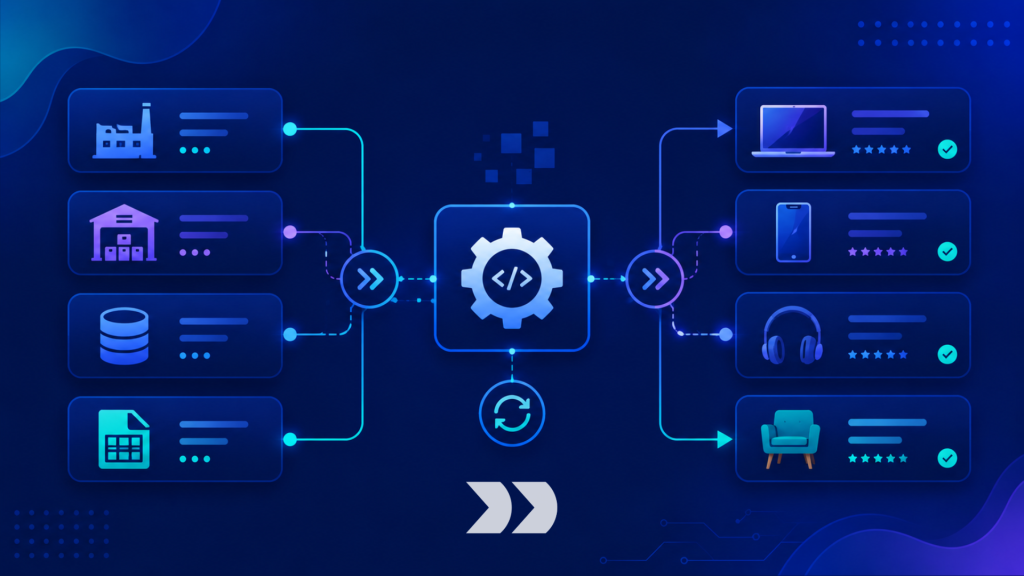
Product information moves across many systems before it reaches customers, sales teams, partners, warehouses, and reporting environments. Product teams may manage attributes in a PIM. ERP may control SKU status, units of measure, tax categories, and item records. Ecommerce platforms may publish customer-facing titles, descriptions, images, and variants. Marketplaces and distributors may require channel-specific catalog feeds. Product API Integration gives product, ecommerce, operations, finance, and data teams a structured way to coordinate product data exchange, catalog API integration, and product information sync across connected enterprise systems.
The Product Information Gap Across Enterprise Systems
Product data often appears simple until it must operate across systems. A product record may include SKU, GTIN, title, description, images, dimensions, materials, safety information, category, price references, tax classification, inventory rules, and marketplace-specific attributes. Different systems use these fields for different purposes.
This creates a product information gap. A product may be approved in PIM but inactive in ERP. A marketplace may reject a listing because a required attribute is missing. A warehouse may use a packaging dimension that does not match the e-commerce product page. GS1 standards are relevant because standardized product identifiers and data exchange practices help organizations improve consistency across commerce and supply chain workflows.
Why Product Data Fragments Over Time
Product data fragments because ownership is distributed. Product teams may own attributes and enrichment. E-commerce teams may own merchandising copy and customer-facing content. Finance may own the tax and product accounting fields. Operations may own dimensions, handling requirements, and warehouse item relationships. Marketplaces may impose their own category and compliance requirements.
Over time, these systems drift. A product title may change in ecommerce but not in distributor feeds. A compliance field may be approved in PIM but not published downstream. A product may be discontinued in ERP while still appearing active in a marketplace. Product API Integration reduces this drift by defining how product updates move across systems.
How Disconnected Product Systems Affect Operations
Disconnected product systems create practical business problems. Product launches can slow because teams manually prepare different catalog formats. Marketplace listings can fail because required fields are missing. Customers can see outdated product details. Warehouses can receive incorrect item dimensions. Finance can struggle to reconcile SKU-level revenue if product identifiers are inconsistent.
Consequently, product information sync becomes an operating control. It helps teams maintain accurate product records across internal systems and external channels. This becomes more important as SKU count, channel count, supplier complexity, and regional catalog requirements increase.
Product API Integration as an Operating Layer
Product API Integration becomes valuable when it operates as a governed layer between product systems, commercial channels, operational platforms, and reporting environments. The goal is not simply to send product records through APIs. The goal is to create a reliable flow of product updates that supports creation, enrichment, validation, approval, publication, fulfillment, and analysis.
This operating layer should define which system owns each field, which changes require approval, which channels receive each product record, and which validation checks must pass before publication. Without these rules, automation can spread incomplete or incorrect product information quickly. Api integration benefits for businesses are significant, enabling streamlined workflows and enhanced data accuracy. This not only helps in maintaining consistency across different systems but also boosts productivity by reducing manual errors. Ultimately, leveraging these integration benefits can lead to informed decision-making and improved customer experiences.
Defining Source Ownership Across Product Data Domains
Source ownership is the foundation of reliable product data exchange. PIM may own descriptions, attributes, images, taxonomy, and enrichment status. ERP may own SKU, item status, unit of measure, product type, tax category, and financial item structure. E-commerce may own merchandising content, SEO fields, and channel presentation. Warehouse systems may have their own package dimensions, storage rules, and handling requirements.
Clear ownership prevents conflicting updates. For example, ecommerce should not override ERP unit-of-measure rules. A warehouse system may update package weight, but it should not change customer-facing claims without review. API logic should preserve these ownership boundaries.
Creating a Common Product, SKU, and Channel Model
A common product model connects SKU, GTIN, product family, variants, bundles, category, attributes, media assets, pricing references, inventory relationships, and channel eligibility. This does not require every system to store product data identically. However, it does require consistent mapping between internal product records and external catalog requirements.
For example, one internal SKU may need different marketplace listing IDs, localized descriptions, image formats, and category mappings across channels. A bundle may contain several inventory items. A variant may share core attributes but differ by size, color, region, or packaging. Product API Integration should preserve these relationships.
Connecting Catalog API Integration to Commercial Execution
Catalog API integration becomes commercially valuable when it supports channel readiness. E-commerce platforms, marketplaces, distributors, retail partners, sales portals, and internal tools may each require different product fields. Some channels require specific images, regulatory fields, compatibility attributes, sustainability claims, or product identifiers.
A connected product layer helps publish the right product information to the right channel. It can prevent draft products from going live, flag missing attributes, route exceptions to owners, and ensure approved changes move consistently across systems.
Infrastructure Requirements for Product Data Exchange
Product data exchange depends on infrastructure that can collect, validate, transform, synchronize, monitor, and govern product records across systems. The objective is not to create fragile point-to-point connectors between every catalog platform. Teams need controlled API workflows that handle retries, idempotency, schema changes, duplicate records, approval status, and exception queues.
Product data is operationally sensitive because it affects customer experience, product availability, fulfillment accuracy, marketplace compliance, and revenue reporting. OpenAPI is relevant because standardized API specifications help teams document, test, and manage integration contracts across software environments.
Continuous Intake Across PIM, ERP, Ecommerce, and Marketplaces
Product data may enter through PIM, ERP, DAM, e-commerce platforms, marketplace APIs, supplier feeds, warehouse systems, pricing tools, and product lifecycle platforms. Continuous intake captures product creation, attribute updates, image approvals, category changes, SKU status changes, channel publication events, and marketplace responses.
Apache Airflow can orchestrate scheduled catalog synchronization and reconciliation jobs. Kafka can support event-driven movement when product status, attribute approval, or channel eligibility changes require rapid downstream updates. Controlled intake helps teams avoid stale product information and delayed channel updates.
def route_product_event(event):
if event["event_type"] == "product.approved":
return {"action": "publish_to_channels", "sku": event["sku"]}
if event["event_type"] == "product.discontinued":
return {"action": "remove_from_catalog", "sku": event["sku"]}
return {"action": "send_to_product_review", "sku": event["sku"]}


REQUIRED_PRODUCT_FIELDS = ["sku", "product_name", "category", "status"]

def validate_product(record):
missing = [field for field in REQUIRED_PRODUCT_FIELDS if not record.get(field)]
if missing:
return {"valid": False, "reason": "missing_fields", "fields": missing}
if record["status"] == "draft":
return {"valid": False, "reason": "not_ready_for_publication"}
return {"valid": True}


event = {
"event_type": "product.approved",
"source_system": "pim",
"sku": "SKU-48192",
"channels": ["ecommerce", "marketplace_us"],
}

record = {
"sku": "SKU-48192",
"product_name": "Commercial Sensor Kit",
"category": "industrial_equipment",
"status": "approved",
}

print(route_product_event(event))
print(validate_product(record))
This routing logic shows how product events can move through a controlled sync layer. Approved products can be published to selected channels, discontinued products can be removed from active catalogs, and unclear events can be routed for product review.
Normalizing Product Attributes, Categories, and Identifiers
Raw product data is rarely consistent across systems. One system may use “color,” another “colour,” and another “finish.” A category may exist in PIM but require a different taxonomy in a marketplace. Units of measure may appear as eaches, packs, cases, kilograms, pounds, inches, centimeters, or pallets.
Normalization aligns SKUs, GTINs, product names, attribute names, category mappings, units of measure, media references, publication status, and channel-specific values. Spark can process large catalogs, supplier files, and marketplace responses. dbt can manage repeatable transformation models and documentation. This makes product information sync consistent across operations and analytics.
Validating Product Data Before Publication
Validation controls prevent incomplete or incorrect records from reaching customer-facing systems. These controls should check for missing required fields, duplicate SKUs, invalid categories, unsupported units, missing images, incomplete compliance attributes, blocked products, and channel-specific restrictions.
Validation should occur before product records are published to ecommerce platforms, marketplaces, distributor feeds, warehouse systems, or sales portals. Data quality frameworks such as Great Expectations can support checks for completeness, uniqueness, accepted values, and cross-system consistency.
REQUIRED_PRODUCT_FIELDS = ["sku", "product_name", "category", "status"]

def validate_product(record):
missing = [field for field in REQUIRED_PRODUCT_FIELDS if not record.get(field)]
if missing:
return {"valid": False, "reason": "missing_fields", "fields": missing}
if record["status"] == "draft":
return {"valid": False, "reason": "not_ready_for_publication"}
return {"valid": True}


record = {
"sku": "SKU-48192",
"product_name": "Commercial Sensor Kit",
"category": "industrial_equipment",
"status": "approved",
}

print(validate_product(record))
This validation check prevents incomplete or unapproved product records from moving downstream. A product missing required fields or still marked as a draft can be blocked before it creates listing errors, catalog conflicts, or fulfillment confusion.
Technology Stack Behind Product Information Sync
Product information sync requires a technology stack that supports APIs, feeds, event streams, batch reconciliation, media references, product hierarchies, and operational monitoring. The stack must support both real-time product events and slower catalog governance workflows.
A mature environment connects PIM, ERP, DAM, ecommerce, marketplaces, pricing tools, WMS, supplier portals, and BI platforms through governed workflows. It should reduce manual catalog work without weakening controls around product accuracy, compliance, and channel publication.
Orchestration and Connectivity Using APIs, Webhooks, Kafka, and Airflow
Product workflows often use APIs for product retrieval, attribute updates, image references, publication status, and marketplace responses. Webhooks can notify downstream systems when product status changes. Kafka can distribute product events across ecommerce, warehouse, analytics, and sales systems. Airflow can coordinate scheduled sync jobs, feed checks, and exception reports.
The integration design should include retry logic, idempotency keys, event deduplication, failure monitoring, and channel-specific error handling. These controls matter because product updates may arrive late, repeat, or fail during marketplace or platform outages. Supply chain event visibility solutions are essential for tracking inventory levels and managing logistics efficiently. By providing real-time insights, these solutions help businesses respond quickly to disruptions and optimize their operations. Furthermore, integrating these capabilities into your existing systems can enhance overall performance and reduce costs significantly.
Processing and Transformation Through Spark, dbt, and Product ETL Pipelines
Processing layers convert raw product, supplier, marketplace, and catalog records into structured product datasets. Spark can process large SKU tables, product attributes, media metadata, feed responses, and publication events. dbt can manage standardized models for product readiness, category mapping, attribute quality, channel status, and catalog analytics.
Product ETL and ELT pipelines can normalize product identifiers, map category taxonomies, classify attributes, align units of measure, connect product variants, and calculate catalog readiness. This makes product data exchange repeatable rather than dependent on manual spreadsheet cleanup.
Storage, Analytics, and Governance in Snowflake, BigQuery, or Databricks
Snowflake, BigQuery, and Databricks can support integrated product intelligence layers where product, ecommerce, operations, finance, and leadership teams analyze catalog status, publication readiness, product quality, channel coverage, marketplace errors, and product-level performance.
Governance controls should include role-based access, audit logs, metadata catalogs, data lineage, retention rules, source documentation, and exception history. These controls matter because product data affects customer-facing claims, fulfillment accuracy, marketplace compliance, pricing, and revenue reporting.
Commercial Impact of Product API Integration
The commercial value of Product API Integration appears when product information becomes more reliable, timely, and easier to publish across channels. Better integration can reduce listing errors, speed up product launches, improve channel consistency, reduce manual catalog work, and support cleaner product reporting. The result is not only cleaner connectivity. It is a stronger control over product information exchange.
For product leaders, ecommerce teams, operations managers, CFOs, and marketplace teams, the practical value is confidence. Integrated product data helps teams understand which products are approved, which are publishable, which are blocked, and which require enrichment. Api integration for marketplace sellers enhances their ability to manage inventory levels effectively. This seamless connection allows for real-time updates, enabling sellers to respond quickly to market demands. With streamlined processes and reduced overhead, sellers can focus on growth strategies and customer engagement.
Improving Product Launch Readiness
Product launches slow down when teams need to manually prepare catalog records for every system. PIM may hold approved attributes, ERP may need item activation, ecommerce may need imagery, and marketplaces may require additional fields.
Product API Integration helps coordinate these requirements. Teams can detect missing fields earlier, validate channel readiness, and publish approved products faster. This reduces the gap between product approval and commercial availability.
Reducing Catalog Errors and Channel Inconsistency
Catalog errors damage customer experience and operational confidence. A product page may show the wrong size, material, compatibility, image, or bundle structure. A marketplace listing may display outdated specifications. A distributor feed may contain an inactive SKU.
Product information sync reduces this risk by ensuring approved records move consistently across systems. It also gives teams a way to identify which channels contain outdated or rejected product information.
Supporting Fulfillment, Inventory, and Revenue Reporting
Product records connect directly to fulfillment, inventory, invoicing, and revenue reporting. A SKU must match what the warehouse picks. A unit of measure must match what finance invoices. A bundle must match the inventory components reserved for an order. A product status must match what sales channels publish.
Integrated product data improves operational accuracy. It also helps finance and analytics teams produce cleaner product-level reporting across channels, regions, and product lines.
Risk Exposure When Product Systems Are Disconnected
Disconnected product systems create operational, commercial, and compliance risks. Products may go live with missing attributes. Marketplaces may reject listings. Warehouses may pick based on incorrect item relationships. Customers may return products because the information was inaccurate. Finance may struggle with duplicate or inconsistent SKUs.
The risk increases as product count, channel count, supplier complexity, and market coverage expand. Manual catalog maintenance may work for small product sets, but it becomes fragile when teams manage thousands of SKUs across many platforms.
Duplicate SKUs and Product Identity Conflicts
Duplicate SKUs weaken reporting, inventory visibility, and catalog governance. A product may appear under different identifiers across PIM, ERP, ecommerce, and marketplaces. Variants may be treated inconsistently. Supplier item numbers may conflict with internal SKU rules.
Product API Integration should preserve SKU, GTIN, supplier item number, parent product, variant, and channel listing relationships. This creates a more reliable product identity model for reporting and operations.
Marketplace Rejections and Publication Failures
Marketplace and retail channels often require strict product fields. Missing images, invalid category values, incomplete safety attributes, unsupported units, or inconsistent identifiers can cause listings to fail. These issues may not appear in internal systems because a product can look complete internally while still failing channel rules.
Catalog API integration should include pre-publication validation and response monitoring. Teams need to know whether a product was submitted, accepted, rejected, or actually visible on the channel.
Governance Gaps in Product Data Use
Product data can create governance issues if sources, transformations, and approval rules are unclear. Teams may use product data for customer pages, marketplace feeds, warehouse operations, regulatory review, pricing analysis, and executive reporting. If the data cannot be reproduced or explained, confidence declines.
NIST Cybersecurity Framework 2.0 is useful because product API environments often connect internal systems, suppliers, platforms, and external partners, requiring governance, access control, monitoring, and risk management.
Governance Requirements for Product Information Exchange
Product information exchange must be governed because product data affects customer-facing content, marketplace compliance, fulfillment, pricing, financial reporting, and legal claims. Data may come from PIM, ERP, DAM, ecommerce platforms, supplier feeds, marketplace APIs, warehouse systems, and analytics tools. Each source has different ownership, quality, and approval requirements.
Governance should make product data easier to use while protecting sensitive product, supplier, pricing, and launch information. The goal is to give teams trusted product visibility without spreading draft or unapproved records across downstream systems.
Source Documentation, Access Controls, and Audit Logs
Product datasets should document source system, field ownership, refresh cadence, transformation logic, publication rules, and known limitations. Access controls should restrict sensitive product information such as unreleased products, supplier cost data, pricing rules, compliance documents, and confidential launch plans. Audit logs should record who changed, approved, exported, or published product records.
These controls help product, ecommerce, operations, and compliance teams demonstrate that product decisions are based on approved data and traceable workflows.
Data Lineage Across Product, Catalog, and Channel Systems
Data lineage allows teams to understand how product information moved from source to publication or reporting. Traceability should cover product creation, attribute enrichment, image approval, taxonomy mapping, validation results, channel publication, marketplace response, warehouse update, and reporting publication.
Lineage also supports debugging. If a marketplace listing shows the wrong image or an ecommerce page shows an outdated attribute, teams can determine whether the issue came from PIM, transformation logic, approval status, API timing, or channel mapping.
Multi-Channel and Cross-Border Product Considerations
Product API Integration becomes more complex across countries, languages, currencies, tax regimes, marketplace requirements, and regulatory environments. A product attribute that is valid in one market may require different wording, measurement units, warnings, or documentation in another.
Cross-border controls should document region-specific attributes, translation status, regulatory approvals, data storage location, publication rules, and permitted use. This reduces the risk that product data exchange works technically but fails commercially or legally across markets.
Evaluating Product API Integration Readiness
Product API Integration becomes valuable when it supports repeatable product workflows, not simply when systems can exchange records. Readiness depends on source ownership, API coverage, SKU mapping, attribute completeness, taxonomy alignment, validation controls, governance, and publication workflows.
A readiness review helps identify where product data risk accumulates before it becomes listing errors, fulfillment issues, marketplace rejection, customer confusion, or reporting inconsistency.
How Teams Assess Product Data Quality
A structured assessment should evaluate duplicate SKUs, missing GTINs, incomplete attributes, invalid category mappings, image completeness, unit consistency, variant relationships, product status accuracy, and channel readiness. It should also review source ownership, update cadence, failed API calls, exception volume, and reconciliation differences between PIM, ERP, ecommerce, and marketplace systems.
For product information sync, data quality must be evaluated operationally and commercially. A product record may look complete in one system while still failing to support channel publication, warehouse fulfillment, customer search, or product-level reporting.
When Organizations Need a Product Integration Architecture Review
A product integration architecture review becomes useful when teams rely on manual catalog exports, disconnected product systems, inconsistent SKUs, delayed marketplace updates, or reports that do not reconcile. The review should assess source coverage, API workflows, transformation logic, validation controls, sync cadence, storage architecture, lineage tracking, governance posture, and exception handling.
The output should clarify where product data risk accumulates, where catalog API integration may be incomplete, and which infrastructure improvements would make product information exchange more reliable for product, ecommerce, operations, finance, and compliance teams.
Conclusion: Product API Integration as Product Information Exchange Infrastructure
Product information exchange depends on reliable data movement across PIM, ERP, DAM, ecommerce platforms, marketplaces, warehouse systems, supplier feeds, and analytics environments. When these systems remain disconnected, teams spend excessive time correcting catalogs, reconciling SKUs, investigating marketplace errors, and explaining inconsistent product records. Product API Integration creates the governed data foundation needed to coordinate product information across the enterprise.
Ultimately, organizations that treat product integration as product information exchange infrastructure, not just catalog connectivity, will be better positioned to improve product data exchange, strengthen product information sync, reduce manual catalog work, and build more reliable catalog API integration across every commercial and operational channel.